


When a delay or outage hits, customers don’t get frustrated because something went wrong — they get frustrated because they weren’t told. Clear communication is what keeps trust intact, especially when timelines shift, systems break, or bad weather forces you to close early. That’s where strong customer notification templates come in.
A short, well-timed message can prevent confusion, reduce support tickets, and reassure people that you’re on top of the situation. Whether it’s a service delay, a shipping slowdown, or a full system outage, the right message sets expectations without creating panic. Using proven SMS notification templates ensures customers receive important updates instantly, even when email or portals go unchecked.
Why Proactive Customer Notifications Matter
Here’s the thing: customers don’t expect you to be perfect. They expect you to be transparent. When there’s a delay, a staffing shortage, a weather closure, or a service outage, silence feels like neglect — but a quick heads-up feels like leadership. When updates fail to reach customers at the right time, frustration escalates quickly — a problem explored in Why Businesses Can’t Afford to Lose Customer Messages — And What to Do About It.

Proactive notifications do three important jobs at once:
1. They manage expectations before frustration builds.
A simple delay notification to customers can prevent a wave of “Any update?” messages, missed appointments, support overload, or negative reviews.
2. They reduce uncertainty during service outages.
When something breaks — servers, payment systems, internal tools — people want clarity. A brief service outage notification message gives customers exactly what they’re looking for: what happened, what it means for them, and when you expect to fix it.
3. They signal professionalism, even in bad weather or unexpected closures.
A quick bad-weather closure text shows customers that you respect their time and safety. It also tells them you have processes in place, not chaos behind the scenes.
When communication is fast, honest, and consistent, customers stay informed instead of guessing. And when they stay informed, they stay loyal — even when something goes wrong.
When to Notify Customers
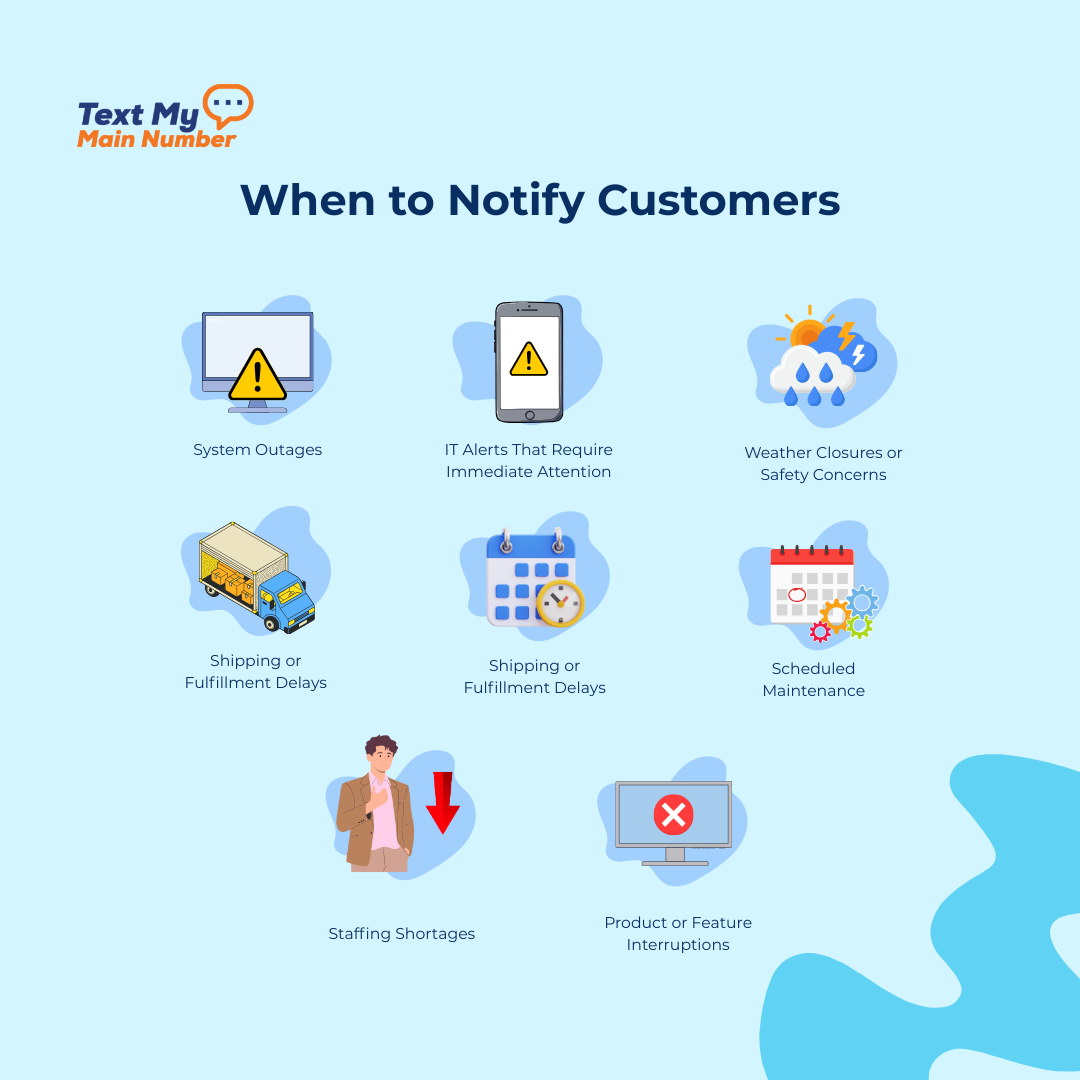
Most businesses struggle not with what to say, but when to say it. Timing is where trust is won or lost. You don’t want to alarm customers unnecessarily, but you also don’t want to leave them in the dark when something impacts their day. A good rule of thumb: if the issue disrupts access, slows service, or changes expectations, it deserves a notification.
Here are the moments where proactive communication matters most:
1. System Outages
A system outage isn’t just an internal problem — it becomes a customer problem the second it affects logins, payments, bookings, or support workflows.
That’s why a system outage notification exists: it’s a clear, timely message that explains what’s down, how customers are affected, and when they can expect things to return to normal. The goal is simple: minimize confusion and keep people informed while you fix the issue. A clear service outage notification message keeps customers informed while your team works toward resolution. Many outage notifications fail simply because messages don’t deliver, which is why understanding the causes outlined in Why Your Business Texts Aren’t Delivering (14 Causes & Proven Fixes) is critical during incidents.
2. IT Alerts That Require Immediate Attention
When something breaks behind the scenes — servers, integrations, dashboards, VoIP lines — speed matters more than anything.
This is where IT SMS alerts shine.
SMS cuts through noise, has the highest open rates, and reaches customers on the one device they always check: their phone. These alerts keep updates short, direct, and impossible to miss, which is exactly what urgent incidents require.
3. Shipping or Fulfillment Delays
If an order won’t ship on time, customers deserve a heads-up. Even a small delay notification prevents frustration and reduces unnecessary support tickets. Transparency buys patience.
4. Appointment or Service Delays
For service providers, running behind schedule happens — but customers need to know the moment your timeline changes. This includes clinics, repair teams, salons, cleaning services, and any business that relies on scheduled appointments. For appointment-based businesses, delay notifications are most effective when paired with reminders, as outlined in How to Use SMS for Effective Appointment Reminders and Confirmations.
5. Staffing Shortages
If you’re short-staffed and response or turnaround times will slow down, a quick message sets expectations and prevents misunderstandings.
6. Product or Feature Interruptions
If a feature temporarily stops working — online ordering, chat support, a booking widget — notify customers before they try to use it and assume your business is ignoring them.
7. Weather Closures or Safety Concerns
Bad weather remains one of the biggest causes of unexpected delays. A simple bad-weather closure text keeps customers safe, informed, and less likely to make unnecessary trips.
8. Scheduled Maintenance
Even planned interruptions can frustrate customers if they don’t know what’s happening. A heads-up before maintenance begins shows you’re organized and respectful of their time.
Delay Notification Templates (Shipping, Service, Staffing)
Delays happen in every industry, but the way you communicate them determines whether customers stay patient or get frustrated. A short, well-framed message keeps expectations realistic, prevents confusion, and shows customers you’re taking responsibility — even when the delay wasn’t your fault.
Below are ready-to-use customer notification templates you can adapt for shipping slowdowns, service delays, and staffing issues.
Shipping Delay Notification Templates
Shipping delays are often caused by carriers, weather, or supply-chain issues — but customers still look to your business for answers. These templates set the right tone: clear, calm, and proactive.
Template 1 — General Shipping Delay
Hi [Name], just a quick update: your order is experiencing a slight delay due to [reason]. It’s still on the way, and we’ll notify you as soon as it ships. Thanks for your patience.
Template 2 — Carrier/Transit Delay
Hi [Name], your package is delayed by the carrier because of [weather/volume/transit]. No action needed — we’ll keep you posted with the next update.
Template 3 — Backordered Item Delay
Hi [Name], the item you ordered is temporarily backordered, which is causing a delay. We expect it to ship by [new date]. Thank you for sticking with us.
Service Delay Notification Templates
Whether you run a clinic, salon, repair team, delivery service, or on-site appointment business, delays can disrupt someone’s day. A quick message helps customers plan around the change instead of sitting and guessing.
Template 1 — Running Behind Schedule
Hi [Name], we’re running about [X minutes] behind today. If you need to adjust your appointment, just reply here. Thank you for your flexibility.
Template 2 — On-Site Visit Delay
Hi [Name], our technician is delayed due to [reason] and will arrive around [new time]. We appreciate your patience.
Template 3 — Service Disruption Delay
Hi [Name], your service request is taking longer than expected. We’re working on it and will update you as soon as it’s completed.
Staffing Delay Notification Templates
Staff shortages are unavoidable — sick days, emergencies, and peak seasons hit every business. Customers understand delays as long as you communicate early and honestly.
Template 1 — Reduced Team Availability
Hi [Name], our team is short-staffed today, which may delay response times. We’re moving as quickly as we can and will get back to you shortly.
Template 2 — Longer Wait Times
Hi [Name], wait times are a bit longer today due to limited staffing. Your request is in the queue, and we’ll follow up ASAP. Thank you for your patience.
Template 3 — Appointment Rescheduling
Hi [Name], we need to adjust today’s appointment due to unexpected staffing changes. Please reply with a time that works for you, and we’ll confirm right away.
Outage & Incident Templates
Outages create uncertainty fast — logins fail, payments don’t go through, systems freeze, or your team can’t access the tools they rely on. In moments like this, customers aren’t just looking for answers; they’re looking for acknowledgment. A clear, steady message keeps people informed without creating panic, and it shows your business is in control even when something breaks behind the scenes.
Below are outage and incident templates you can use for system failures, planned maintenance, weather closures, and emergencies.
System Outage Notification Templates
These templates work when a major part of your service is down — dashboards, websites, portals, apps, booking systems, or communication tools.
Template 1 — General System Outage
Hi [Name], we’re currently experiencing a system outage affecting [feature/service]. Our team is working on it now. We’ll update you as soon as it’s resolved. Thank you for your patience.
Template 2 — Login or Portal Outage
Hi [Name], logins to [platform/app] are temporarily unavailable due to a system issue. We’re on it and will notify you once access is restored.
Template 3 — Payment/Checkout Outage
Hi [Name], our payment system is down at the moment. If you’re trying to check out or make a payment, please try again shortly. We’ll keep you updated.
Partial Service Outage Templates
Not everything goes down at once. Sometimes a single feature — booking, messaging, reporting — fails while the rest works fine. These templates keep communication precise.
Template 1 — Feature-Specific Outage
Hi [Name], [specific feature] is currently unavailable due to a temporary issue. All other services are running normally. We’ll notify you when this is fixed.
Template 2 — Slow Performance / Degraded Service
Hi [Name], you may notice slower load times with [feature]. Our team is investigating and working to restore full performance.
Planned Maintenance Templates
Scheduled maintenance is predictable, but customers still appreciate a heads-up — especially if they rely on the service for work or appointments.
Template 1 — Routine Maintenance
Hi [Name], we’re performing scheduled maintenance on [date/time]. You may experience limited access during this window. Everything will be back online once it’s complete.
Template 2 — Overnight Maintenance
Hi [Name], maintenance is planned for tonight between [time–time]. Services may be unavailable during this period. Thanks for your understanding.
Weather Closure & Safety Templates
Bad weather remains one of the most common causes of business interruptions. A fast bad bad-weather closure text prevents confusion and keeps customers safe.
Template 1 — Weather Closure
Hi [Name], due to severe weather, our location will be closed today. We’ll reach out to reschedule appointments and provide updates. Stay safe.
Template 2 — Delayed Opening
Hi [Name], we’re opening later today because of weather conditions. Doors will open at [time]. Thanks for your patience.
Emergency or Incident Templates
These templates work for urgent issues that require immediate customer awareness — from security concerns to facility problems.
Template 1 — Unexpected Incident
Hi [Name], we’re experiencing an unexpected issue at our facility. Service may be interrupted while we resolve it. We’ll share updates shortly.
Template 2 — Security or Data Incident (High-Level, No Details)
Hi [Name], we’re reviewing a potential security issue involving our system. At this stage, no action is required from you. We’ll update you once we have more information.
Tips for Tone, Clarity, and Follow-Ups

When you’re messaging customers about delays or outages, the content matters — but the tone matters more. A well-crafted message does three things at once: it informs, reassures, and keeps the relationship intact. Here’s how to strike the right balance every time.
Keep the tone calm and steady
Customers mirror the energy you project. If your message sounds rushed or chaotic, you create unnecessary anxiety. A steady, confident tone tells people you’re aware of the issue and already working on it.
Be clear about what’s happening
Customers don’t need technical jargon. They just want to know what’s affected and what it means for them. One sentence that explains the situation is usually enough. Clarity earns trust.
Set expectations without overpromising
If you know the timeline, say it. If you don’t, be honest about that too. Overpromising a fix and missing the window makes the situation worse. Understating and delivering early builds credibility.
Keep messages short and easy to skim
Delays and outages are already interruptions. Your message shouldn’t become another one. Use short sentences, clear structure, and only the essential details.
Follow up when you fix the issue
The follow-up is where customer loyalty is won. Closing the loop shows professionalism, attention to detail, and respect for the customer’s time. It also tells customers they don’t need to keep checking in — you’ve got them covered.
Offer an alternate path if needed
If customers can temporarily use another channel — web, phone, email, a backup process — say so. A quick redirect can prevent frustration and save your support team from a flood of messages.
Communicate like a human, not a script
Customers can tell when a message is copied and pasted from a corporate handbook. Write like a real person who understands the inconvenience and cares about fixing it. Empathy is a competitive advantage.
Clear communication turns a potential customer headache into a moment of trust. Whether you’re dealing with a delay, an outage, bad weather, or a system hiccup, the right message keeps expectations aligned and relationships intact. These customer notification templates give you a foundation to work from, but the real power comes from sending messages at the right time, in the right tone, through a channel your customers actually read.
Businesses looking to centralize alerts, updates, and notifications often start by evaluating platforms like those compared in Best Business Texting Apps for Small Businesses: Compare Features & Free Trials.
If you want a platform built for fast, reliable business texting: one that helps you send updates, alerts, and notifications without worrying about deliverability — Text My Main Number makes it simple.
Start communicating with confidence.
Start your 14-day free trial
.svg)

