
Buy Template
Industry Insights

AI Conversation Summaries for Customer Service Handoffs

How to prepare and check an AI-written handoff so the next employee can reply without changing a promise, overlooking a restriction, or inventing progress.

AI Conversation Summaries for Customer Service Handoffs

The word worth checking first in a conversation summary is often the verb. “Requested” leaves a decision open. “Approved” tells the next employee that someone has already made it.

AI conversation summaries can give a covering employee a short account of what the customer needs and what has happened so far. But a summary that turns “we’ll check” into “we confirmed” gives that employee the wrong starting point.

The question we want answered is practical: What can I safely say to this customer now?

Build the summary around that reply. Preserve the current request, the actual promises and the unfinished work. Keep the original messages accessible so the employee can check details that could change the answer.

What AI Conversation Summaries Should Tell the Next Employee

A useful handoff tells the covering employee where the conversation stands, without making them reconstruct every exchange.

Customer-service summarization research, including the TWEETSUMM project, describes this use: giving the next person context about the issue and its proposed solution. That is a sensible, specific job for a summary.

Start with what the customer wants now. An earlier request may have changed. Keep background only when it affects the answer: a spending restriction matters; the greeting at the start of the conversation usually doesn’t.

Include what has happened, what the business has promised and what remains unanswered. Keep the person responsible, the deadline and any condition attached to a promise. Identify missing information and conflicting statements rather than smoothing them over.

Attach references the covering employee can open. Use existing message links when available, or the file name and stable row references for an export. The reviewer should record their name and the last message checked.
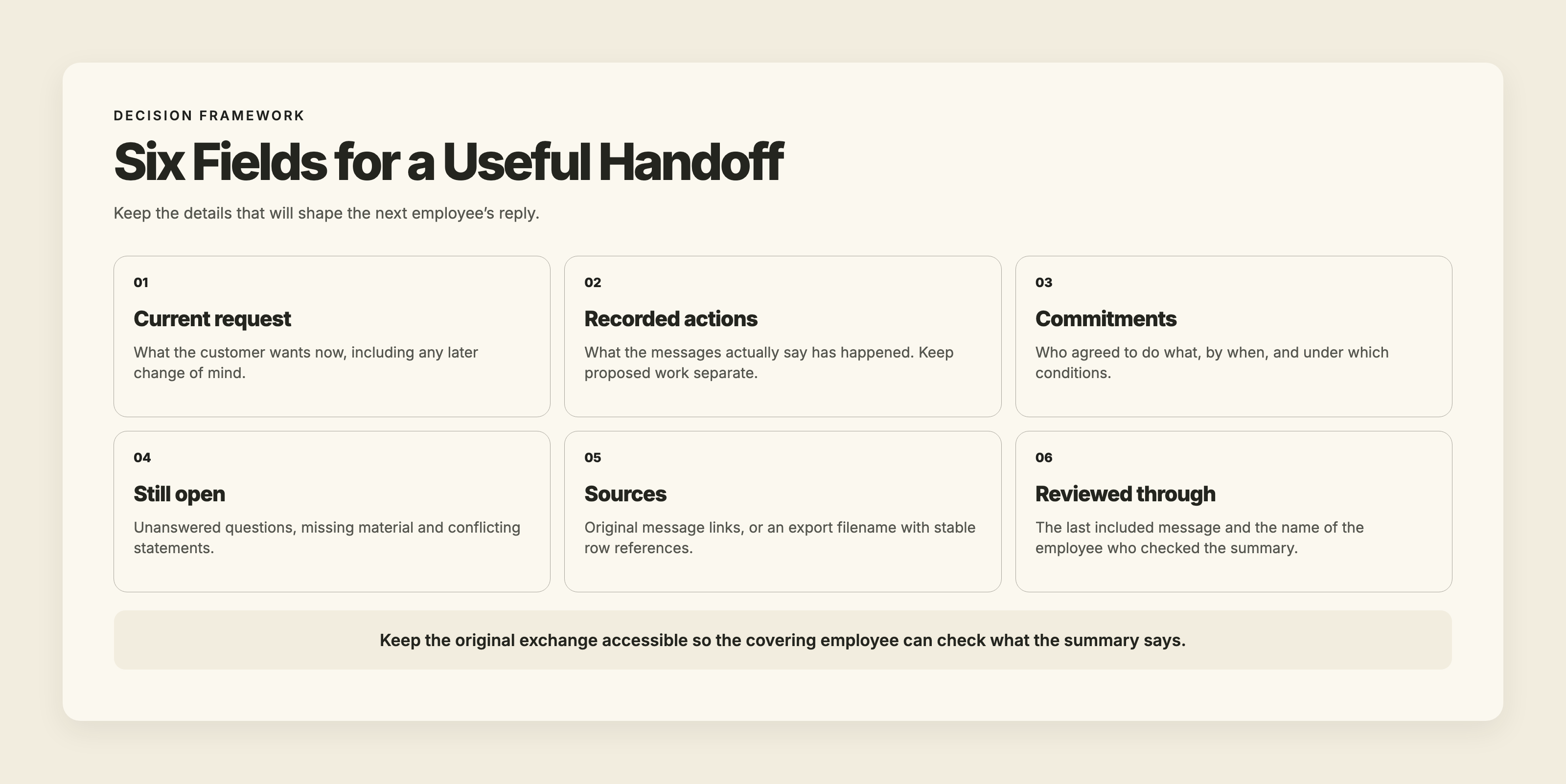
Six handoff fields: current request, recorded actions, commitments, open questions, source references, and the last message checked with the reviewer’s name.

Within the broader subject of conversation intelligence, this is a small, immediate task: helping someone continue an individual exchange. Keep the summary focused on the reply ahead rather than trying to explain the customer’s whole relationship with the business.

A Bicycle Repair Example: The Part Change Is Still Open

Picture a bicycle repair shop with a bike already in for service. The customer texts asking whether the shop can fit a wider tire and keep the agreed collection day.

The employee replies: “We’ll check the frame clearance and availability, then let you know whether we can include it before collection.”

The customer adds: “Please send me the added cost and wait for my approval before fitting anything. The tire I mean is in the photo I emailed.”

A draft describing the change as approved and the collection day as confirmed would alter the agreement. The shop has agreed to investigate. The customer has explicitly required approval before installation.

Keep the Condition Attached to the Promise

“Then let you know” matters. So does “whether.” Those words preserve the connection between checking the tire and answering the timing question.

The finished handoff should carry forward the wider-tire request, the clearance and availability checks still owed, and the unsettled timing. It should also preserve the instruction to wait for price approval and note that the emailed photo isn't in the texts. The last included message is the customer’s instruction about cost and approval; the employee checking the handoff adds their name.

That gives the covering employee a useful starting point. Their next reply can acknowledge the approval requirement and the questions still awaiting an answer. Before promising an update by a particular time, they need to find out who can do those checks.
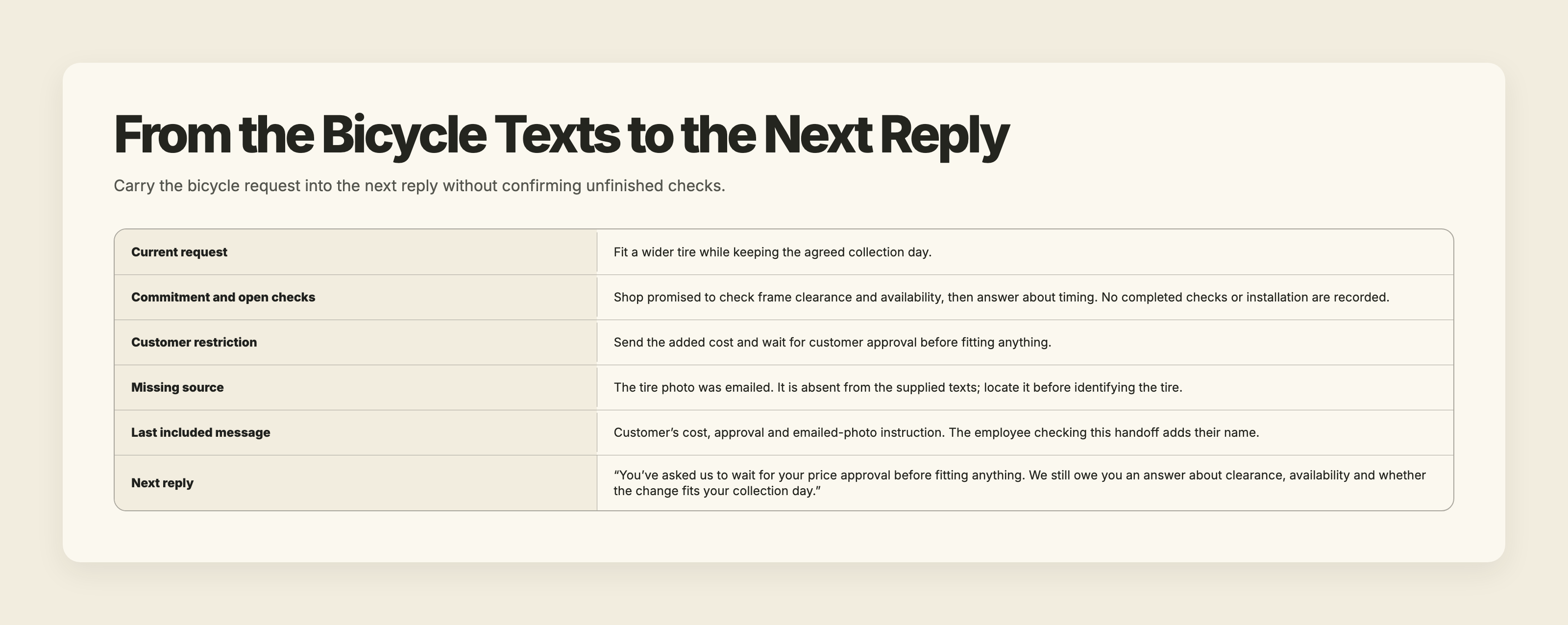
A bicycle-shop handoff preserves the wider-tire request, unfinished checks, price-approval restriction, missing photo and last included text, then shows a reply that makes no new promise.

Treat Missing Material as Unfinished Work

The emailed photo is outside the text exchange. If it wasn't given to the AI, the summary should identify it as unavailable.

The covering employee can locate the email or ask a colleague where it was saved. Check internally before asking the customer to resend it, and don’t guess which tire it shows.

Keep a missing source separate from an unanswered business question. Finding the photo may settle which tire the customer means. It won’t, by itself, settle whether that tire fits or can be installed before collection. Those are separate checks for the shop.

Give the AI a Specific Job and Checkable Sources

Use both sides of the relevant conversation, in order. Keep the speaker, timestamp and a stable reference for each message. A short customer reply such as “yes, but only if it’s ready then” needs the preceding exchange to make sense.

Choose the material carefully. The right business context for this task includes the conditions attached to an agreement and any later changes. Unrelated customer history adds reading without necessarily helping the handoff.

Tell the tool to prepare an internal handoff for an employee who will reply next. Ask it to preserve the current request, recorded actions, commitments and unanswered questions. Require it to distinguish customer statements from employee promises and retain later corrections.

Tell it to reuse the references you give it rather than invent links. Attach a reference to each statement about a price, date, approval or completed action so the reviewer can go straight to the supporting message.

Missing emails, photos or phone conversations should remain visible gaps. If the customer mentions a call whose details are unavailable, ask the AI to flag the missing call. Don’t let it fill in an account of what probably happened.

Before uploading messages to an outside AI tool, remove customer information the task does not require. Check inside the message text as well as the contact columns. Use a tool approved for your business’s customer information, and check its training-use and retention settings separately. Excluding information from model training does not, by itself, tell you whether that information is stored.

Leave the reviewer’s name and the last message checked for a person to complete. Generated text should never certify its own review.

Review What Could Change the Next Reply

Check the details before polishing the wording.

Research on factual consistency in dialogue summaries documents summaries that conflict with their source conversations. A fluent handoff still needs checking against the messages.

Start with statements the covering employee is likely to repeat to the customer: a price, an agreed date, an approval or a report that work is finished. Open the source for each one. Check who said it and whether the surrounding exchange changes its meaning.

In the bicycle example, a summary could name the right tire and preserve the collection question while still omitting the instruction to wait for customer approval.

Then read the latest customer message alongside the summary’s account of the current request. A summary can accurately describe several earlier messages while overlooking the change that matters now.

Check the references themselves, too. A row number beside a claim makes it easier to inspect; it does not make it correct. If the reference points to the wrong message, correct both the wording and the reference before passing the handoff on.

Only then shorten sentences or remove repetition.

Read Anything Newer Than the Summary

Record the last included message rather than relying only on the time the summary was written.

In the bicycle example, the customer might later text: “Leave the original tire for now. I need the bike back as planned.”

The covering employee should read the newer messages, update the current request and check whether work has begun. They can acknowledge the customer’s instruction immediately. Confirming that the change has been stopped requires knowing its actual status.

After reviewing the new messages, update the handoff’s last-included-message reference. Otherwise, the next colleague may repeat the same check or rely on an older account.
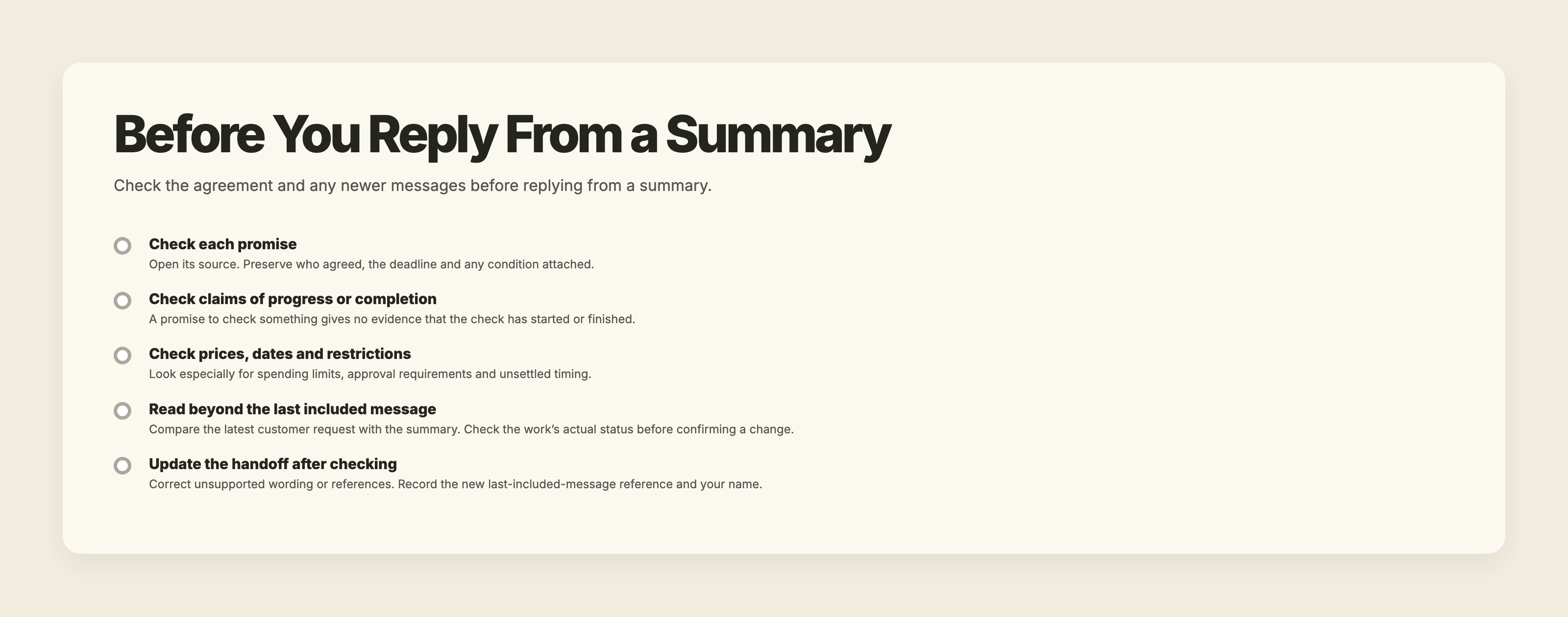
Five checks before replying: verify promises, progress claims, prices and restrictions; read newer messages; then correct the handoff and record the last message checked.

Keep the effort sensible. If selecting the messages, generating the draft and correcting it takes more work than writing the handoff yourself, write it yourself. A brief exchange may need no summary at all. Try the method on a longer conversation where changes and conditions are genuinely difficult to follow.

Use TMMN for the Shared Text Record

The starting point is a conversation your team can access.

With TMMN, each person signs in separately, while colleagues assigned to the same number share its conversations. The message log records who sent each outgoing text. Our guide to team texting from a single business number explains that setup.

Users with message-log permission can export the record in Excel, CSV or PDF format. It includes dates, message text, direction, sender or receiver, and which team member sent each outgoing text. Saved contacts appear by name instead of number, so remove unnecessary names as well as phone numbers before sharing a file with an outside tool.

TMMN provides the shared texting record. AI summarization requires a separate tool; it is not a built-in TMMN feature.

To see how shared texting works on your existing business number, start a 14-day free trial. Use it to evaluate shared business texting, including how colleagues continue an exchange from their own logins.

Check the Reply for Promises Before Sending It

The best test happens when the covering employee prepares the customer’s next reply.

Ask them to identify every phrase saying the business has approved, promised, changed or completed something. Each phrase should match a source. If the source is missing, the employee needs to investigate or change the wording.

For the bicycle example, before the later cancellation, the reply can acknowledge the tire request and the requirement for price approval. It can say the shop owes the customer an answer about clearance, availability and timing. Saying those checks are underway requires evidence that someone has started them.

That last distinction is easy to miss. Even a cautious-sounding reply can invent progress.

Give a colleague the reviewed summary and access to its sources, then ask them to draft the next response. The summary is ready when that reply carries forward the actual agreement without adding a promise—or reporting work—that the record cannot support.

Ready To Strengthen Your Customer Connections?

Start your free 14-day trial and experience the impact of efficient business texting on your customer engagement.

AI & Business Understanding
 ·
November 3, 2026

AI Conversation Summaries for Customer Service Handoffs

How to prepare and check an AI-written handoff so the next employee can reply without changing a promise, overlooking a restriction, or inventing progress.

3D illustration of two employees collaborating on a laptop while sitting on a wooden bench, beneath the headline “The Right Message. The Right Contacts,” representing organized SMS contact groups.

The word worth checking first in a conversation summary is often the verb. “Requested” leaves a decision open. “Approved” tells the next employee that someone has already made it.

AI conversation summaries can give a covering employee a short account of what the customer needs and what has happened so far. But a summary that turns “we’ll check” into “we confirmed” gives that employee the wrong starting point.

The question we want answered is practical: What can I safely say to this customer now?

Build the summary around that reply. Preserve the current request, the actual promises and the unfinished work. Keep the original messages accessible so the employee can check details that could change the answer.

What AI Conversation Summaries Should Tell the Next Employee

A useful handoff tells the covering employee where the conversation stands, without making them reconstruct every exchange.

Customer-service summarization research, including the TWEETSUMM project, describes this use: giving the next person context about the issue and its proposed solution. That is a sensible, specific job for a summary.

Start with what the customer wants now. An earlier request may have changed. Keep background only when it affects the answer: a spending restriction matters; the greeting at the start of the conversation usually doesn’t.

Include what has happened, what the business has promised and what remains unanswered. Keep the person responsible, the deadline and any condition attached to a promise. Identify missing information and conflicting statements rather than smoothing them over.

Attach references the covering employee can open. Use existing message links when available, or the file name and stable row references for an export. The reviewer should record their name and the last message checked.

Six handoff fields: current request, recorded actions, commitments, open questions, source references, and the last message checked with the reviewer’s name.

Within the broader subject of conversation intelligence, this is a small, immediate task: helping someone continue an individual exchange. Keep the summary focused on the reply ahead rather than trying to explain the customer’s whole relationship with the business.

A Bicycle Repair Example: The Part Change Is Still Open

Picture a bicycle repair shop with a bike already in for service. The customer texts asking whether the shop can fit a wider tire and keep the agreed collection day.

The employee replies: “We’ll check the frame clearance and availability, then let you know whether we can include it before collection.”

The customer adds: “Please send me the added cost and wait for my approval before fitting anything. The tire I mean is in the photo I emailed.”

A draft describing the change as approved and the collection day as confirmed would alter the agreement. The shop has agreed to investigate. The customer has explicitly required approval before installation.

Keep the Condition Attached to the Promise

“Then let you know” matters. So does “whether.” Those words preserve the connection between checking the tire and answering the timing question.

The finished handoff should carry forward the wider-tire request, the clearance and availability checks still owed, and the unsettled timing. It should also preserve the instruction to wait for price approval and note that the emailed photo isn't in the texts. The last included message is the customer’s instruction about cost and approval; the employee checking the handoff adds their name.

That gives the covering employee a useful starting point. Their next reply can acknowledge the approval requirement and the questions still awaiting an answer. Before promising an update by a particular time, they need to find out who can do those checks.

A bicycle-shop handoff preserves the wider-tire request, unfinished checks, price-approval restriction, missing photo and last included text, then shows a reply that makes no new promise.

Treat Missing Material as Unfinished Work

The emailed photo is outside the text exchange. If it wasn't given to the AI, the summary should identify it as unavailable.

The covering employee can locate the email or ask a colleague where it was saved. Check internally before asking the customer to resend it, and don’t guess which tire it shows.

Keep a missing source separate from an unanswered business question. Finding the photo may settle which tire the customer means. It won’t, by itself, settle whether that tire fits or can be installed before collection. Those are separate checks for the shop.

Give the AI a Specific Job and Checkable Sources

Use both sides of the relevant conversation, in order. Keep the speaker, timestamp and a stable reference for each message. A short customer reply such as “yes, but only if it’s ready then” needs the preceding exchange to make sense.

Choose the material carefully. The right business context for this task includes the conditions attached to an agreement and any later changes. Unrelated customer history adds reading without necessarily helping the handoff.

Tell the tool to prepare an internal handoff for an employee who will reply next. Ask it to preserve the current request, recorded actions, commitments and unanswered questions. Require it to distinguish customer statements from employee promises and retain later corrections.

Tell it to reuse the references you give it rather than invent links. Attach a reference to each statement about a price, date, approval or completed action so the reviewer can go straight to the supporting message.

Missing emails, photos or phone conversations should remain visible gaps. If the customer mentions a call whose details are unavailable, ask the AI to flag the missing call. Don’t let it fill in an account of what probably happened.

Before uploading messages to an outside AI tool, remove customer information the task does not require. Check inside the message text as well as the contact columns. Use a tool approved for your business’s customer information, and check its training-use and retention settings separately. Excluding information from model training does not, by itself, tell you whether that information is stored.

Leave the reviewer’s name and the last message checked for a person to complete. Generated text should never certify its own review.

Review What Could Change the Next Reply

Check the details before polishing the wording.

Research on factual consistency in dialogue summaries documents summaries that conflict with their source conversations. A fluent handoff still needs checking against the messages.

Start with statements the covering employee is likely to repeat to the customer: a price, an agreed date, an approval or a report that work is finished. Open the source for each one. Check who said it and whether the surrounding exchange changes its meaning.

In the bicycle example, a summary could name the right tire and preserve the collection question while still omitting the instruction to wait for customer approval.

Then read the latest customer message alongside the summary’s account of the current request. A summary can accurately describe several earlier messages while overlooking the change that matters now.

Check the references themselves, too. A row number beside a claim makes it easier to inspect; it does not make it correct. If the reference points to the wrong message, correct both the wording and the reference before passing the handoff on.

Only then shorten sentences or remove repetition.

Read Anything Newer Than the Summary

Record the last included message rather than relying only on the time the summary was written.

In the bicycle example, the customer might later text: “Leave the original tire for now. I need the bike back as planned.”

The covering employee should read the newer messages, update the current request and check whether work has begun. They can acknowledge the customer’s instruction immediately. Confirming that the change has been stopped requires knowing its actual status.

After reviewing the new messages, update the handoff’s last-included-message reference. Otherwise, the next colleague may repeat the same check or rely on an older account.

Five checks before replying: verify promises, progress claims, prices and restrictions; read newer messages; then correct the handoff and record the last message checked.

Keep the effort sensible. If selecting the messages, generating the draft and correcting it takes more work than writing the handoff yourself, write it yourself. A brief exchange may need no summary at all. Try the method on a longer conversation where changes and conditions are genuinely difficult to follow.

Use TMMN for the Shared Text Record

The starting point is a conversation your team can access.

With TMMN, each person signs in separately, while colleagues assigned to the same number share its conversations. The message log records who sent each outgoing text. Our guide to team texting from a single business number explains that setup.

Users with message-log permission can export the record in Excel, CSV or PDF format. It includes dates, message text, direction, sender or receiver, and which team member sent each outgoing text. Saved contacts appear by name instead of number, so remove unnecessary names as well as phone numbers before sharing a file with an outside tool.

TMMN provides the shared texting record. AI summarization requires a separate tool; it is not a built-in TMMN feature.

To see how shared texting works on your existing business number, start a 14-day free trial. Use it to evaluate shared business texting, including how colleagues continue an exchange from their own logins.

Check the Reply for Promises Before Sending It

The best test happens when the covering employee prepares the customer’s next reply.

Ask them to identify every phrase saying the business has approved, promised, changed or completed something. Each phrase should match a source. If the source is missing, the employee needs to investigate or change the wording.

For the bicycle example, before the later cancellation, the reply can acknowledge the tire request and the requirement for price approval. It can say the shop owes the customer an answer about clearance, availability and timing. Saying those checks are underway requires evidence that someone has started them.

That last distinction is easy to miss. Even a cautious-sounding reply can invent progress.

Give a colleague the reviewed summary and access to its sources, then ask them to draft the next response. The summary is ready when that reply carries forward the actual agreement without adding a promise—or reporting work—that the record cannot support.

This article first appeared on Text My Main Number.

Keep reading.

All articles

Ready to talk it through?

When you’re ready to compare options, we’ll help you work out what fits.

Talk with us
Or call 1-800-797-3167