
Giving an AI more business information does not necessarily make it more useful. It may simply give the system more material to misapply.
The real implementation question is narrower: What information does this AI need for this task, under these conditions, with these limits?
That is the core of business context for AI. It is not a large pile of company documents, unrestricted access to business systems, or a longer prompt. It is an intentionally assembled set of inputs that tells the AI what is approved, what rules apply, what role it is performing, what is true now, what it may access, and what it is allowed to do.
Those distinctions matter because knowledge alone does not create authority. An AI may know that an appointment exists without being permitted to reschedule it. It may have access to a service policy without knowing whether that policy applies at a particular location or date. It may produce a reasonable answer using information that was once correct but is no longer current.
Operators therefore need to design context as an operating boundary, not just an information supply.
Understanding how to clearly assign, track, and manage information boundaries within AI systems is critical to maintaining operational clarity and accountability. The importance of this approach is well addressed in How to Assign, Track, and Close Customer Conversations Efficiently.
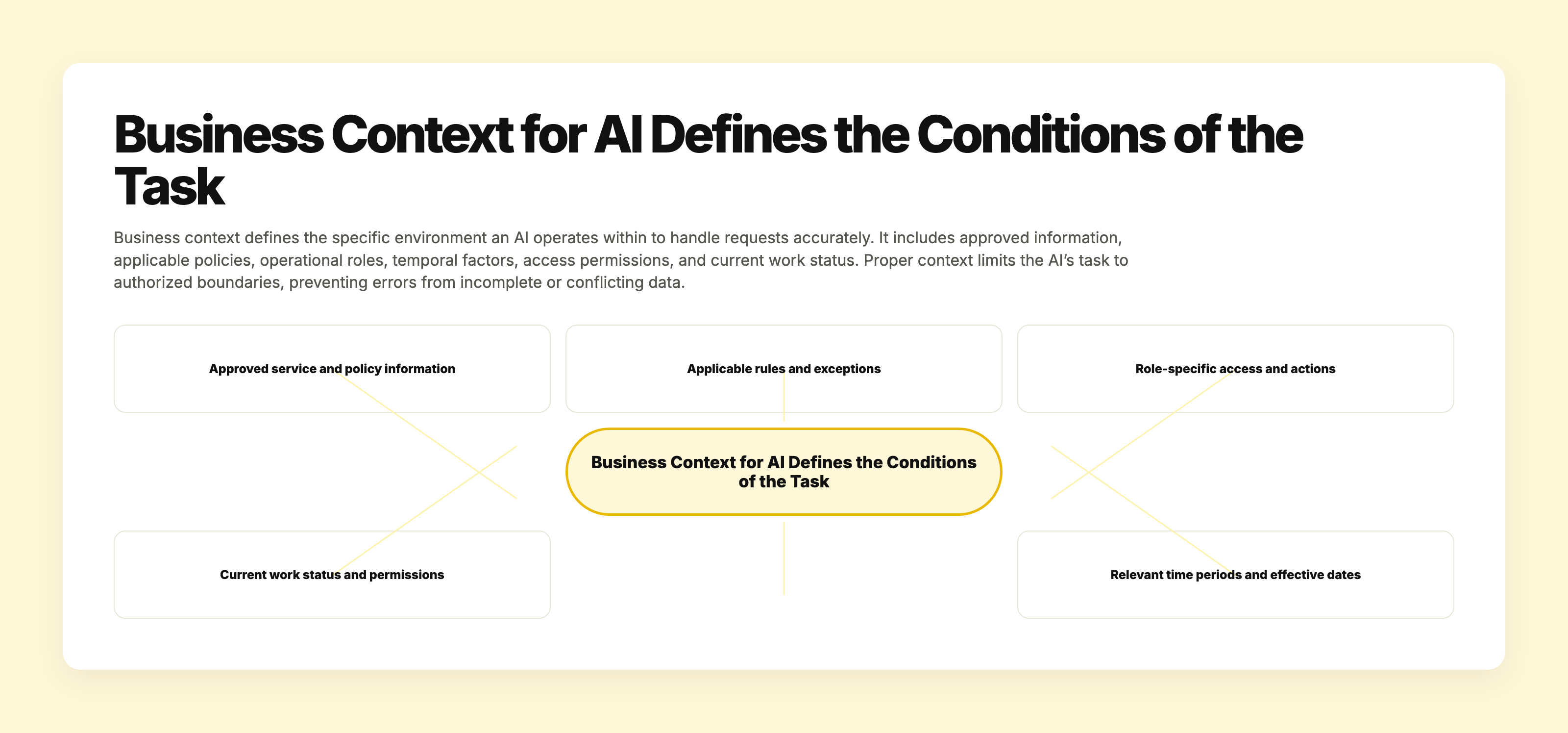
Business Context for AI Defines the Conditions of the Task
A prompt expresses a request. Business context establishes the environment in which that request should be handled.
“Prepare a follow-up message” is a request. To handle it within business boundaries, an AI may also need to know:
- which service information has been approved;
- which policy applies to the situation;
- which business role it is supporting;
- what time period or effective date matters;
- which records it may access;
- the current status of the work;
- whether it may only draft or may take a further action.
Without those inputs, the AI has to operate across unresolved gaps. It may not know whether a general rule has an exception, whether an old document remains applicable, or whether the person requesting the work has authority to initiate it.
The answer is not to expose every available business resource. Limiting AI access to essential information while still supporting seamless communications helps avoid the pitfalls of missed messages and operational friction, a topic explored in depth in Why Businesses Can’t Afford to Lose Customer Messages — And What to Do About It.
Broad access can introduce unrelated, conflicting, outdated, or sensitive material. It can also make it harder to explain why the AI produced a particular proposal.
The better design starts with a bounded task and assembles the context required for that task. This is closer to preparing a controlled work surface than opening the entire filing cabinet.
Treat Context as Different Inputs, Not One Knowledge Pile
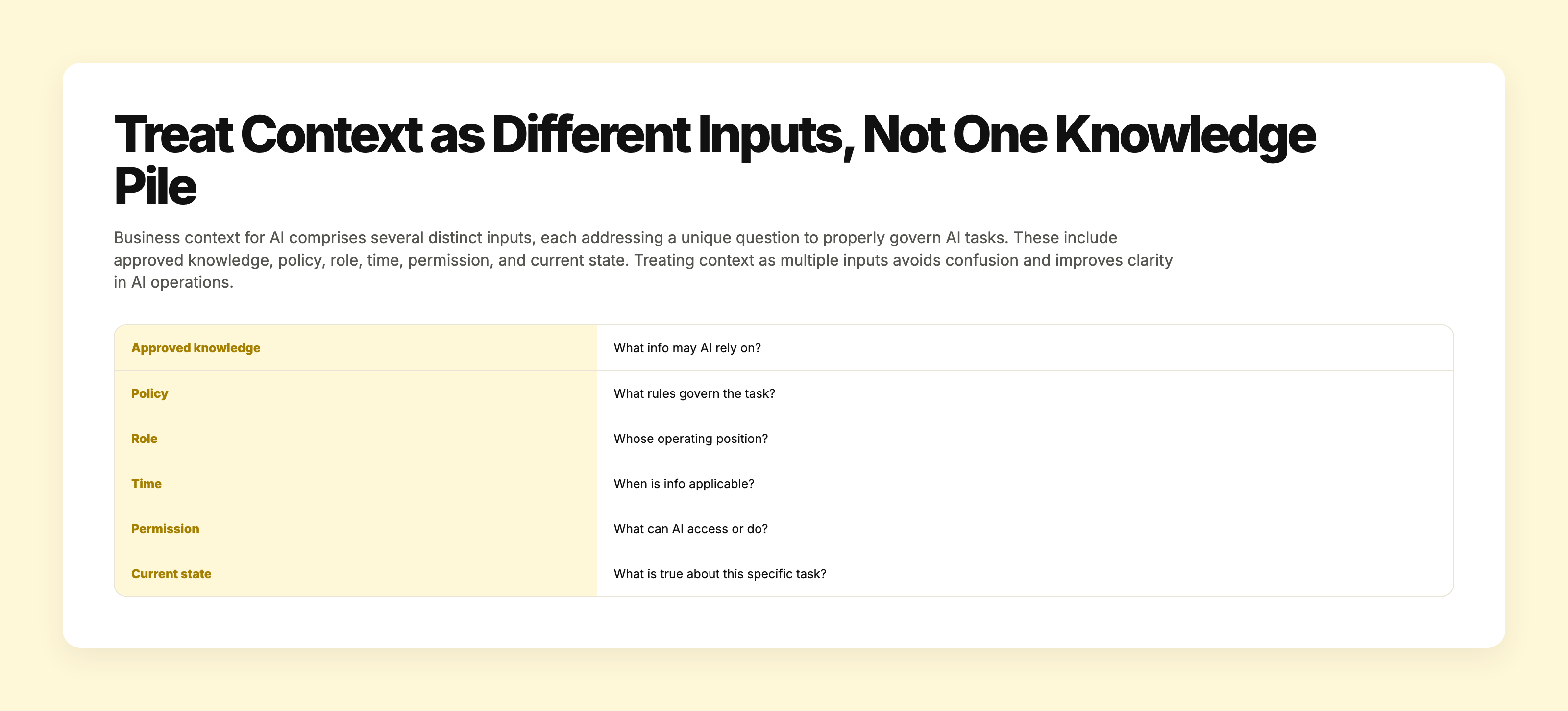
Operators often use “company knowledge” as if it were a single category. In practice, an AI task may depend on several different kinds of input, each answering a different question.
Approved knowledge: What information may the AI rely on?
Approved knowledge is the business information accepted for a defined use. That could include an authorized service description, operating instructions, location details, or a current pricing document.
Approval should be meaningful. A document does not become suitable merely because it exists in a shared drive or can be retrieved by a system. Someone needs to know who owns it, what it covers, and whether it remains applicable.
This also prevents rough notes, abandoned drafts, and superseded material from silently carrying the same weight as an approved source.
Policy: What rule governs this situation?
Knowledge describes the business. Policy constrains how the business operates.
An AI might know the available services while still needing a separate rule for cancellations, refunds, scheduling changes, exceptions, or escalation. Combining facts and policies into one undifferentiated source makes it easier to confuse what the business offers with what the business permits.
Policies also need scope. A rule may apply only to a location, service type, customer category, or period. The name of the policy is not enough; the context must establish when it governs.
Role: From whose operating position is the AI working?
The same information can be appropriate for one role and inappropriate for another.
An AI supporting appointment preparation may need service details and scheduling status. It may not need payroll files, internal financial reports, or administrative settings. Defining the role helps determine both what the AI should see and what kind of work it may propose.
Role is not a decorative persona. Telling an AI to “act like an operations manager” does not grant the authority of an operations manager. The role must connect to explicit access and action boundaries.
Time: When is the information applicable?
Business information often has an effective period. Hours change. Offers expire. Staff availability shifts. Policies are revised.
The AI therefore needs more than a document date. It may need to know whether the information is effective for the date of the task. A future schedule should not govern today’s appointment, and an expired policy should not control a current response simply because it remains searchable.
Permission: What may the AI access or do?
Permission answers two separate questions:
1. Which information may the AI retrieve?
2. Which actions, if any, may it initiate?
Keeping these separate is essential. Read access to a schedule does not imply permission to alter it. Access to approved wording does not imply permission to publish or send it.
Current state: What is true about this specific work now?
Policy explains what is generally allowed. Current state explains where the particular task stands.
Has an appointment been confirmed, changed, canceled, or completed? Is a request still pending? Has a person already approved the proposed response? The next appropriate step depends on the current state, not merely on general business knowledge.
Together, these inputs create context that is specific enough to guide work without pretending that more information is always better.
Start With the Task and Work Backward
The safest way to assemble business context is not to begin with all the information the AI could access. Begin with the exact work requested.
Write the task in operational terms. “Help with customers” is too broad. “Prepare a follow-up draft for a scheduled service visit” is more useful because it exposes the decisions the AI must support.
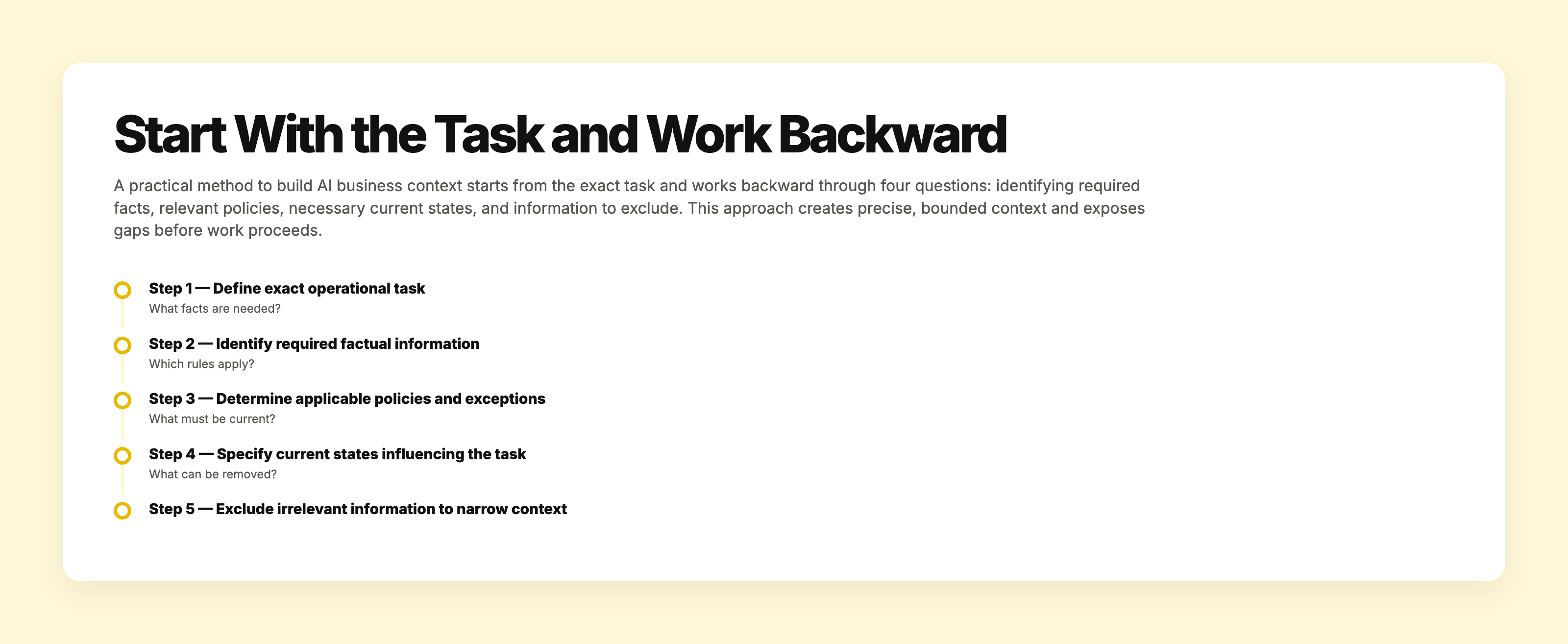
Then work backward through four questions.
What facts are required? Identify the approved service details, location information, appointment data, or other facts needed to prepare the work.
What rules apply? Determine which policy governs the task and whether any conditions or exceptions require human judgment.
What must be current? Identify the state that could change the correct response: appointment status, staff availability, effective dates, or an unresolved request.
What can be removed? Exclude information that does not help complete or supervise the task. Irrelevant access is not harmless just because the AI never appears to use it. It expands the operating surface and makes oversight less precise.
This backward method also reveals missing context before work begins. If the task requires current availability but no authoritative source provides it, the system should not fill the gap by treating an old schedule as current. The operator has found a dependency that must be resolved.
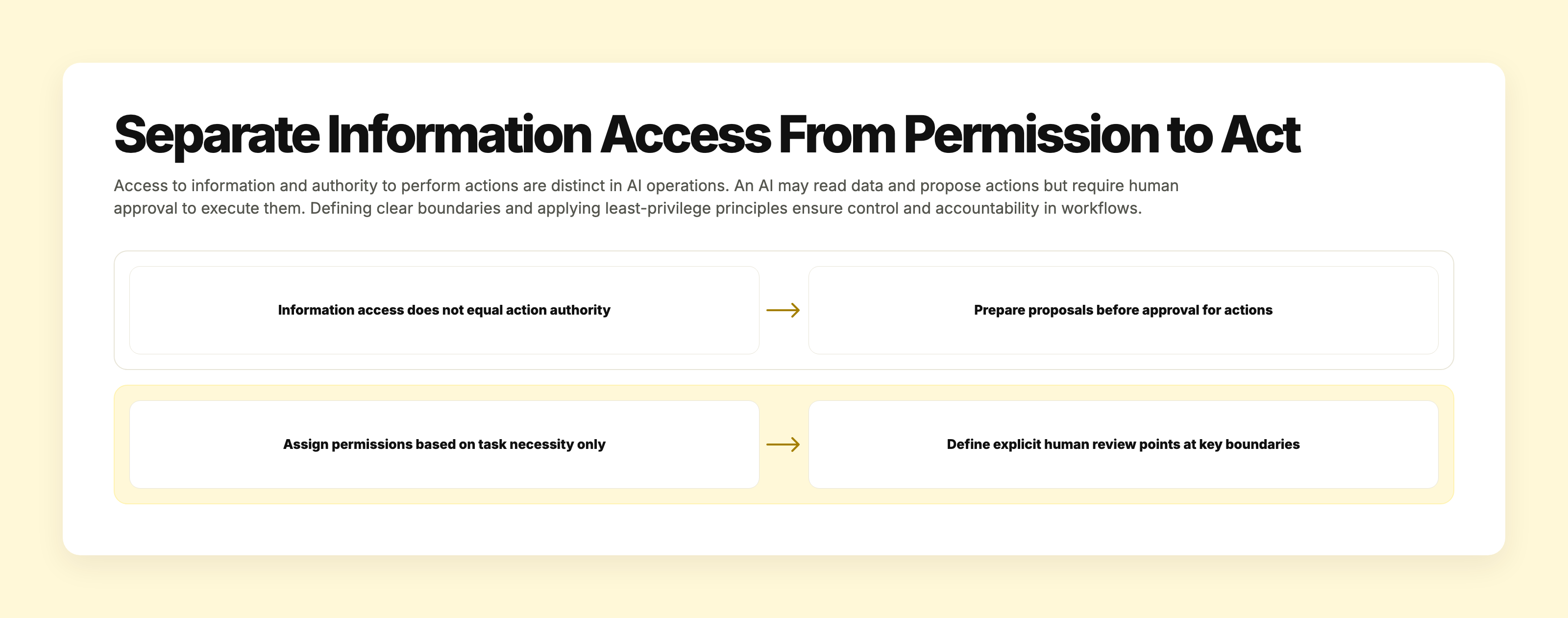
Separate Information Access From Permission to Act
A capable response can still exceed the AI’s authority.
Model reasoning does not grant business permission. Neither does access. An AI can have enough information to recommend an action while remaining unauthorized to take it.
That distinction should appear directly in the workflow:
- The AI can read the relevant appointment status.
- It can use the approved service and policy information.
- It can prepare a proposed follow-up.
- A person reviews or approves the proposal when the consequence warrants it.
- Only an authorized actor or system performs the action.
Not every step needs the same approval treatment. The consequence matters. Preparing internal text is different from sending a commitment, changing a booking, issuing a refund, or modifying a business record.
Least-privilege authorization provides a useful baseline: give the AI only the access and authority necessary for the assigned task. This principle aligns closely with best practices in managing business texting permissions and ensuring that communication actions match operational authority, as outlined in Legal Aspects of Business Text Messaging.
If it needs to read one scheduling field, that does not justify access to every operational system. If it only needs to prepare a draft, it does not need permission to send one.
Human review is most useful at consequential boundaries, not as a vague instruction to “keep a human involved.” Specify the boundary. Is approval required before external communication, before a schedule change, or before an exception to policy? An identifiable decision point can be operated and checked. A general promise of oversight cannot.
Use Time and Current State to Keep Context Applicable
A business can provide accurate information and still provide the wrong context.
Suppose an approved document correctly describes service hours for one period, while the task concerns a later period with different hours. The source may be authentic and the text may be accurate, but it is not applicable.
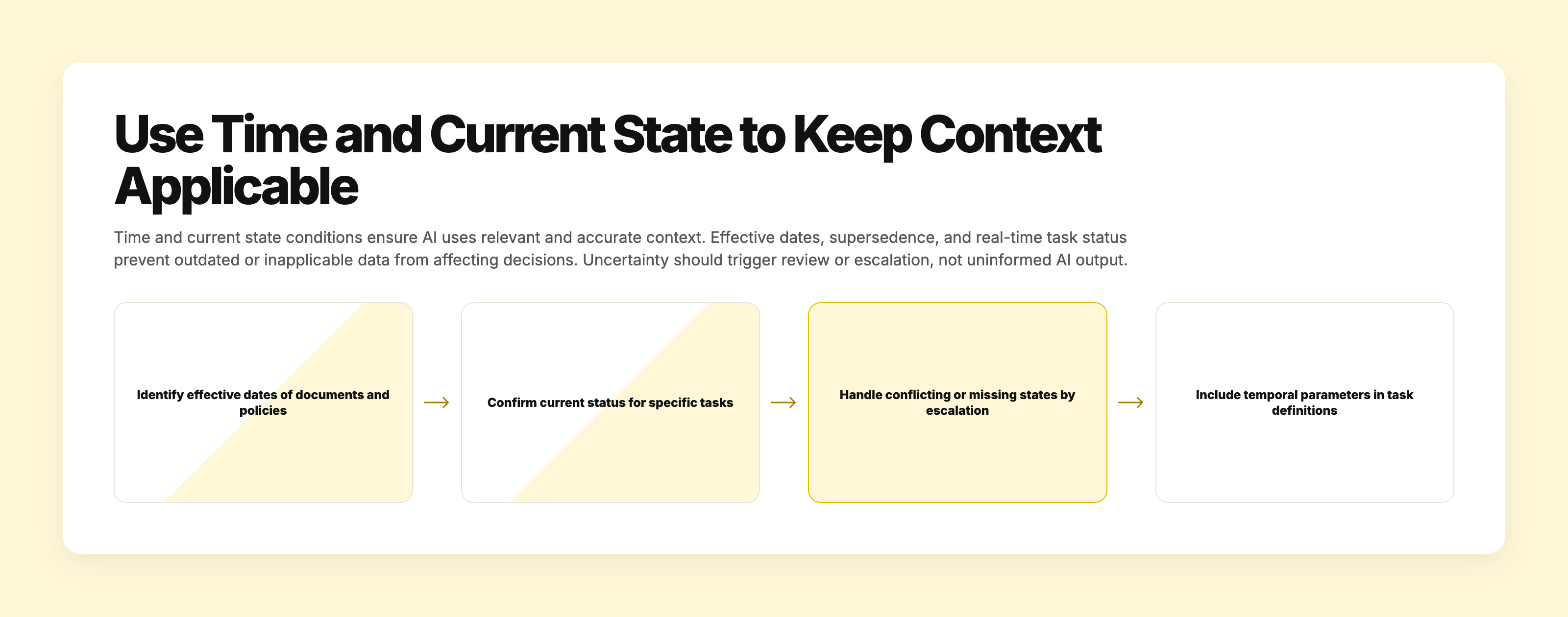
This is why freshness cannot be reduced to a timestamp. Operators need to ask:
- What date or event makes this information effective?
- Has another source superseded it?
- Is the task using the current state of the specific work?
- What should happen if current state cannot be confirmed?
The last question is especially important. Designing workflows that detect missing or conflicting data supports stronger business memory and helps prevent errors, similar to approaches discussed in How Teams Actually Handle Customer Conversations Without Losing Context.
Uncertainty should change the workflow. If a required status is unavailable or conflicting, the AI may need to stop at a proposal, flag the conflict, or route the task for human review. Missing current state should not be disguised by fluent output.
Time also belongs inside the task definition. “Prepare tomorrow’s service follow-up” gives the system a temporal condition. It then needs sources that are applicable to tomorrow, not merely the newest document it can find.
A Hypothetical: Preparing a Service Follow-Up Without Overexposure
Consider a hypothetical small service business preparing a follow-up for an upcoming appointment.
The AI’s task is limited: prepare a draft for review. It is not authorized to send the message, alter the appointment, promise an exception, or access unrelated business records.
The context could be assembled as follows:
Approved knowledge: the authorized description of the booked service and the correct location instructions.
Applicable policy: the current rule for arrival windows, schedule changes, and situations that require staff review.
Role: support for the staff member preparing appointment communications—not a manager, billing administrator, or scheduling authority.
Time: the date of the appointment and the effective dates of the service instructions and policy.
Permission: read only the fields needed for the draft, such as service type, appointment time, location, and communication status. No access to unrelated financial or personnel information.
Current state: the appointment remains scheduled, no change request is pending, and no previous approved follow-up has already been sent.
With that context, the AI may prepare a proposed message using approved information. If the current state instead shows a pending change request, the normal draft may no longer be appropriate. If the policy contains an exception that requires judgment, the task should move to a person.
The value comes from the boundary. The AI receives enough context to prepare useful work, but not enough authority to turn a draft into an unreviewed business commitment.
A Practical Context-Assembly Checklist
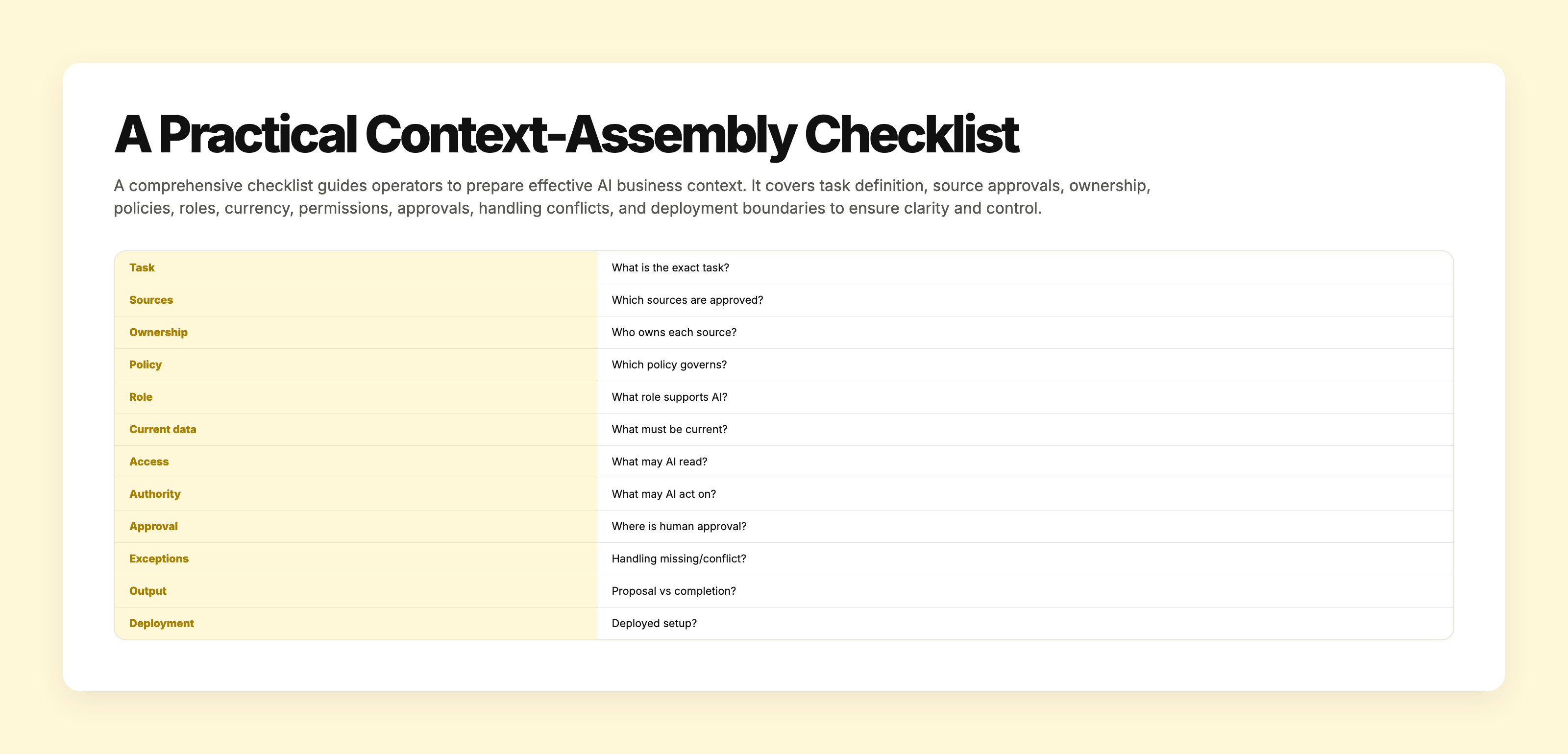
Before giving an AI a recurring business task, an operator should be able to answer these questions:
- What is the exact task? Define the intended output and where the AI’s work stops.
- Which sources are approved? Name the authoritative information rather than granting access to an entire repository.
- Who owns each source? Establish responsibility for applicability and correction.
- Which policy governs the task? Include its scope, conditions, and effective period.
- What role is the AI supporting? Use that role to limit both information access and proposed work.
- What must be current? Identify statuses, dates, or operating conditions that can change the correct next step.
- What may the AI read? Apply the minimum access needed for the task.
- What may it propose or initiate? Do not treat information access as action authority.
- Where is human approval required? Place review before actions whose consequences warrant it.
- What happens when context is missing or conflicting? Define a stop, flag, or escalation path.
- How will completion be distinguished from a proposal or attempt? Do not let generated output stand in for verified work.
- What is actually deployed? Distinguish intended architecture and bounded technical foundations from production operation, customer-facing availability, or commercial readiness.
The final test is concrete: choose one real task and list every piece of information and authority the AI would receive. If you cannot explain why each item is necessary—or where the AI must stop—the context is not ready. Remove the excess, resolve the gaps, and set the approval boundary before expanding access.
A 14-day free trial provides a bounded way to test these ideas in practice before making a broader commitment.

.svg)