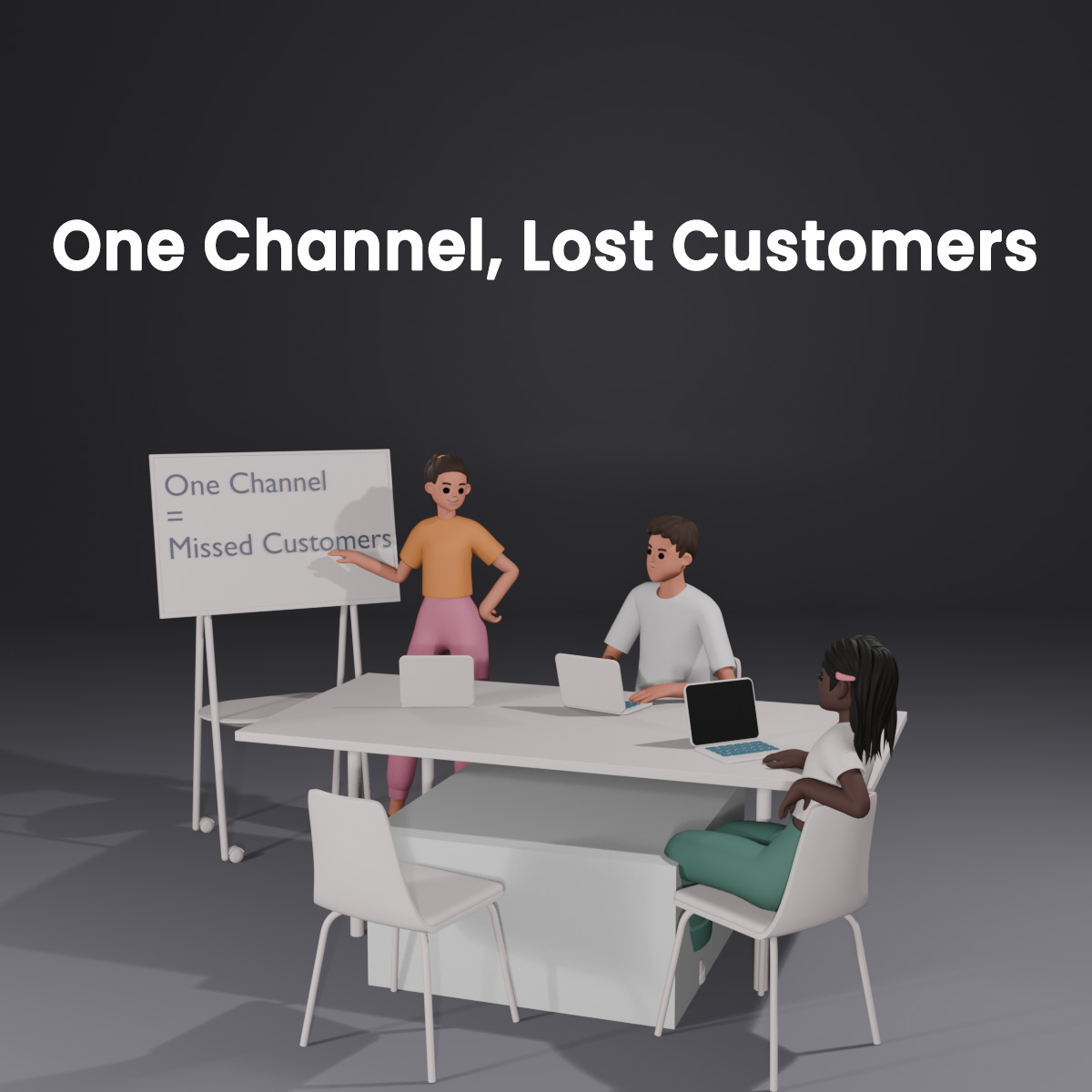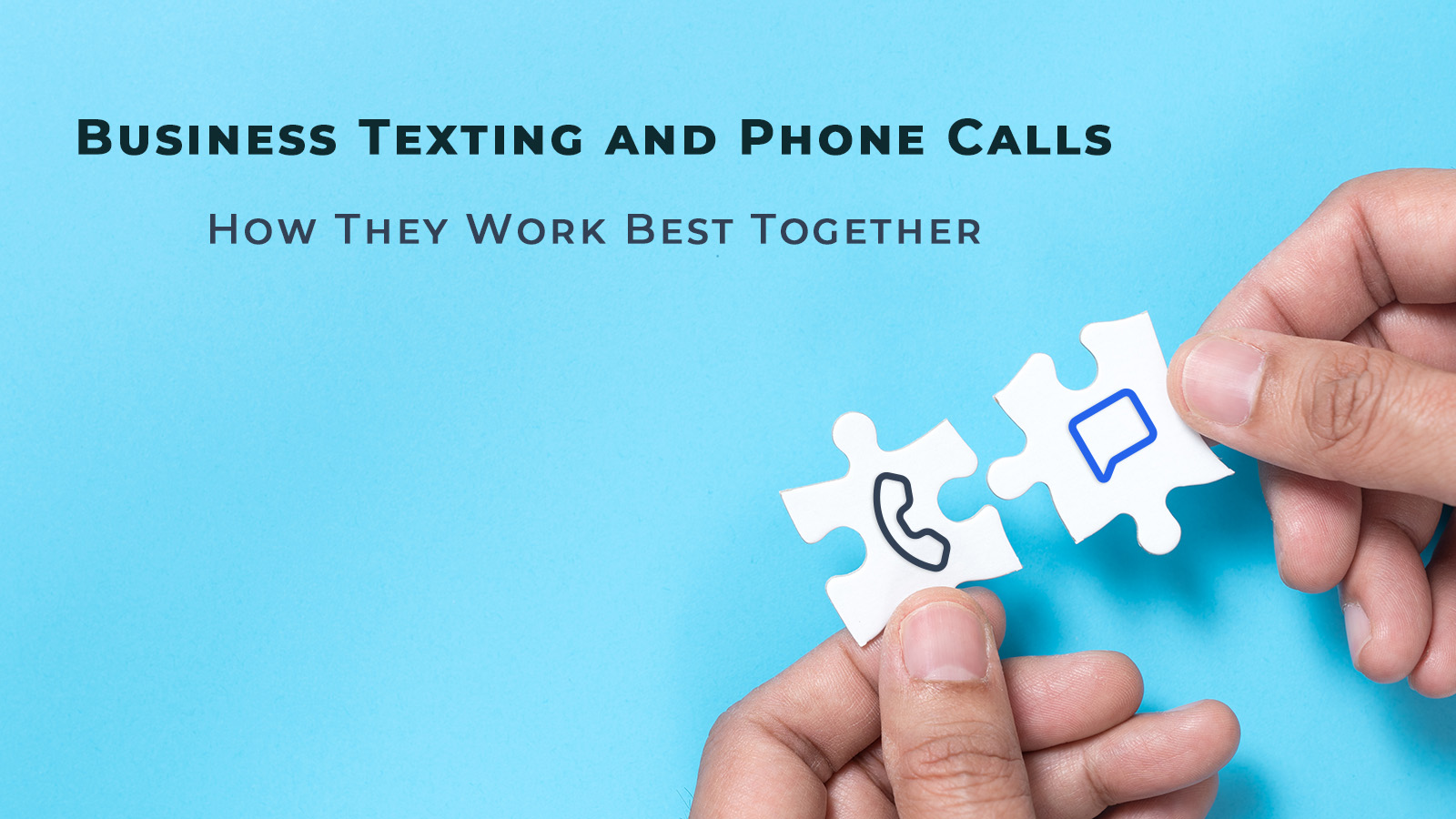

Modern business communication is not about choosing between texting or phone calls. It is about understanding how each channel supports different moments in the customer journey — and using them together with intention.
Text messages and phone calls serve distinct roles. Texting keeps conversations moving without interruption. Phone calls provide clarity, direction, and human connection when nuance or urgency matters. Problems arise not because businesses use the wrong channel, but because they default to one channel for every situation.
Customers begin forming opinions about your business long before a sale or service takes place. This is why businesses that fail to respond quickly or consistently often lose customers before a conversation even begins, a pattern we explore in detail in Why Small Businesses Lose Customers to Missed Messages (And How to Fix It). How you communicate — when you text, when you call, and how smoothly those interactions flow — directly shapes how responsive, organized, and professional your business feels.
This article explains how business texting and phone calls complement each other, where each channel is most effective, and how combining both strategically leads to clearer communication, stronger customer relationships, and fewer missed opportunities.
The Core Difference Between Texting and Phone Calls
The primary difference between business texting and phone calls is not speed. It is control.
A phone call requires immediate attention. It interrupts whatever the customer is doing and asks them to respond in real time. When that timing is appropriate, calls are effective. When it is not, calls feel intrusive or inconvenient.
Text messages operate differently. They give the recipient control over when to engage. This difference in control is one of the key reasons text messaging consistently outperforms calls for routine communication, which is why many businesses adopt it as a primary channel, as explained in 5 Reasons Why You Should Use a Business Texting Service. The message is delivered instantly, but the response can happen on the customer’s schedule. That distinction alone explains why texts are often read quickly but answered later — and why they feel less disruptive.
Understanding this difference helps businesses make better communication decisions. Phone calls work best when a conversation needs direction, clarification, or emotional context. Texting works best when the goal is to inform, confirm, or move a conversation forward without pressure.
When businesses match the channel to the customer’s need for immediacy versus flexibility, communication becomes clearer, more respectful, and far more effective.
When Business Texting Works Best
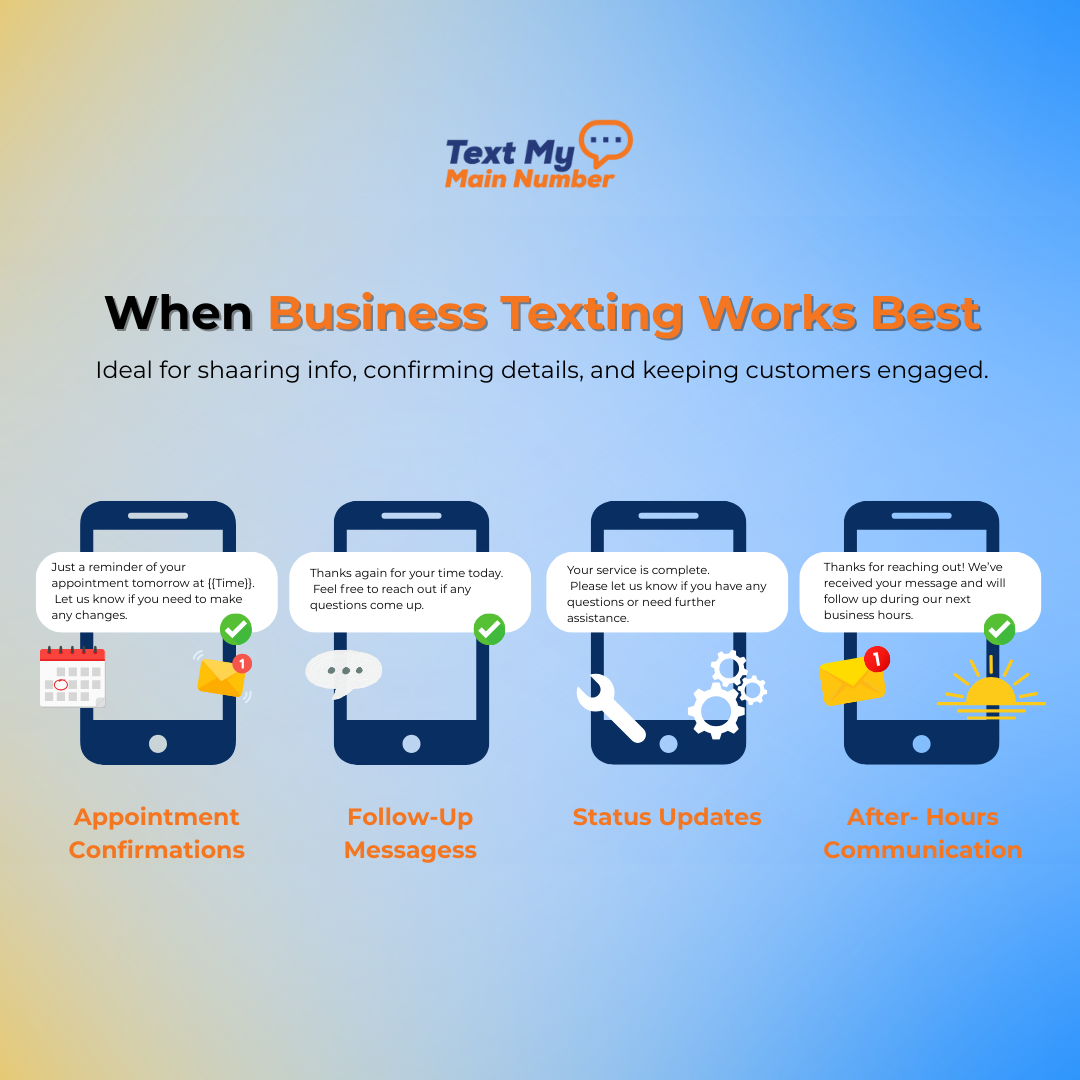
Business texting is most effective when the objective is to share information clearly, move a conversation forward, or confirm details without requiring immediate interaction. It allows businesses to stay responsive while respecting the customer’s time and attention. When used intentionally, texting reduces friction, improves response rates, and keeps communication efficient without feeling intrusive.
Appointment Confirmations and Reminders
Reducing no-shows and missed visits through clear, timely communication
Appointment-based businesses depend on precision. Missed appointments affect revenue, scheduling efficiency, and staff availability. Text messaging is particularly effective here because it delivers critical information without interrupting the customer’s day.
Healthcare clinics, dental offices, and service providers commonly use texts to:
- Confirm upcoming appointments
- Send reminders shortly before the scheduled time
- Provide simple instructions or arrival details
A brief text confirmation does not require a phone conversation, yet it gives the recipient a clear opportunity to acknowledge, reschedule, or ask a quick question. This lowers no-show rates while keeping the interaction professional and respectful.
For example, a dental office confirming a routine cleaning can send a short reminder that is read within minutes, even if the patient responds later. The result is better attendance without additional staff workload.
Follow-Ups That Should Not Feel Pushy
Maintaining momentum while giving customers space
Follow-ups are necessary, but poorly timed calls can feel intrusive and counterproductive. Text messaging offers a way to stay present without applying pressure.
This is especially valuable in industries where decisions take time, such as real estate, home services, or consultations.
Real estate agents, for example, often rely on texting after a showing to:
- Thank the client for their time
- Offer next steps without urgency
- Invite questions at the client’s pace
A short follow-up text keeps the conversation open while signaling professionalism and patience. Unlike repeated calls, it allows the prospect to respond when they are ready, which often leads to more meaningful engagement. For real estate teams looking to formalize this approach, our guide on SMS for Real Estate Agents breaks down compliant follow-up workflows and ready-to-use text examples that keep conversations moving without pressure.
Status Updates and Service Notifications
Keeping customers informed without unnecessary conversations
Many customer interactions are informational rather than conversational. In these cases, texting is the most efficient way to deliver updates clearly and consistently.
Service-based businesses frequently use text messages to:
- Share technician arrival windows
- Notify customers when work begins or ends
- Send payment reminders or invoices
These messages set expectations without requiring the customer to answer a call or return a voicemail. Customers appreciate knowing what is happening, and businesses benefit from fewer inbound status-check calls.
For example, a home service company can send a text when a technician is en route, reducing uncertainty and improving the customer experience with minimal effort.
After-Hours Communication
Acknowledging customer outreach outside business hours
Customers do not stop reaching out when offices close. Without a response, messages sent after hours can feel ignored, even if they are seen the next morning.
Texting provides a practical solution through automated acknowledgments that:
- Confirm the message was received
- Set clear expectations for follow-up
- Reassure the customer that they have not been overlooked
An after-hours text reply helps preserve trust and professionalism. It also prevents missed opportunities by ensuring that inquiries are captured and addressed promptly once staff is available. If after-hours messages are a recurring challenge, this is where automated replies make a measurable difference. Auto-reply texts are especially useful after hours, helping businesses acknowledge messages, set response expectations, and maintain professionalism when teams are unavailable, as explained in Auto-Reply Texts for Business: 25 Templates to Boost After-Hours Engagement.
For many businesses, this simple acknowledgment is the difference between a frustrated prospect and a customer who feels respected and informed.
When Phone Calls Work Better
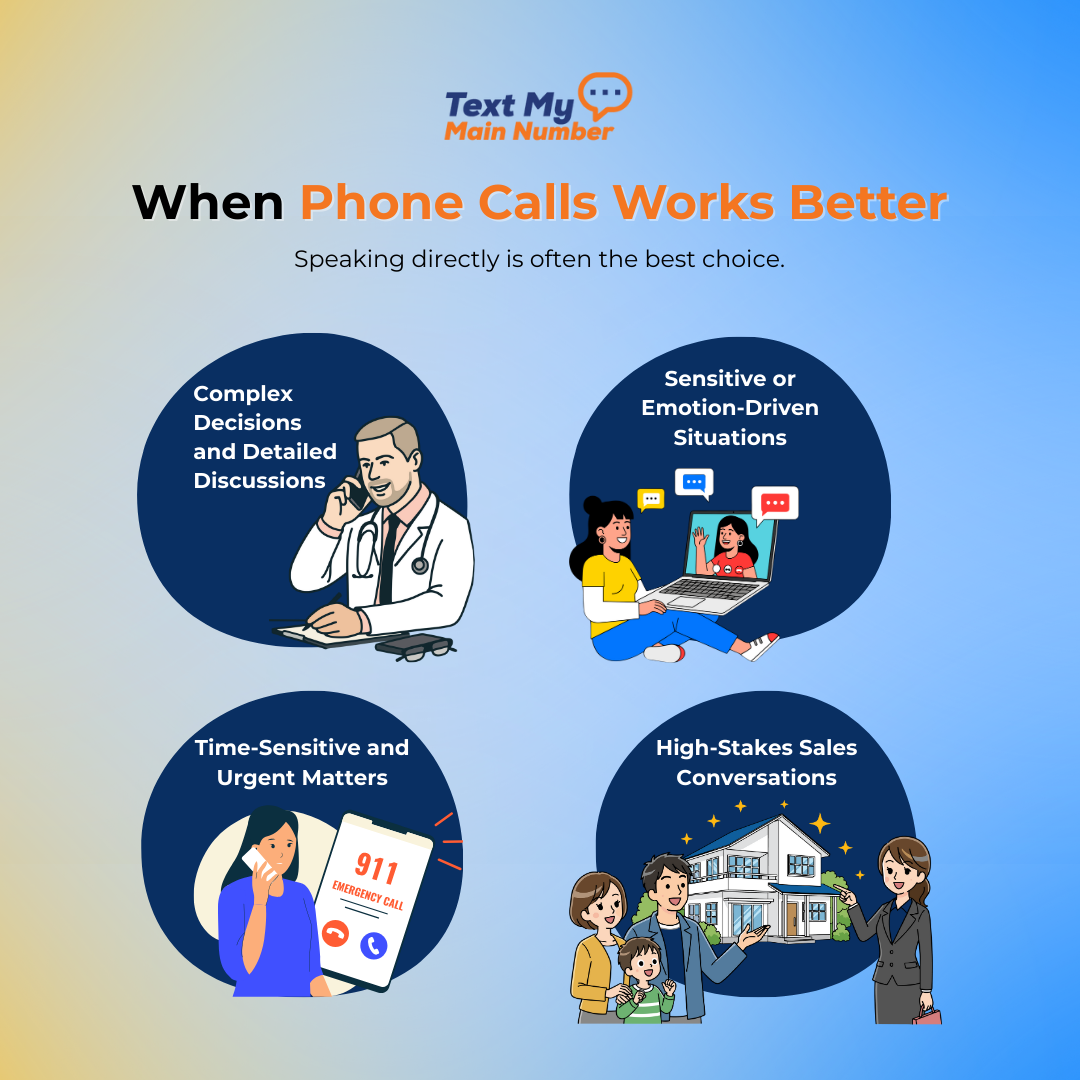
Phone calls are most effective when a conversation cannot be reduced to a single message or simple response. They provide immediate interaction, allow for clarification in real time, and convey tone and intent in ways text cannot.
Calls work best when decisions are complex, emotions are involved, or timing is critical. In these moments, the ability to listen, respond, and guide the conversation directly prevents misunderstandings and unnecessary delays.
Complex Decisions and Detailed Discussions
Navigating conversations that require explanation and back-and-forth
Some conversations involve multiple variables, follow-up questions, and real-time clarification. In these cases, phone calls are more efficient than extended message threads.
Common examples include:
- Healthcare consultations discussing treatment options
- Financial conversations involving pricing or payment plans
- Detailed service estimates or project scopes
A phone call allows the business to explain context, answer questions as they arise, and ensure the customer fully understands their options. Tone, pacing, and pauses all contribute to clarity — something text messages cannot replicate in complex scenarios.
Sensitive or Emotion-Driven Situations
Providing reassurance when empathy matters
Certain conversations require more than information. They require understanding.
Hotlines, medical inquiries, and billing disputes often involve stress or concern. In these situations, a text message can feel impersonal or dismissive, even when the intent is helpful.
A phone call allows:
- Empathy to be expressed through tone
- Concerns to be acknowledged immediately
- Trust to be built through real human interaction
When reassurance is needed, hearing a calm, attentive voice can significantly change how the conversation is received.
High-Stakes Sales Conversations
Guiding serious prospects toward confident decisions
When a customer begins asking detailed questions, they are often signaling readiness to move forward. At this stage, phone calls are more effective than text exchanges.
In industries such as real estate, professional services, or high-value retail, calls allow businesses to:
- Address objections in real time
- Adapt the conversation based on the customer’s responses
- Provide clarity that accelerates decision-making
Rather than reacting message by message, a call lets the business lead the conversation with intention.
Time-Sensitive and Urgent Matters
Taking immediate action when delays are costly
When something requires immediate attention, relying on text messaging introduces uncertainty. Messages can be unread, delayed, or missed entirely.
Phone calls are the right choice when:
- Immediate confirmation is required
- Safety or service continuity is at risk
- A fast decision prevents larger issues
In urgent situations, the immediacy of a phone call ensures the message is received and acted on without delay.
The Real Problem: Businesses Default to One Channel
Most businesses do not make deliberate decisions about how they communicate. Instead, they rely on the channel they have always used — whether that is phone calls, text messages, or a mix applied inconsistently.
This default behavior creates breakdowns in communication, not because the tools are ineffective, but because they are used without a defined purpose. A channel that works well in one situation is applied universally, even when it no longer fits the customer’s needs or the context of the conversation.
The consequences show up in predictable ways:
- Excessive phone calls can feel disruptive and are often ignored
- Overuse of text messages can strip conversations of clarity and tone
- Lack of visibility into past interactions leads to missed follow-ups
- Inconsistent responses across team members create confusion and erode trust
These issues are frequently mistaken for a problem of responsiveness or message volume. In reality, they point to a deeper operational gap.
This is not a communication volume problem. In fact, most breakdowns happen because businesses lack a structured messaging strategy, not because they send too many messages — a distinction outlined clearly in Inbound vs. Outbound Texting Explained: Choosing the Right SMS Strategy.
It is a workflow problem — one caused by the absence of clear rules around when to text, when to call, and how to move between the two.
How Smart Businesses Combine Texting and Phone Calls

The most effective businesses do not rely on a single communication channel. They use texting and phone calls together, with clear intent behind each interaction. The goal is not to communicate more, but to communicate in a way that fits the situation.
Text messages are used to create awareness, confirm details, and keep conversations moving forward. Phone calls are used to resolve complexity, address concerns, and guide decisions that require real-time discussion.
When these channels are used intentionally, communication feels organized rather than reactive.
Real Estate
Balancing responsiveness with relationship-building
In real estate, speed matters, but pressure can stall decisions. Successful agents use texting and calls in sequence rather than interchangeably.
A typical workflow includes:
- Sending a text immediately after a new inquiry to acknowledge interest
- Transitioning to a phone call once the buyer is ready to discuss pricing, availability, or next steps
- Using follow-up texts to maintain momentum without overwhelming the prospect
This approach keeps leads warm while respecting the buyer’s pace.
Healthcare and Dental Offices
Clear information without unnecessary interruptions
Healthcare providers rely on texting for operational communication and phone calls for clinical conversations.
Text messages are commonly used to:
- Confirm and remind patients of appointments
- Share basic instructions or arrival details
Phone calls are reserved for situations where:
- Treatment plans need explanation
- Patients have concerns or questions that require reassurance
Post-visit follow-up texts then provide continuity by checking in and outlining next steps.
Service Businesses
Keeping customers informed while staying flexible
Service-based businesses benefit from clear, predictable communication that does not require constant interaction.
Texting works well for:
- Arrival windows and scheduling updates
- Job completion notifications
- Invoices and payment reminders
Phone calls are used when:
- A change requires customer approval
- Additional work or cost needs discussion
This combination reduces friction, prevents misunderstandings, and keeps both sides aligned.
The Guiding Principle
Effective communication strategies are built around context. The channel supports the moment, not the other way around.
When businesses tailor their communication to meet the customer’s needs and the nature of the conversation, clarity improves, response rates increase, and trust builds naturally.
Where Text My Main Number Fits In
The challenge most businesses face is not choosing between texting and phone calls. It is managing both in a way that feels organized, consistent, and easy to maintain as teams grow.
Text My Main Number is designed to address this exact gap. It focuses on practical communication tools that support real workflows rather than adding unnecessary complexity.
TMMN helps businesses bring structure to everyday conversations by enabling them to:
- Send and receive business texts from a real phone number
Communicate with customers using a professional number they recognize and trust, rather than personal devices or fragmented channels. - Use message templates for common scenarios
Standardize responses for confirmations, follow-ups, and updates while still allowing messages to sound natural and human. - Automate after-hours replies and acknowledgments
Ensure customer messages are received and acknowledged even when staff is unavailable, setting clear expectations without manual effort. - Maintain organized texting and calling workflows as teams scale
Keep communication consistent across multiple users and departments, reducing missed follow-ups and duplicated responses.
Text My Main Number is built for businesses managing ongoing, real-world conversations — where clarity, reliability, and consistency matter more than feature overload.
Final Thought: Communication Is Part of the Experience
Customers do not judge your business solely by what you offer. They judge it by how easy it is to communicate with you, how quickly they receive clarity, and how consistently their messages are handled.
When texting and phone calls are used intentionally, communication becomes an asset rather than a friction point. Customers feel acknowledged without being interrupted. Conversations move forward without pressure. Teams stay organized instead of reacting message by message.
Text My Main Number is built to support this exact balance. It helps businesses structure real conversations across text and voice, automate the moments that do not need manual effort, and maintain consistency as teams and message volume grow.
If you want to see how this works in practice, Text My Main Number offers a 14-day free trial. It’s a simple way to experience clearer business texting, better follow-ups, and more reliable communication — without changing how you already operate.

.svg)