

Two owners can review the same week of customer conversations and reach very different conclusions.
The first owner sees a dependable sequence of calls, emails, text messages, questions, and replies. How Small Teams Manage Customer Conversations Without Burnout (2026 Guide) explains the crucial ways in which managing conversation history helps employees maintain clarity and avoid overload in everyday communication.
An estimate was sent Tuesday. The customer asked about scheduling Wednesday. An employee answered that afternoon. The customer approved the work Friday.
The second owner reviews those same exchanges alongside other estimates from the month. She notices that eight customers asked nearly identical scheduling questions before approving. Five waited until an employee clarified whether parts had to be ordered before an appointment could be confirmed. Three approved shortly after that explanation.
Both owners are working from the same conversations. They are simply asking those conversations to perform different jobs.
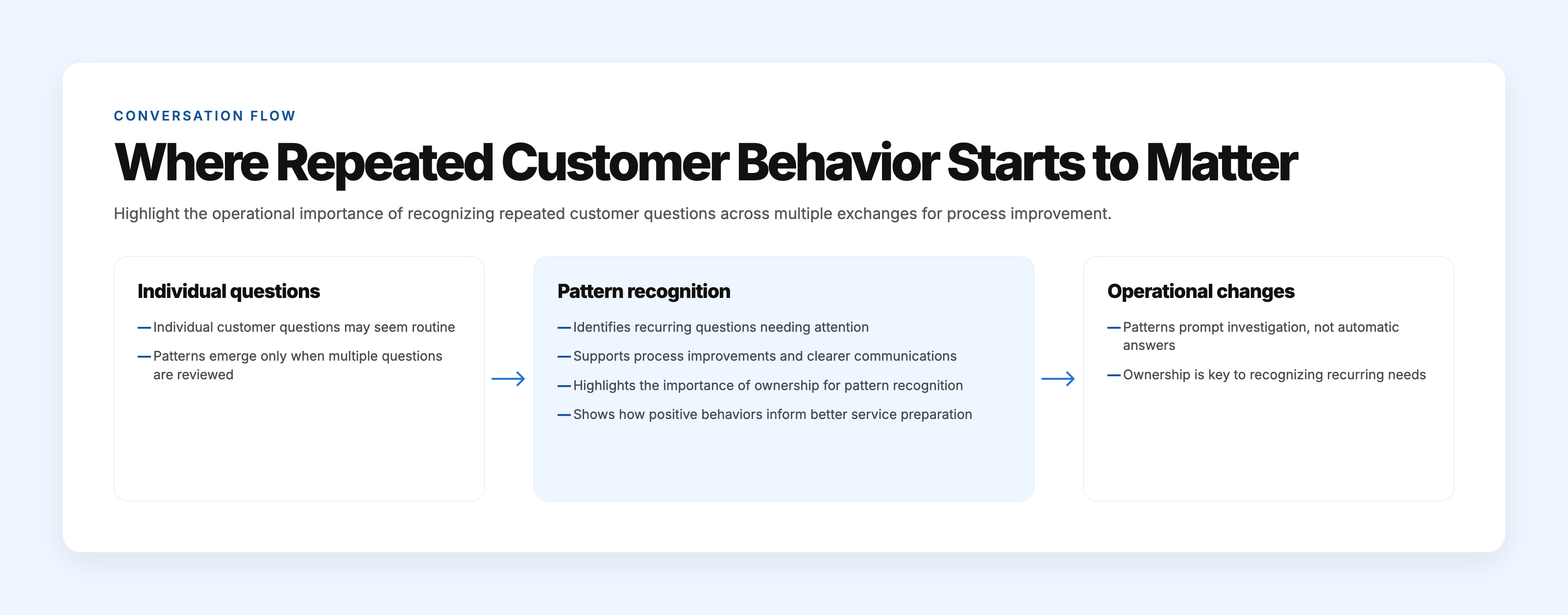
At the center of the conversation history vs conversation intelligence distinction is scope. Conversation history preserves what happened in an individual exchange. Conversation intelligence looks across exchanges for repeated questions, pauses, responses, and decision patterns. History is useful for verifying facts and continuing a customer conversation. Intelligence becomes useful when an operator is deciding whether an estimate, explanation, policy, follow-up process, or staffing choice needs attention.
That distinction is easy to blur because both begin with the same source material. A complete history can feel informative simply because it contains a large amount of detail. Yet chronological detail does not reveal a pattern on its own. Someone still has to compare similar conversations, account for gaps and inconsistencies in the record, and connect the findings to a practical business question.
The purpose of conversation intelligence is not to analyze every sentence or assign significance to every pause. It is to notice repetition that may help the business make a better decision.
What a Dependable Conversation History Is Good For
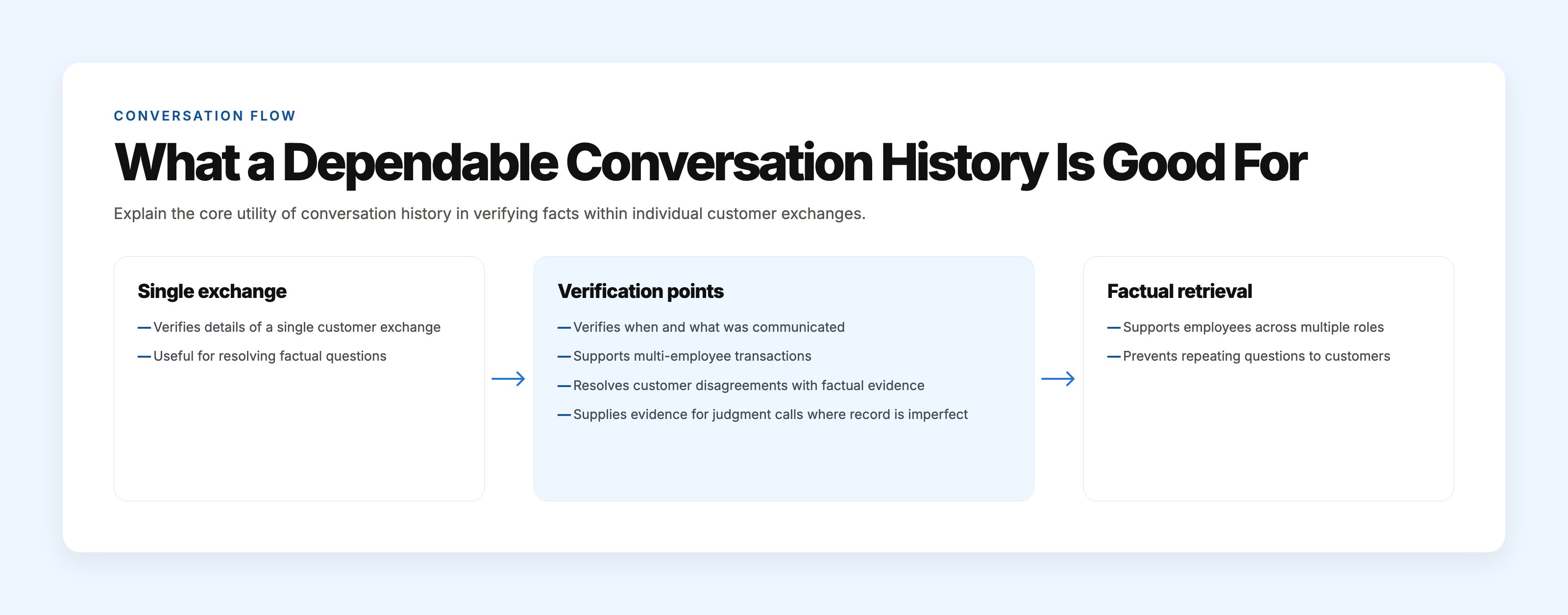
Conversation history answers factual questions about a specific customer exchange. It can show when a message was sent, who replied, what price was quoted, which appointment date was discussed, and whether an employee made a particular commitment.
Consider a family-owned furniture store handling an order for a dining table. The customer calls to confirm the expected delivery week. An employee reviews the previous exchange and sees that the salesperson estimated four to six weeks, with a final delivery date to be confirmed after the manufacturer accepts the order. The employee does not need an analysis of broader customer behavior. The immediate task is verification.
That kind of review is often less tidy than the record makes it appear. The delivery estimate may be in an email, the fabric selection in a handwritten sales note, and the access instructions in a text sent to a different employee. A dependable history matters because the employee taking the call is otherwise left reconstructing the order from memory, asking a coworker who may be off that day, or making the customer repeat information already provided.
History is also useful when several employees participate in a transaction. A salesperson may discuss fabric choices, an office employee may process the deposit, and a delivery coordinator may confirm access instructions. Each person needs access to the relevant exchange so the order proceeds according to what was discussed.
In these situations, a chronological record is often sufficient. The employee has a narrow question, and the answer exists in the exchange. Adding interpretation would not necessarily improve the response.
Conversation history also helps resolve ordinary disagreements. A customer may remember being told that installation was included, while the written estimate says installation would be priced after a site visit. Reviewing the exchange allows the business to respond based on the language actually used rather than anyone’s recollection.
Even then, the record may expose an imperfect handoff rather than a clean answer. The salesperson may have said, “We can take care of installation,” while the estimate treats installation as a separate charge. Neither statement is necessarily false, but the customer can reasonably hear the first as a promise that the work is included. The history shows where the misunderstanding began. It does not remove the need for judgment.
An owner may still choose to honor the customer’s understanding, split the cost, or revise the estimate. History supplies evidence for that judgment.
This is the basic value of preserving conversations: the business can verify an individual exchange without guessing. When the question concerns one customer, one commitment, one date, or one response, that may be all the business needs.
Conversation intelligence begins when the question gets wider. If several customers interpret the installation language the same way, the owner is no longer reviewing one disagreement. The owner is deciding whether the estimate itself invites confusion.
Where Repeated Customer Behavior Starts to Matter
A single customer question can be ordinary. The same question appearing in fifteen similar conversations may deserve a closer look.
This often becomes visible during routine work rather than through formal analysis. At a commercial cleaning company, an account coordinator answers a property manager who wants to know whether quarterly floor care is included in a renewal proposal. The coordinator checks the service schedule, writes a reply, and moves on to the next account.
Over the next six weeks, other property managers ask versions of the same question. Some refer to “floor maintenance,” others to “buffing,” and others to “periodic hard-floor service.” One coordinator answers from memory. Another forwards the question to operations. A third copies language from an older proposal that no longer matches the current service schedule. The wording varies, the handling is inconsistent, and no single exchange appears serious enough to raise an alarm.
The decision point, however, is the same. How Businesses Handle 50+ Customer Conversations Per Day Without Chaos describes operational methods for keeping track of frequent customer questions to prevent routine issues from overwhelming teams.
Customers want to understand whether a visible part of the service is included in the renewal price.
Conversation history can retrieve each exchange. Comparing the exchanges helps the operator recognize that the questions belong together, including the replies that took longer because employees were unsure which document controlled the answer.
That observation may lead the company to place a clearer service schedule inside future renewal proposals. It may also lead to no change. Perhaps the question appears only among properties with a particular flooring type, or perhaps the service genuinely requires a separate discussion because frequency depends on traffic and surface condition. The pattern provides a reason to investigate, not an automatic answer.
The same principle applies to positive behavior. A furniture retailer may notice that customers who ask about room dimensions often schedule an in-store visit after receiving a simple measuring guide. An auto repair shop may find that estimates are approved more readily when the advisor explains which repairs are urgent and which can wait. A local accounting practice may observe that clients respond faster when document requests are grouped by category rather than sent as one long list.
These observations rarely arrive in a clean report. The measuring guide may be sent by only one salesperson. One service advisor may naturally explain repair priority while another reads the estimate line by line. An accounting employee may have created category headings simply because clients kept replying with incomplete document sets. Useful patterns often begin as employee workarounds before anyone recognizes them as process information.
None of those findings changes what happened in the original conversations. They change how the business prepares for the next similar conversation.
Repetition is easy to overlook because each exchange can appear routine. The customer asks. The employee answers. The workday continues. Ordinary conversations rarely announce that they contain a useful operational pattern.
In practice, the missing piece is often ownership. Employees assume the manager sees the recurring questions because the manager can access the messages. The manager assumes employees will mention anything important. Both assumptions can persist while customers continue doing the same extra work.
The question is not whether the business possesses the messages. It is whether someone periodically compares enough similar exchanges to see what customers repeatedly need before they can decide.
The Difference Appears in Everyday Decisions
A specialty auto repair shop provides a practical example of how the distinction plays out over time.
On Monday morning, service advisor Elena sends an estimate to a customer whose vehicle needs suspension work. The estimate separates parts and labor but does not explain whether the alignment is included. At 10:40 a.m., the customer texts to ask. Elena answers that the alignment is included after installation. The customer approves the work shortly before lunch.
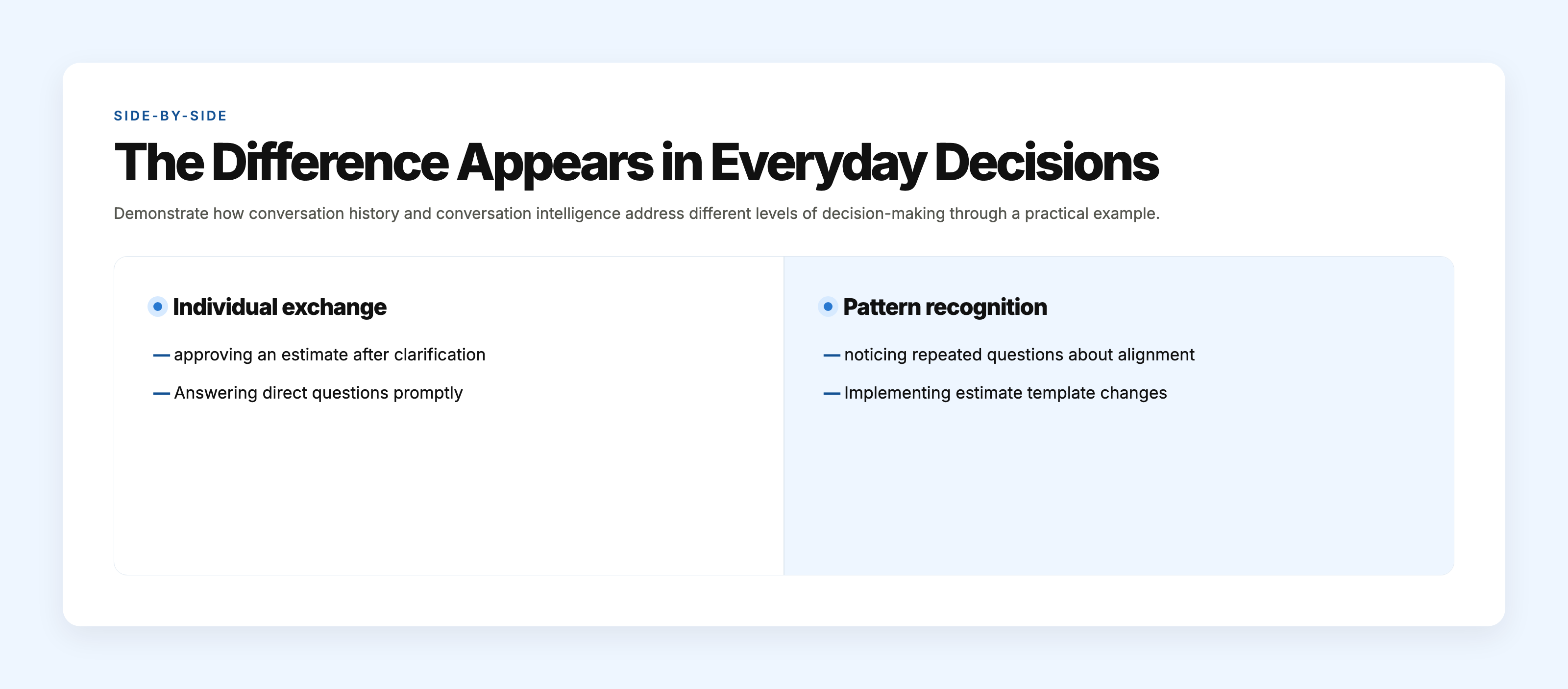
Later that day, another advisor handles a similar estimate. That customer calls with the same question and also asks whether the vehicle will be ready the same day. The advisor answers both questions, and the customer says he wants to compare the estimate with another shop before deciding.
By Wednesday, the second customer has not replied. The office coordinator sends a courteous follow-up, but there is still no response. The shop cannot safely conclude that alignment language caused the silence. The customer may have chosen a lower price, delayed the repair, or decided not to keep the vehicle.
On Thursday afternoon, the owner reviews the week’s open estimates. He can see every completed exchange. Nothing is absent. Each employee responded appropriately. From a history perspective, the records have done their job.
Then he notices that four suspension estimates generated questions about alignment and completion timing. Two were approved after clarification. Two remain open.
The records are not perfectly uniform. One question came through text, another was summarized in a call note, and a third appears only because the advisor added “alignment included” to the estimate after speaking with the customer. The fourth advisor remembers answering the question but did not write down exactly how it was asked. The pattern is still visible, but it requires the owner to read across systems and ask employees what happened rather than rely on a clean set of identical records.
An internal assumption surfaces during the review. Elena thought the owner had already been comparing estimate questions because he reviews open work every Thursday. The owner assumed the service advisors would mention recurring objections during the morning meeting. The office coordinator had noticed the same follow-up issue but treated it as a sales matter outside her role. Everyone handled the individual customers, but no one had taken responsibility for comparing the exchanges.
The breakdown was not in answering customers. It was in assuming that routine handling would naturally produce a broader observation.
The owner decides on a limited change. Future suspension estimates will state whether alignment is included and provide a realistic completion window. The shop will compare the next twenty similar estimates before drawing a stronger conclusion.
The change does not produce an immediate, perfect result. One customer still asks whether “included” means there will be no additional charge if the alignment takes longer than expected. Another asks whether the completion window includes time for a road test. Those questions help the shop distinguish between confusion that can be prevented and reasonable detail that a customer may still want before authorizing expensive work.
This is conversation intelligence in practical form. It does not require the shop to claim that it knows why every customer paused. It uses repeated questions to make the next estimate easier to understand, then checks whether the change affects the conversations that follow.
An exchange can be handled correctly and still contribute to a pattern worth examining. Good individual service does not guarantee that anyone owns the repeated problem.
When the Record Is Enough—and When Comparison Helps
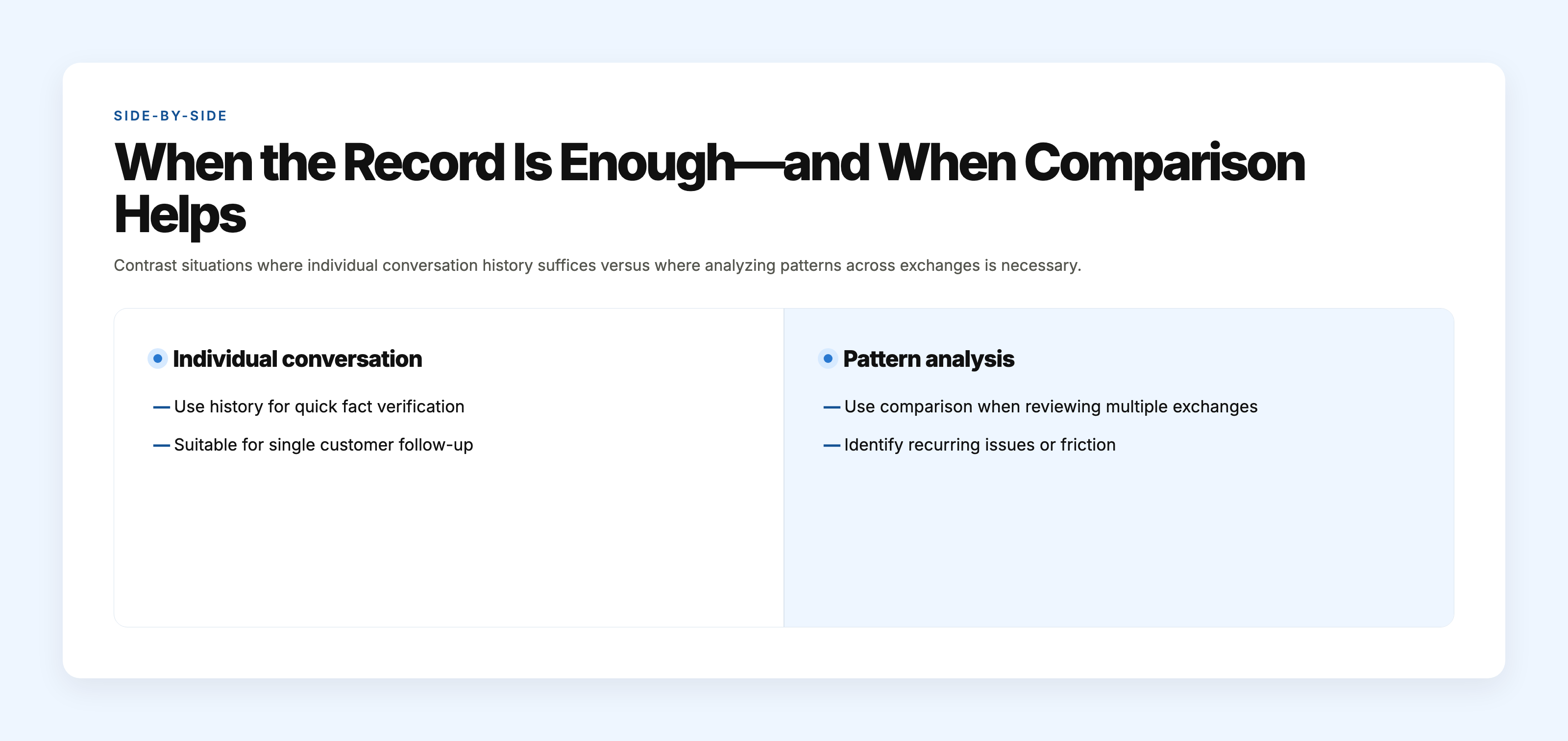
Not every customer interaction needs interpretation. In many daily situations, history is the faster and more appropriate tool.
If an employee needs to confirm whether a customer approved a color, accepted a service date, received a revised price, or requested a callback, reviewing the individual exchange is enough. The task is direct, and the scope is narrow.
Comparison becomes useful when a manager is deciding something that will affect multiple customers. An estimate may need different payment-stage language. Appointment reminders may be leaving out parking instructions. Renewal emails may introduce notice periods too late. Complex inquiries may repeatedly arrive during hours when the most experienced employee is unavailable.
Those decisions cannot be supported well by one memorable conversation. They require a relevant set of exchanges, and the set is not always obvious at first.
At a local accounting practice, tax-season clients repeatedly ask whether a document was received. For one client waiting on confirmation of one upload, history supplies the answer. Across a larger group, the questions expose a messier process. Some clients receive an automatic portal confirmation. Others upload through a link sent by an employee and receive no visible acknowledgment. A receptionist has begun checking the portal manually because clients call after waiting a day. Preparers assume the portal message is sufficient, while clients often overlook it or do not understand that “upload complete” also means the practice can access the file.
The recurring question is no longer just a client preference. It is creating duplicate checking work and pulling the receptionist into a process she does not own.
Customer behavior also changes with the size and complexity of the decision. Someone booking a simple appointment may need only a time and location. Someone approving a costly repair may want to understand alternatives, timing, warranty coverage, and what happens if additional work is discovered.
A pause after a high-cost estimate is not inherently negative. The customer may be reviewing finances or comparing providers. Yet if many customers stop responding after the same unclear passage, that passage deserves review.
Silence can feel intentional to the person waiting for a reply. An advisor sees that the customer opened the estimate but did not respond and assumes the customer is not interested. From the customer’s side, the decision may still be active. The estimate may have raised a question the customer did not want to spend another phone call resolving, especially if the question seems as though it should already have been answered.
Employees develop workarounds around this uncertainty. One advisor calls every open estimate after two days. Another sends a short text asking whether the customer has questions. A third avoids following up because previous customers described repeated calls as pressure. If those differences are not visible, the business may compare outcomes without realizing that customers received materially different follow-up.
A dependable history shows the pause and the handling around it. A broader review helps the operator decide whether similar pauses tend to occur in the same place, while preserving room for the explanations the record cannot prove.
Putting a Number on Repeated Clarification
The financial effect of repeated questions is usually modest in any single conversation. Across a month or a year, it can become worth addressing.
A home-services company reviewing 50 estimates from one month finds that 18 customers asked whether material disposal was included in the quoted price. The questions are not tagged neatly. Some appear as direct replies to the estimate. Several arrive by text. Two are recorded as short call notes, and one is found only because an office employee remembers checking the price with the estimator before replying.
Every estimate and most of the related replies are available, so the company can reconstruct how the conversations unfolded. The imperfect records also show why a simple message count would understate the work.
Each clarification takes about seven minutes. An office employee reads the message, checks the estimate, confirms the service terms, writes a reply, and records the response. Some take less time. Others require a call to the estimator because disposal differs for unusually heavy material. Seven minutes is a reasonable working average, not a claim that every exchange is identical.
Eighteen clarifications multiplied by seven minutes equals 126 minutes. That is just over two hours of paid employee time spent answering one recurring question during a single month.
The labor cost alone is not dramatic. At an estimated loaded labor cost of $30 per hour, the direct monthly expense is roughly $63. Across twelve similar months, it would be about $756.
The more useful financial question concerns estimate approval. Of the 18 customers, 12 approved after receiving clarification, three declined, and three never responded. The company cannot attribute every decision to disposal language. Price, timing, trust, and competing bids may have mattered more.
Still, the pattern gives the owner something specific to test. The company updates the estimate template so disposal is stated clearly near the price rather than buried in a service note near the bottom of the page. The office employee keeps a simple tally of disposal questions while reviewing the next 50 estimates. Only six customers ask.
If employee time falls from 126 minutes to 42 minutes, the company saves 84 minutes of repetitive work in that cycle. The result is useful even though it is not transformative. It removes a small source of friction that had been repeated often enough to become routine.
The owner can also compare approval behavior while treating the numbers carefully. If approvals improve, that is useful evidence, but not proof that one wording change caused the entire difference. Weather, seasonal demand, staffing, pricing, and the mix of jobs can all affect what customers decide.
The revised language may also create a new question. Customers could begin asking what “standard disposal” excludes, especially on jobs involving concrete, appliances, or hazardous material. That does not mean the change failed. It may mean the estimate has moved the discussion from a basic inclusion question to the exceptions that genuinely require clarification.
The strongest result may simply be fewer avoidable exchanges. Employees spend less time repeating the same explanation, and customers can evaluate the estimate without creating another task for themselves.
Small questions become expensive less through their size than through their frequency.
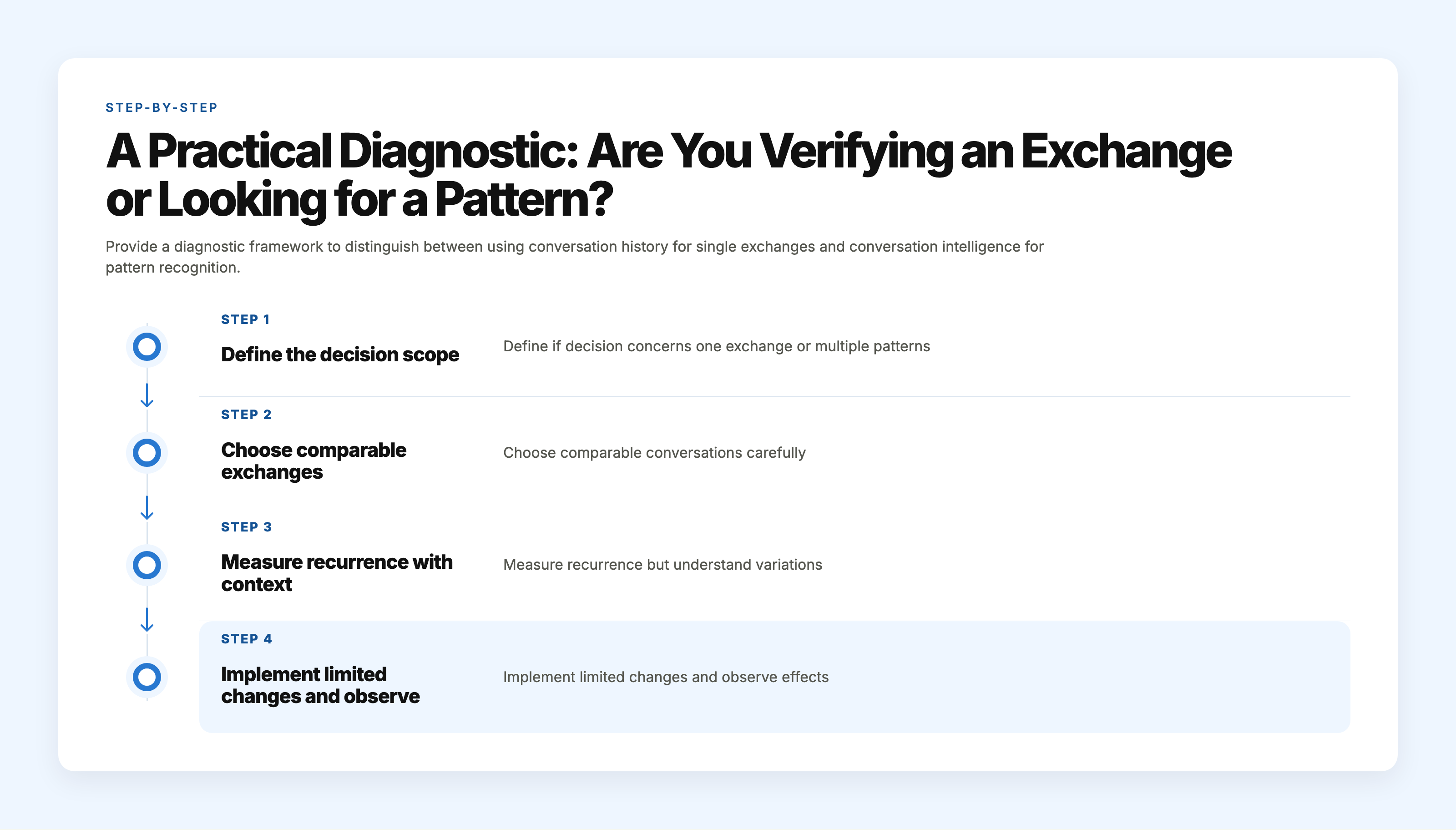
A Practical Diagnostic: Are You Verifying an Exchange or Looking for a Pattern?
A useful way to separate conversation history from conversation intelligence is the Exchange-or-Pattern Diagnostic. It is not a technology assessment. It is a four-part review for identifying what kind of work the business is actually trying to do.
First, define the decision. Determine whether the team needs to answer a question about one exchange or make a change that could affect many future exchanges. “Did we promise Tuesday delivery?” is an exchange question. “Why do delivery questions increase after deposits are paid?” is a pattern question.
When this distinction is skipped, the resulting mistake is usually practical. Employees may spend half an hour discussing a simple commitment that could have been verified in one message. At the other extreme, an owner may change a delivery policy after one difficult call without checking whether other customers experienced the same problem.
Second, choose comparable conversations. A pattern review works only when the exchanges involve a similar service, customer decision, time period, or stage. Mixing appointment changes, sales inquiries, billing questions, and renewal discussions can create misleading conclusions.
A furniture store comparing delivery questions cannot treat every customer message as equally relevant. A delivery question before a deposit is paid may reflect purchase planning. The same question after the order has been placed may reflect concern about a missed expectation. The words can match while the operational meaning differs.
Comparable does not mean perfect. Records may span calls, texts, email, employee notes, and conversations that were only partly documented. The operator still has to decide whether the available group is coherent enough to support a decision. A thin record may justify closer observation before it justifies a process change.
Third, measure recurrence without pretending it proves intent. Count how often the question, pause, or response appears. Then read enough of the underlying conversations to understand the variations. Ten customers asking about a warranty may indicate unclear wording, but it may also reflect a high-value purchase where careful questions are normal.
Counts show frequency; the conversations explain the circumstances. Neither alone is sufficient when the decision carries operational consequences.
Fourth, select a limited action and observe what follows. The business might revise one paragraph, add one timing detail, change the order of follow-up messages, or prepare employees to answer a recurring question earlier. Changing several things at once makes it difficult to know which adjustment helped, particularly when different employees apply each change differently.
Failure at this stage often looks like overreaction. An owner sees three similar phrases and creates a new policy for every customer. Staff then spend more time following a rule that addressed a narrow exception. One employee follows it exactly, another quietly returns to the old method, and a third creates a shortcut because the new requirement slows down busy periods. The business believes it tested a change, but customers received three different versions of it.
A useful pattern should make the customer decision or employee response clearer, not add procedure without a practical benefit.
The Exchange-or-Pattern Diagnostic keeps the work grounded. Its value is not in forcing every situation through a formal exercise. It prevents a factual question from becoming an analysis project and a recurring operational problem from being dismissed as another isolated customer.
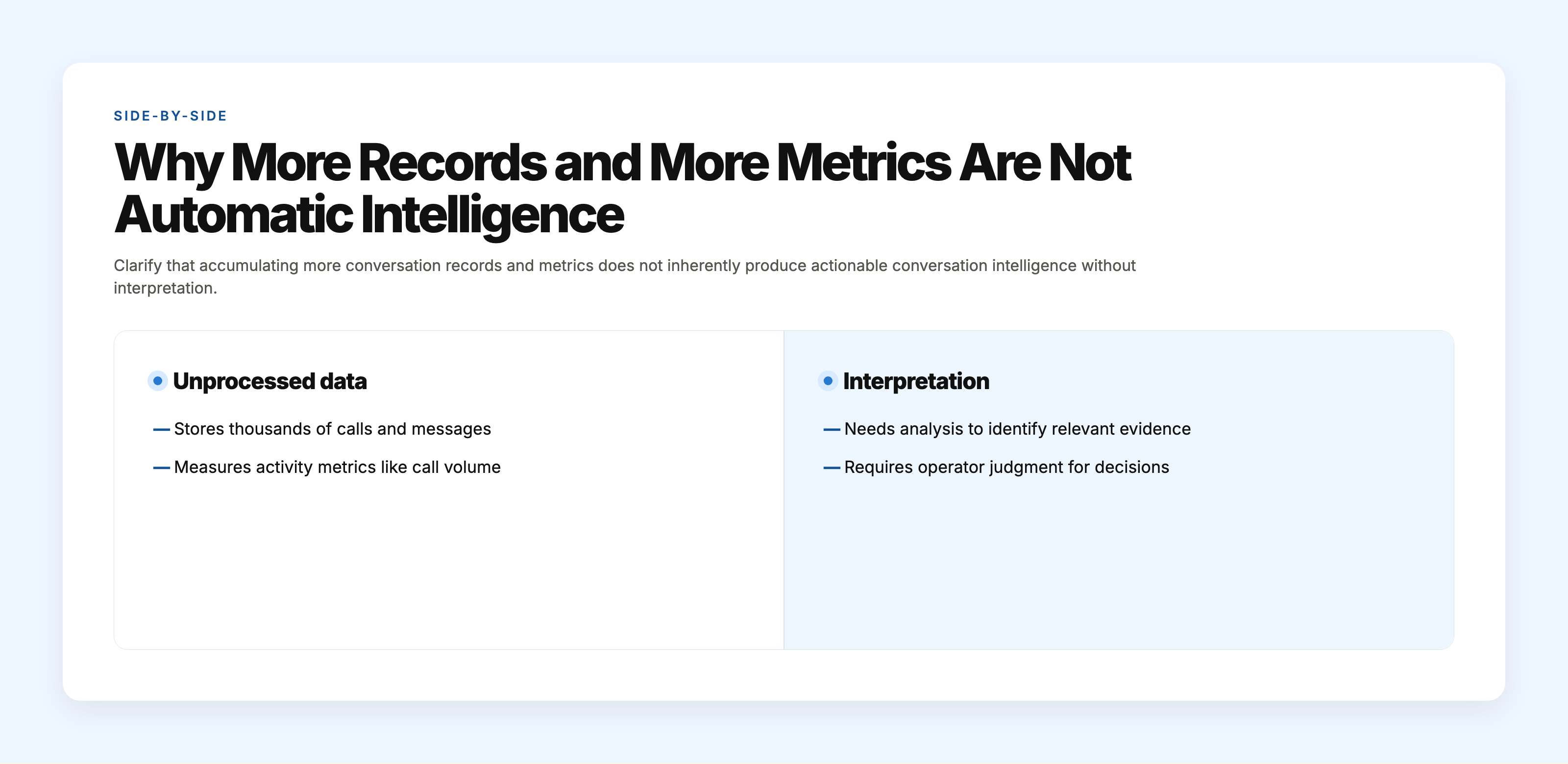
Why More Records and More Metrics Are Not Automatic Intelligence
Retaining more conversations expands the evidence available to a business. It does not determine which evidence is relevant or what decision should follow.
A company can store thousands of calls and messages while continuing to review them only when a customer asks a factual question. That history still has value. It simply is not being used for comparison.
Volume can also hide weak records. A business may retain every call recording but have no consistent way to connect a call to the estimate, job, renewal, or employee action that followed. Another may store text messages while important customer decisions continue to happen on personal phones or in undocumented conversations at the front counter. More records do not eliminate missing context.
Memorable conversations create another distortion. Owners naturally remember the angry complaint, the unusually large sale, and the customer who approved immediately. Those exchanges attract attention because they are vivid. They may say little about the experience of the typical customer.
A commercial cleaning manager may revise an entire proposal process after one property manager objects strongly to a contract term. A review of forty renewals might show that the term rarely creates questions, while an unremarkable description of supply charges causes repeated clarification. The loudest exchange is not always the most representative one.
This bias can affect employees as well. A coordinator who recently handled an angry call may begin overexplaining the same contract term to every customer. Another employee, having never encountered the complaint, may continue using the original explanation. The resulting inconsistency can make later comparisons look as though customer behavior changed when the handling changed first.
Activity metrics have similar limits. Call volume, message count, response time, and conversation length can help a manager understand workload. They do not necessarily show why customers hesitate or which explanation helps them proceed.
A twelve-minute call could be productive or confusing. A two-message exchange could signal clarity or an abrupt end. A fast response may still fail to answer the customer’s actual question. The number describes the activity, not its significance.
Interpretation therefore remains tied to the conversations and the work around them. Operators need to examine the wording, decision stage, service type, employee response, and customer reaction before drawing a conclusion. A question asked before pricing is discussed may not mean the same thing as that question appearing after a customer has received an estimate.
Patterns are prompts for judgment, not substitutes for it.
The operational distinction remains straightforward. Communication records preserve evidence and support follow-through. Conversation intelligence emerges when relevant exchanges are compared in service of a defined decision. Treating those functions as interchangeable leads either to excessive analysis or shallow conclusions.
Calls and messages can contribute more to business decisions when recurring customer behavior is examined carefully. That value still depends on operator judgment, especially when records are incomplete, employee handling varies, or customer intent cannot be known from the exchange alone.
Key Takeaways
- Conversation history verifies what happened in a specific customer exchange.
- Conversation intelligence compares relevant exchanges to identify recurring operational friction.
- A complete record is not automatically an interpreted pattern.
- Repeated customer questions often expose unclear language, inconsistent handling, or missing ownership.
- Patterns support judgment; they do not prove customer intent or justify broad changes on their own.
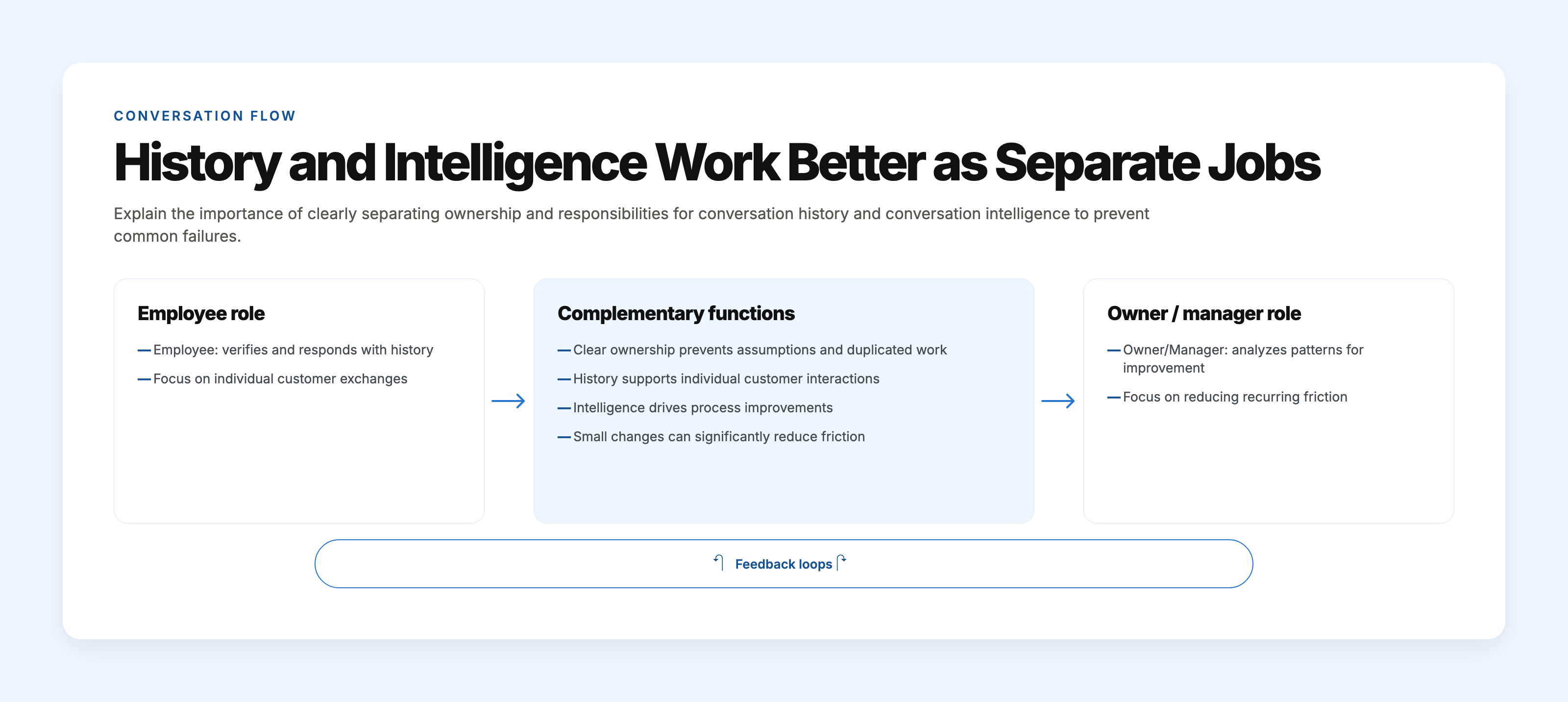
History and Intelligence Work Better as Separate Jobs
Conversation history and conversation intelligence are complementary, but they are not the same thing.
In daily operations, the separation is less about terminology than ownership. An employee answering a customer needs a reliable account of what was already said. An owner reviewing recurring friction needs enough comparable evidence to decide whether the problem belongs to one exchange or to the process around many exchanges.
When those responsibilities remain vague, familiar failures follow. Employees answer the same question repeatedly but assume management already knows. Managers review open work but focus on individual outcomes. Office staff create private notes or saved replies to handle recurring confusion. Customers receive correct answers, yet the extra effort remains built into the process.
The opposite failure is also common. One complaint receives disproportionate attention because it reached the owner directly. A policy changes, employees adapt unevenly, and the business adds work without confirming that the original problem was widespread.
Separating the jobs creates a useful boundary. The factual trail supports the customer in front of the business. The wider comparison supports decisions that will shape later exchanges. Neither needs to become more elaborate than the decision requires.
The most durable improvements are often small. A 14-day free trial can help a team test whether clearer communication context improves the continuity of everyday customer work.
A completion window is added to an estimate. A portal confirmation is made easier to notice. A service inclusion is moved beside the price. An employee who has been answering the same question from memory finally has approved language to use. The change may save only a few minutes at a time, but it also removes uncertainty from the customer’s side and inconsistency from the employee’s side.
A business does not need endless analysis. It needs enough evidence to recognize when customers are repeatedly doing extra work to understand an estimate, policy, schedule, or service description—and enough restraint not to invent certainty where the conversations do not provide it.
A good record prevents the business from guessing about yesterday. A useful pattern prevents it from repeating the same avoidable friction tomorrow.

.svg)