

A customer who once sent detailed replies begins answering with a few words. Instead of volunteering useful information, she waits for direct questions. Before approving the next step, she asks for the date, price, and instructions in writing—even though those points were discussed earlier.
It is easy to read this change as impatience, indecision, or simply a preference for brief communication. Often, it is something more practical. The customer has learned that supplying detail does not necessarily make later interactions easier. She now expects to check the business’s work, repeat important instructions, and keep her own version of each agreement close at hand.
That shift rarely arrives with a formal complaint. It appears through caution. Customers share less, verify more, and take longer to proceed. Their customer conversation history may contain several productive exchanges, but if the relevant details do not influence the next interaction, the customer still feels responsible for carrying the relationship forward.
When Detailed Customers Start Giving Short Answers
Consider a family arranging weekly support for an aging parent. On Monday morning, the daughter spends 25 minutes with a care coordinator explaining that her father has a medical appointment every other Wednesday, becomes confused by unfamiliar arrival times, and cannot hear the doorbell from the back room. She also explains that she lives an hour away and needs advance notice of schedule changes.
The coordinator is attentive and reassuring. How Small Teams Manage Customer Conversations Without Burnout (2026 Guide) demonstrates the operational risks when important details fail to transfer smoothly between roles, which can lead to the very continuous confirmation loops seen here.
She repeats the important points, says she understands why consistency matters, and promises that the team will take the notes into account. The daughter finishes the call feeling that she has explained the situation properly.
Later that afternoon, a scheduler calls to discuss the first visit. The scheduler asks whether Wednesdays are generally available and whether someone will be home to let the care worker in. The daughter repeats the scheduling limitation and door instructions, assuming the first conversation may not yet have reached the scheduling desk.
The next day, another employee sends a proposed schedule that includes the restricted Wednesday. The daughter replies with the limitation for a third time. Her message is shorter now: “As mentioned, every other Wednesday does not work. Please confirm this has been updated.”
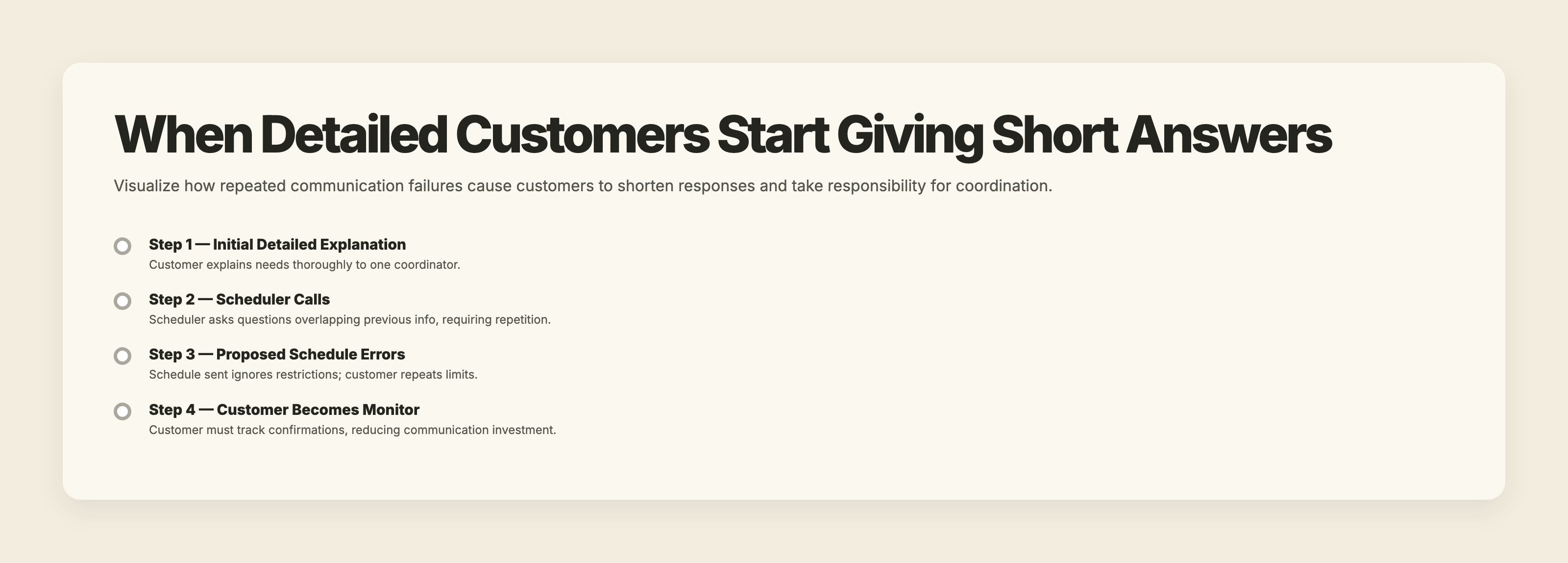
The breakdown is not merely that one detail was overlooked. The daughter has become the person responsible for checking whether the provider can safely coordinate the service. What began as a straightforward intake conversation has turned into a small monitoring job she did not expect to take on.
Inside the office, each employee has been active. The coordinator completed the intake. The scheduler made the call. Another employee prepared the calendar. Yet the work performed in one part of the relationship did not shape the work performed in the next. When the daughter asks for confirmation, someone may describe her as demanding or unusually anxious. From her perspective, confirmation is now necessary.
This is how a cooperative customer becomes guarded. The first repeated question may receive a patient answer. The second creates doubt. By the third, the customer reduces her investment in the conversation. She may continue with the service, but she no longer assumes that giving a complete explanation once will save time later.
Her later messages may look less warm or less helpful. She may stop adding useful context because it feels pointless to explain more than the business will carry forward. Staff may see only the shorter replies. They do not always see the earlier experience that taught her to write that way.
The Extra Work Customers Take On
When relevant details are forgotten, the customer takes on several small administrative jobs. The customer must remember what was said, recognize when an earlier decision has been missed, correct the current employee, and decide whether another written confirmation is necessary. None of these tasks may take long individually. Together, they change the experience of working with the business.
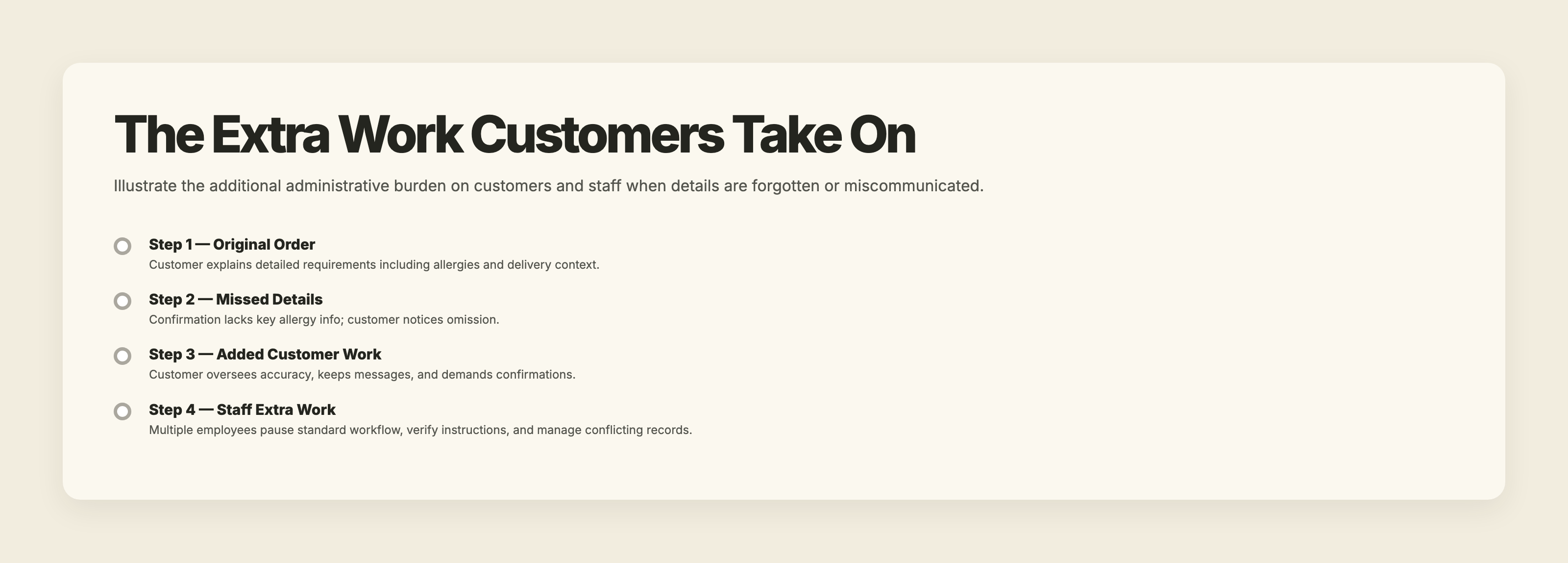
A workplace administrator ordering a catered lunch provides a familiar example. During the initial planning call, she explains that two meals must be prepared separately because of severe allergies, not simply marked as vegetarian. She gives the names of the attendees, asks that the meals be sealed and labeled, and mentions that the lunch will be served in a busy meeting room where substitutions are hard to manage at the last minute.
When the menu confirmation arrives, it lists the head count but not the allergy preparation. She sends a correction. On the morning of the event, the delivery coordinator asks whether there are any dietary requirements.
At that point, the administrator is no longer just buying lunch. She is supervising the caterer’s understanding of the order. She keeps earlier emails open, takes screenshots of the approved menu, and asks which employee will brief the kitchen. Her additional checking is rational because the consequence of an error will appear in front of her colleagues, not in the caterer’s office.
She may also begin to change how she works with the supplier. Instead of making a quick call, she puts every detail in an email. Instead of trusting a verbal acknowledgment, she asks for written confirmation. Instead of accepting a suggested menu, she goes through each item line by line. Those habits can make the customer look difficult from the outside when they are really a response to added risk.
Staff also inherit extra work. The delivery coordinator pauses the dispatch process, contacts the kitchen, and waits for an answer. The kitchen lead searches for the latest instruction. A manager becomes involved because the wording in two messages differs slightly. A routine order now requires several people to verify a point the customer supplied at the beginning.
The conflict between those messages creates another problem. One employee may treat the newest timestamp as authoritative. Another may trust the note entered by the manager. A third may assume the kitchen already confirmed the change. Until someone owns the decision, the order remains technically active but operationally unsettled.
Reliable service is often judged by how much attention the customer can safely stop paying. If customers need to monitor dates, repeat restrictions, and preserve proof of prior decisions, the service may still be completed correctly, but it does not feel easy. That distinction matters because customers often return to providers that reduce their workload, not merely those that eventually produce an acceptable result.
Retelling, Reconfirming, and Reconsidering
The Recall Tax is the practical effort a customer absorbs when information previously supplied does not make a later exchange easier. It tends to appear in three forms: retelling, reconfirming, and reconsidering. These are not formal stages that every customer follows in order. They are observable responses that may overlap during one order or emerge gradually across a longer relationship.
Retelling occurs when the customer provides the same decision, preference, limitation, or instruction again. Failure looks ordinary: “Can you remind me which entrance we should use?” or “Which version did you approve?” The question may be polite and reasonable in isolation. Operationally, however, it reopens a decision that employees may have believed was settled.
Sometimes the customer answers immediately because the detail is easy to retrieve. Sometimes she has to look through old messages while standing in a hallway, sitting between meetings, or trying to finish another task. Details can also shift slightly in the retelling. A restriction that began as “delivery after 1:00 p.m.” becomes “early afternoon,” then appears on a dispatch note as “afternoon delivery.” The business hears a simple answer, but repeated translation has made the instruction less precise.
Reconfirming begins when the customer no longer assumes that a repeated answer will be applied correctly. A property owner arranging seasonal maintenance may restate that the side gate must remain locked because of a dog. After being asked twice, he sends a written note and requests a reply from the crew supervisor. The work expands from sharing an instruction to verifying that the business has understood and distributed it.
He may wait for the confirmation before leaving for work. If none arrives, he may text again that afternoon. Inside the business, a coordinator may be waiting for the crew supervisor, while the supervisor assumes the instruction is already on the work order. The note exists, but no one has confirmed receipt. The customer’s concern remains open because internal ownership remains unclear.
Reconsidering is the most consequential form, though it may be almost invisible. The property owner receives no reply for a day and wonders whether the silence means the instruction has been noted or ignored. He checks another provider’s availability while waiting. Delays create doubt because the customer cannot see the internal checking taking place; silence can feel like a decision not to engage with the concern.
The existing provider may eventually respond and complete the visit without incident. Why Businesses Lose Track of Customer Conversations (And How to Fix It) explains how missing ownership and unclear record status produce gaps between business activity and customer experience that motivate comparison shopping.
Even so, the customer has already compared alternatives. That comparison changes future behavior. The next quote is less likely to be accepted automatically, and the next scheduling delay is judged against an available substitute. The relationship can become commercially fragile before it appears operationally troubled.
The Recall Tax compounds quietly. The business sees one clarification at a time; the customer experiences the accumulated pattern.
What Repetition Costs During an Ordinary Week
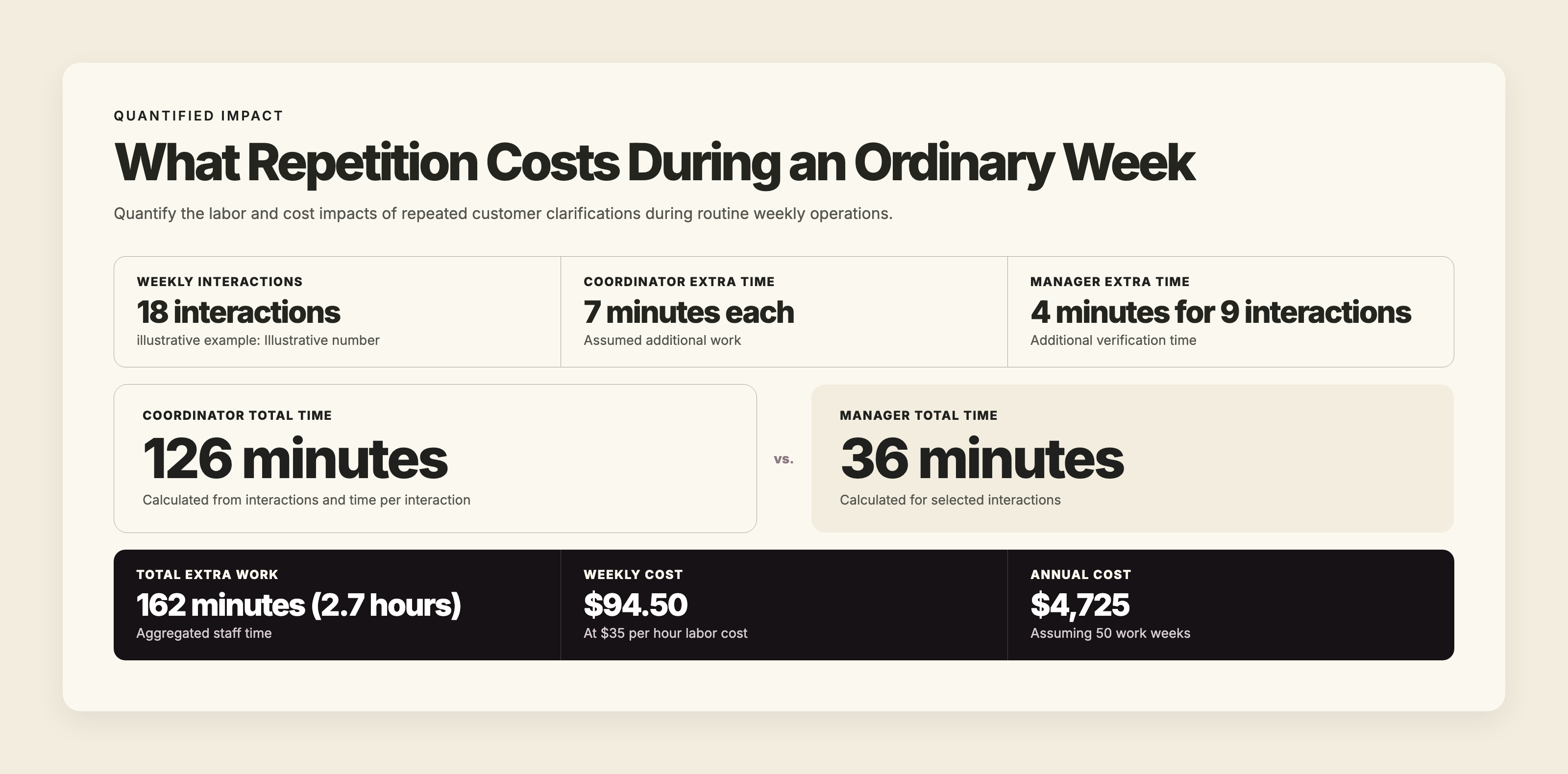
The labor effect can be estimated without assuming that every repeated question causes a cancellation. Take a small catering company handling 18 active inquiries, event changes, and repeat orders each week. Suppose each affected interaction requires seven extra minutes from a coordinator to ask for or verify information already supplied.
That is 126 minutes of coordinator time. If nine of those interactions also require four minutes from a kitchen lead or manager, another 36 minutes are added. The total is 162 minutes, or 2.7 hours. At a blended loaded labor cost of $35 per hour, the direct weekly cost is about $94.50. Across 50 working weeks, that becomes $4,725.
On paper, 2.7 hours can look manageable. In the middle of an ordinary week, it rarely arrives as one neat block of lost time. It arrives as a coordinator reopening an order while the phone rings, a kitchen lead stepping away from prep to search an inbox, or a manager being pulled into a question that should have been settled days earlier. The minutes are scattered, which is one reason they are easy to overlook.
The more important operational effect appears in elapsed time. A coordinator asks the customer to repeat a dietary instruction at 10:30 a.m. The customer is in meetings and replies at 3:15 p.m. The kitchen lead sees the answer after the production schedule has been prepared, so final confirmation moves to the following morning. Seven minutes of staff work has added nearly a day to the customer’s decision cycle.
Now assume only two of the 18 weekly interactions involve an order awaiting final approval, with an average order value of $850. The delay does not mean the company loses $1,700. It does mean those decisions remain unsettled longer. If one repeat customer every two months chooses a simpler alternative for a future event, and the typical order contributes $250 after direct costs, the annual missed contribution is roughly $1,500.
Those numbers are deliberately modest and illustrative. The point is not to attach a dramatic price to every clarification. It is to show the multi-step effect: extra minutes become delayed replies; delayed replies interfere with scheduling; scheduling uncertainty slows approval; slower approval gives comparison behavior more time to develop. The financial impact is often a collection of ordinary delays rather than one obvious lost account.
The Details That Should Make the Next Conversation Easier
Preserving useful customer conversation history does not mean documenting every remark. A customer’s weekend plans, a passing joke, or an unrelated complaint may have no bearing on future work. Trying to retain everything can make employees spend more time writing than serving, while leaving the next person unsure which details affect the job.
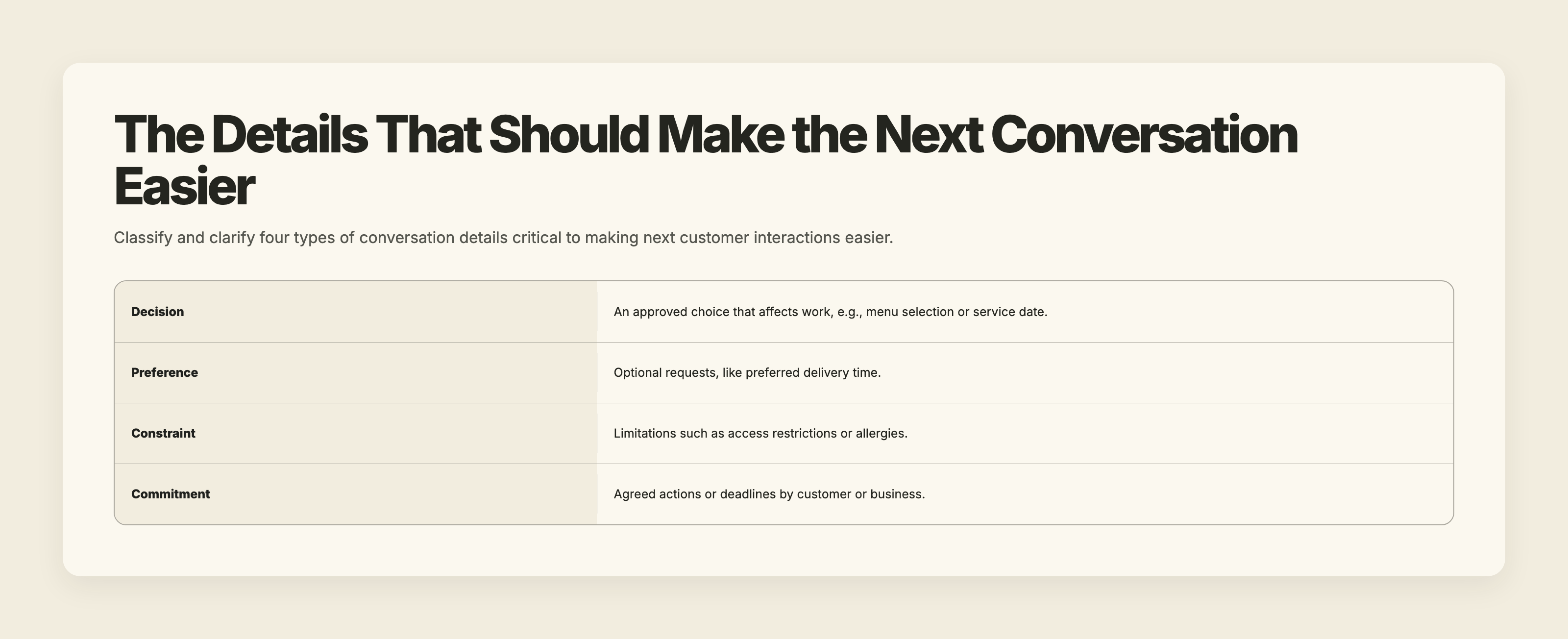
Four kinds of information usually deserve closer attention: decisions, preferences, constraints, and commitments. A decision may be an approved menu or service date. A preference may be a request for afternoon delivery when possible. A constraint could involve building access, allergies, or a narrow availability window. A commitment is something the business or customer has agreed to do by a particular time.
The useful test is forward-looking. If this detail is overlooked, could it change the work, the timing, the customer’s effort, or the next decision? An office manager’s preference for invoices by email may be useful. Her instruction that purchase orders require a department code before payment is operationally important. One makes the relationship smoother; the other can determine whether the invoice is processed at all.
The distinction becomes especially important during handoffs. A coordinator may know that a family is flexible about the first appointment but needs a stable schedule afterward. If only the requested start date travels to scheduling, the deeper constraint is lost. The scheduler sees an open calendar slot and believes the need has been met, while the family expects long-term consistency.
A handoff can fail even when the notes are technically present. A scheduling screen may show a short instruction, but the employee opening it may not know whether it is a preference, a firm restriction, or an old detail that no longer applies. The customer should not have to clarify the importance of the same instruction each time the work changes hands.
Dependable carryover requires more than a note. The person receiving an operationally important detail needs to leave enough context for the next role to understand what it affects. The receiving role needs a visible way to show that the detail has been seen and applied. Without that acknowledgment, both employees can reasonably believe the other person completed the handoff.
Status matters as much as content. A note that says “Wednesday unavailable” may have been firm when it was entered six months ago, temporary during a medical treatment period, or replaced during a later call. If current and outdated instructions look the same, employees either act on stale information or return to the customer for reassurance.
Conflicting records are where informal systems often break. One message says delivery can occur after noon; a later order note says 1:30 p.m.; the dispatch sheet still shows 12:30 p.m. The team needs one current instruction and a clear owner for resolving the difference. Otherwise, three employees can each follow a record faithfully and still produce the wrong arrival time.
Resolution does not always require another customer interruption. Timestamps, the source of the change, the person who approved it, and the work already scheduled may establish which instruction is current. When genuine ambiguity remains, one employee can contact the customer with the conflict already identified: “We have your original noon window and a later change to 1:30. We are holding 1:30 unless that change was temporary.” That is different from asking the customer to reconstruct the entire exchange.
Good carryover is selective rather than exhaustive. Employees need enough detail to act without asking the customer to restart the explanation. They also need to know who owns the detail, whether it is current, where it applies, and whether the next person received it. The aim is not perfect recall. It is to preserve the parts of an exchange that should change what someone does next.
Why Polite Recovery Does Not Remove the Work
A sincere apology can repair the tone of an interaction. It cannot return the time the customer spent repeating an instruction, locating an earlier email, or waiting for confirmation. Businesses sometimes overestimate the effect of a courteous recovery because the customer responds graciously and the immediate issue is resolved.
The customer may say, “No problem,” because she wants the task completed, not because the extra work did not matter. She may be polite to the employee who called while quietly changing how she prepares for future interactions. The issue closes in the business’s queue, but the work moves into the customer’s calendar, inbox, and memory.
Asking for a recap is a common example. “Could you quickly send the details again?” sounds minor, especially when the answer takes only two minutes to write. But the customer must stop, find the information, decide how much to repeat, and wait to see whether the new version is handled correctly. If this happens regularly, the customer learns to keep a separate file because the business cannot be relied upon to carry the details.
Sending more confirmations can create a similar burden. A property maintenance company may send a booking confirmation, an arrival reminder, and a day-of notice. Yet if none reflects the customer’s access restriction, each message creates another checking task. More communication has not reduced effort; it has given the customer three opportunities to search for the same omission.
It can also create internal noise. The customer replies to the first confirmation, phones after the second, and texts when the third still appears unchanged. Those responses may enter different queues. One employee updates the booking, another opens a service ticket, and a third calls the crew. The company has generated multiple pieces of work without establishing which record controls the visit.
Keeping every account with one employee can make the experience feel more consistent, but it is also fragile. When that employee is off, overloaded, or moved to another responsibility, colleagues may hesitate because they cannot see the basis for earlier decisions. One says, “I thought Maya was handling the gate instructions.” Another assumes the crew already received them. The customer encounters the consequences of an internal assumption she could not have anticipated.
Familiarity has limits as well. Employees who know regular customers may remember broad preferences but confuse similar details between accounts. A warm relationship does not make human recall dependable. Politeness, familiarity, and additional messages all have value, but none removes the original burden unless the information supplied actually influences later action.
A Better Test for Customer Conversation History
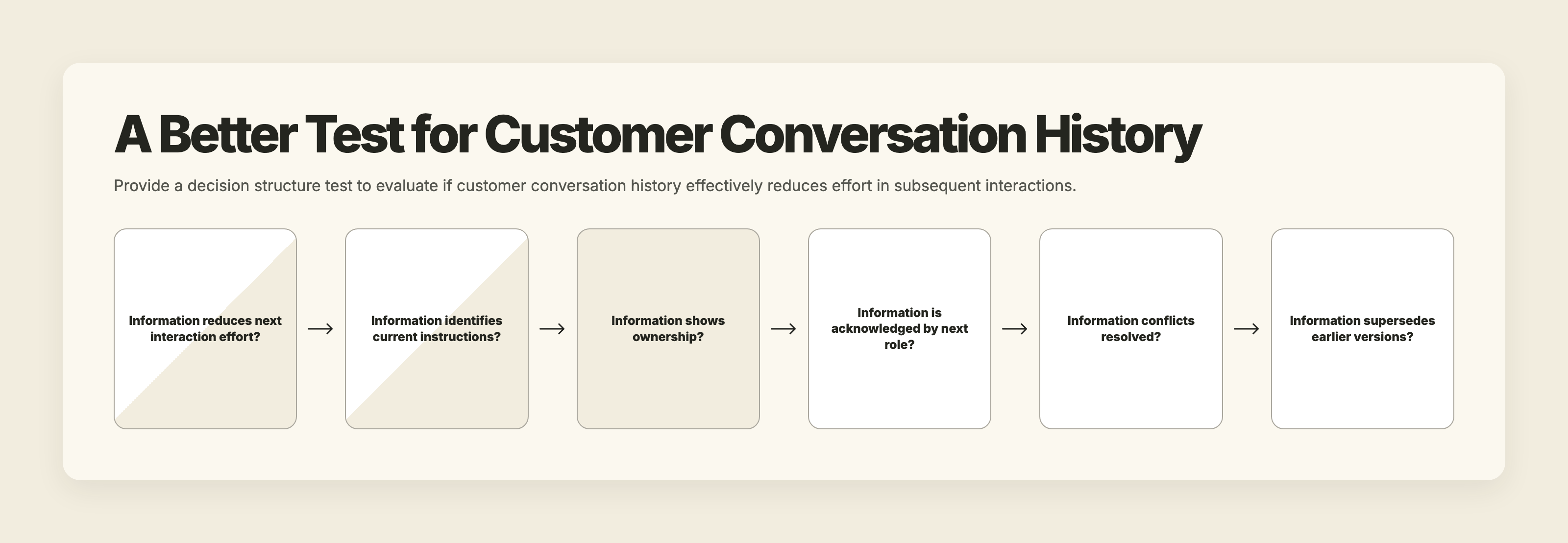
A practical test for customer conversation history is simple: does information already provided reduce the effort required in the next interaction? This question shifts attention away from the volume of communication and toward its effect. A long trail of calls and messages is not useful merely because it exists. Its value appears when the next employee can speak and act with appropriate awareness.
In a repeat catering order, the customer should not need to narrate the entire previous event. The employee does need to know which menu was approved, which requirements remain relevant, what changed, and what still requires a decision. If those points shape the opening of the conversation, the customer can focus on the new event rather than revisiting the old one.
The opening matters. “I see you used the same lunch format last time, and the two sealed allergy meals still apply. Has anything changed for this event?” feels different from asking the customer to begin again with head count, menu, dietary needs, and delivery instructions. The first approach leaves room for the new decision. The second sends the customer back through work she already completed.
Awareness alone is not enough when the record contains uncertainty. If one note describes the allergy meals as individually sealed and another says separately boxed, the employee needs to recognize the conflict before presenting the order as confirmed. A dependable history makes disagreement visible rather than allowing whichever note is easiest to find to become the answer.
The same test exposes the gap between visible work and shared awareness. One employee may update a calendar, another may send an email, and a third may return a phone call. Each action can be completed correctly while no one realizes that the customer is still waiting for one combined answer. Internally, the team appears busy. Externally, the customer experiences silence.
That silence is frequently misread. Staff may believe they are checking details before responding, while the customer sees no sign that anyone is handling the request. After a day or two, the customer asks for an update. If the reply begins by requesting information already supplied, the delay now feels less like careful work and more like disregard.
Inside the team, the missing element is often not effort but ownership. The coordinator believes the manager will confirm the exception. The manager believes the scheduler will reply once the calendar is changed. The scheduler updates the calendar but does not know the customer is waiting for confirmation. Everyone touches the issue; no one closes the loop.
A useful audit trail therefore has to answer practical questions without forcing another search through free text. Which instruction is current? Who supplied or approved it? What work does it affect? Has the receiving role acknowledged it? If two records disagree, who is responsible for settling the difference? A detail that cannot answer those questions may be stored, but it is not yet dependable.
Correction matters too. Customers change their minds, temporary restrictions expire, and employees occasionally record information incorrectly. A corrected instruction needs to replace or clearly supersede the earlier one rather than sit beside it as another plausible version. Otherwise, the history grows while certainty declines.
For a small team, improvement often begins with a narrow operating habit: carry forward the details that influence the next action, identify their status, and make receipt visible. This does not require capturing every sentence. It requires treating prior customer effort as something the next interaction should build upon rather than ask for again.
Where TMMN Fits In
TMMN’s interest in this issue begins with a common operating failure: a useful customer detail exists in one interaction but does not influence the next piece of work. A phone conversation, written message, internal decision, and follow-up may all concern the same need while being handled as separate events. The customer experiences one relationship; the team often encounters several disconnected tasks.
The practical consequence appears at the handoff. A customer explains why a delivery window is firm, but the scheduling note preserves only the time. A coordinator confirms an exception, but the field employee sees the original work order. A manager resolves a conflict in email, while the person returning the customer’s call reads an older account note. The information is present somewhere, yet the next action proceeds without it.
Spoken information makes this problem especially visible. Customers often explain nuance more naturally in conversation: why a timing restriction exists, which part of an order is flexible, or what would prevent them from proceeding. A brief written entry may capture the date while losing the condition attached to it.
Spoken Touch represents a future direction within that operating problem: helping useful verbal detail contribute to later spoken and written exchanges without treating every conversation as material to preserve indefinitely. It is not a substitute for employee judgment, clear ownership, or confirmation between roles. Even well-captured information can fail if no one knows whether it is current or who is responsible for acting on it.
The present principle is narrower and more operational. Decisions, preferences, constraints, and commitments need to remain connected to the work they affect. Critical details need visible status. Changes need to supersede older instructions. A receiving employee needs to know when a handoff requires acknowledgment rather than silent assumption.
The goal is not to gather more information for its own sake. Excess collection creates its own burden for employees and can obscure the few details that should affect service. The useful measure is whether the team can identify what matters now, apply it to the current task, and correct it when circumstances change.
For the customer, the result is straightforward. The next conversation begins further ahead. The family arranging care can discuss a schedule change without restating the father’s needs. The workplace administrator can adjust the lunch count without reopening the allergy discussion. The property owner can approve the seasonal visit without checking the gate instruction again.
Key Takeaways
- Customers become guarded when prior detail fails to reduce later effort.
- Retelling often becomes reconfirming, then quiet comparison with alternatives.
- Stored information is not dependable until its status, ownership, and effect are clear.
- Polite recovery resolves the exchange but does not remove the customer’s added work.
- Reliable service allows customers to stop acting as the business’s memory and quality check.
Conclusion
Customers decide how much effort to invest based on what prior experience has taught them. A 14-day free trial can help a team test whether clearer communication context improves the continuity of everyday customer work.
If details are carried forward, they continue sharing freely and proceed with less hesitation. If they repeatedly have to retell, reconfirm, and supervise, they become cautious or choose a provider that appears easier to work with.
The hidden cost of forgetting is not only that the business asks the same question twice. It is that the customer gradually becomes the memory, quality check, and handoff system the business lacks. Remembering is not about preserving every detail. It is about ensuring that the details that matter reduce the work required to continue the relationship.

.svg)