
A Communication Breakdown Explained
Silence is rarely neutral in business communication — response time shapes how customers feel about your brand before a word is even exchanged. Research consistently shows that delayed responses significantly lower customer trust and satisfaction, particularly during the first interaction. When a customer reaches out and doesn’t hear back, they don’t assume you’re busy. They assume something is wrong.
Not always immediately. But the clock starts ticking the moment a message goes unanswered.
This article breaks down what actually happens when response times slip, why delays create outsized damage, and how businesses can fix the problem without hiring more staff or adding chaos to their workflows.
The First Breakdown: Expectations Are Set Instantly
Response time is judged against what the customer believes should happen next.
Customers don’t measure responsiveness in isolation. They measure it against the expectation your channel creates. The moment someone reaches out, they form a mental timeline for what “reasonable” looks like. If you miss that window, the customer doesn’t think, “They’re busy.” They think, “This might not be handled well.”
Why do expectations form so quickly
Every inbound touchpoint carries an implied promise: I contacted you, so you will acknowledge me.
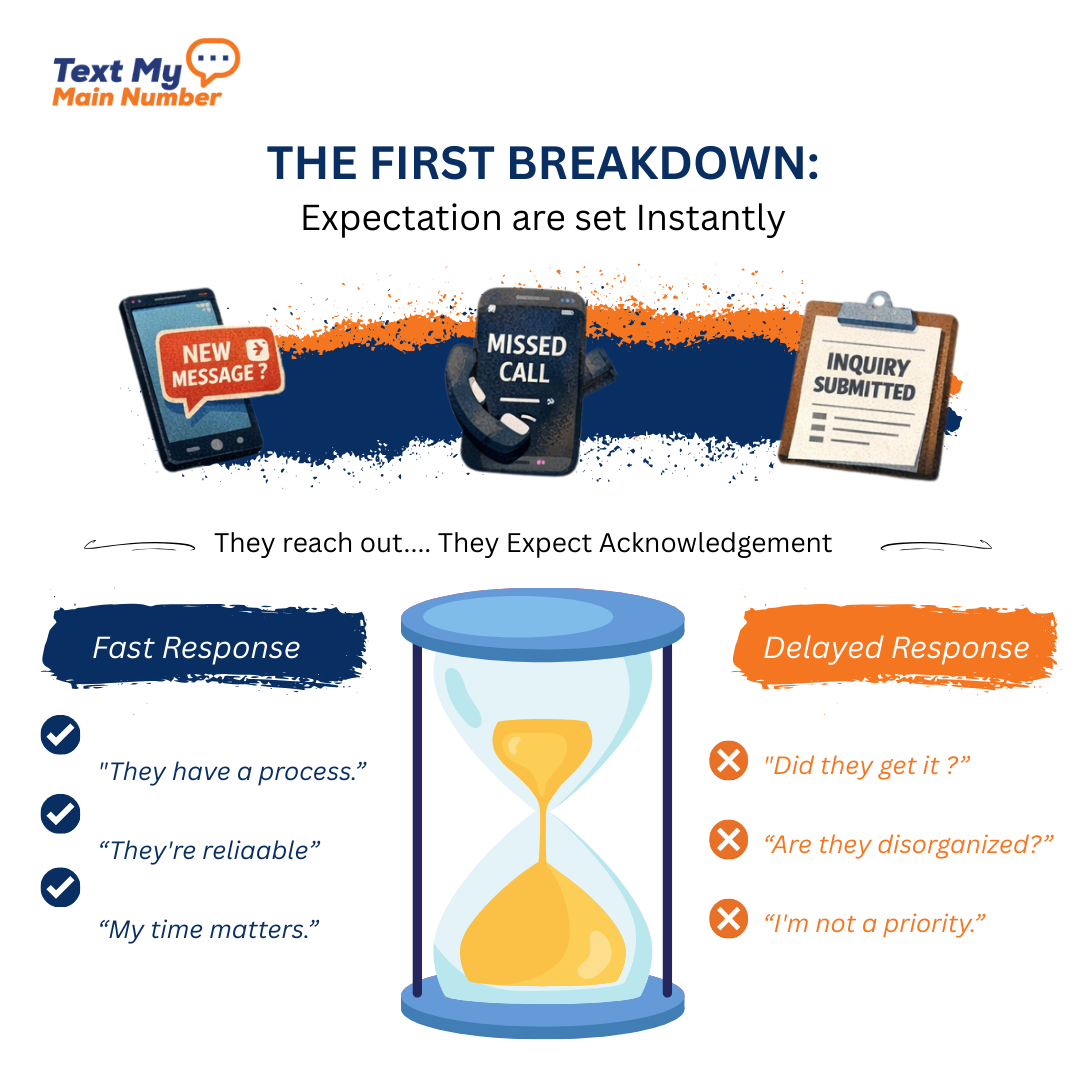
That promise is triggered by:
- A text message to your business number
- A missed call where they expect a callback or voicemail follow-up
- A form submission for an inquiry, booking, or quote request
Each one signals a different level of urgency, but they all create the same baseline expectation: someone will respond.
What customers interpret from your response speed
How quickly you acknowledge a customer determines how your business is perceived before you say a single meaningful word.
A fast acknowledgment communicates:
- Organization: “They have a process.”
- Reliability: “They won’t drop the ball.”
- Respect: “My time matters here.”
A delayed or missing acknowledgment communicates the opposite:
- Disorganization: “I may have to chase them.”
- Uncertainty: “Did they even get my message?”
- Low priority: “They’re not paying attention.”
This happens even when the delay is unintentional.
The most important distinction: acknowledgment vs resolution
This is where many businesses misunderstand the problem. Customers are not always demanding a full answer immediately. Most of the time, they just need confirmation that their message was received and will be handled.
That’s why this breakdown hits hardest in SMS and phone calls:
- These channels feel direct and personal
- Customers expect a quick signal that the message landed
- Silence feels like neglect, even if you respond later
When expectation is created instantly, and acknowledgment doesn’t follow, trust begins to erode before a real conversation even starts. This pattern closely mirrors why many businesses lose customers to missed messages in the first place, as explained in Why Small Businesses Lose Customers to Missed Messages (And How to Fix It).
How This Plays Out Across Industries

The impact of delayed responses depends on context, but the outcome is consistent: lost trust.
Communication breakdowns don’t look the same in every industry, but they follow the same pattern. Choosing the right channel for each interaction plays a major role in how quickly customers feel acknowledged, which is why many teams compare texting and calling strategies as outlined in Business Texting vs Phone Calls: How to Use Both Effectively. When customers reach out and don’t hear back, uncertainty fills the gap. How that uncertainty affects the relationship depends on what the customer is trying to accomplish — and how much is at stake.
Below is how slow or missing responses commonly affect different types of businesses.
Real Estate
Response time determines who earns the conversation
In real estate, speed is not a competitive advantage. It is a baseline expectation.
A buyer who texts about a listing is often comparing multiple options at the same time. That message signals active interest and a narrow window of attention. When an agent acknowledges the inquiry quickly, the conversation moves forward. When they don’t, the buyer assumes the agent is unavailable or disengaged.
In practice, this means:
- A delayed acknowledgment often results in the buyer contacting another agent
- The original agent may never know the opportunity was lost
- Even a short delay can end the conversation before it begins
The buyer rarely follows up to ask why there was no response. They simply move on.
Healthcare and Dental Practices
Silence increases anxiety and erodes confidence
Patients reach out to healthcare providers with different levels of urgency, but almost always with some degree of concern. Whether the question is about scheduling, billing, or post-visit instructions, the expectation is reassurance and clarity.
When messages go unanswered:
- Patients may worry their request was missed
- Anxiety increases, especially for post-treatment concerns
- Patients attempt to reach the office again through calls or emails
Over time, this pattern leads to frustration. A missed or delayed response can feel dismissive, even when the staff is simply busy. The result is lower patient satisfaction, more inbound calls, and negative reviews that reflect communication issues rather than clinical care. For appointment-based practices, timely acknowledgment isn’t just courteous — it directly helps reduce dental no-shows and follow-up confusion.
Service Businesses
Uncertainty damages the customer experience
For service-based businesses such as home repair, maintenance, or installation, timing is central to the customer experience. Customers want to know when someone will arrive, whether a job is confirmed, or if a change request has been seen.
When messages are not acknowledged promptly:
- Customers assume delays or scheduling issues
- They question whether the business is organized
- They may reach out repeatedly through multiple channels
For example, a homeowner waiting for a technician who hasn’t received confirmation may cancel or reschedule unnecessarily, simply because they did not receive a clear response.
The lack of acknowledgment creates confusion that could have been avoided with a simple message.
Hotlines and Support Services
Delayed responses carry higher stakes
In support and hotline environments, response time can carry serious emotional or practical consequences. People reaching out are often seeking immediate help, guidance, or reassurance.
In these situations:
- Silence can feel like abandonment
- Even a short delay may discourage further outreach
- Trust can be lost in moments that require care and attention
A brief acknowledgment, even if full support follows later, signals that someone is present and listening. Without that signal, the impact of silence can be profound.
The Hidden Cost: Internal Chaos
Delayed responses create operational friction long before customers complain
Slow or missed responses don’t just damage the customer experience. They quietly disrupt internal operations.
When businesses lack clear communication workflows, teams are forced into reactive mode. Messages arrive through multiple channels. Ownership is unclear. Follow-ups depend on memory instead of process.
Over time, this leads to predictable breakdowns:
- Messages are overlooked or buried
- Follow-ups are inconsistent or forgotten
- Multiple staff members respond differently to the same issue
- Some customers receive duplicate replies, while others receive none
What initially appears to be a customer service failure is often a structural one. The issue isn’t effort or intent. It’s the absence of systems that support consistent communication at scale.
This is not a people problem.
It is a process problem. Over time, these gaps result in missed customer messages that quietly damage trust and revenue without triggering obvious complaints.
Why “We’ll Respond Later” Isn’t Enough
Many businesses operate under the assumption that a delayed response can be repaired as long as a complete answer eventually arrives. In practice, this rarely holds true.
Customers don’t measure responsiveness by how thorough the final reply is. They measure it by whether their message was recognized in the first place.
A short acknowledgment:
- Confirms the message was received
- Reassures the customer they haven’t been ignored
- Sets expectations for next steps
This is where communication breakdowns most often occur. Businesses plan to respond once time allows, assuming the delay will be understood. Customers, however, experience the gap differently. Without acknowledgment, the absence of a response feels immediate and absolute, creating uncertainty that can undermine trust before any resolution is delivered.
By the time a detailed reply arrives, the customer’s confidence in the business may already be diminished — not because the answer was insufficient, but because the silence suggested inattention or disorganization.
How Smart Businesses Prevent the Breakdown
Preventing communication breakdowns does not require constant availability or immediate resolution. What it requires is clarity. Smart businesses recognize that acknowledgment and resolution serve different purposes, and they treat them accordingly.
Instead of waiting until a full response is ready, they acknowledge messages as soon as they are received. This simple confirmation reassures customers that their inquiry has not been missed and sets the stage for a more thoughtful follow-up. At the same time, clear expectations are established around when a detailed response will arrive, removing uncertainty from the process.
Consistency also plays a critical role. By using well-written templates for common situations, teams can respond quickly without sacrificing a professional, human tone. Automated after-hours replies further ensure that no message goes unanswered, even when staff is unavailable.
Together, these practices create a structure where silence once existed. Customers feel informed and respected, while teams remain focused and effective rather than overwhelmed.
Where Text My Main Number Fits In
Turning delayed responses into clear, dependable communication
This is the exact communication gap Text My Main Number is built to address.
Most businesses don’t struggle because they ignore customers. They struggle because their tools don’t support timely acknowledgment, visibility, and consistency as message volume grows. Texts, missed calls, and inquiries arrive throughout the day, but without structure, it becomes easy for messages to go unanswered longer than intended.
Text My Main Number brings order to this process by separating acknowledgment from resolution and giving teams the tools to manage both effectively.
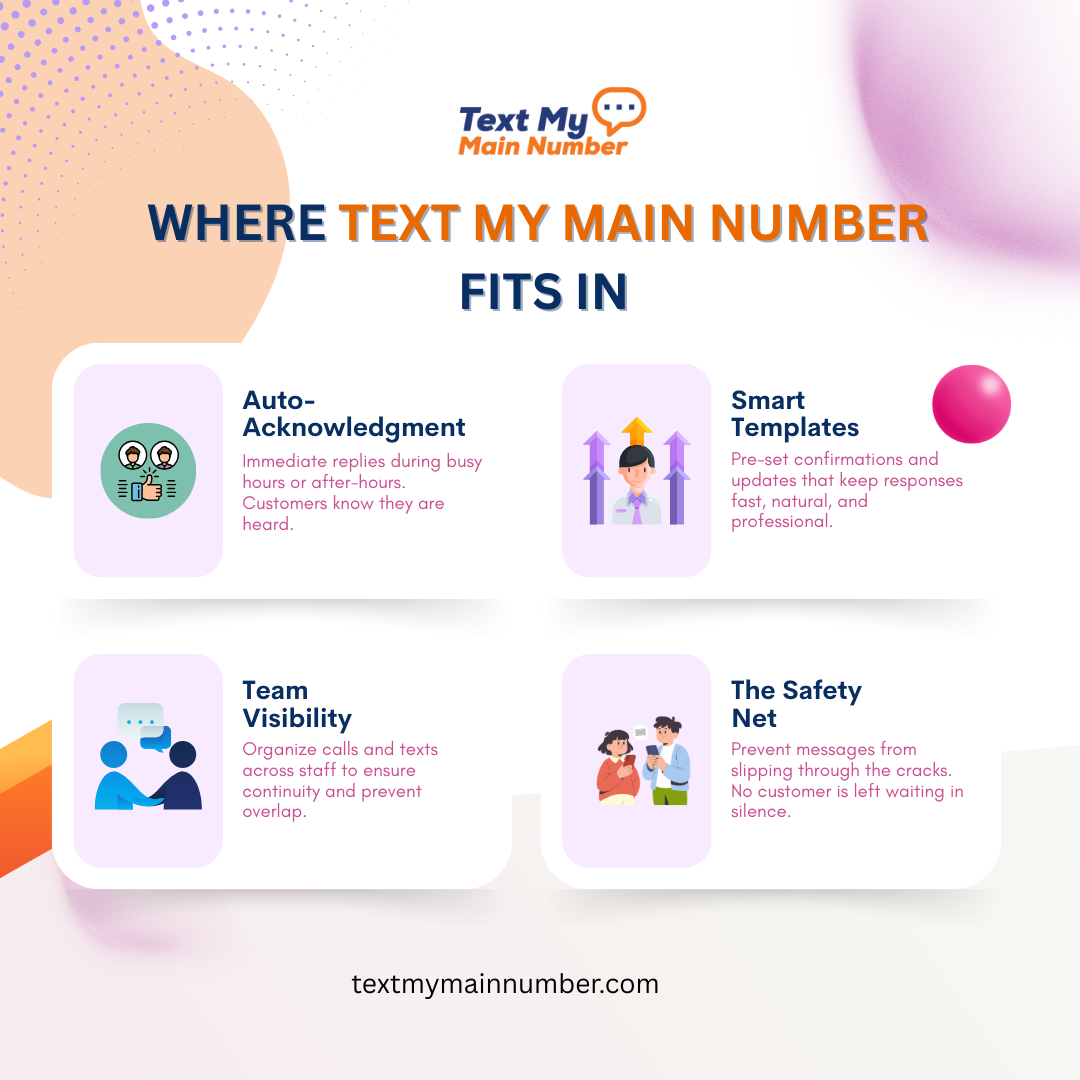
With TMMN, businesses can:
- Acknowledge incoming texts automatically during busy hours or after hours, so customers immediately know their message was received and will be handled
- Use message templates for common situations such as confirmations, follow-ups, and updates, keeping responses fast while still sounding natural and professional
- Keep texting and calling organized across teams, ensuring visibility and continuity as multiple staff members handle customer conversations
- Prevent messages from being missed or forgotten, so no customer is left waiting in silence
These features work together to create clarity instead of urgency. Customers receive reassurance right away, while teams gain the flexibility to respond thoughtfully rather than reactively.
The goal isn’t to reply faster at all costs.
It’s to make sure customers never feel ignored, even when a full response takes time.
That shift is what turns communication into a reliable part of the customer experience rather than a recurring point of failure.
The Real Takeaway
When customers don’t hear back, the impact goes beyond frustration. Silence signals uncertainty, and uncertainty quickly turns into lost confidence. Even strong services and good intentions can be undermined by missed or delayed communication.
Communication is not a supporting function. It is part of the service itself. Every acknowledgment, follow-up, and response shapes how reliable and professional your business feels.
If you want to prevent these breakdowns without adding pressure on your team, Text My Main Number offers a 14-day free trial. It’s a practical way to bring structure to business texting and voice workflows, reduce missed messages, and ensure customers always know they’ve been heard—without changing how you already operate.

.svg)