Most communication problems inside growing businesses are not caused by a lack of responses. They come from a lack of ownership.
A customer sends a text message. Someone replies. An email comes in. Another employee responds. A voicemail gets forwarded internally. A note gets left in a shared inbox. From the inside, it feels like progress because activity is visible.
But activity and accountability are not the same thing.
This is where businesses start struggling to track customer conversations in a meaningful way. The issue usually is not message storage. It is ownership continuity. Who owns the next move? What still needs to happen? Did the conversation actually reach resolution?
Those questions matter more as the business grows.
Nobody intentionally ignores the customer. Nobody decides to create confusion. The breakdown usually comes from keeping communication handling informal after the business has become more complex.
At small volume, memory can carry a lot. A receptionist remembers which customer called earlier. A technician follows up because the issue stays top of mind. An owner notices something unresolved while reviewing messages late at night.
That structure works longer than most businesses expect.
Until it doesn’t.
More employees get involved. More inbound channels appear. More conversations require coordination instead of individual handling. Communication starts moving through the business rather than staying with one person from beginning to end.
At that point, customer conversations stop being “messages” and start becoming operational work.
And operational work requires ownership, tracking, visibility, and measurable closure. Businesses that reach this stage often realize that disconnected channels create operational blind spots, which is why communication continuity becomes increasingly important as teams grow across texting, calls, email, and internal coordination through From Texting to Full Conversations: How Businesses Scale Communication Over Time.
Customer Conversations Become Operational Work Faster Than Most Businesses Expect
Many businesses assume communication problems begin once volume becomes overwhelming. In reality, the pressure usually starts much earlier.
A company may only be handling 20 to 40 inbound customer conversations per day when the first coordination issues appear. That volume does not sound excessive on paper. The problem is that not every conversation ends with a single reply.
Some conversations require scheduling. Others require internal clarification. Some need technician callbacks. Others need approvals, pricing confirmation, rescheduling, escalation, or follow-up after service completion. One customer interaction can easily become five separate touchpoints across multiple employees.
This is where informal communication handling starts breaking down.
A customer sends a text asking whether a technician is still arriving that afternoon. The receptionist replies that she will check with dispatch. Dispatch messages the technician. The technician is driving between jobs and responds later. Meanwhile, another employee answers an unrelated billing email from the same customer. By the end of the day, nobody has clearly owned the original scheduling concern.
From the customer’s perspective, the business responded multiple times. The actual issue, though, remained unresolved.

That gap matters more than many businesses realize.
Response activity is easy to count. Customers are measuring something else. They are watching whether the business appears coordinated, aware, and in control. That perception gap is often where businesses begin losing trust quietly because customers interpret fragmented handling as a sign the company is already struggling operationally, which becomes increasingly common in situations described throughout Why Most Businesses Lose Track of Customer Conversations (And How to Fix It).
As teams grow, partial handling becomes dangerous because conversations begin moving through the company in fragments instead of progressing through a clear lifecycle. Employees respond to the portion directly in front of them rather than to the full context surrounding it.
The failure rarely announces itself clearly. More often, the business starts feeling heavier to operate. Employees spend more time checking statuses, re-reading threads, and confirming what already happened.
Customers repeat themselves more often. Internal clarification increases. Follow-ups reopen previously “handled” issues. Managers spend more time checking statuses manually because ownership remains unclear. Employees begin mentally tracking unresolved items instead of trusting a process.
In many businesses, a manager eventually reaches a point where they are checking the inbox, reviewing the call log, and searching internal notes simply to figure out whether one customer issue is still open.
Pressure builds before anyone labels it a communication problem.
Communication breakdowns rarely look dramatic at first. They usually look like ordinary busyness.
Most communication problems do not begin with negligence. They begin with conversations slowly outgrowing the systems surrounding them.
That is why many businesses miss the shift early on. The phones are still ringing. Messages are still getting answered. Work is still moving. Employees still feel productive.
Meanwhile, coordination is already becoming dependent on memory, inbox habits, and whoever happens to notice the problem first.
Why Fast Responses Still Lead to Poor Customer Handling
A fast reply can create the appearance of efficiency while adding instability behind the scenes.
This happens often in businesses trying to improve responsiveness without improving coordination. Employees are encouraged to answer quickly, reduce wait times, and keep inboxes moving. On the surface, those goals sound reasonable. Customers generally appreciate responsiveness.
Trouble starts when speed becomes disconnected from ownership.
A customer contacts a business asking whether an installation appointment can be moved from Thursday to Friday morning. The employee replying wants to be helpful, so she quickly responds that she will “take care of it.” The message feels responsive. The customer feels acknowledged.
But no formal assignment occurs.
The scheduling team is not clearly notified. The calendar is not updated immediately. Another employee later sees the original appointment and assumes it remains unchanged. Thursday morning arrives. The technician appears at the original scheduled time. The customer is frustrated because they believed the issue had already been resolved the day before.
From the business perspective, someone responded quickly. From the customer perspective, the business failed operationally.
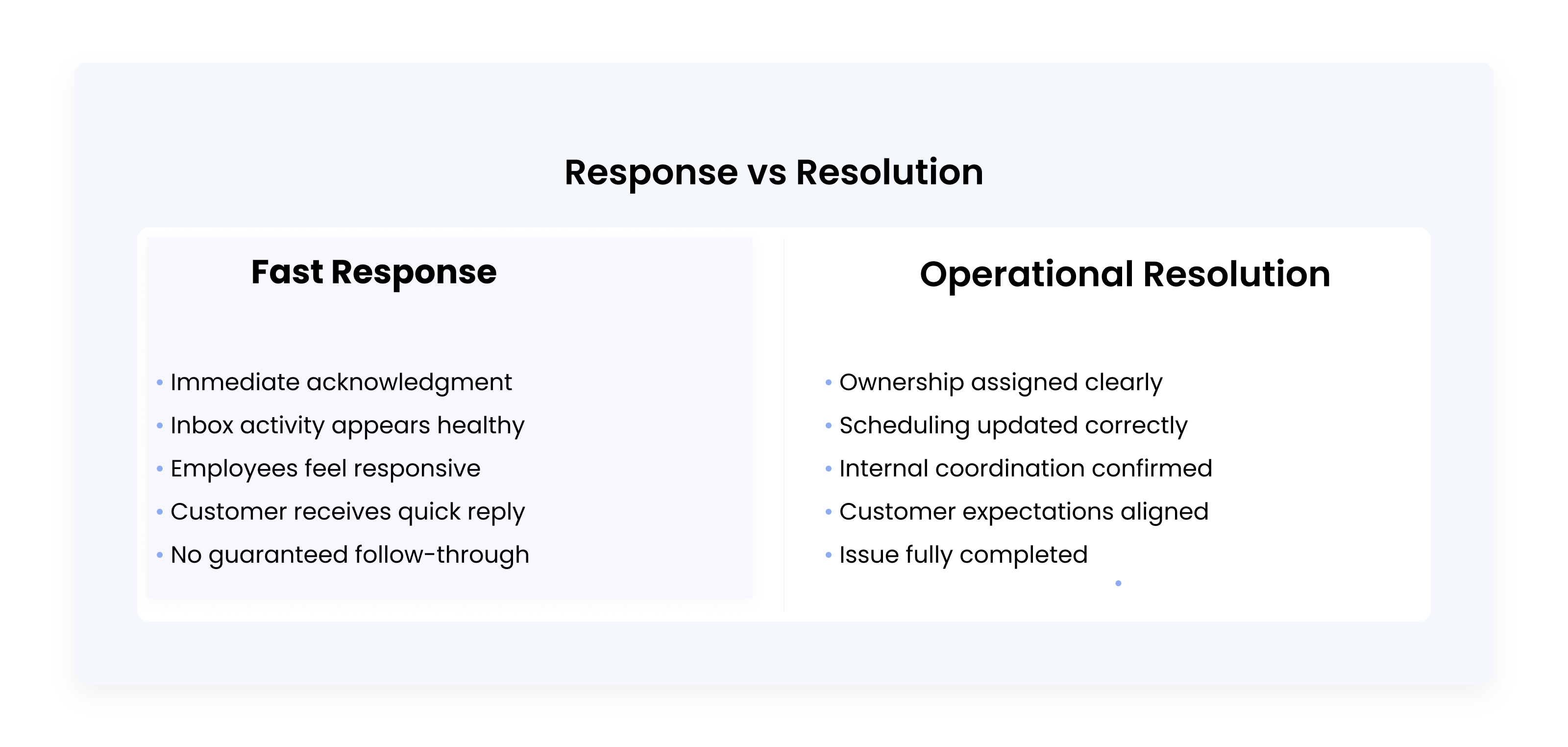
One of the most common communication misconceptions inside growing companies is that response activity equals resolution progress.
Customers are not only evaluating whether someone answered them. They are evaluating whether the business appears coordinated enough to follow through consistently.
This matters more as customer expectations change. People increasingly assume businesses maintain continuity across channels and employees automatically. If they send a message in the morning and call later that afternoon, they expect the second employee to already understand the situation.
Silence creates doubt. Inconsistent continuity creates a different concern: maybe the business is not organized internally.
That concern changes customer behavior quickly, even when customers never say it directly. Some double-check timelines. Others follow up repeatedly “just to make sure.” Some stop fully trusting verbal confirmations.
In many cases, the customer opens another browser tab and starts checking a competitor before the original issue is even resolved.
That moment matters more than most businesses realize.
Operational trust usually erodes long before a customer formally leaves.
Very few customers explicitly announce that internal inconsistency lowered their confidence. More often, response patterns change. They become harder to close, slower to reply, or less willing to commit quickly.
Many businesses experience the added workload without seeing the source. Poor coordination creates repeat-contact loops. Customers reach back out because previous handling did not create confidence. Employees spend additional time reconstructing context that should already exist.
The conversation itself becomes more expensive every time continuity breaks. In many businesses, these breakdowns start long before leadership recognizes the communication issue itself because unresolved follow-ups, disconnected updates, and scattered handling slowly compound into larger operational friction, similar to the patterns discussed in What Happens When Your Team Grows Without a Communication System.
The Difference Between Visibility and True Ownership
Shared visibility is not the same thing as accountability.
Many communication systems begin failing at that exact point.
Businesses often assume that if multiple employees can see incoming conversations, the communication problem has been solved. Shared inboxes, team chat channels, email forwarding chains, and internal notes all create visibility. Everyone can technically access the information.
Visibility without ownership usually creates ambiguity instead of control.
One employee assumes another person already handled the issue. A manager sees the conversation but expects the receptionist to follow up. The receptionist believes dispatch already contacted the customer. Dispatch assumes the issue was resolved earlier because someone responded initially.
Nobody intentionally ignores the customer.
Responsibility was simply never attached clearly to the conversation itself.
Activity is easy to see. Ownership is where things usually disappear.

The risk increases when conversations move between departments. A sales inquiry may require scheduling. Scheduling may require technical clarification. Technical clarification may require billing adjustments. Each handoff introduces another opportunity for ownership dilution.
A common internal moment inside growing businesses sounds something like this:
“I thought you already handled that.”
Usually, that sentence surfaces late in the day while a customer is still waiting on an answer, a technician is already leaving for the evening, and nobody can immediately explain where the request stalled.
That single moment explains a surprising percentage of customer communication failures.
Not because employees are careless. Usually because the structure never clearly defined who owns the next action, who owns final resolution, and when a conversation is officially considered complete.
Without structured ownership, teams begin leaning heavily on memory and internal assumptions. Employees carry unresolved issues in their heads while also managing new inbound conversations. Managers manually check statuses because system-level clarity does not exist consistently.
After enough repetition, workarounds start forming around the system itself. Sticky notes appear on monitors. Internal texts replace formal updates. Certain employees become “the person who usually knows what’s going on.”
That is usually a sign the operating structure is already straining.
Employees spend increasing amounts of energy reconstructing conversation history instead of moving work forward. Teams become reactive because they keep re-verifying what already happened instead of working from reliable continuity.
The customer experiences the result as inconsistency.
One employee sounds informed. Another asks them to repeat details. A third promises follow-up but lacks prior context. Eventually, the interaction starts feeling disconnected even when the business is actively trying to help.
Most customers will tolerate occasional delays. What creates frustration faster is the sense that nobody truly owns the outcome from beginning to end.
What Happens When Conversations Move Between Employees Without Structure
Communication handling usually breaks at the handoff point.
Not during the first response. Not during intake. During transition.
Consider a small HVAC company handling roughly 35 inbound customer conversations daily across phone calls, text messages, website inquiries, and email.
At 9:15 AM, a customer texts asking whether someone can inspect a failing unit before the weekend because temperatures are rising. The receptionist replies quickly and says she will coordinate with scheduling.
At 10:30 AM, the dispatcher reviews the technician calendar and notices Friday is heavily booked. He plans to discuss options with the owner later that afternoon.
At 11:45 AM, another employee receives a voicemail from the same customer asking whether the inspection request was confirmed. That employee forwards the voicemail internally but assumes scheduling already handled the earlier text exchange.
At 2:10 PM, the owner becomes occupied with an equipment issue at another job site. The scheduling discussion never happens.
The next morning, the customer receives no update.

By Friday afternoon, the customer contacts another provider.
The business does not just lose a conversation. It potentially loses a seasonal inspection opportunity, future maintenance revenue, and a customer who may have needed recurring service twice a year for the next several years.
Nobody intentionally ignored the request. Multiple employees interacted with the conversation. Internal activity occurred throughout the day. Continuity from assignment through closure never held.
That is the real breakdown.
Growing businesses often underestimate how much friction accumulates during internal transitions. Every handoff creates a small opportunity for delay, ambiguity, assumption, or priority drift.
Partial progress creates false confidence internally. Employees feel like movement occurred because conversations were acknowledged. The customer, meanwhile, is still waiting for proof that someone actually owns the resolution.
Duplicate effort follows.
One employee rechecks prior notes. Another reconstructs context from text messages. Someone searches email history. A manager asks for status updates manually. The business starts spending additional labor simply trying to understand where conversations currently stand.
Communication systems become increasingly expensive when clarity depends on employee memory rather than structure.
The businesses that manage this transition best usually stop treating customer conversations as isolated messages. They begin treating them as trackable workflows with ownership states, next actions, escalation paths, and closure confirmation.
That shift changes everything.
Once conversations become operational work, informal coordination stops scaling reliably.
The Hidden Labor Cost of Reopened Customer Conversations
Many businesses underestimate how much labor disappears into repeated communication cycles.
A conversation that should have been resolved once often re-enters the business multiple times because ownership, tracking, or closure remained incomplete.
Cost builds over time in ways many teams do not initially notice.
Consider a service company receiving approximately 40 inbound customer conversations daily. Assume 15% of those conversations require reassignment, clarification, or repeat follow-up because the original handling lacked continuity.
That equals six conversations per day experiencing drift.
Now assume each reopened conversation creates an additional 10 minutes of labor between employees reviewing notes, rechecking details, contacting customers again, clarifying internally, or reconstructing context.
The result is roughly 60 extra labor minutes daily.
Over five business days, that becomes five additional hours weekly spent managing communication inefficiency rather than productive work.
Across a month, the same pattern can easily become 20 to 22 hours of duplicated labor.

At even a modest blended labor cost of $30 to $45 per hour between office staff, technicians, dispatch, and management oversight, the business may lose $600 to nearly $1,000 monthly simply from communication rework.
But the impact rarely stops there.
Some reopened conversations involve sales opportunities. Others involve existing customers evaluating reliability. Delays create hesitation. Repeated clarification lowers confidence. Customers begin reading inconsistency as a signal of future service inconsistency.
One delayed scheduling issue may not lose a customer immediately. Several uncertain moments, though, can push customers into comparison behavior.
A customer waiting on a callback may search another provider “just in case.” A lead who receives inconsistent answers may delay commitment. A frustrated client may stop recommending the business even if they technically remain a customer.
Even one inbound lead per week going cold because nobody fully owned follow-up can create significant opportunity leakage over time.
The labor cost is measurable. The lost confidence usually is not.
Payroll pressure is often easier to spot than the communication rework sitting underneath it.
This is why communication inefficiency becomes difficult to measure accurately. Businesses see the visible workload but not the operational drag surrounding it. Employees appear busy. Conversations remain active. Customers are still interacting.
Yet the same energy keeps getting spent repeatedly on issues that should already be resolved.
After enough time, teams begin adapting around the inefficiency instead of fixing it. Rework becomes part of the normal workload. Managers start expecting follow-up failures. Employees automatically double-check one another because nobody fully trusts the system flow.
That normalization becomes dangerous because businesses often try solving the pressure by adding more employees before fixing ownership structure itself. More employees increase handling capacity, but they also increase coordination complexity. Without structured tracking and closure systems, growth can accelerate confusion instead of stabilizing it.
The problem is rarely just communication volume.
The larger issue is unresolved continuity.
A Four-Layer Framework for Assigning, Tracking, and Closing Customer Conversations
Businesses that handle customer communication efficiently usually develop a repeatable structure whether they realize it formally or not.
The exact software matters less than the discipline underneath it.
A practical conversation management framework usually requires four core layers: assignment clarity, status visibility, next-action ownership, and measurable closure.

Layer 1 — Assignment Clarity
Every conversation requiring follow-up needs a clearly identifiable owner. Not a department. Not a shared inbox. A person.
Failure at this stage creates ambiguity immediately. Employees begin assuming others will handle next steps. Conversations remain visible but operationally unclaimed. Shared visibility without assignment discipline almost always creates drift over time.
This is often where businesses start experiencing “I thought someone already handled that” moments. Nobody deliberately avoids responsibility. The structure itself simply never established who owns the next move.
A useful internal test is simple: can anyone looking at the conversation immediately identify who currently owns the next action?
When that answer becomes unclear, delays usually begin compounding quickly.
Clear ownership reduces hesitation internally. Employees know where responsibility lives. Managers know where accountability sits. Customers experience fewer restarts because continuity remains attached to a specific operational owner.
Layer 2 — Status Visibility
Businesses need a reliable way to distinguish between active, pending, escalated, waiting, scheduled, and completed conversations.
Without visible progression states, managers and employees constantly rely on memory and manual checking.
More importantly, different waiting states create different responsibilities. Waiting on a customer response is not the same as waiting on internal approval. Waiting on technician confirmation is different from waiting on scheduled completion.
When those distinctions become unclear, conversations stall.
Failure here creates reactive operations. Teams repeatedly ask each other for updates because the system itself does not provide enough clarity. Conversations pause because nobody realizes the issue is waiting on approval, scheduling, pricing confirmation, or technician follow-up.
One unresolved status often creates a chain reaction behind the scenes. Dispatch waits on approval. The technician waits on dispatch. The customer waits on everyone.
The longer visibility gaps remain unresolved, the more manual oversight businesses require simply to maintain continuity.
Layer 3 — Next-Action Ownership
Many conversations stall because businesses track the conversation itself but not the next action required to move it forward.
A customer may be waiting for scheduling approval. A technician may need to confirm inventory. Billing may need clarification before work proceeds. If the next required action is unclear, the conversation pauses without anyone formally recognizing the pause occurred.
Internally, these pauses can feel harmless because nothing is actively failing. From the customer side, though, the business has gone still.
Customers do not experience the internal reasoning behind the delay. They only experience silence, inconsistency, or uncertainty.
Businesses that manage conversations well usually maintain clear momentum between actions instead of assuming progress will continue automatically.
Once momentum disappears, conversations rarely recover cleanly on their own.
Layer 4 — Measurable Closure
A conversation should not be considered complete simply because someone responded last.
Closure requires confirmation that the issue itself reached resolution.
Without closure discipline, businesses create reopening cycles where conversations repeatedly return because prior handling only addressed part of the underlying need. Customers follow up again. Employees revisit old issues. Managers spend time rechecking previously “closed” work.
This becomes especially important across multiple channels. A customer may receive a text response while still waiting for the actual scheduling update, technician confirmation, or billing correction that originally triggered the conversation.
Businesses that scale communication successfully usually separate response activity from actual completion.
That distinction creates cleaner continuity, lower repeat-contact volume, and stronger customer confidence over time.
Modern Customers Expect Continuity Across Every Interaction
Customers no longer separate communication channels the way businesses often do internally.
A customer may send a text message in the morning, call later that afternoon, and respond to an email the next day while expecting the business to maintain continuity throughout the interaction.
From the customer’s perspective, it is one conversation.

Internally, however, many businesses still process those interactions as disconnected events.
The gap creates frustration faster than many teams realize.
Customers assume prior context should already exist. When employees repeatedly ask for the same details, transfer conversations without continuity, or restart explanations from zero, customers begin questioning the organization behind the business itself.
Coordination quality increasingly reads as operational competence.
Customers do not simply evaluate the final outcome anymore. They evaluate how the process feels while the issue is being handled.
A delayed response creates uncertainty. A fragmented response creates doubt.
Those are different experiences psychologically.
Customers often compare providers long before making a final decision. One company may answer slightly slower but appear coordinated and informed. Another may respond instantly while still sounding disconnected internally.
In many cases, customers trust the coordinated company more.
Communication consistency increasingly shapes how reliable a business feels before the actual service is even delivered.
A customer waiting for a callback may remain patient if they believe the business is organized internally. But if multiple employees appear disconnected, priorities seem unclear, or details repeatedly disappear between conversations, confidence starts eroding before the transaction officially fails.
Most customers never formally announce that trust erosion directly.
Instead, behavior changes around the edges. Response times slow down. Questions become more cautious. Customers ask for confirmation multiple times. Some begin testing other providers before making a final decision.
This matters especially in service-oriented industries, where communication itself becomes part of the customer experience. Scheduling, updates, approvals, service coordination, and follow-up handling all influence perceived reliability long before the actual service outcome occurs.
Branding gets a lot of attention. Communication consistency often sends the stronger signal once a customer is already interacting with the business.
A polished website cannot offset internal coordination breakdowns for very long.
Customers notice when businesses appear synchronized. They also notice when they do not. That visibility gap becomes especially damaging when missed callbacks, delayed replies, and disconnected follow-ups start affecting customer confidence directly, which is one reason businesses increasingly focus on operational continuity in Why Missed Calls and Unanswered Texts Quietly Cost Businesses Revenue.
Key Takeaways
- Communication problems usually begin when conversations outgrow informal coordination.
- Fast responses create little value if ownership and follow-through remain unclear.
- Shared visibility does not automatically create accountability.
- Reopened conversations increase labor costs, operational pressure, and customer hesitation.
- Businesses scale communication more effectively when continuity becomes measurable instead of memory-based.
Communication Systems Mature When Accountability Becomes Measurable
The businesses that handle customer conversations most effectively usually reach the same realization eventually:
Communication cannot rely primarily on memory once complexity increases.
That does not mean every business needs enterprise-level infrastructure. It means accountability eventually needs measurable structure.
Who owns this conversation?
What is waiting next?
What stage is it currently in?
What happens if no action occurs?
Has the issue actually been resolved?
Simple questions. Hard to answer consistently once communication volume, employees, and channels all increase at the same time.
At this stage, communication maturity changes from reactive handling into coordinated management.
The business stops relying as much on individual heroics. Employees no longer carry unresolved conversations mentally throughout the day. Managers spend less time manually investigating statuses. Customers experience smoother continuity because ownership remains visible instead of living inside scattered assumptions.
Pressure drops across the business.

Not because work disappears.
Because uncertainty decreases.
And uncertainty is one of the most expensive forms of friction inside growing teams.
One of the clearest signs a business is maturing operationally is when conversations stop depending on individual memory and start depending on shared continuity.
The goal is not perfect communication. No real business operates without occasional delays, confusion, or overlap. The larger objective is creating enough structural continuity that conversations continue progressing reliably even when workload increases, employees rotate, priorities change, or channels multiply.
Communication systems then begin functioning less like inbox collections and more like coordination infrastructure.
This is also where many businesses begin rethinking how messaging, calls, scheduling, internal coordination, and follow-up workflows affect one another operationally. Systems like TMMN increasingly sit inside that broader shift toward making customer communication easier to assign, track, follow through on, and close consistently across growing teams.
The companies that adapt to that shift earlier usually experience fewer slowdowns later. For businesses trying to improve how conversations are assigned, tracked, and followed through across growing teams, the easiest way to see the operational difference directly is through a 14-day free trial.
Not because they communicate more.
Because they coordinate better.

.svg)