Communication problems inside a growing business rarely start as obvious failures.
They usually begin as coordination pressure.
Messages are still being answered. Phones are still ringing. Someone is always “handling things.” Customers are still coming in. From the outside, the business looks responsive enough.
The strain shows up in how the work moves.
More appointment requests begin arriving. Customers text after hours. Service issues overlap with new inquiries. Missed calls create callbacks while email requests keep stacking up in the background. One employee forwards screenshots to another because “they should probably see this.” A receptionist starts deciding what feels urgent while the owner answers whichever request appears first.
The issue is not always message neglect.
The issue is that customer communication has started moving through human memory instead of structured coordination.
Assignment timing, workload distribution, and follow-through begin to weaken before the business has a clean name for the problem.
A message routing system is not simply about directing conversations into folders or assigning them randomly. It determines how customer communication moves through a business so urgency, responsibility, timing, and follow-through remain visible as volume increases.
Responsiveness alone is not enough once communication volume grows.
The order in which conversations receive attention matters just as much as response speed itself. This shift becomes much more visible as businesses move beyond isolated texting workflows and start managing ongoing multi-step customer interactions across departments and channels, which is why many growing teams eventually struggle with From Texting to Full Conversations: How Businesses Scale Communication Without Losing Leads.
A company can technically answer every message and still lose customers because the wrong conversations received attention first.
Businesses rarely become harder to operate because nobody cared.
They become harder to operate when attention, ownership, and timing start moving without structure underneath them.
The Operational Problem Isn’t Volume — It’s Prioritization
Communication issues are often blamed on volume first.
Owners assume the phones are ringing too much. Employees assume there are too many emails. Teams conclude they need more staff because everyone feels busy all day.
Sometimes volume truly is the issue.
Frequently, it is not.
The deeper problem is that incoming conversations begin carrying identical operational weight regardless of consequence. A pricing request enters the same queue as a customer emergency. A low-priority scheduling confirmation lands beside a failed-service escalation. A missed callback from a valuable customer gets buried between routine appointment updates and internal questions that could have waited until later in the afternoon.
As queue pressure increases, important requests start blending into routine traffic. A serious customer issue may sit beside three scheduling confirmations simply because they arrived through the same inbox within the same ten-minute window.
That kind of environment trains teams to react instead of prioritize.
An owner may spend twenty minutes resolving a low-impact issue while a serious customer problem remains untouched because nobody identified its urgency quickly enough. The customer on the other side never sees the internal activity happening behind the scenes. They only experience the delay.
When urgency is involved, delays are rarely interpreted as neutral.
Customers do not usually assume the business is overloaded. They assume the business is disorganized, inattentive, or not equipped to respond properly.
A customer may send a message at 9:15 AM asking whether an urgent issue can be handled that afternoon. By 10:30 AM, they still have not heard back. Around noon, they begin checking alternatives. By early afternoon, they may already be speaking with another provider who responded first, even if the original business eventually replies later that day.
Modern response expectations have changed substantially over the last few years, especially as customers increasingly expect businesses to recognize urgency, maintain continuity, and respond consistently across multiple communication channels, something explored further in What Customers Expect When Contacting a Business — Modern Communication Standards.
Inside the company, nothing may feel broken. The receptionist was answering calls. The office manager was resolving scheduling conflicts. The owner was dealing with payroll issues. The technician was already in the field trying to finish another job before traffic worsened.
Activity and prioritization are not the same thing.

A busy environment can make a business feel responsive because everyone is occupied. Employees are answering messages, forwarding requests, calling customers back, checking voicemail, and switching between tabs constantly. But the operational question is not whether people are active. It is whether the right conversations are being sequenced correctly.
The strain becomes much more visible once a business grows beyond owner-managed coordination.
When one owner handles most inbound communication personally, instinct can often compensate for missing structure. The owner usually knows which customer matters immediately, which technician should receive a request, and which conversations can wait until later in the afternoon.
Once requests begin flowing across multiple employees, informal prioritization starts breaking down.
Routing discipline becomes necessary when the queue no longer separates urgency on its own.
Not because communication stopped happening.
Because too many conversations started arriving without any meaningful separation between urgency, ownership, and routine activity.
Why Modern Businesses Struggle to Distinguish Signal From Noise
Inbound activity now arrives from everywhere simultaneously.
Text messages. Missed call alerts. Emails. Website forms. Internal chat requests. Appointment confirmations. Customer follow-ups. Review complaints. Sales inquiries. Support escalations.
Access is not the hard part anymore.
The hard part is identifying what deserves attention first without forcing employees to manually triage the queue all day.
A lot of businesses still operate as though incoming requests arrive in predictable waves. They no longer do. Conversations now enter continuously throughout the day, often across multiple channels at once, while customers increasingly expect continuity regardless of how they reached out.
This creates operational noise that is hard to identify while the day is moving.
Employees spend large portions of the day sorting information instead of advancing work. Staff reopen the same message threads repeatedly trying to remember whether somebody already replied. Receptionists become unofficial dispatchers. Owners become escalation filters. Employees interrupt one another throughout the day attempting to determine who is responsible for what.
A business can technically have access to every conversation and still lack operational clarity.
Those are completely different conditions.
Shared inboxes often improve exposure without improving direction. Everyone can see the same customer activity, but nobody necessarily owns the next action. Conversations remain accessible while accountability becomes diluted.
This is also where many businesses begin discovering that adding more communication tools does not automatically improve coordination, especially when conversations continue moving through disconnected systems without clear operational structure underneath them, which is exactly the problem examined in The Hidden Cost of Too Many Communication Tools in Growing Businesses.
Awareness and structure get confused easily.
Awareness means somebody saw the message.
Structure means the business already understood where the request belonged before internal coordination had to begin from scratch.
Every manual decision introduces delay. Employees pause to ask questions. Conversations wait for clarification. Requests get forwarded internally. Notes get copied between systems. Someone assumes another person already handled it.
Each interruption appears small by itself.
Five minutes here. Fifteen minutes there.
Across a full workday, those interruptions begin consuming real operating capacity.
A customer requesting immediate service may wait forty-five minutes because their message entered the same lane as routine activity. Another customer may receive duplicate responses from two employees because ownership was unclear. A technician may arrive at a jobsite without context because details remained trapped inside a separate thread nobody transferred properly.
The business itself may still appear functional.
Inside the operation, communication has started behaving more like unmanaged traffic than coordinated activity.

The coordination load is difficult to notice from inside the business because each interruption feels reasonable. A receptionist answers a scheduling question. An employee checks whether another team member responded. Someone forwards a screenshot “just in case.” Another person sends a second follow-up because ownership remains unclear.
Individually, the interruptions feel harmless.
Together, they slow the business down in ways leadership often does not recognize immediately.
Long before anyone formally identifies a coordination issue, duplicate handling usually starts appearing throughout the day. One employee responds to an inquiry while another simultaneously prepares a callback because both assumed the conversation was still unclaimed. A manager asks for an update on a customer issue while support believes dispatch already handled it. Time gets consumed not only by customer work, but by employees repeatedly trying to determine the current status of conversations themselves.
What Customers Expect Before They Ever Hear Back
Customers form impressions before a full conversation even begins.
Response delays now carry more operational meaning than they used to.
Years ago, many customers expected businesses to take time responding. Today, customers often assume businesses can recognize urgency almost immediately. They may never consciously think about routing systems or operational workflows, but they absolutely notice when interactions feel coordinated versus reactive.
A customer contacting a business about an urgent issue is not simply waiting for a reply.
They are evaluating signals.
Did the business acknowledge the issue quickly? Did the response feel connected to the actual problem? Did the conversation move efficiently toward resolution? Did the customer need to repeat information multiple times to different employees?
Those moments shape trust surprisingly fast.
A delayed response creates uncertainty. Uncertainty creates hesitation. Hesitation creates comparison behavior.
Customers start exploring alternatives before they formally leave.
This dynamic is especially common in service businesses where urgency and responsiveness influence perceived competence. A customer experiencing a time-sensitive issue often judges operational readiness through conversation flow itself. Fast acknowledgment combined with clear coordination signals organization. Delays combined with inconsistent handling signal friction.
Customers rarely complain directly about this.
Many simply stop replying.
That withdrawal happens constantly inside growing businesses without anyone clearly identifying the cause.
Imagine a customer contacting a contractor after discovering water damage in their basement. The message arrives at 8:40 AM through text. The receptionist sees it while simultaneously handling inbound calls and scheduling changes. She forwards the message internally to the owner because it “sounds important.”
The owner is driving between appointments.
An hour later, he reads the message and assumes somebody already acknowledged it because the text had been forwarded internally. Nobody replies.
By early afternoon, the customer has contacted two additional contractors. One responds within minutes with a clear acknowledgment and next-step timing. The customer schedules with them instead.
Technically, the original business never rejected the customer.
The customer simply trusted the company that reduced uncertainty faster.
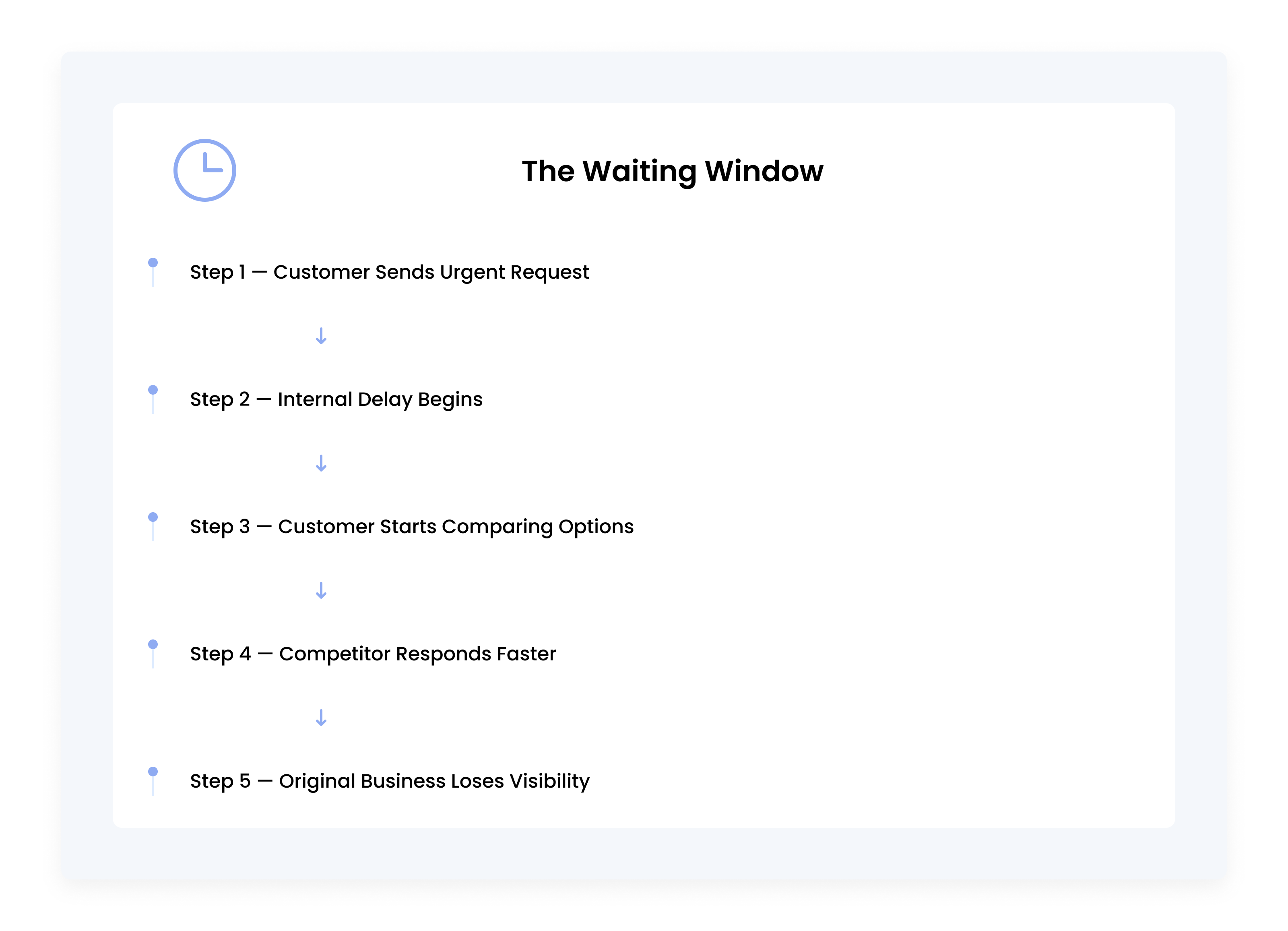
Customers rarely describe these moments as routing failures.
They describe them as professionalism, responsiveness, or organization.
Underneath those impressions, however, is usually operational structure.
In many cases, the customer never informs the original business they moved on. The company simply notices the conversation “went cold.” Employees may assume the customer changed their mind or was price shopping from the beginning.
Often, the decision changed during the waiting period.
Sometimes the customer stops replying altogether. Other times they commit to the first company that appeared organized enough to reduce uncertainty quickly. By the time the original business circles back, the decision has already been made.
From the business side, that can look like a lead that cooled. Operationally, it may have been a routing sequence that gave the customer too much time to compare alternatives.
When Teams Become Human Routing Systems
Businesses often develop hidden operational roles that nobody officially assigned.
One employee becomes “the person who knows where things go.” Another becomes the unofficial escalation point. Someone else quietly becomes responsible for tracking follow-ups simply because they are detail-oriented. A receptionist starts managing prioritization because nobody else established a consistent structure.
These arrangements can function temporarily.
Growth exposes the limits.
A business receiving fifteen conversations per day can survive through memory and informal coordination. A business receiving one hundred conversations daily across multiple channels starts depending on systems whether it recognizes that shift or not.
Without structured routing, employees become human traffic controllers all day long.
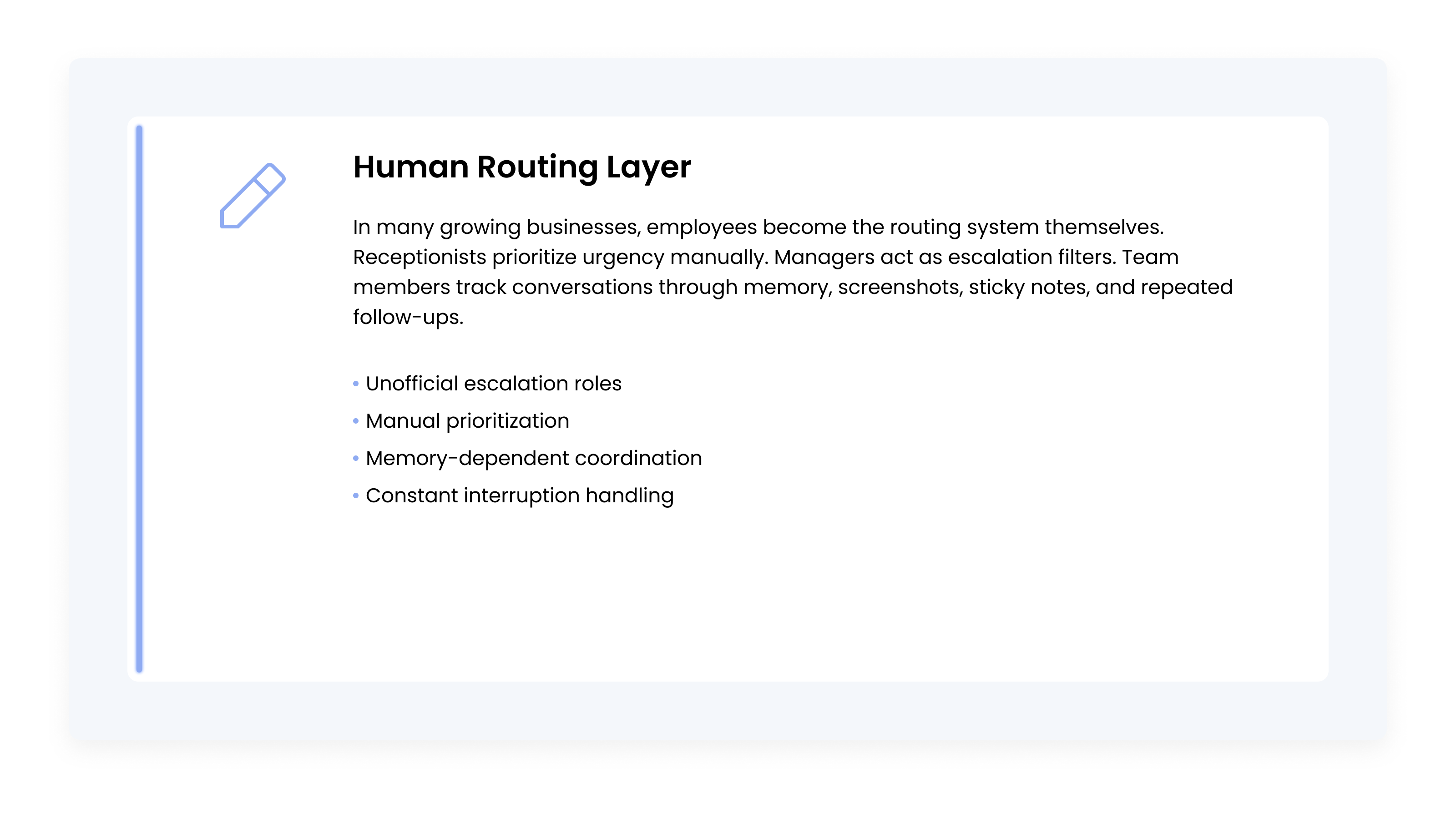
That creates cognitive load most businesses never formally measure.
An employee answering phones is no longer simply answering phones. They are continuously evaluating urgency, ownership, timing, customer history, internal availability, and operational priority in real time while still attempting to complete their primary responsibilities.
Mistakes stop feeling isolated after a certain point.
They become part of the operating environment.
One of the most common internal friction moments sounds deceptively simple:
“I thought you handled it.”
Those five words appear constantly inside businesses operating without strong routing discipline.
A technician assumes the office confirmed the appointment. The office assumes the owner approved the estimate. The owner assumes support already replied to the customer. Meanwhile, the customer is waiting for the business to act like one coordinated operation.
Conversations usually stall at the ownership layer rather than the access layer.
Consider a small HVAC company during peak summer season. At 9:00 AM, a customer texts reporting a failed air conditioning system inside a home with elderly residents. The office coordinator mentally flags it as important but receives three inbound calls simultaneously. She messages the dispatcher internally while continuing phone coverage.
The dispatcher assumes the owner will prioritize the request because the message included “elderly residents.” The owner is already dealing with technician scheduling issues and believes dispatch reassigned someone.
By 1:30 PM, nobody has updated the customer.
Internally, several employees saw the request.
Operationally, nobody fully owned the next action.
Later that afternoon, one employee says, “I thought dispatch called them already,” while dispatch assumed the office confirmed scheduling. The conversation remained visible all day, but responsibility never fully attached itself to anyone.
This is where many routing failures actually live.
Not in lack of effort.
In unclear ownership movement between employees.
The difficult part is that everyone involved usually feels productive. Nobody intentionally ignored the customer. Nobody consciously decided the issue was unimportant. The request simply moved between access and ownership until the response window became too long.
The longer a business operates this way, the more employees begin compensating manually for structural gaps. Someone keeps personal sticky notes. Another employee mentally tracks unanswered customers throughout the afternoon. A manager starts checking message threads late at night because nobody fully trusts the handoff process underneath the daily activity.
Systems become most important right around the moment employees stop trusting memory alone.
That type of coordination load becomes increasingly common as businesses add employees, departments, communication channels, and after-hours messaging expectations without establishing clear routing logic underneath them.
How Response Delays Quietly Impact Revenue and Customer Confidence
Response delays rarely appear directly on profit-and-loss statements.
That makes them easy to underestimate.
A business may look financially stable while opportunity loss develops through operational friction nobody formally measures. Leads cool gradually. Existing customers lose confidence slowly. Employees spend increasing amounts of time manually coordinating requests instead of advancing productive work.
The financial impact accumulates indirectly before it becomes obvious.
Imagine a service business receiving approximately 120 inbound interactions daily across phone calls, texts, website inquiries, and email requests.
Roughly 70 may involve routine operational activity. Another 30 may involve scheduling adjustments or general questions. Around 15–20 may represent legitimate sales opportunities. Only 2–3 may involve urgent high-value situations requiring immediate prioritization.
Without structured routing, all 120 interactions enter roughly the same operational environment.
Now consider what happens when even a small percentage of high-value inquiries experience delay.
Suppose five qualified sales inquiries per week wait ninety minutes longer than they should because they entered general communication handling instead of priority review. If only one of those opportunities converts elsewhere due to delayed response, and the average customer value equals $2,500 annually, the business loses approximately $130,000 in annualized revenue opportunity over time.
Not because nobody responded.
Because response sequencing failed.

That math becomes significantly more serious in industries where urgency strongly influences conversion behavior. Home services, medical offices, legal firms, property management companies, contractors, and customer support environments all experience some version of this dynamic.
The internal operational damage extends further than revenue loss.
Employees trapped inside manual triage lose productive capacity throughout the day. Small interruptions fracture attention continuously. Work slows down because employees repeatedly pause to redirect conversations, clarify ownership, or search for missing context.
In some environments, technicians sit waiting for updates while office staff reopen message threads repeatedly trying to confirm who responded already. Duplicate callbacks occur because ownership remains unclear. Ten employees each losing fifteen to twenty minutes daily to repeated coordination confusion creates dozens of lost labor hours every month.
At a certain point, the business starts feeling understaffed even though the deeper issue is unmanaged coordination underneath the workday itself.
Businesses often respond with surface-level fixes first.
More notifications. More inboxes. More shared access. More forwarding. More urgency language.
But adding more noise rarely improves prioritization.
Usually, it creates even more noise.
Some businesses eventually hire additional administrative staff believing the workload itself is the issue. Occasionally that helps temporarily. But if requests still enter the business without structured routing logic, the new employees inherit the same confusion at a larger scale.
The underlying problem remains intact.
The business still lacks a reliable system for determining what matters first, who owns the next action, and how escalation should move when timing becomes critical.
The Difference Between Shared Visibility and Actual Routing
Many businesses believe organizational problems were solved the moment everyone gained access to the same inboxes and message threads.
The challenge is rarely visibility alone anymore. Businesses increasingly need communication environments capable of preserving continuity across texting, calls, email, and follow-up activity without forcing teams to rebuild context repeatedly throughout the day, particularly as communication channels continue overlapping inside modern operations described in SMS vs Voice vs Email vs Tickets: Choosing the Right Customer Communication Channel.
Operationally, that is usually only the beginning.
Shared access helps employees see conversations. It does not automatically determine who owns the next step, what deserves priority, how urgency escalates, where requests should move, or what happens if nobody responds.
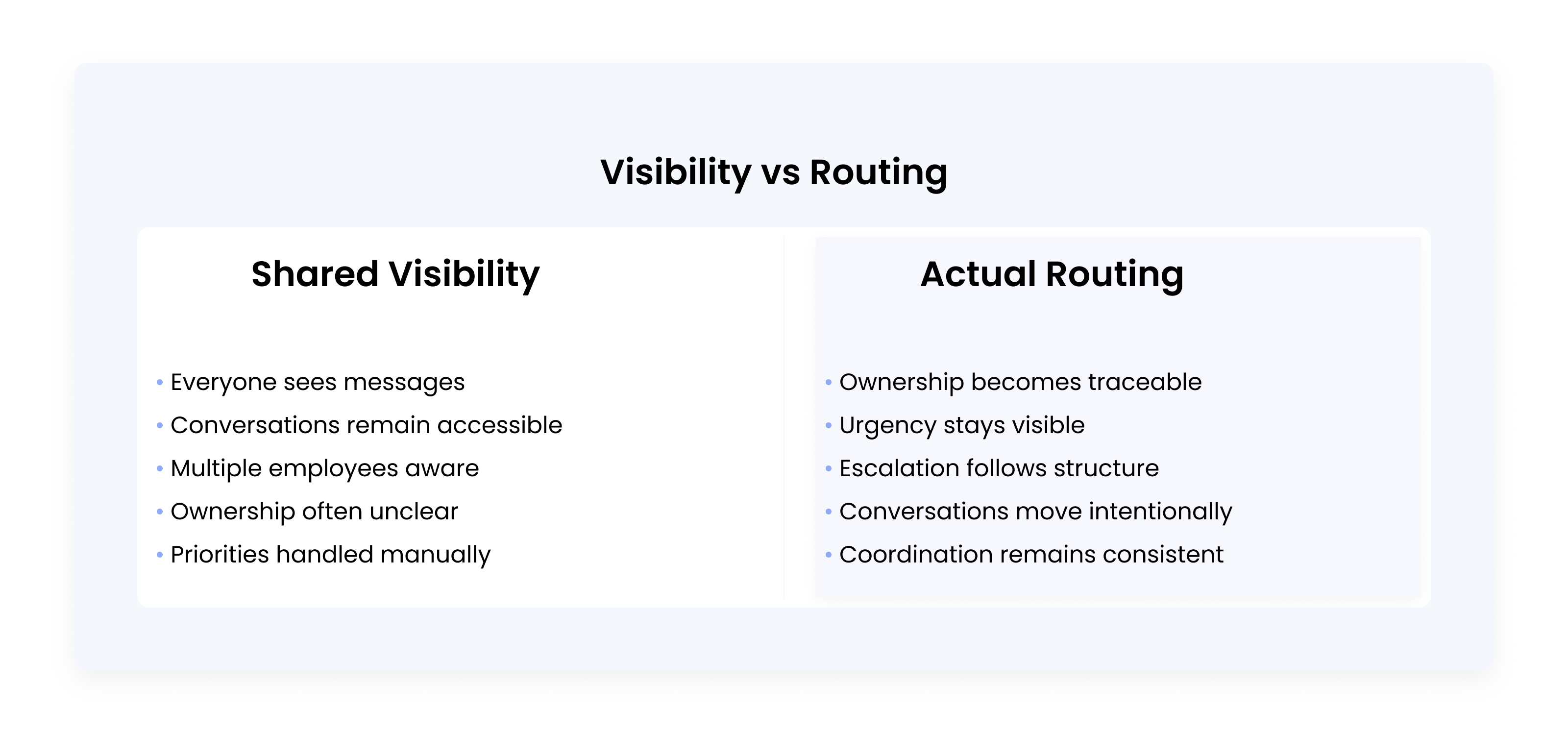
Those decisions still require structure.
Without routing logic, shared access can actually increase ambiguity because everyone sees the same customer activity while assuming someone else is already handling it.
That creates a dangerous illusion of coordination.
Messages remain available, so the business feels organized. Internally, though, communication still depends heavily on human interpretation and manual coordination.
The weakness becomes most obvious during periods of interruption.
A calm day can hide weak routing surprisingly well. High-volume days expose it immediately.
Suddenly, multiple employees are touching the same conversations simultaneously. Internal notes get missed. Customers repeat themselves. Priorities shift constantly based on whichever request appeared most recently instead of which request mattered most operationally.
Many businesses mistake this for growth pressure alone.
In reality, the environment lacks directional structure underneath the activity itself.
A real message routing system does more than display conversations centrally. It determines where requests belong, who should handle them, how urgency escalates, when ownership changes, and what shared context follows the interaction afterward.
That consistency becomes increasingly important as businesses expand across departments, locations, channels, or larger teams.
Without it, continuity gradually breaks apart under scaling pressure.
Customers feel this breakdown even when they cannot describe it technically.
The business starts feeling disconnected.
One employee lacks context from a previous conversation. Another asks for information the customer already provided earlier. A third promises follow-up timing nobody internally confirmed.
From the customer perspective, the business begins behaving like separate disconnected entities instead of one coordinated organization.
Most operational failures are not caused by lack of effort.
They are caused by lack of alignment underneath the communication itself.
A business can purchase more messaging tools and still remain structurally disorganized underneath. More exposure does not automatically create more clarity. In some environments, it simply exposes more employees to the same unmanaged coordination problems.
Routing maturity matters because the goal is not simply seeing conversations.
The goal is controlling how requests move through the organization once they arrive.
A Practical Framework for Handling Customer Message Flow
Routing maturity improves when conversations stop being treated as isolated messages and start being understood as operational activity moving through an organization.
Every customer interaction is going somewhere.
The question is whether the movement is intentional or improvised.
A practical routing structure does not need to become overly complex. It simply needs enough operational clarity that employees are not forced to improvise continuously once conversation volume increases.
One useful way to think about routing maturity is through four operational layers:
Recognition
Ownership
Escalation
Continuity
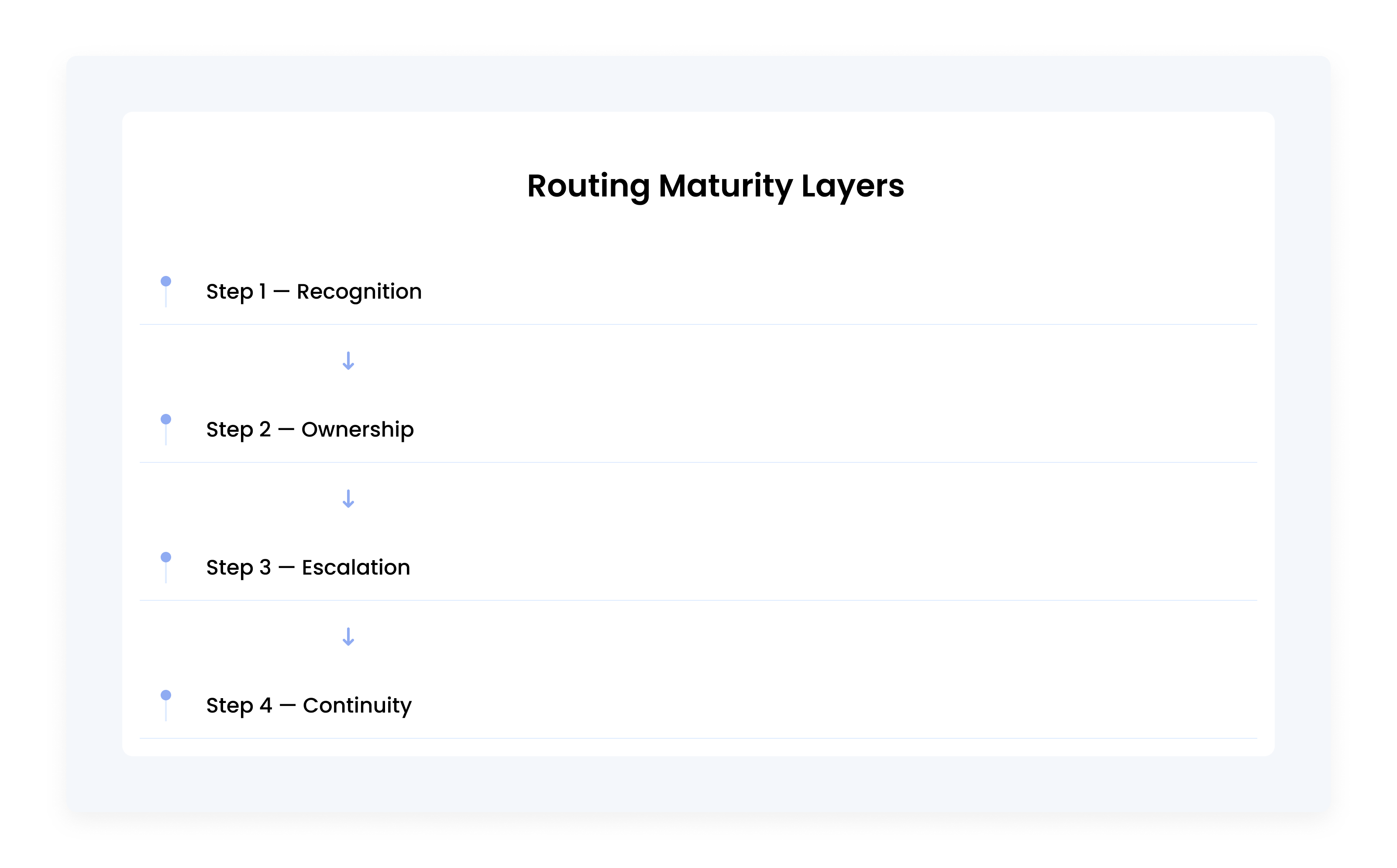
Recognition means the business can distinguish between informational activity and operationally important requests quickly enough for urgency to remain visible. Failure at this stage usually looks like every message entering identical workflows regardless of customer value or timing sensitivity.
When recognition breaks, businesses lose time before they even realize something important arrived.
In real environments, recognition failure often appears when an urgent service request sits beside routine scheduling traffic for forty-five minutes because nobody separated operational priority from normal inbound flow.
Ownership means the next responsible person becomes immediately clear. Failure here often produces internal ambiguity, duplicated work, or the familiar “I thought someone else handled it” problem.
Ownership gaps create drift.
Conversations remain visible while progress stops.
In stronger environments, responsibility becomes traceable instead of assumed. Employees can immediately identify who currently owns the interaction, what action was taken last, and whether the customer is still waiting on a response.
Escalation means the business already understands what happens when urgency increases or timing thresholds pass. Without escalation structure, employees improvise priority decisions inconsistently throughout the day.
Uneven escalation produces uneven customer experience because timing depends on whichever employee happened to notice the request first.
Inside many growing businesses, escalation exists informally rather than structurally. Employees rely on instinct, hallway conversations, or memory instead of predefined coordination movement.
Continuity means context moves with the conversation as responsibility changes. Failure here forces customers to repeat themselves while internal teams lose historical visibility.
A customer explaining the same issue three separate times to three separate employees rarely experiences the business as organized, even if everyone involved was genuinely trying to help.
In practice, most coordination pressure starts appearing long before businesses formally recognize it as a systems issue, especially once multiple employees begin handling the same customer conversations simultaneously without shared continuity, similar to the operational patterns discussed in How Teams Actually Handle Customer Conversations Without Losing Context.
Continuity breakdowns damage trust faster than many businesses expect because customers experience them as disorganization.
The strongest operational environments are not necessarily the fastest.
They are usually the clearest.
Employees understand where conversations belong. Customers experience smoother movement. Priorities remain visible. Ownership stays traceable. Internal friction decreases because employees spend less mental energy deciding what should happen next.
Clarity scales more reliably than urgency.
That clarity becomes increasingly valuable once businesses grow beyond small informal coordination habits.
Massive enterprise systems are not always necessary for routing maturity. In many cases, businesses simply need clearer operational logic around urgency, assignment, escalation timing, and continuity between departments. Even modest improvements in those areas can significantly reduce coordination load.
Once routing improves, employees stop spending so much energy figuring out where conversations belong.
They can focus more energy on actually helping customers.
Key Takeaways
- Routing problems usually begin before businesses recognize them as operational failures.
- Customers often experience coordination breakdowns as delays, inconsistency, or uncertainty rather than obvious service problems.
- Shared access alone does not create accountability, prioritization, or continuity between employees.
- As businesses grow, communication pressure shifts from a responsiveness problem into an ownership and coordination problem.
- Clarity scales more reliably than urgency.
Where Structured Communication Systems Begin to Matter
Businesses rarely set out intentionally to build operational systems.
They usually grow into needing them.
At smaller scale, responsiveness survives through proximity. The owner sees most conversations personally. Teams communicate verbally throughout the day. Employees remember context because volume remains manageable.
Growth changes that environment.
More conversations enter simultaneously. More employees touch customer interactions. More work happens asynchronously. More channels become active. More interruptions hit the same people responsible for keeping the day moving.
At some point, the business stops operating through memory and starts operating through systems whether it planned for that transition or not.
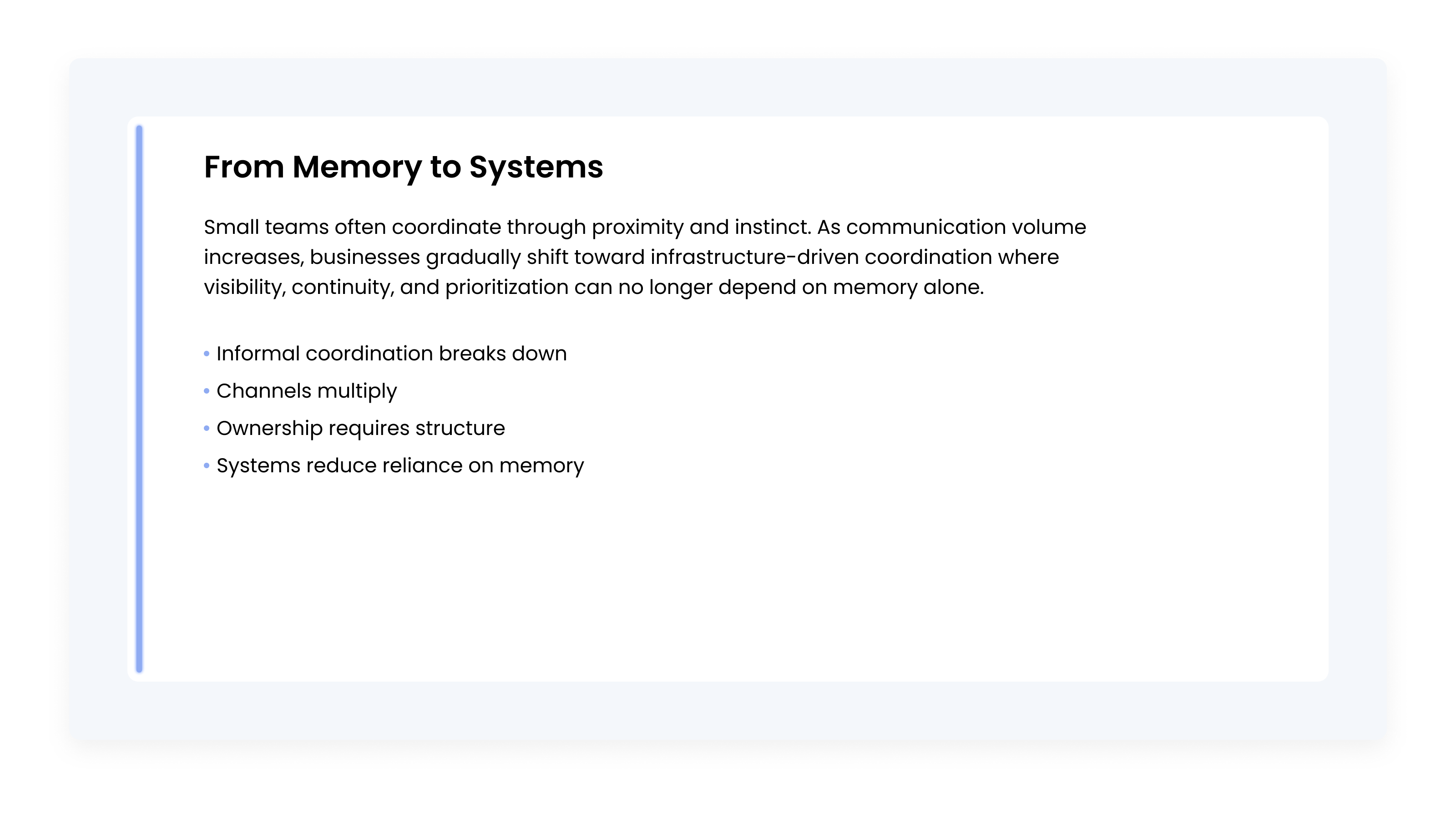
Structured routing begins mattering operationally when informal coordination capacity has been exceeded.
This is also where platforms gradually evolve from simple messaging tools into operational infrastructure. Businesses begin needing access that persists beyond individual employees. They need continuity across conversations. They need prioritization discipline. They need environments capable of supporting ownership instead of relying entirely on human memory.
The transition is subtle but important.
Strong systems do not simply help businesses communicate more.
They prevent customer attention, urgency, and responsibility from separating as conversation volume increases.
Over time, the businesses that scale most smoothly are usually not the businesses with the most inbound activity. They are the businesses where coordination remains controlled even while pressure increases underneath it.
Customers may never see the routing structure directly.
They still feel the difference when conversations move smoothly, urgency gets recognized quickly, and nobody asks them to repeat the same problem three separate times.
The businesses that maintain trust at scale are usually not the loudest or fastest.
They are the ones where communication still feels coordinated after the business becomes busy.
For businesses trying to create that kind of operational continuity across customer conversations, a 14-day free trial can help demonstrate how centralized communication visibility changes day-to-day coordination pressure once volume starts increasing.
Eventually, message routing stops looking like an inbox feature and starts looking like operational discipline.

.svg)