


Every business eventually hits the same question: Is SMS marketing actually worth the investment?
On paper, SMS looks unbeatable — open rates north of 95%, instant visibility, direct access to your customers without fighting algorithms or spam filters. But high engagement only matters if you can point to something tangible: more revenue, more bookings, fewer no-shows, faster responses, or saved hours for your team.
The good news is that SMS is one of the rare marketing channels where ROI isn’t vague or theoretical. You don’t need a complex attribution model or a data science team to figure it out. The impact shows up in real numbers, and the math behind it is surprisingly simple. Once you understand what to measure — and how to measure it — you get a clear picture of what every text is doing for your business.
What makes SMS different is that almost every action is trackable. You can see how many people clicked, replied, booked, purchased, confirmed, showed up, or converted. That means your ROI isn’t a guess — it’s a direct comparison between what you spent and what you earned back as a result of texting.
This guide breaks everything down step by step.
You’ll learn:
- What “return” actually means in SMS (it’s more than sales)
- The simplest, most accurate way to calculate ROI
- The key metrics that shape SMS performance
- Real examples — from promotions to appointment reminders
- Practical ways to improve your ROI over time
By the end, you’ll know exactly how to measure SMS ROI, how to calculate ROI from text campaigns using basic numbers, and how to make each campaign more profitable and more efficient. You’ll finally have a framework you can rely on every month — no guesswork, no ambiguous data.
What Counts as “Return” for SMS?
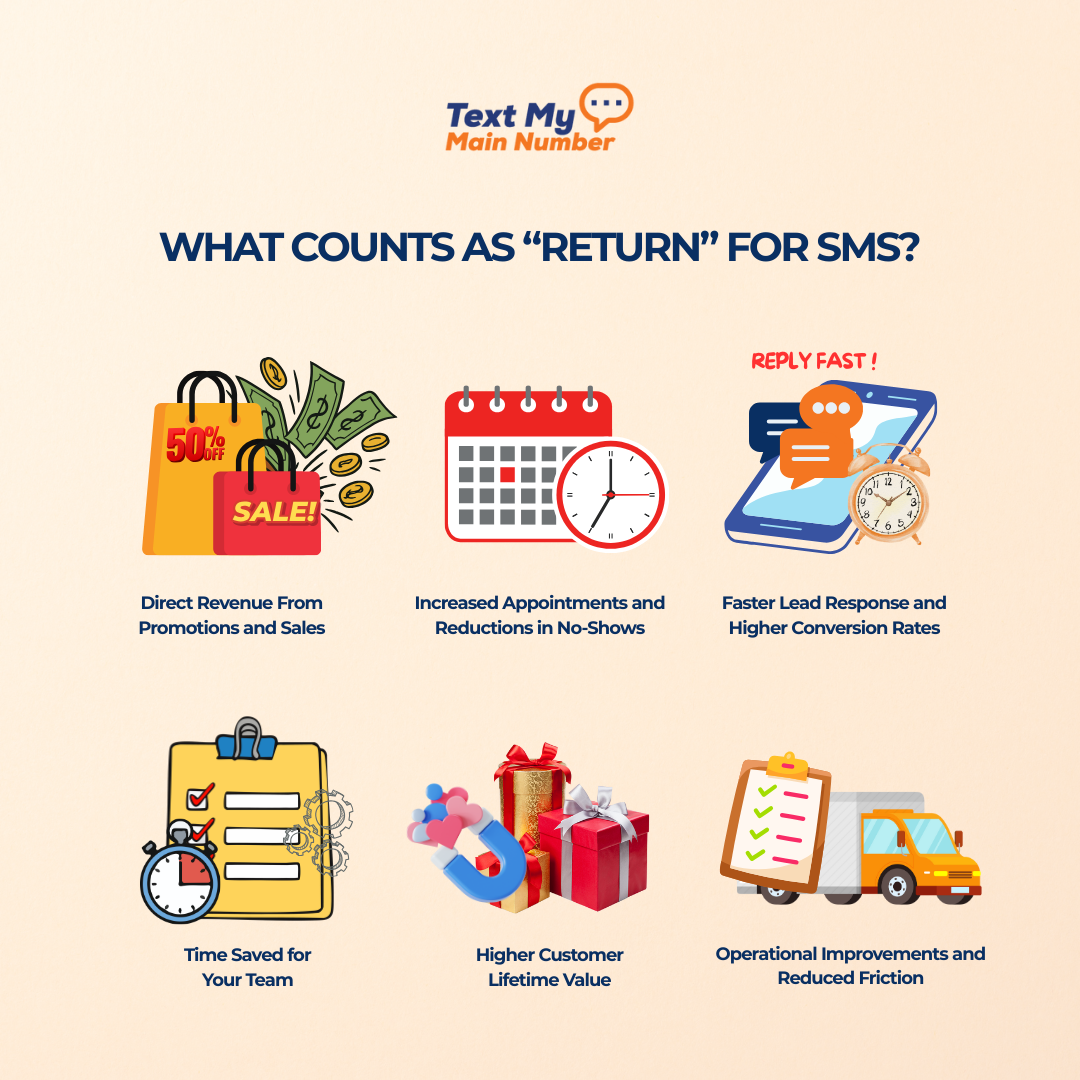
Before you calculate SMS ROI, you need a clear definition of what “return” actually is. Different businesses measure success differently, and SMS can produce value across several dimensions — not just revenue. Breaking it down by category makes ROI easier to understand and far more accurate.
1. Direct Revenue From Promotions and Sales
For e-commerce brands, retail stores, and product-based businesses, this is the most straightforward form of return. When you send a promotional text — a limited-time offer, a flash sale alert, a product drop, or a restock notification — the purchases that follow are directly tied to that campaign.
This type of return is easy to measure because customers act quickly after receiving a text. You can track revenue through coupon codes, unique links, or time-based attribution windows. And because SMS has an exceptionally high open rate, you get a clear cause-and-effect relationship: you send a message, your customers buy, and the revenue tied to that text is your return.
2. Increased Appointments and Reductions in No-Shows
For service-based businesses, missed appointments are one of the biggest hidden expenses. A single no-show might cost you an hour of lost revenue; multiple no-shows per week can impact your entire month's financial performance. Research published by the U.S. National Library of Medicine shows that missed appointments cause significant financial burden on practices and clinics, underscoring why reducing no-shows is essential ROI-wise.
SMS dramatically changes this dynamic. When people receive confirmations, reminders, or quick check-ins, they show up. They also reschedule faster, which allows you to fill gaps instead of losing the slot entirely. The return here isn’t measured by new revenue — it’s measured by the revenue you keep. To see exactly how reminder-based texts drive measurable ROI, this breakdown of How to Use SMS for Effective Appointment Reminders and Confirmations shows the mechanics and real-world impact.
Even a small improvement in show-up rates turns into a meaningful ROI. If a business prevents a handful of no-shows per month, SMS pays for itself many times over.
3. Faster Lead Response and Higher Conversion Rates
Speed is one of the strongest drivers of ROI, especially in industries where customers comparison-shop quickly. When someone fills out a form, requests a quote, or asks about availability, the business that replies fastest usually wins the conversation.
SMS gives you a direct line back to the lead within minutes. There’s no waiting for email opens, no voicemail tag, no missed call loops. The faster you respond, the more leads you convert — and the additional revenue from those conversions is part of your SMS return. Research from Harvard Business Review demonstrates that responding to leads within the first few minutes dramatically improves conversion rates, making speed one of the most powerful drivers of ROI.
Businesses in real estate, home services, healthcare, coaching, and retail all see measurable gains simply because SMS closes the gap between inquiry and engagement.
4. Time Saved for Your Team
This is one of the most overlooked forms of ROI, but it matters just as much as revenue. Every time SMS replaces a manual process — confirming appointments, answering basic questions, sending reminders, providing updates — your team saves minutes that would otherwise be lost to repetitive communication. Automation plays a major role here, and SMS Autoresponders for Small Businesses in 2026: The Complete Human-Centered Guide shows how automated workflows compound ROI over time.
Over days and weeks, that time compounds. Staff spend less effort chasing unresponsive customers or performing administrative tasks, and more time on work that actually drives revenue. The value here is measured in efficiency, productivity, and smoother operations.
5. Higher Customer Lifetime Value
SMS keeps your customers engaged long after the first purchase or appointment. It helps you maintain their attention with relevant updates, reminders, and personalized touches. When communication feels immediate and helpful, customers stick around longer and spend more over time.
This creates long-term ROI through:
- repeat purchases
- stronger loyalty
- more referrals
- higher retention
- increased subscription renewals
Even modest improvements in customer lifetime value have a significant financial impact because they affect revenue over months or years, not just days.
6. Operational Improvements and Reduced Friction
Some returns aren’t tied to revenue at all — they come from making your business easier to operate. SMS clears up miscommunication, reduces delivery confusion, speeds up feedback loops, and keeps customers informed before small issues turn into expensive problems.
The financial benefit shows up indirectly through fewer errors, less wasted time, fewer rescheduled jobs, smoother handoffs, and happier customers who require less support.
Simple SMS ROI Formula (With Examples)
.png)
Most channels make ROI feel complicated. SMS doesn’t. Because actions happen quickly — clicks, replies, bookings, purchases — you can tie results directly to a specific message. The math behind SMS ROI is surprisingly straightforward once you define your return and your total cost.
At its core, the formula looks like this:
SMS ROI = (Return – Cost) ÷ Cost × 100
That’s the entire calculation. But the clarity comes from understanding what goes into each part.
Return is the revenue or value created by your SMS campaign.
Cost includes your messaging platform, message volume, and any promotional expenses tied to the campaign.
Once you have those numbers, the ROI becomes obvious.
Here’s what it looks like in practice.
Example 1: Revenue From a Promotional Campaign
A boutique sends a weekend sale offer to customers.
Campaign cost (platform + messages): $120
Revenue from this SMS campaign: $1,450
Using the formula:
(1,450 – 120) ÷ 120 × 100 = 1,108% ROI
That’s the advantage of SMS: small spend, fast returns, easy attribution.
Example 2: Reduced No-Shows for a Service Business
A med spa uses SMS reminders for appointments.
Monthly cost of SMS: $80
Revenue saved from reduced no-shows: $600
(600 – 80) ÷ 80 × 100 = 650% ROI
In this case, the spa didn’t earn more money — it kept money it was previously losing. That still counts as return.
Example 3: Lead Follow-Up and Faster Conversions
A home service company texts new leads within 2 minutes instead of calling hours later.
SMS cost: $50
Extra bookings gained due to SMS: $900
(900 – 50) ÷ 50 × 100 = 1,700% ROI
Speed alone generated the return.
Example 4: Time Savings for the Team
A dental clinic replaces manual reminder calls with SMS automation.
SMS cost: $60
Value of staff time saved per month: $300
(300 – 60) ÷ 60 × 100 = 400% ROI
Even when return isn’t revenue, it’s still real value.
Why This Formula Works So Well
What makes SMS ROI so predictable is the immediacy. The moment your text goes out, you’ll often see:
- clicks within minutes
- replies in seconds
- bookings the same day
- orders within hours
There’s no long lag time, no ambiguous attribution, and no complex analytics setup required.
The channel is direct, measurable, and fast — which is exactly why calculating ROI from text campaigns is easier than almost any other marketing activity.
Key SMS Metrics to Track (CTR, Reply Rate, Conversion Rate)
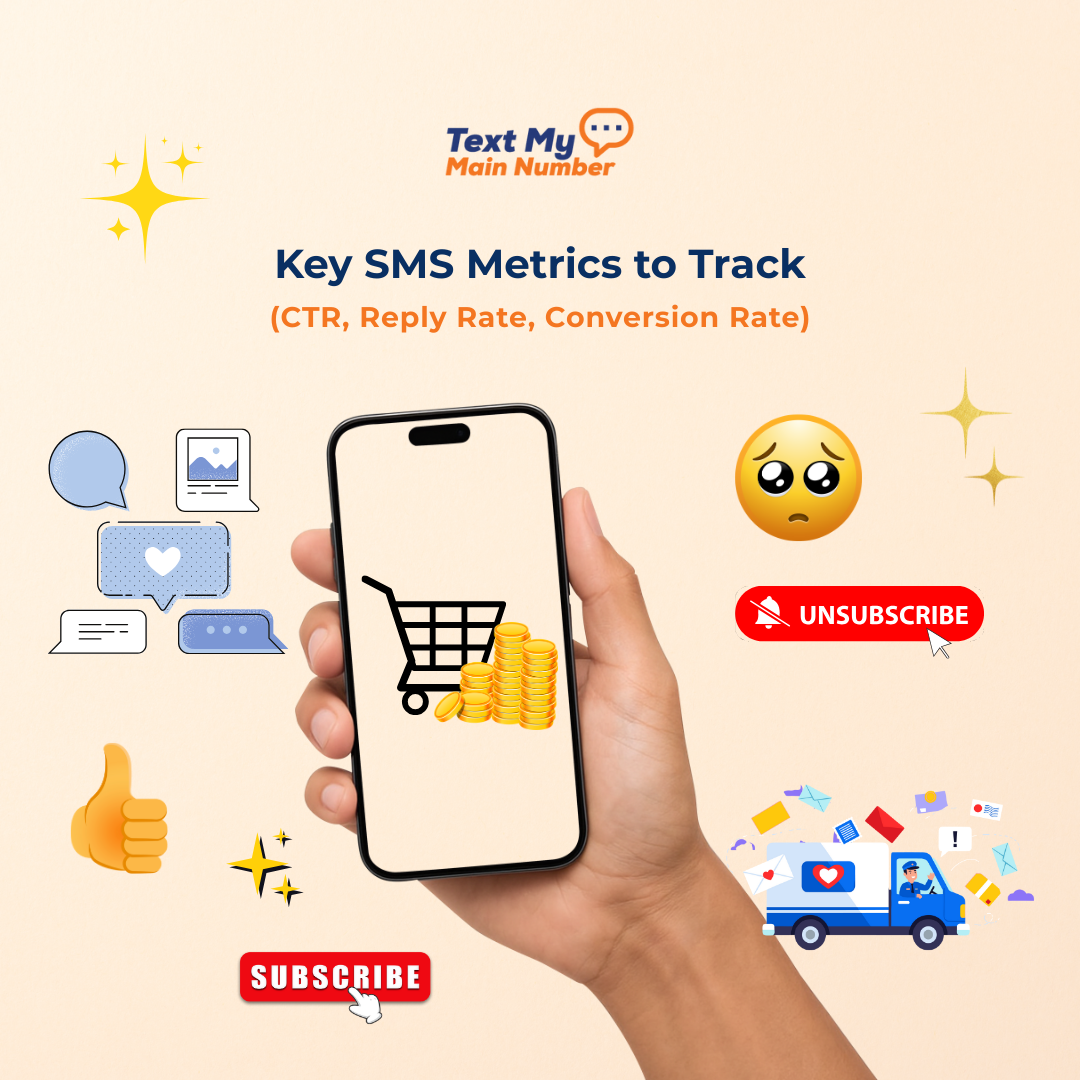
Calculating SMS ROI becomes effortless once you understand a handful of core metrics. These numbers show you how people interact with your messages, where campaigns are succeeding, and where gaps are costing you money. You don’t need dozens of KPIs — just the essential ones that directly affect performance and outcomes.
Click-Through Rate (CTR)
CTR tells you how many people tapped your link. It’s the fastest indicator of whether your message caught their attention and whether your offer was compelling enough to explore.
A strong CTR usually means:
- Your copy made sense
- The CTA was clear
- The timing felt right
- The audience was relevant
Since SMS open rates are extremely high, CTR becomes the real filter: it shows whether your message motivated action.
Reply Rate
SMS is a two-way channel, so reply rate matters just as much as clicks — sometimes more. A high reply rate means your audience is engaged and willing to continue the conversation.
This metric is especially important for:
- appointment confirmations
- real estate lead follow-ups
- customer service
- quote requests
- reminders and rescheduling
When reply rates are strong, your ROI improves automatically because engagement leads to conversions.
Conversion Rate
Conversion is the moment the message accomplishes its goal — a purchase, a booking, a sign-up, a completed action. This is the anchor metric for measuring SMS marketing ROI.
Conversions may include:
- sales from promotional texts
- leads booking appointments
- subscribers renewing
- customers completing a payment
- shoppers returning to finish checkout
Because SMS creates urgency and immediacy, conversion rates are often higher than email or ads. If you want to go deeper into tracking performance and tightening this loop, Maximizing SMS Conversion Rates: How to Track, Measure, and Improve Results walks through optimization strategies tied directly to ROI.
Unsubscribe Rate
This number tells you whether your messaging respects the customer's attention. A low unsubscribe rate means your content feels relevant and valuable. A spike, however, signals over-messaging or misalignment in tone or timing.
While unsubscribes aren’t pleasant, they’re a critical signal for protecting long-term ROI — fewer unsubscribes means a healthier list and better future performance.
Delivery Rate
For campaigns to perform, messages need to reach the phone. Delivery rate reflects the health of your number registration, your 10DLC compliance, and overall sender reputation.
Poor delivery rates can destroy ROI, even if your content is strong. That’s why understanding carrier rules and registration matters — 10DLC Registration: Complete 2025 Guide for Small Business Texting explains how compliance protects deliverability and long-term SMS performance. If carriers filter or block your texts, everything else falls apart.
SMS Conversion Benchmarks
There's no universal number, but strong benchmarks generally look like this:
- CTR: 20–35%
- Reply Rate (for conversational flows): 25–45%
- Conversion Rate (promo SMS): 8–15%
- Conversion Rate (reminders/appointments): 25–60%
These are not strict rules, but they help you understand whether your campaigns are performing at the level SMS typically delivers.
Real-World Example: Appointment Reminders
Let’s walk through a real scenario where SMS produces measurable, undeniable ROI — and where the return has nothing to do with selling a product. This example applies to healthcare clinics, spas, salons, dental offices, home services, real estate showings, coaching sessions, and any business that books appointments.
The biggest financial leak in these industries is simple: people forget to show up.
Every no-show is revenue left on the table. Staff time is wasted. Schedules fall apart. And your ability to fill that slot disappears once the hour passes.
SMS solves this problem almost immediately.
The Scenario
A clinic averages 200 appointments per month.
On average, 12% of patients don’t show up.
That’s 24 missed appointments every month.
Each appointment is worth $75 in revenue.
So the clinic loses:
24 × $75 = $1,800 per month, or $21,600 per year.
When they switch to SMS reminders — confirmations, day-before reminders, and morning-of nudges — their no-show rate drops from 12% to 6%.
That reduction alone recovers 12 appointments per month.
12 × $75 = $900 saved every month
$900 × 12 = $10,800 saved every year
Now look at the cost side.
The clinic pays $90/month for SMS messaging.
The ROI Calculation
Return: $900
Cost: $90
(900 – 90) ÷ 90 × 100 = 900% ROI
And this is from one type of SMS workflow.
There were no promotions, no sales codes, no complicated funnels — just simple reminders sent at the right time.
If the business also uses SMS for follow-ups, re-booking, referrals, or last-minute slot fills, the ROI grows even further.
Why This Example Matters
A lot of businesses assume ROI only comes from campaigns with direct sales. But operational ROI — like reduced no-shows — is just as powerful, often more. It’s predictable, recurring, and directly tied to efficiency.
And here’s the takeaway:
The more time-sensitive your business is, the higher your SMS ROI tends to be.
Appointments, services, deliveries, showings, and estimates all benefit immediately from reminders and confirmations.
This is why SMS isn’t just a marketing channel. It’s a retention engine and a revenue protection tool.
How to Improve Your SMS ROI Over Time
SMS delivers strong results right out of the gate, but the real gains come from refinement. Once you understand what your audience responds to — and what they ignore — you can consistently increase conversions, reduce costs, and squeeze more value out of every message. ROI isn’t just about the math; it’s about improving the inputs that drive the math.
Here are the core principles that move the needle over time.
- Refine Your Targeting
Even the best message won’t perform well if it’s sent to the wrong people. Start segmenting your audience based on behavior, preferences, purchase history, or appointment type. When the message feels relevant to the recipient, engagement rises naturally.
The more precise your targeting becomes, the less you need to send — and the more each message earns.
- Improve Timing and Cadence
SMS is immediate. Timing determines whether a message becomes action or noise. For promotions, sending texts when people are naturally on their phones — early afternoon, early evening, weekends — can noticeably increase clicks and conversions.
For reminder-based workflows, adjust intervals. A day-before reminder might work for some businesses, while others see better results with a two-hour heads-up. Test different timing windows to see what produces the highest response.
- Strengthen Your Calls to Action
A vague CTA wastes attention. A clear one drives ROI.
“Learn more” rarely performs as well as:
- “Book now for tomorrow”
- “Confirm your appointment”
- “Tap to claim your discount”
When people understand exactly what you want them to do — and why now — they act faster. Better CTAs almost always correlate with higher conversion rates.
- Shorten the Path to Action
The fewer steps involved, the better your results. If someone needs to click, scroll, enter information, and navigate multiple screens, your ROI drops. SMS works best when it leads someone to a single action: booking, paying, replying, or checking out.
A direct link to a booking page or a simple reply option (“Reply YES to confirm”) removes friction and increases your return.
- Personalize When Possible
Personalization doesn’t always mean inserting someone’s name. It means sending messages that reflect their behavior and needs. Tailored promotions, follow-ups based on past activity, or reminders aligned with service frequency all outperform generic blasts.
The more a customer feels the message is for them, the stronger your ROI.
- Monitor Key Metrics Consistently
ROI improves when you know what’s influencing it. CTR shows whether your message captured attention. Reply rate signals engagement. Conversion rate confirms whether the action happened. A dip in any metric is your early warning signal to adjust message style, timing, or segmentation.
Businesses that regularly track performance see ROI climb simply because they correct issues as they appear.
- Stay Compliant and Maintain Deliverability
Good ROI depends on your messages actually reaching customers. Proper 10DLC registration, clean sender reputation, and compliant messaging ensure your texts aren’t filtered or blocked by carriers. Strong deliverability is one of the quietest but most powerful drivers of long-term SMS performance.
- Test, Observe, Adjust — Then Repeat
The businesses with the highest SMS ROI don’t send more messages — they send smarter messages. They test copy variations, experiment with timing, measure outcomes, and refine their approach. Over time, these small adjustments produce a measurable lift in conversions and revenue.
SMS is a direct channel. The feedback loop is fast. When you listen to what the data is telling you, ROI increases naturally.
Final Thoughts
Measuring SMS ROI becomes surprisingly simple once you understand what to track and why it matters. The numbers don’t hide — clicks, replies, conversions, appointments, revenue saved, time gained. SMS is one of the rare channels where both the impact and the math are clear. You can see exactly what each message contributes and how it shapes customer behavior.
But the real advantage isn’t just the formula. It’s the consistency. When you refine your targeting, improve timing, personalize your approach, and track the metrics that actually matter, SMS becomes a predictable engine — one that drives revenue, reduces operational waste, and strengthens customer relationships month after month.
And this is exactly where Text My Main Number helps you get ahead. You get a platform built for real-world ROI: automated reminders, high-engagement templates, unified SMS + VoIP communication, clean 10DLC compliance, and analytics that tie every message back to outcomes that matter.
If you’re ready to turn texting into one of your highest-performing channels, start your 14-day free trial and see how quickly SMS ROI becomes obvious when you’re using the right tools.
.svg)

