The Moment a Business Realizes Email Is No Longer Enough
Most businesses do not wake up one morning and decide they need a shared inbox. The shift usually happens gradually. An owner starts forwarding messages manually. A receptionist copies another employee on replies “just in case.” Someone asks in Slack whether a customer ever received a quote. A technician calls the office from the field because the customer says they already spoke to someone else yesterday.
At first, these moments feel manageable. They look like ordinary growth friction. More customers. More conversations. More moving parts. The real pressure comes from communication volume expanding faster than the business’s ability to track what is moving, who touched it last, and what still needs to happen next.
In smaller teams, customer context lives inside people’s heads. The owner remembers which customer called last week. The office manager remembers which estimate is still pending. A sales rep remembers that someone asked for revised pricing but wanted to wait until Friday before making a decision. The system works because the business is still operating on proximity and memory rather than structure.
Then the company edges slightly beyond that threshold.
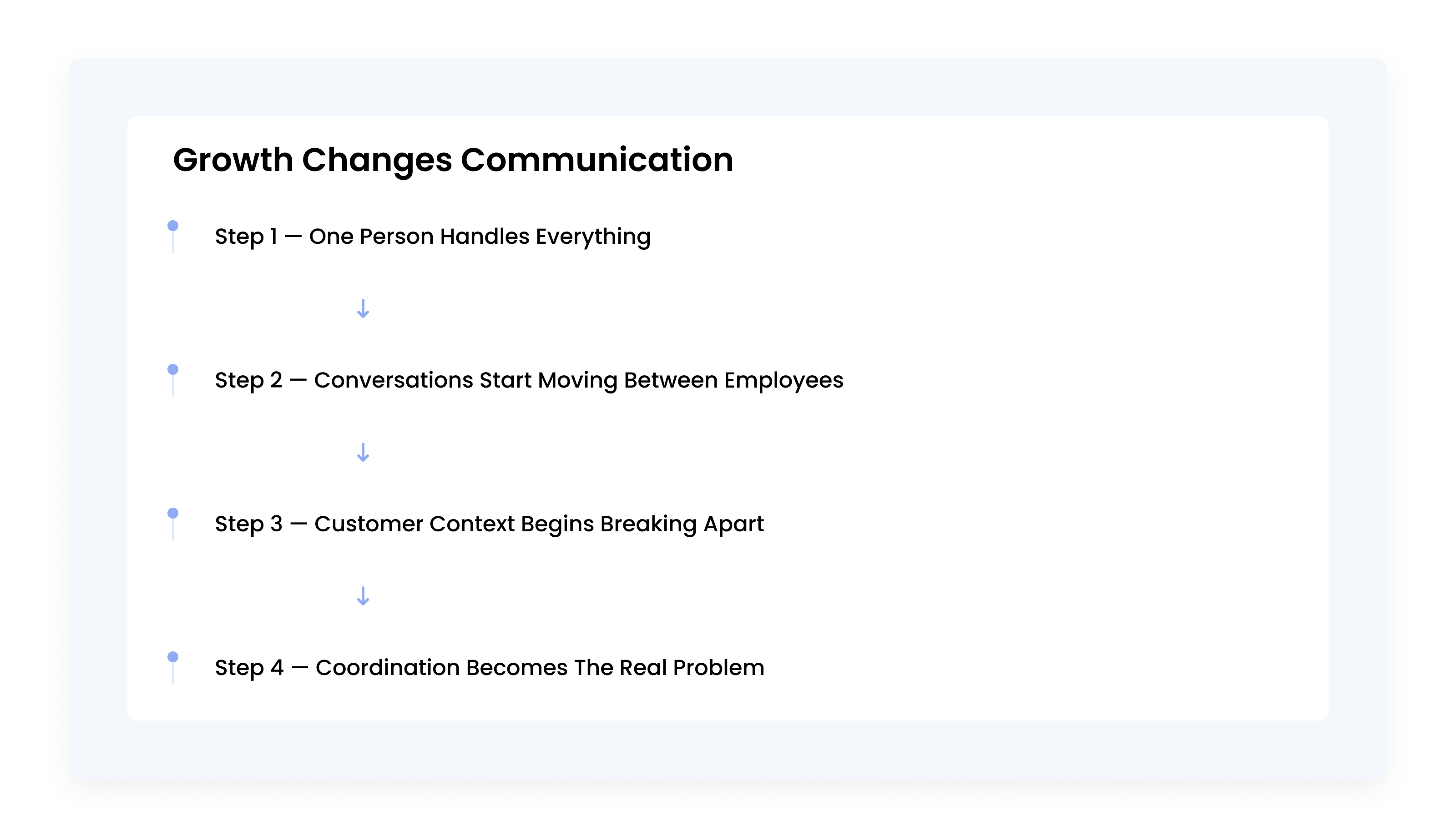
Not dramatically. Maybe the business adds two employees. Maybe inbound inquiries increase. Maybe text messaging gets added alongside email and phone calls. Suddenly conversations no longer move through one person naturally. They move between people. Once messages begin crossing schedules, departments, and shifts regularly, coordination becomes the real operational challenge.
A shared inbox business setup is often introduced during this stage because leadership recognizes that individual inboxes are no longer sustainable. The business needs broader access to conversations. What many teams discover afterward, however, is that shared access alone does not keep the work moving cleanly.
A shared inbox can centralize communication while still leaving responsibility unclear. Everyone can see the conversation, but nobody is fully responsible for moving it forward. In other situations, multiple employees assume someone else already handled it.
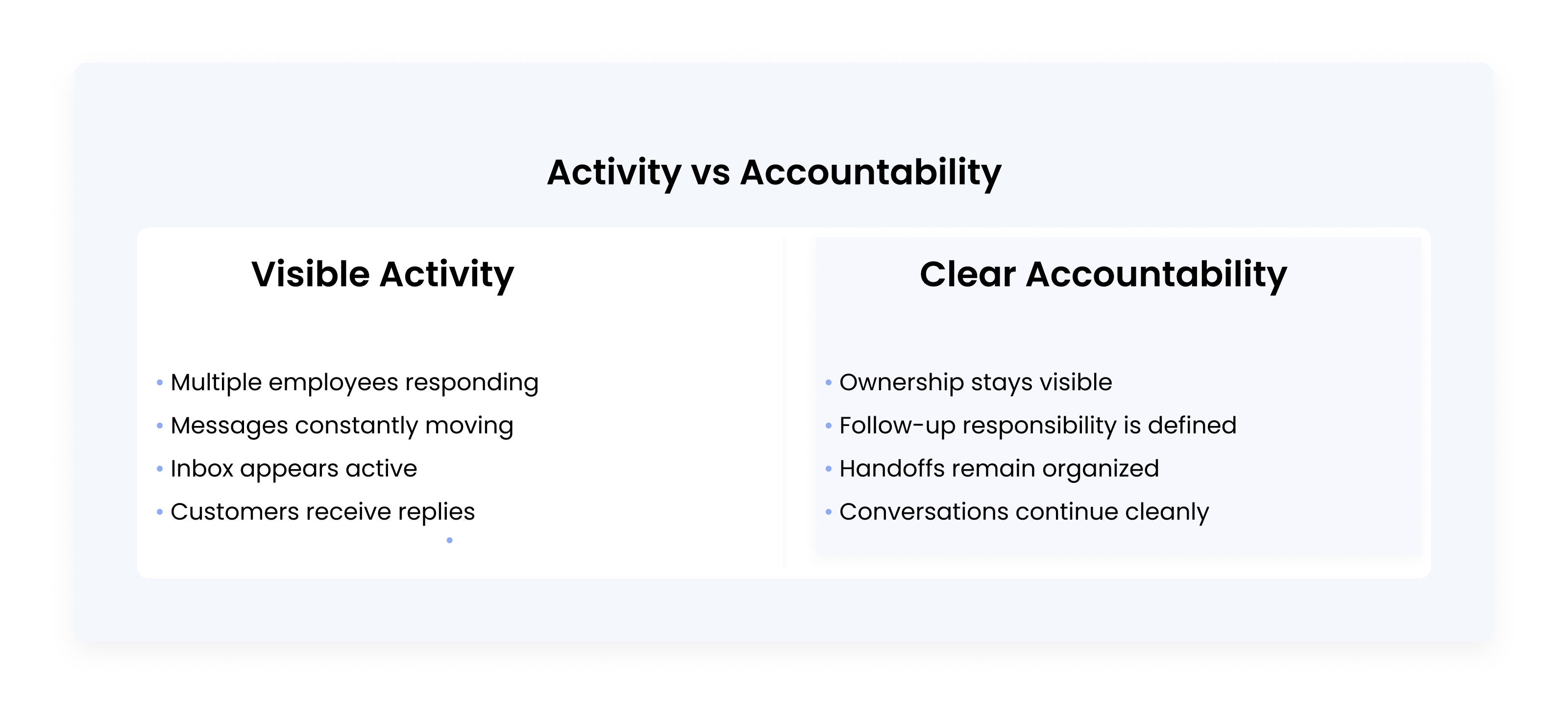
Activity is easy to spot. Accountability disappears much faster.
Some businesses install a shared inbox and immediately feel more organized. Others become even more confused than before. The software itself rarely determines the outcome. The operating habits around the messages do.
A mature communication setup is not defined by whether messages are visible. It is defined by whether customer context survives when the conversation moves from the receptionist to the owner, from the owner to dispatch, or from sales to service. Businesses rarely notice the exact moment this starts failing. Customers usually recognize it earlier through hesitation, repetition, and inconsistency.
That is often the stage where ordinary email starts showing its limits.
Why Shared Inboxes Often Create New Problems Instead of Solving Old Ones
A surprising number of shared inbox failures come from good intentions. Teams are trying to improve coordination. They centralize communication because scattered inboxes feel unsustainable. But after implementation, many businesses notice a different type of friction appearing underneath the surface.
The inbox becomes crowded without necessarily becoming clearer.
One employee replies to a customer while another drafts a response at the same time. Someone marks a message unread intending to revisit it later, but nobody else understands that action still means work is pending. Internal clarification conversations begin happening in separate channels while the customer conversation remains disconnected from those decisions.
What develops underneath is partial awareness.
Inside growing businesses, communication often appears active externally while internally nobody fully understands the current state of the customer relationship. Customers interpret responsiveness as coordination. Meanwhile, employees may still be improvising around missing information, incomplete handoffs, or assumptions made earlier in the day.
Operational disorder rarely announces itself dramatically. Most of the time it just looks like everyone staying busy.
Businesses also tend to misunderstand what a shared inbox is supposed to accomplish. Many assume the goal is collaborative access. In practice, the harder problem is keeping the thread of the work intact as communication moves between people, departments, schedules, and channels. That operational shift becomes even more noticeable as businesses move beyond isolated texting and start managing communication as an ongoing customer relationship, which is where From Texting to Full Conversations: How Businesses Scale Communication Without Losing Leads aligns naturally with the same coordination challenges.
Without structure around movement and responsibility, a shared inbox simply centralizes ambiguity.
Consider a small HVAC company handling inbound service requests. The receptionist receives a message Monday morning from a homeowner asking about a failing air conditioning unit. She responds quickly and tells the customer someone will follow up shortly with scheduling details.
Later that afternoon, the owner reads the message while between jobs and assumes the office already scheduled it because the customer received a reply. The technician sees the customer name mentioned in an internal chat thread but never sees the actual customer conversation itself.
Tuesday morning arrives. The customer has heard nothing further.
By Tuesday afternoon, the customer sends another message. This time the tone changes slightly. Less warm. More cautious. They ask whether someone is still available this week.
Nobody intentionally ignored the customer. That is what makes this type of failure difficult to detect internally. Every person involved felt partially aware of the situation. But partial awareness is not the same thing as clear responsibility.
The customer does not see internal intentions. They only experience whether the business keeps the thread together or makes them restart the process.
Once communication starts feeling uneven, confidence starts shifting long before the lead is officially lost.
The Hidden Coordination Cost Behind Multi-Person Communication
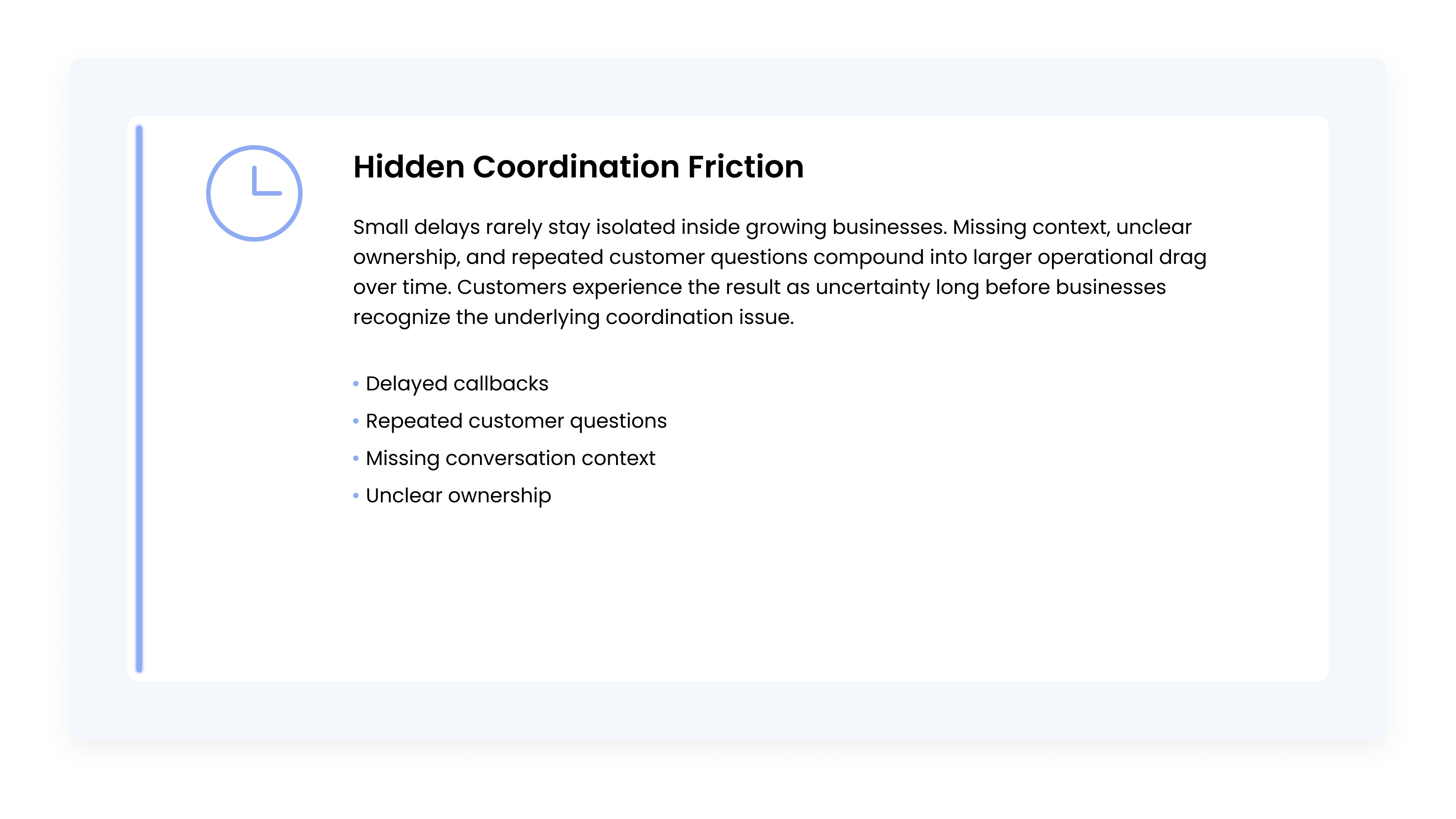
The coordination cost inside growing businesses is rarely measured directly because it usually hides inside small operational delays. A customer waits twenty extra minutes for clarification. A callback gets postponed until tomorrow because nobody knows who owns it. A technician arrives at a job site without the full conversation history because details stayed trapped inside email threads or side conversations.
Individually, these moments feel minor.
Together, they create friction that compounds across the customer experience.
In a lot of multi-person communication environments, businesses confuse participation with coordination. Multiple employees may be interacting with customer conversations, but the presence of activity can actually make accountability less obvious. Everyone touched it. Nobody clearly carried it.
As message volume increases, that pattern becomes harder to control.
A customer might receive quick replies but still feel uncertain about what is actually happening. One employee confirms availability. Another asks the customer to resend details already provided earlier. A third responds without seeing previous context entirely.
Inside the office, another layer of inefficiency builds on top of that.
A front-office employee opens a conversation at 4:45 PM before closing. She scrolls through a long email chain, checks two internal Slack messages, opens the customer’s last invoice manually, then searches the technician calendar to determine whether the estimate was approved earlier that day. Nearly fifteen minutes pass before she feels confident enough to send a simple follow-up reply.
That kind of reconstruction happens constantly inside businesses where customer history is spread across too many disconnected places. The operational drag usually becomes far more visible once teams start juggling multiple platforms at the same time, which is exactly why The Hidden Cost of Too Many Communication Tools in Growing Businesses connects naturally to the breakdown happening inside these environments.
From the customer’s side, the business starts feeling scattered even though everyone internally feels busy and responsive.
Customers increasingly judge reliability through the way a company communicates before they ever judge the actual service. Organized communication suggests organized operations.
Once conversations begin feeling disjointed, customers start reassessing confidence.
That shift rarely happens dramatically. Customers usually do not send angry messages announcing they lost trust. Instead, hesitation appears first.
They delay responding.
They request additional confirmation.
They compare providers more actively.
They become slower to commit.
A customer who originally planned to move forward immediately may now decide to “think about it overnight.” During that time, they may open another provider’s website in a separate browser tab, submit another quote request, or reread earlier communication looking for reassurance that never fully arrived.
Most businesses interpret lost opportunities as pricing issues, market conditions, or weak leads. Sometimes the issue is simpler than that. The customer stopped feeling confident that the business had control of the situation.
Inside the business, these breakdowns rarely feel dramatic while they are happening. They usually feel like another overloaded afternoon with too many moving parts.
What Customers Expect From Modern Business Communication Now
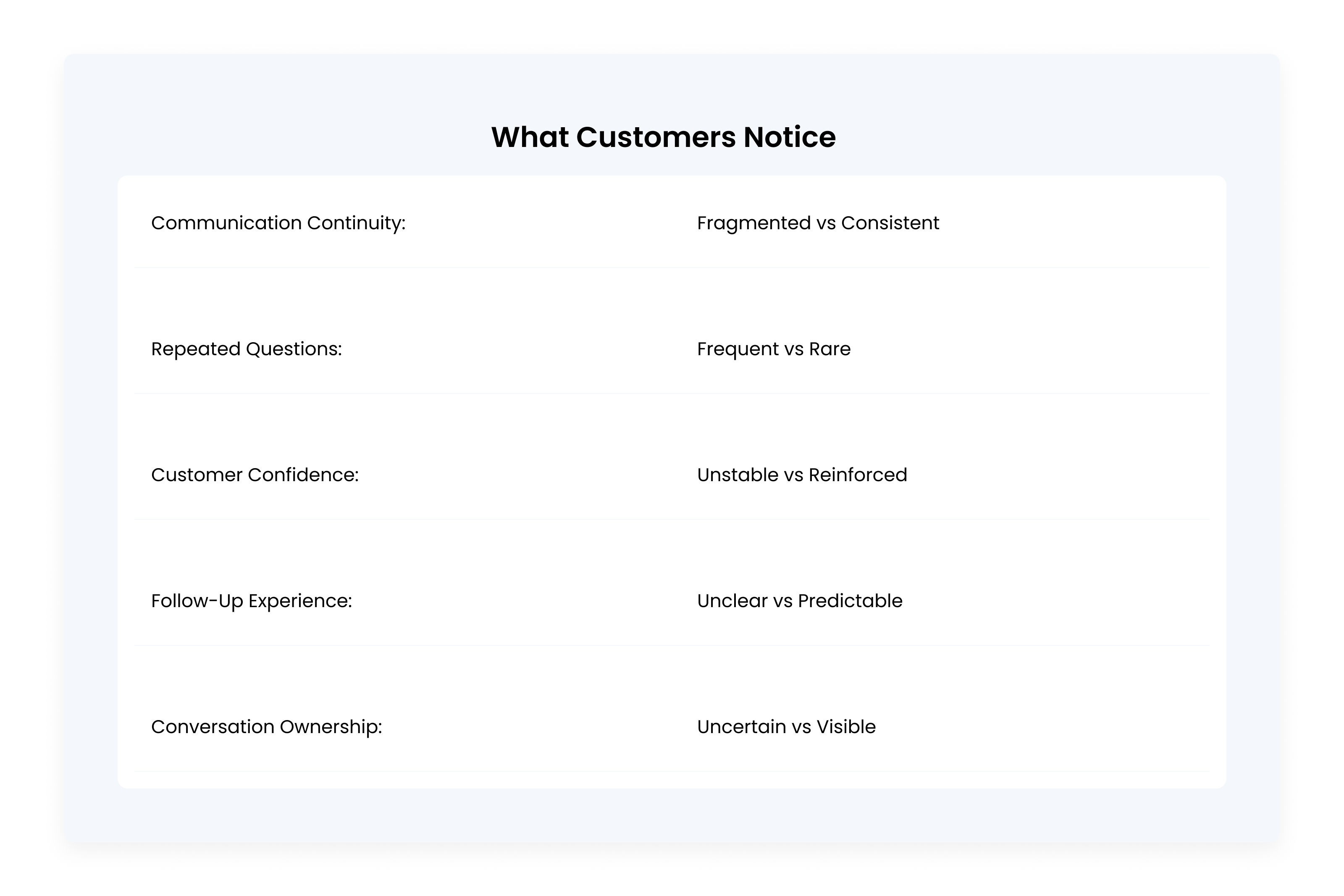
Customers no longer separate communication channels mentally the way businesses often do operationally. They do not think in terms of departments, inboxes, or internal ownership structures. They think in terms of whether the business remembers what already happened.
If they sent a message yesterday, they expect today’s interaction to include yesterday’s context automatically.
That expectation changes how communication breakdowns feel emotionally.
Years ago, customers tolerated repeating information more easily because fragmented communication systems were common. Today, when customers have to restate details repeatedly, resend information, or explain prior conversations again, they begin reading the experience differently.
The issue no longer feels procedural. It starts feeling organizational.
A customer comparing providers may never explicitly say this. They may simply describe one company as “more on top of things.” Usually what they are responding to is how steady and coordinated the communication feels.
Consider a customer requesting a commercial quote from two service providers. One company responds quickly but inconsistently. Different employees ask overlapping questions. Scheduling details shift between people. Response timing varies unpredictably.
The second company responds slightly slower initially but keeps the conversation clean throughout the process. The customer never has to repeat information. Every reply shows that someone has seen what already happened.
The second company often feels safer operationally even if both companies provide similar services.
Silence also feels different now than it did previously.
A delayed response no longer feels like “they’re probably busy.” Customers are accustomed to rapid communication everywhere else in their lives. Even reasonable delays can begin creating uncertainty if the prior context appears disconnected.
This becomes especially important during active decision-making moments.
If a customer sends a question after receiving a proposal and hears nothing back for several hours, the silence often becomes interpretive. They begin wondering whether the company forgot, became disorganized, or lost interest. That hesitation tends to build long before a customer formally leaves, and What Happens When Customers Don’t Hear Back Fast Enough reinforces how quickly delayed communication starts affecting trust and decision-making.
Intentional or not, communication gaps create narratives inside the customer’s mind.
The businesses that handle this transition well are usually not the ones responding fastest every single time. They are the ones keeping the clearest thread around follow-up, customer history, and who is moving the conversation next.
Where Shared Inbox Systems Quietly Break Down
Many shared inbox systems fail structurally because they centralize communication without defining how conversations move operationally afterward.
Messages arrive. Employees can see them. Replies happen. But nobody fully defines what responsibility looks like once a conversation enters the system.
Breakdowns often start right there.
A common failure point appears during handoffs. A receptionist gathers information and forwards the customer to sales. Sales assumes service scheduling will handle follow-up later. Service believes sales is still actively managing the conversation.
The customer sits inside the inbox visible to everyone yet actively owned by nobody.
As message volume increases, these failures become harder to detect because activity creates the illusion of progress. Internally, the inbox looks busy. Externally, the customer is the one feeling the gaps.
The problem becomes even more complicated once multiple channels overlap.
A customer sends an email requesting pricing in the morning. Later that afternoon, they text asking whether anyone reviewed the estimate yet. Before closing time, they call the office directly because nobody responded to the text. Meanwhile, one employee updates the email thread, another responds to the text conversation separately, and the receptionist leaves a handwritten note for the owner regarding the phone call.
Now the business technically responded in multiple places while still failing to maintain a unified conversation.
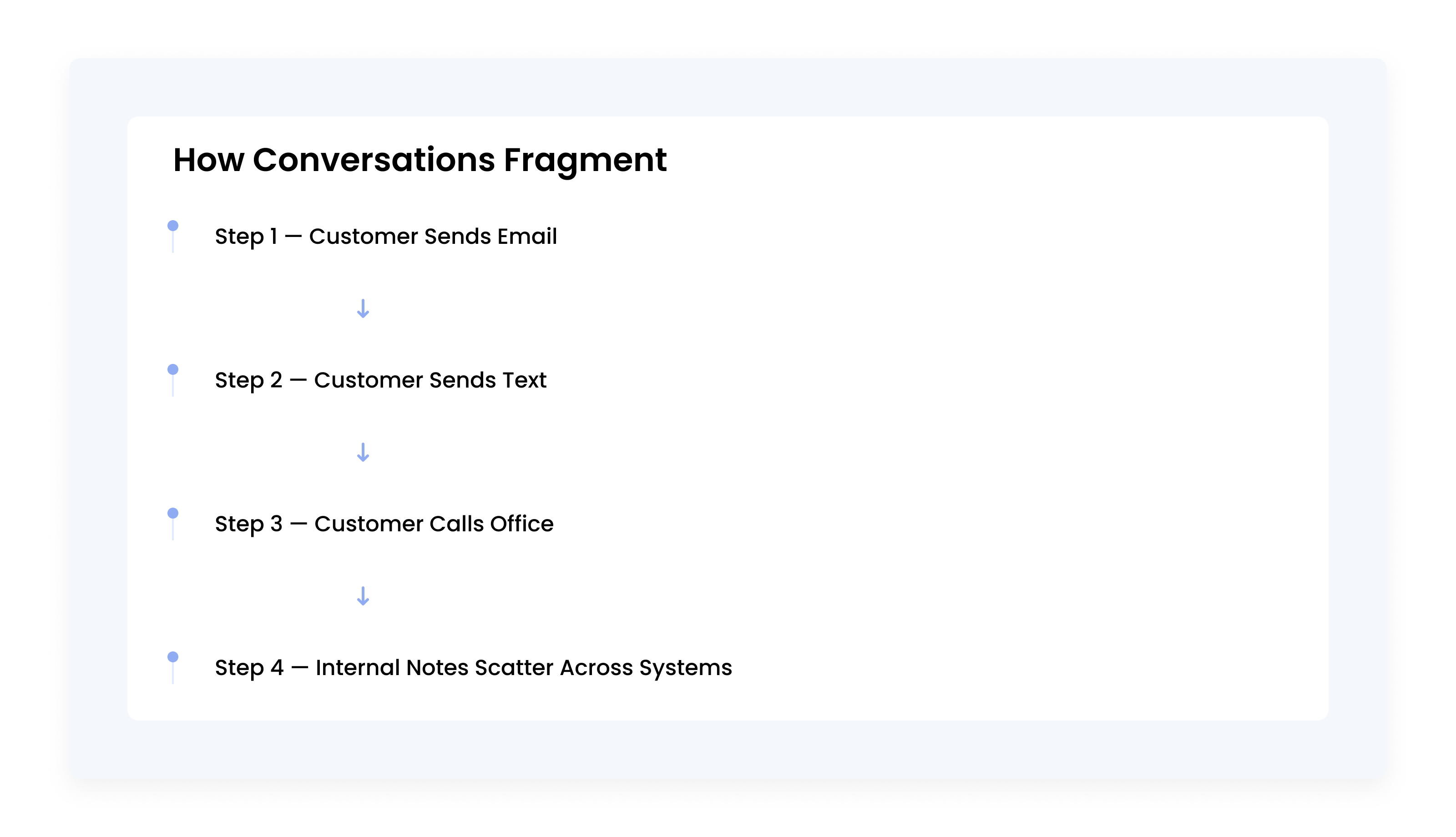
That is where communication problems start becoming expensive operationally rather than merely inconvenient.
Many businesses also rely too heavily on informal coordination habits. Employees begin creating workarounds instead of durable workflows.
Someone leaves messages unread as reminders.
Someone flags conversations manually.
Someone sends side messages through Slack or text.
Someone keeps personal notes separately.
Over time, the communication setup stops functioning as one system. It becomes several overlapping memory systems operating simultaneously.
This is why many teams mistakenly believe shared inbox software “doesn’t work” for their business. In reality, the operational habits surrounding the inbox never matured alongside the volume of messages, callbacks, estimates, and follow-ups.
The inbox itself is rarely the real problem.
The deeper issue is that businesses outgrow informal coordination before they recognize it.
One employee remembers context today. Another employee remembers it tomorrow. At some point, nobody fully remembers which details were communicated where.
That is when customers begin feeling uncertainty in ways the business may not notice immediately.
A Practical Framework for Building Shared Inbox Accountability
The businesses that use shared inbox systems successfully usually follow a simple operational principle: visibility and responsibility are treated as separate functions.
Visibility means the team can access the conversation.
Responsibility means someone is accountable for movement.
Those are not the same thing.
A practical framework for building shared inbox accountability starts with four operational layers:
Intake,
Assignment,
Context Preservation,
and Resolution Visibility.
Each layer solves a different coordination problem.
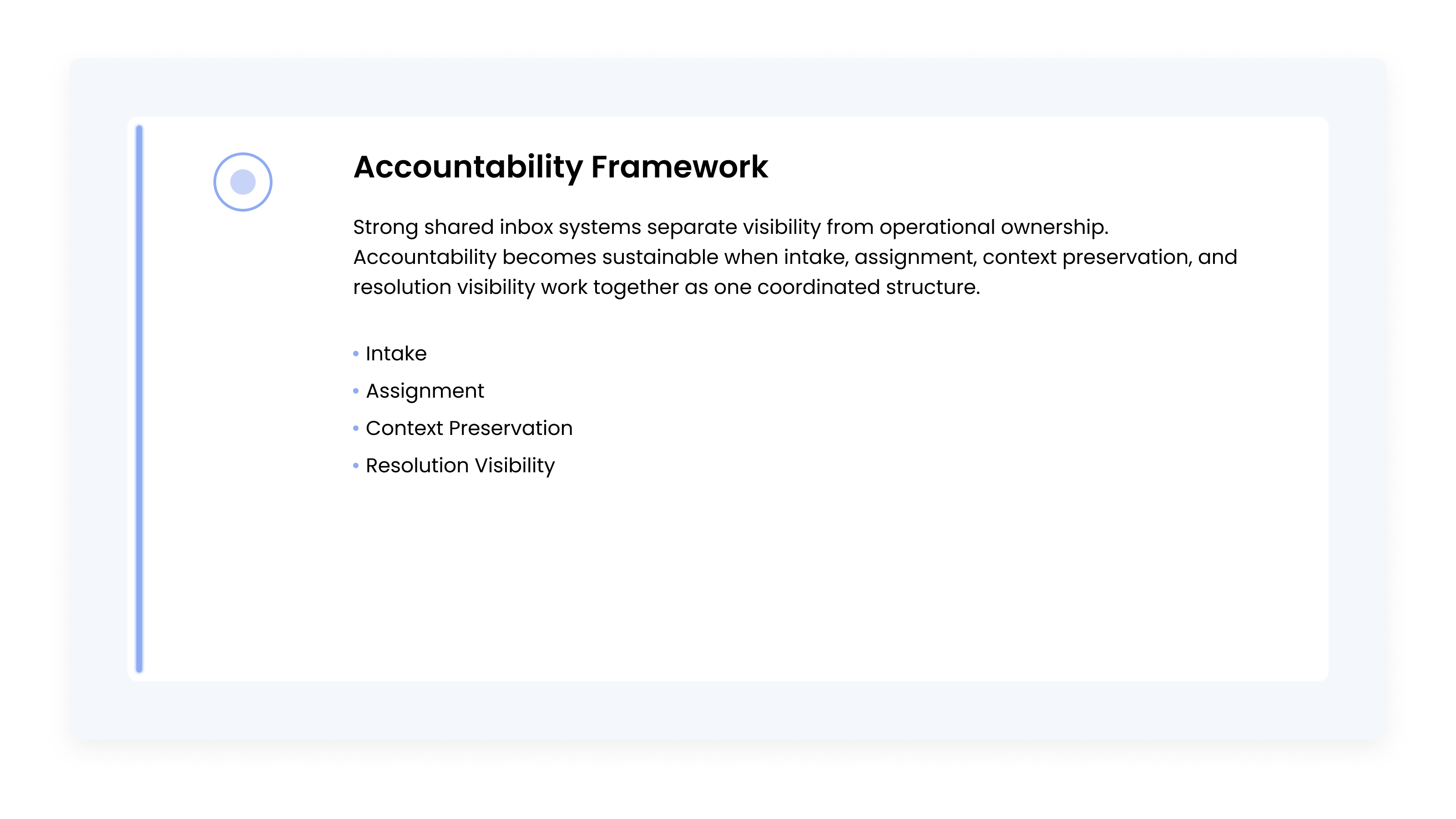
Intake determines how conversations enter the system and what information gets captured immediately. Failure at this stage usually looks like incomplete customer details, inconsistent categorization, or unclear urgency signals. In daily operations, weak intake creates confusion downstream for everyone else touching the conversation later, especially during busy periods or shift transitions.
Assignment defines who owns movement after intake occurs. This is where many businesses struggle. Messages remain visible to multiple people without clear accountability. A mature communication structure does not simply show conversations to everyone. It keeps responsibility visible even when the work changes hands throughout the day.
In real environments, assignment breakdowns often happen during schedule overlap. A morning office coordinator assumes the evening shift saw an unresolved callback request. The evening employee assumes dispatch already handled it because notes were partially updated. By the next morning, the customer has now waited almost twenty-four hours while every employee involved believed somebody else still owned movement.
Context Preservation determines whether communication history survives handoffs intact. This includes prior replies, internal notes, customer preferences, pending questions, unresolved details, quote revisions, and scheduling expectations. Failure here creates the classic “Can you resend that information?” experience customers increasingly dislike because it signals that the business is not carrying the conversation forward cleanly.
This is often the stage where businesses realize communication problems are no longer isolated employee mistakes. The day-to-day operating structure is starting to fail under growth pressure.
Resolution Visibility ensures unresolved conversations remain visible until completion, not just until someone replies. Without this layer, teams often mistake responses for resolutions. A reply may have been sent, but the customer issue may still be incomplete operationally.
Consider an internal moment inside a growing plumbing company.
At 9:15 AM, the office coordinator replies to a customer requesting emergency service. She tells the customer dispatch will confirm scheduling shortly.
At 10:40 AM, dispatch assumes the owner already handled scheduling because the customer conversation appears active.
At 1:20 PM, the technician arrives at another appointment and notices a missed internal note referencing the emergency customer.
At 3:45 PM, the customer sends another message asking whether someone is still coming.
Nobody ignored the customer intentionally. The system simply lacked clear coordination around responsibility transitions.
This is the difference between communication activity and communication management.
What Operational Visibility Actually Looks Like in a Scaling Business
Operational visibility is not simply seeing messages inside one inbox. It is knowing the current state of customer movement across the business at any given moment.
That becomes increasingly important as businesses grow beyond founder-led communication.
In smaller operations, visibility happens naturally because fewer people touch conversations. The owner sees most interactions personally. Problems get corrected informally through proximity.
Growth changes that environment entirely.
Once communication starts passing between front office staff, sales teams, field technicians, support employees, and management, awareness has to become built into the workflow rather than dependent on who happens to remember the details.
A mature shared inbox business setup allows anyone interacting with the customer to understand:
what has already happened,
what is still pending,
who currently owns movement,
and what the customer expects next.
Without that structure, businesses begin operating on assumptions instead of shared understanding.
Assumptions create expensive drift.
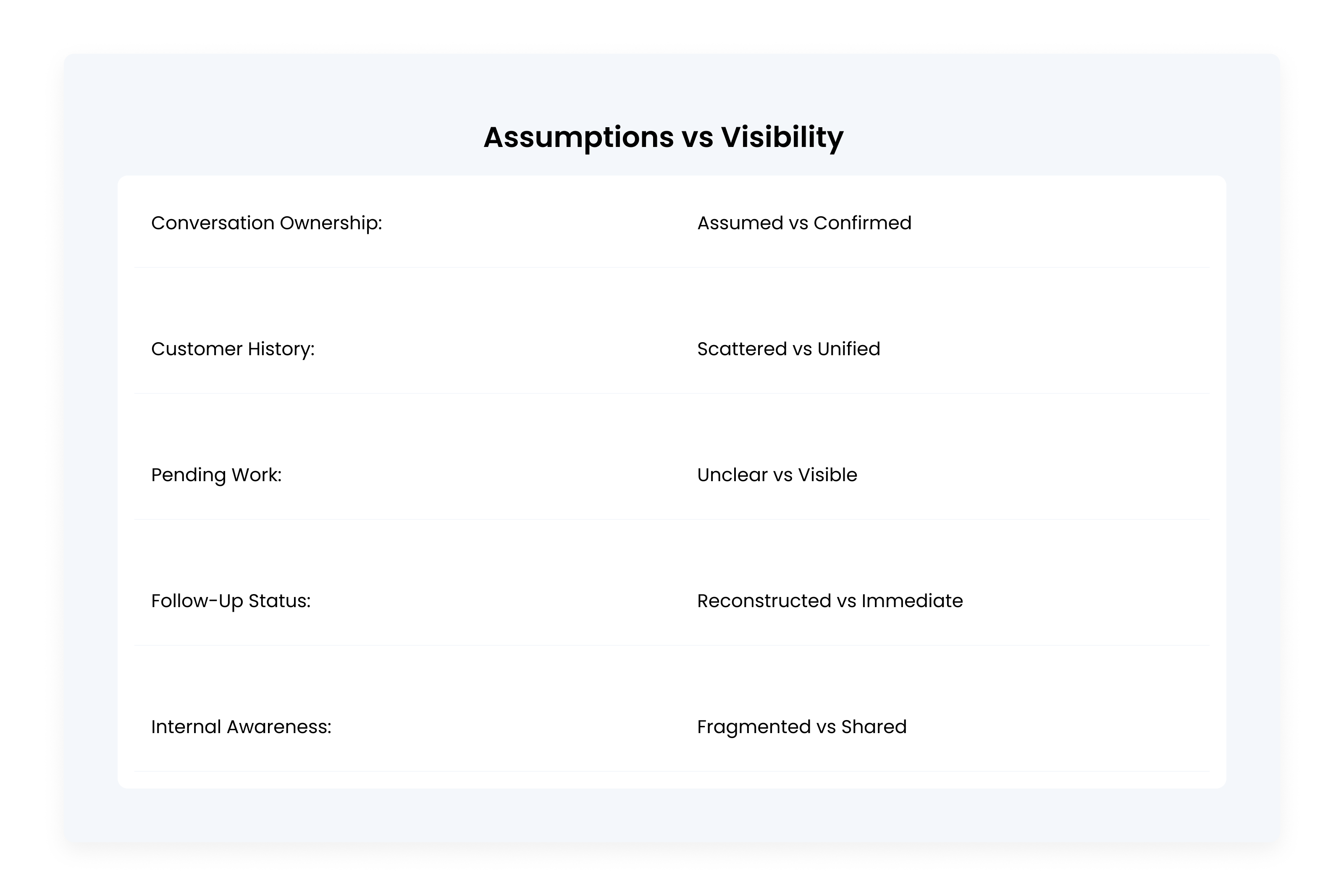
One employee assumes follow-up already occurred. Another assumes the customer declined service because they stopped responding. A third assumes the issue is still active but lower priority.
The customer may still be waiting for a clear answer.
In stronger communication environments, a front-office employee can open a conversation immediately and understand the situation within seconds. The estimate was sent yesterday at 3:12 PM. The customer requested a callback after 5 PM because they work during the day. Dispatch is waiting for technician availability confirmation. A follow-up reminder is already attached for tomorrow morning if no response arrives tonight.
That level of awareness changes communication quality because employees stop rebuilding context manually every time a conversation changes hands.
The gap between internal perception and customer reality becomes especially damaging because it does not show up as one obvious operational collapse. It shows up in small inconsistencies: a missed callback here, a repeated question there, a customer who stops replying after seeming ready to move forward.
The businesses that handle growth most effectively usually stop treating communication as isolated interactions. They begin treating customer conversations as part of the operating system that keeps scheduling, sales, service, and follow-up connected. That broader shift toward connected communication workflows is closely related to the operational maturity discussed in “How Teams Actually Handle Customer Conversations Without Losing Context.”
Customers often cannot judge technical quality before purchasing. They judge coordination first.
That is partly why communication systems are moving toward unified customer history, clearer assignment, and easier internal collaboration instead of isolated messaging channels. The shift is less about adding more tools and more about making sure conversations do not lose meaning as they move through teams, schedules, and workflows.
The Financial Cost of Delayed or Unclear Conversation Handling
Communication friction rarely appears on a profit-and-loss statement directly, which is one reason many businesses underestimate its operational cost.
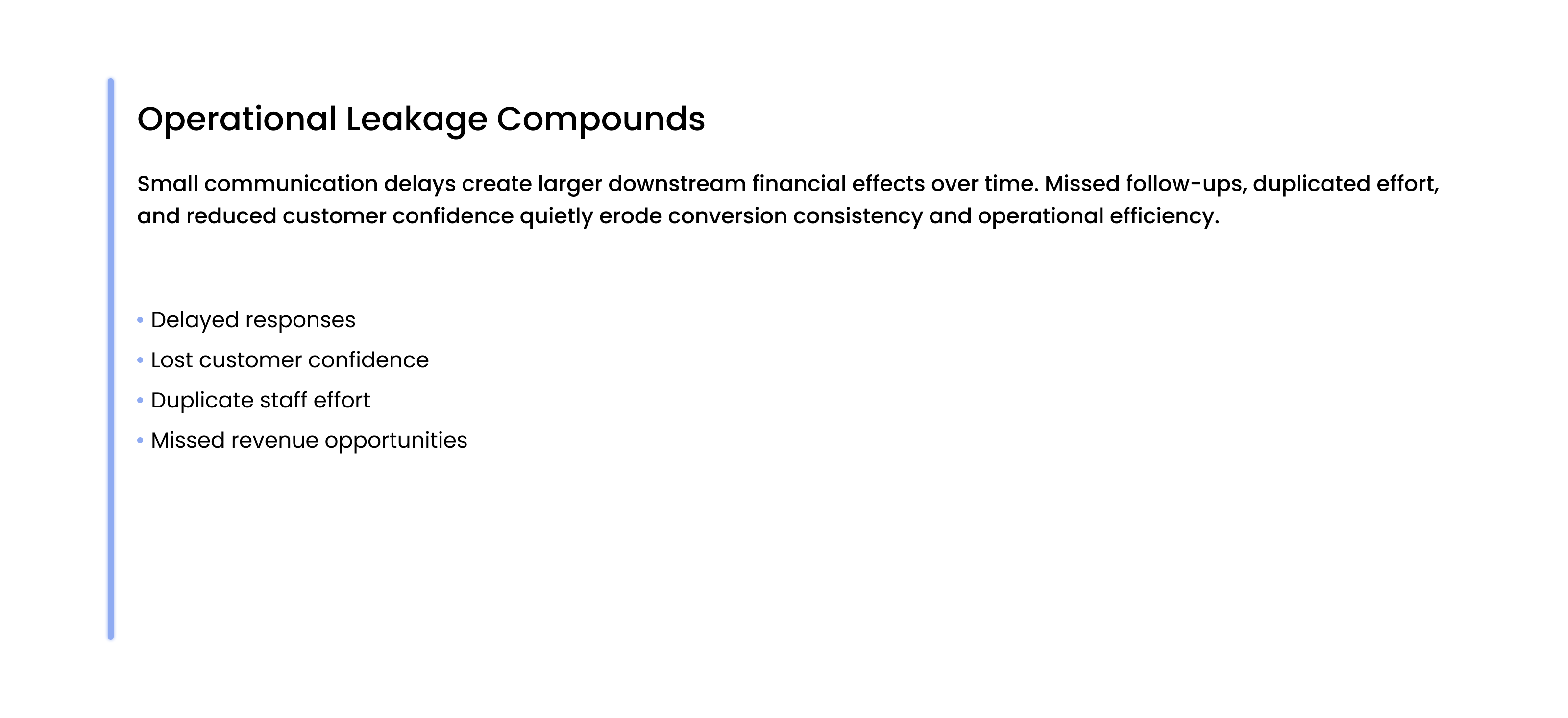
The impact usually hides inside delayed follow-ups, lower conversion consistency, missed scheduling opportunities, and customers losing confidence before anyone internally realizes it happened.
Consider a service business receiving approximately 40 inbound inquiries per day across phone calls, website forms, text messages, and email.
If only 15% of those conversations experience responsibility confusion or delayed follow-up, that affects 6 conversations daily.
Now assume each delayed interaction adds an average of 20 minutes before the customer receives meaningful clarification or next-step movement.
Operationally, that may not sound catastrophic. But customer behavior changes quickly once uncertainty enters the interaction.
If even 2 of those 6 customers decide to compare another provider because communication feels inconsistent, the business is now introducing additional competitive exposure daily.
Assume one of those customers represented a $1,500 job that otherwise would have converted.
Over the course of a month, that becomes:
1 lost job per week × $1,500
4 weeks × $1,500 = $6,000
That example only reflects directly visible revenue loss.
It does not include reduced referral confidence, additional staff time spent clarifying confusion, duplicate replies, rescheduling friction, or the operational drag created by employees constantly rebuilding customer context manually.
In many businesses, two employees may separately review the same conversation history within an hour simply because responsibility remained unclear. One follows up by email while another calls the customer directly believing no response was sent yet. Those moments create labor waste internally while simultaneously making the business feel less coordinated externally.
Most communication inefficiency does not arrive as a dramatic collapse. It arrives as accumulated operational leakage spread across hundreds of small interactions.
That is one reason many growing businesses feel constantly busy while still struggling to create smoother customer movement internally.
The issue is not always workload volume.
In many cases, the business is spending too much energy compensating for weak coordination structure.
How Communication Systems Mature as Teams Grow
Communication systems usually evolve in stages whether businesses recognize the transition consciously or not.
In the earliest stage, communication revolves around individuals. The owner knows every customer. Most conversations happen directly. Context remains manageable because communication volume is still relatively contained.
Then growth introduces movement.
More employees become involved. More channels appear. Conversations begin shifting between people throughout the day.
At this stage, many businesses rely heavily on informal coordination. Team members remember details mentally, send quick internal messages, or create personal reminder systems. For a while, this approach works surprisingly well under moderate volume.
Then the strain starts surfacing in small operational ways.
Memory-heavy coordination scales poorly because it depends on people remaining consistently available, informed, and synchronized under growing communication pressure.
The business reaches a point where communication is no longer just about sending and receiving messages. It becomes part of how work moves.
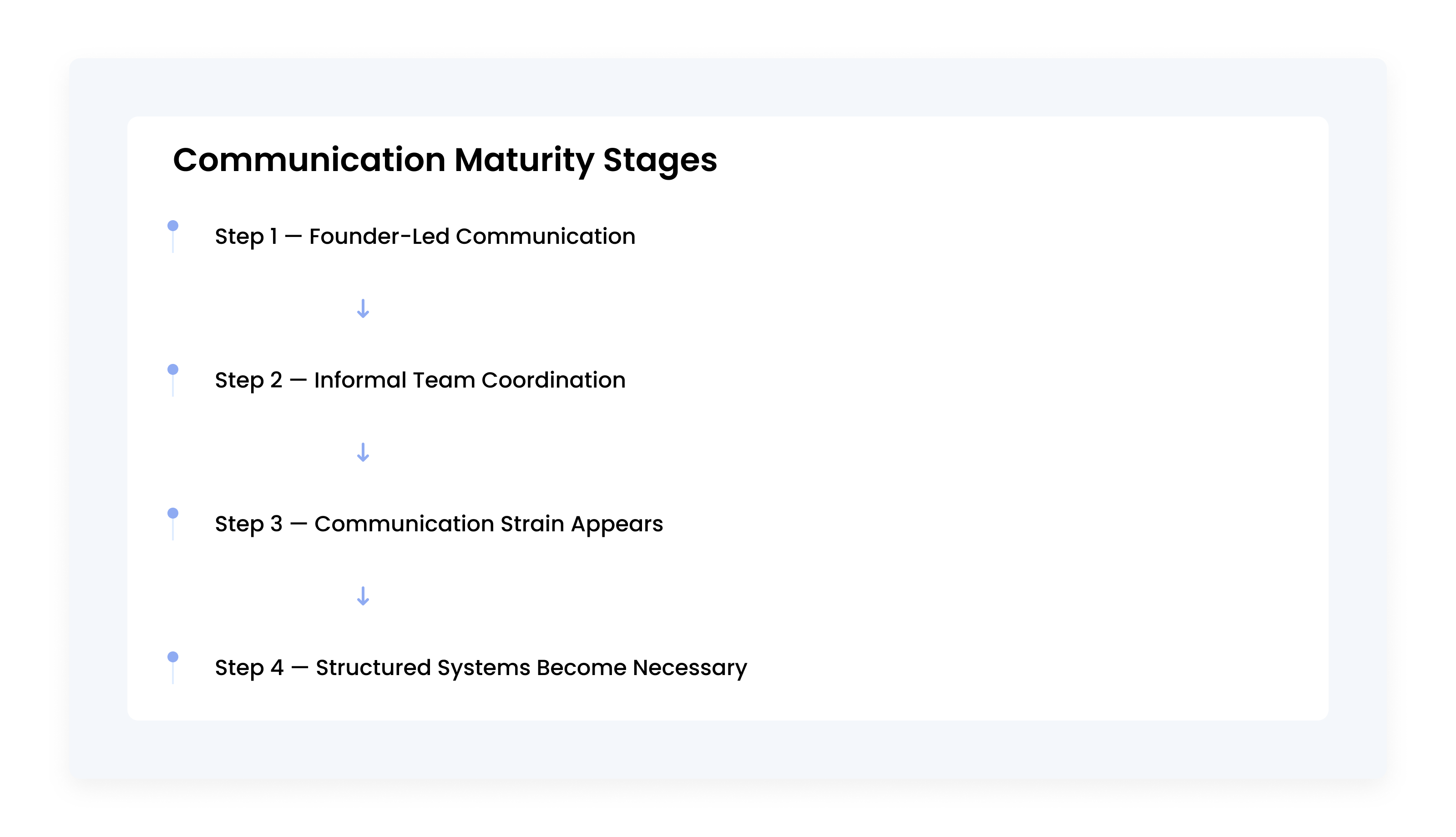
That is an important maturity shift.
At that stage, the business no longer needs communication tools merely to send messages. It needs systems capable of preserving customer history, clarifying responsibility, keeping next steps visible, and reducing uncertainty as conversations move through the organization.
The businesses adapting successfully to this shift are usually not the ones adding the most tools. They are the ones reducing friction between awareness and action.
More software does not automatically create stronger coordination.
In many environments, disconnected communication systems actually increase uncertainty because employees spend more time rebuilding context than moving customers forward confidently.
The strongest communication setups tend to feel calm internally even during busy periods because responsibility remains visible and conversations retain their meaning as they move between people.
That level of steadiness does not happen accidentally. It develops through structure, repetition, and operational discipline over time.
Key Takeaways
- Shared inbox problems usually begin as coordination problems long before they look like technology problems.
- Customers judge operational reliability through continuity, not through how many channels a business offers.
- Visibility without responsibility creates activity without accountability.
- Most communication breakdowns inside growing businesses feel ordinary internally while creating uncertainty externally.
- Businesses usually outgrow informal coordination earlier than they realize.
Where TMMN Fits Into the Evolution of Structured Customer Communication
TMMN’s role inside this transition is less about replacing communication channels and more about helping businesses maintain cleaner movement around customer conversations.
That matters because many communication platforms focus primarily on message delivery while coordination behind the scenes remains disconnected.
The businesses experiencing the most communication strain today are often not lacking communication tools. They are lacking structural alignment between conversations, accountability, and shared awareness.
As businesses grow, customer communication stops behaving like isolated interactions and starts behaving more like the practical system that supports scheduling, sales progression, customer confidence, field coordination, internal accountability, and long-term retention.
That complexity becomes difficult to manage through disconnected inboxes and informal coordination habits alone.
The longer-term direction of systems like Spoken Touch reflects a broader shift already happening across service businesses and customer-facing teams. Customer history, assignment visibility, internal collaboration, and conversation movement are starting to belong in the same place instead of being scattered across separate tools.
Not because it sounds modern.
Because businesses eventually reach a point where informal coordination becomes too fragile to support continued growth reliably.
The companies adapting well to this transition are usually not the ones chasing the most features. They are the ones reducing uncertainty inside customer movement.
They create environments where customers do not have to repeat themselves repeatedly. Where responsibility survives handoffs. Where internal awareness remains intact even during busy periods. Businesses moving in that direction are usually responding to the same customer expectations outlined in What Customers Expect When Contacting a Business — Modern Communication Standards.
That often starts with something deceptively simple:
building a shared inbox that actually works. Businesses trying to centralize customer conversations without losing accountability can explore how these workflows operate in practice through a 14-day free trial.

.svg)