



Recognizing the Shift: Why Solo Communication Won’t Scale
In the early days of a small business, the owner or solo operator personally handles every customer interaction. Whether it’s a text message, phone call, or email, that one person manages the flow of information and responses. This setup provides tight control and a consistent voice. But once the number of conversations climbs beyond a handful each day, maintaining the same level of individual attention quickly becomes unmanageable.
Picture a boutique home goods store run by Lisa, the owner, who answers every inquiry herself. If a customer texts about product availability, Lisa not only replies but also handles follow-up questions and coordinates pickup or shipping. The conversation stays contained, and customers appreciate the personal touch. However, as business grows and inquiry volume doubles or triples, Lisa finds herself spending half her day just keeping up with messages. It no longer feels sustainable.
To handle this growth, Lisa must shift from solo communication to a team-based approach. This isn’t a minor change—it fundamentally alters how customers experience the business. Without careful adjustment, the clarity and immediacy once guaranteed by a single contact can quickly erode. Incoming messages start bouncing among multiple people, and customers lose the direct connection they’d grown used to.
Lisa’s turning point comes when she hires an assistant, Sarah, to help manage her workload. At first, Sarah starts replying independently to inquiries. Within days, however, customers begin repeating questions or express confusion over order statuses. Lisa realizes the simple act of bringing someone else into conversations has introduced new operational challenges—fragmented exchanges, delayed follow-ups, and inconsistent messaging.
Many operators face this scenario unprepared. They expect extra help to lighten the load and maintain customer satisfaction, only to discover that adding people without a clear process often creates more problems than it solves, costing time and customer goodwill.
Understanding Customer Expectations in Multi-Person Conversations
Customers rarely focus on who exactly they’re talking to within a business. The principles discussed in What Customers Expect When Contacting a Business — Modern Communication Standards become even more important once multiple people begin participating in customer conversations. What matters to them is that the interaction feels smooth, responsive, and reliable. When a new team member joins the communication chain, customers don’t lower their expectations. They still want quick answers, a consistent voice, and seamless progress toward achieving their goal — whether that’s buying a product, scheduling a service, or resolving a question.
Consider David, a regular customer of an online subscription box company. Initially, he communicated directly with the founder and received personalized answers about his preferences. When the company hired a support coordinator, responses came from multiple voices that sometimes used different terminology or failed to acknowledge previous conversations. David didn’t want to repeat himself or chase down information; he assumed the team was coordinated.
This disconnect creates friction. Many of these issues stem from the same breakdowns examined in Why Businesses Lose Track of Customer Conversations (And How to Fix It), where visibility gaps and missing context create unnecessary customer effort. Customers notice delays, repeated questions, and changes in tone, leading them to wonder if their business still matters. Doubt creeps in: Will their request be handled promptly? Is the company paying attention? If messages go unanswered or replies lag, customers begin to question the company’s responsiveness and may look elsewhere.
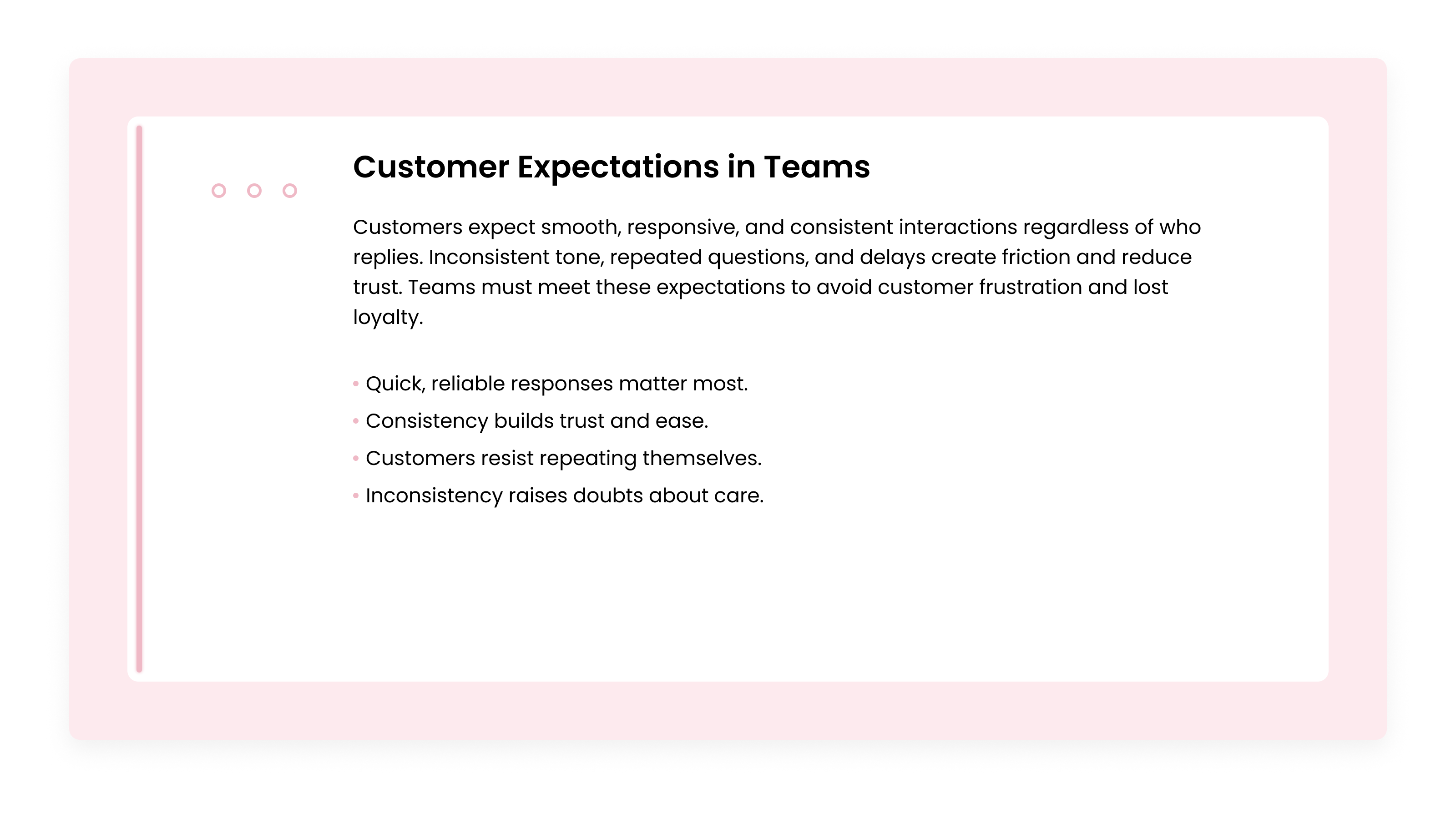
A key point is how much effort customers feel they must invest. When dealing with a single person, the communication line is straightforward. But when multiple people get involved, customers often feel they have to work harder to keep the conversation moving. They may need to repeat information or wait for internal team coordination. That extra effort translates into friction, even if the business thinks it’s only distributing the workload.
Impatience with inconsistency is another customer expectation. Conversations that jump in style, timing, or quality come across as unreliable. The trust built over time with a single contact dissolves unless the team creates shared standards to maintain a consistent experience.
Diagnosing Team Communication Gaps: A Practical Framework
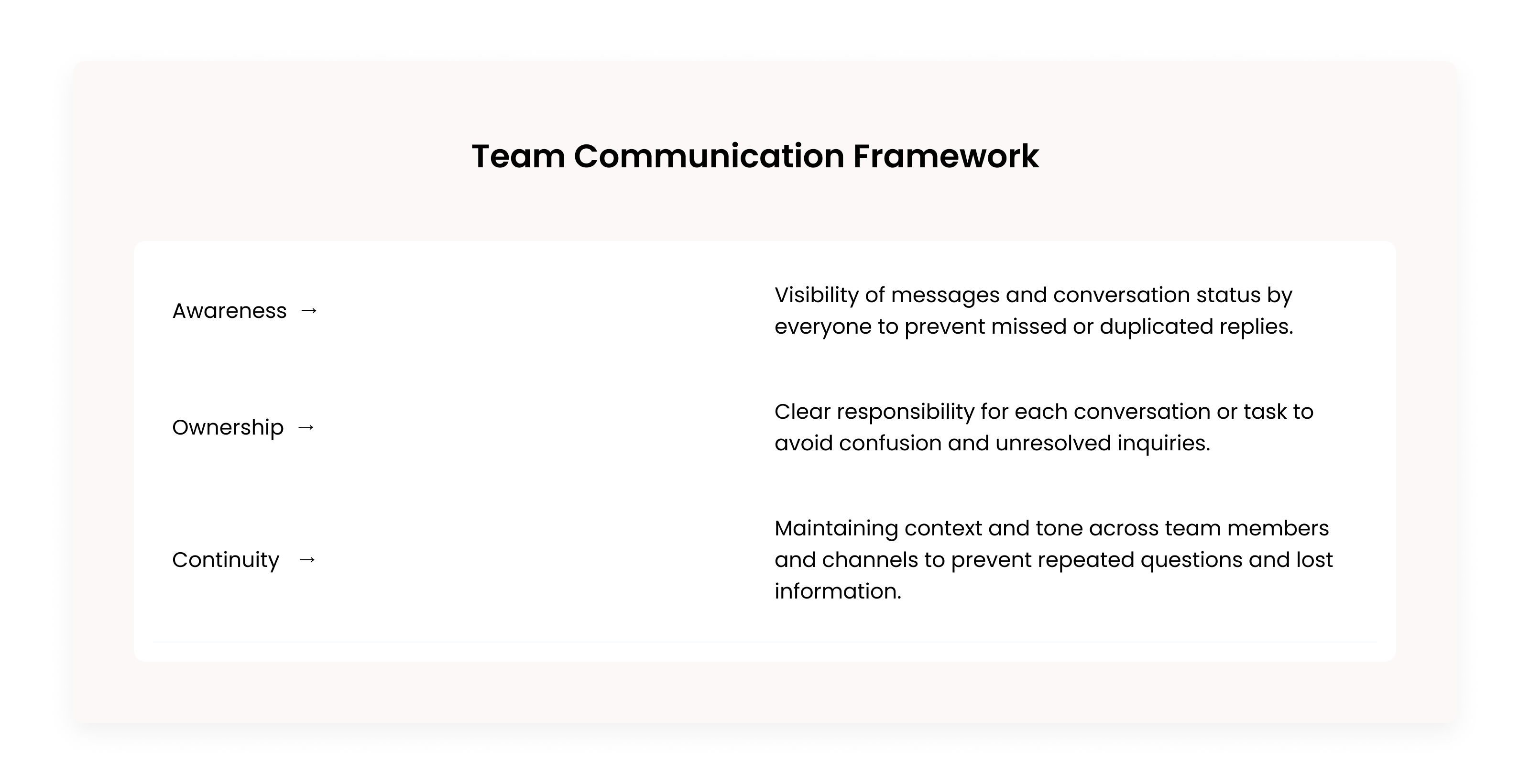
As businesses transition from solo to team-based communication, breakdowns tend to happen in familiar ways. A simple framework focused on three elements—Awareness, Ownership, and Continuity—helps pinpoint problem areas and guide solutions.
Awareness means everyone on the team clearly sees incoming requests and the current status of customer conversations. When awareness fails, messages fall through the cracks or get duplicated. For example, Sarah might not know Lisa promised a follow-up until the customer asks again, exposing a missed internal handoff. In one moment, Sarah returned from lunch to find a flurry of messages she hadn’t noticed, some of which needed urgent replies. She felt blindsided because no clear system highlighted pending follow-ups while she was away.
Ownership ensures one person takes responsibility for each conversation or task, preventing confusion about who’s handling what. If ownership isn’t clear, inquiries bounce between people without resolution, triggering “I thought you were handling that” moments. This confusion breeds gaps and frustration. Once, Lisa assigned Sarah to manage all product inquiries, but when a question about shipping unexpectedly popped up, both hesitated, assuming the other would take care of it. The message lingered, unresolved for hours.
Continuity preserves context and tone throughout a conversation’s lifespan, especially when it passes from one team member to another or shifts channels—from text to phone, for instance. Many of the operational habits covered in How Teams Actually Handle Customer Conversations Without Losing Context are designed specifically to prevent these handoff failures. Without continuity, customers face repeated questions, inconsistent answers, and feel as if they’re starting over each time. When Jenna asked about shipping after Sarah’s initial stock update, the assistant who responded next had no notes, forcing Jenna to restate information she’d already provided. Frustration shadowed the exchange.
Fixing just one element isn’t enough; success demands all three align. Awareness without ownership leaves tasks seen but not done. Ownership without continuity leads to robotic, disconnected replies. Continuity without awareness risks delays that frustrate customers.
An operational insight: these three elements form the invisible backbone of team communication. When one weakens, the whole system falters—not because people aren’t trying, but because gaps quietly expand beneath the surface.
Quantifying the Impact: How Inefficiencies Affect Time and Trust
Beyond theory, it helps to see how these inefficiencies hit operations and revenue in real terms.
Lisa’s shop now receives roughly 50 customer messages daily—texts, social media inquiries, emails. She no longer handles all messages alone; Sarah and another assistant also reply. One busy morning, 20 new messages arrive. Ideally, these get distributed evenly with replies within a day.
In reality, unclear roles and tracking cause problems:
- Three messages remain unanswered by day’s end.
- Five customers get conflicting or unclear responses, prompting follow-up questions.
- Two inquiries require multiple team members to clarify before resolving.
Assuming each order averages $100 and about 20% of inquiries convert, lost sales add up:
- 3 unanswered messages represent $300 in potential revenue lost (3 x $100 x 20%).
- 5 confused responses lead 40% of those customers to drop off or buy elsewhere, costing $200 (5 x $100 x 20% x 40%).
- Duplicated efforts mean extra staff time. Clarifying a doubled inquiry takes 15 extra minutes; at $20 per hour wage, that’s $10 per case, or $20 total for two cases.
In total, about 1.5 hours of avoidable work piles up daily, along with around $500 in direct missed revenue. Over a month, lost sales could reach $6,000, not accounting for trust damage affecting customer loyalty.

Beyond dollars, this inefficiency burdens staff, who juggle unclear responsibilities, repeated follow-ups, and inconsistent info. Frustration mounts as employees feel caught between serving customers and smoothing internal missteps—eventually hurting morale and the customer experience.
This scenario shows how small cracks multiply into significant costs before they become obvious problems. The steady drip of wasted time and waning trust quietly undermines growth.
Real-World Patterns: How Team-Based Messaging Changes Behavior
When a team takes over customer communication, certain behavior patterns emerge among staff and customers, creating practical challenges.
Staff often juggle more fragmented tasks. Instead of focusing on a few conversations deeply, team members react to scattered notifications across channels. This fragmenting boosts the chance of mistakes or overlooking details that a solo operator would catch. Sarah described her mornings as “jumping around so much, it’s hard to get into the flow of any one conversation.”
Teams also develop “zones of ambiguity” over ownership. One person may start handling a conversation but drop it midstream; others hesitate jumping in without clear guidance. This leads to follow-up delays and inconsistent messages. The phrase “I thought you were covering that” becomes common. After a weekend, Lisa noticed a string of complaints about late replies and traced them to questions bouncing back and forth without clear accountability.
In Lisa’s shop, Sarah once received an urgent customer message late on Friday. She assumed Lisa would take care of it, while Lisa expected Sarah to reply. The message went unanswered, missing a callback opportunity. Internally tense and externally disappointing, the break didn’t cause a crisis but revealed a weak link.
From the customer side, behavior shifts toward testing responsiveness. When replies slow or feel inconsistent, doubt creeps in. Customers may disengage, switch providers, or repeatedly follow up for reassurance.
Remember David from the subscription box example? After positive early experiences, he noticed delays and answers coming from different people who didn’t know his past preferences. Instead of complaining, he silently paused orders for a month and browsed competitors—not because of price or product quality, but because the trust and ease had faded.
Small gaps like these quietly add up to lost business without explicit complaints. Customers step away gradually, triggered by subtle signals: hesitation, silence, and repeated explanations.
Where Businesses Usually Go From Here
As businesses gain experience with team communication, many find common "quick fixes" don’t work. Adding more software platforms without adjusting processes often leads to alert overload and confusion rather than clarity. Expanding the responding team doesn’t help if responses overlap or conflict. Shared inboxes without clear role definitions spark turf wars and missed messages. Lengthening response times from complexity erodes business reliability.
Instead, operators discover a few crucial lessons:
First, every conversation must have clear ownership—someone accountable for seeing it through. This doesn’t mean one person handles everything but that no inquiry falls between the cracks with multiple people assuming someone else is responsible.
Second, systems and routines should promote visibility so the team knows what’s pending and who’s working on it. Without this, things can look busy but real progress stalls.
Third, maintaining context and customer preferences is vital. Teams develop shared language or note-taking habits to preserve continuity, especially when conversations pass between people or touch different channels.
For Lisa’s team, this meant operational shifts: each new inquiry was triaged and assigned, with a shared tagging system marking conversation status and notes. When Sarah stepped away, Lisa could pick up exactly where the conversation stopped. This reduced duplicate replies and eased customer hesitation.
One telling moment came when Sarah replied to a customer about stock availability but didn’t confirm delivery details. Two hours later, the delivery team asked about the customer’s request, assuming Sarah had completed it. Lisa thought the same, resulting in a delayed shipment and a customer complaint.
This incident reinforced the need for clearer ownership—not just for initial replies but for all next steps—and formal handoff protocols.
The Insight Line: Fragmentation rarely looks like failure. It looks like busyness.
Operators often mistake activity for progress. The challenge is keeping awareness and responsibility amid the noise.
Jenna’s growing doubt shows how trust erodes subtly. After her first delayed message and conflicting replies, she shifts from hopeful to hesitant. Instead of complaining, she waits and repeats her question. When the answer remains incomplete, she sends fewer messages and eventually buys from a different store—without explanation. From the outside, her silence seems deliberate but is really quiet frustration and communication fatigue.
This example captures a frequent unseen consequence: trust declines before leads are lost. Customers rarely announce they’re moving on; they simply withdraw.
What Small Teams Eventually Discover
Experience proves that moving from solo to team messaging demands distributed responsibility combined with intentional clarity-building. Teams who invest time in simple, practical systems for tracking conversations, assigning ownership, and preserving context avoid many common traps.
Simplicity beats piling on more software or more people. Effective systems fit naturally into daily work, requiring minimal extra effort.
Some teams draft “handoff checklists” or brief status notes to capture the conversation’s state before passing it along. Others assign a triage role to ensure no inquiry slips unacknowledged. These routines shape an operational rhythm aligned with real workflows, not idealized models.
Each business grows at its own pace, but an enduring lesson emerges: team communication won’t run itself. It requires continuous attention to who’s aware, responsible, and how conversation context moves between people. Awareness of these three elements separates chaotic teams struggling to keep up from well-coordinated groups delivering steady, consistent customer experiences.
Success lies less in tools or features and more in everyday moments of clarity and shared responsibility.
Key Takeaways
- As communication scales, control shifts from a single voice to a shared system; without deliberate coordination, that shift magnifies missed messages and confusion.
- Customers measure responsiveness by ease and consistency, not by how many people answer; disjointed conversations raise doubts quietly but decisively.
- Team communication breaks down when awareness, ownership, and continuity are out of sync; improving one without the others rarely fixes the underlying issues.
- Fragmentation in team messaging feels like busyness rather than failure, masking operational leaks that erode trust and productivity over time.
- Practical clarity-building—assigning clear ownership, ensuring visibility, and preserving conversation context—outweighs piling on tools or expanding headcount.
H2 Conclusion
Shifting from solo communication to team-based messaging is a natural step as businesses grow. Yet it unfolds new challenges, exposing complexities beneath what once seemed straightforward. Quiet errors accumulate: unanswered messages, customers who stop responding, frustrated staff unsure who owns what.
The realities of daily operations—missed handoffs, “I thought you handled it” moments, hesitant customers—draw a picture far from tidy theories. Observing these moments teaches a vital truth: running a small team means managing conversations with ongoing attention to awareness, ownership, and continuity.
This isn’t a problem solved once and forgotten. For many small teams, a 14-day free trial provides a practical way to observe how conversation ownership, visibility, and continuity function under real operating conditions. It’s a continuing rhythm shaping how customers experience the business day after day. Those who recognize and adapt to these realities build stronger connections—not by adding more responders but by fostering shared clarity and true responsibility across their team.

.svg)

.png)