Why Texting Is the Starting Point, Not the Finish Line
Texting earns its place early because it removes friction fast. Customers don’t have to wait on hold. Teams don’t have to block time for every interaction. Quick questions get quick answers, and follow-ups that used to fall through the cracks suddenly happen. For small businesses, SMS often feels like the first real communication system that actually works.
At low volume, this is enough. Conversations are few, ownership is obvious, and memory fills in the gaps. One person can manage most interactions without needing structure, handoffs, or documentation. Texting feels efficient because it is.
The problem begins when growth changes the shape of communication.
As customer volume increases and more people touch the same conversations, texting starts to absorb responsibilities it was never designed to handle. Threads get longer. Context spreads across days or weeks. Multiple team members step into the same exchange. What once felt lightweight begins to feel fragile.
Texting doesn’t fail because it stops delivering messages. It fails because businesses start using it as a complete communication strategy rather than what it is: an entry point. SMS is optimized for speed and convenience, not for continuity, escalation, or shared ownership. When those needs appear, relying on texting alone forces teams to stretch it beyond its natural limits. This pattern is closely aligned with the core argument in Why Texting Alone Isn’t Enough as Your Business Grows (And What Works Instead), which examines how communication complexity outpaces single-channel systems as teams expand.
That’s why businesses often feel like communication is “breaking” even though response times are fast. The issue isn’t effort. It’s that the system no longer matches the complexity of the conversations it’s supporting.
The Difference Between Messages and Conversations
As businesses grow, one distinction becomes critical: messages are not the same as conversations. Treating them as interchangeable is where communication starts to break down.
Messages Are Transactional
Messages are designed for quick, contained exchanges. They work best when the goal is to deliver or receive a specific piece of information and move on.
Typical message-driven interactions include:
- Confirming an appointment or delivery
- Answering a simple pricing or availability question
- Sending a reminder or short update
In these moments, speed and convenience matter more than depth. SMS excels here because it’s lightweight and unobtrusive. The interaction starts and ends cleanly.
Conversations Are Ongoing and Contextual
Conversations extend beyond a single exchange. They involve history, intent, emotion, and next steps.
A conversation might:
- Span multiple days or weeks
- Involve more than one team member
- Shift between text and voice depending on urgency or complexity
- Build toward a decision, resolution, or long-term relationship
Conversations don’t reset just because time passes or the channel changes. Customers expect continuity, even if they can’t articulate it explicitly.
Why This Difference Matters as Businesses Scale
In the early stages, businesses can treat conversations like messages because volume is low and ownership is clear. The same person handles everything, and memory fills in the gaps.
As teams grow, that safety net disappears.
When communication systems are built only for messages:
- Context is lost when conversations pause and resume
- Customers are forced to repeat themselves
- Handoffs between team members feel clumsy
- Switching from text to call breaks the flow
These breakdowns mirror the operational friction described in The Hidden Cost of Too Many Communication Tools in Growing Businesses, where disconnected systems quietly undermine continuity. The system may still deliver messages quickly, but it fails to support the relationship behind them.
Scaling Communication Means Designing for Conversations
Scaling communication isn’t about sending more messages or responding faster. It’s about supporting conversations as they evolve.
That means:
- Preserving history across interactions
- Allowing conversations to move between channels naturally
- Making context visible to anyone who steps in
- Treating communication as a continuous thread, not isolated moments
Businesses that make this shift don’t just feel more responsive. They feel more organized, more trustworthy, and easier to work with — even as volume increases.
What Breaks When Businesses Try to Scale Messaging

At a certain point, businesses don’t just use texting — they rely on it. What once handled quick exchanges starts carrying the weight of entire customer relationships. That’s when cracks begin to show.
Texting doesn’t stop working. It just starts doing jobs it was never designed to handle.
Conversations Stretch Beyond Their Natural Limits
Messaging works best when interactions are short and self-contained. As businesses grow, those interactions stretch across multiple days, involve more details, and require follow-ups that don’t neatly fit into a single thread.
Long text chains become hard to manage. Important details get buried. Earlier context gets overlooked. What should feel like progress starts to feel like maintenance, with teams scrolling instead of moving forward.
Context Gets Lost as Volume Increases
When messaging volume rises, context becomes fragile.
Multiple conversations look similar at a glance. Threads blur together. Team members step in without knowing what’s already been discussed. Customers resume conversations assuming the business remembers, while the system provides no easy way to surface that history quickly.
This gap forces customers to repeat themselves and teams to make assumptions — neither of which builds confidence.
Ownership Becomes Unclear
Texting scales poorly when responsibility spreads.
In small teams, it’s obvious who’s replying. In growing teams, shared inboxes without structure create hesitation. Messages sit unanswered because no one is sure who owns the next response. Other times, multiple people reply, creating inconsistency.
The issue isn’t responsiveness. It’s accountability. Messaging alone doesn’t define ownership or make handoffs visible.
Urgent Issues Move Too Slowly
Texting is asynchronous by nature. That’s a strength for convenience, but a weakness for urgency.
When problems are time-sensitive or emotionally charged, waiting on back-and-forth messages increases friction. Customers want reassurance, clarity, and resolution — not a delayed exchange that stretches over hours.
Businesses that try to force urgency into text conversations often frustrate customers without realizing why.
Teams Work Harder Without Getting Faster
Perhaps the most subtle failure is effort without progress.
Teams respond quickly. Notifications are constant. Yet conversations take longer to resolve, decisions slow down, and follow-ups slip. Messaging volume increases, but outcomes don’t improve at the same pace.
That’s the signal that messaging is being asked to scale beyond its role.
Texting is powerful, but it isn’t a complete communication system. When businesses try to scale messaging instead of scaling conversations, they end up working harder just to stay in place — and that’s when communication starts to feel like a bottleneck instead of an advantage.
How Voice Fits Into Full Conversations
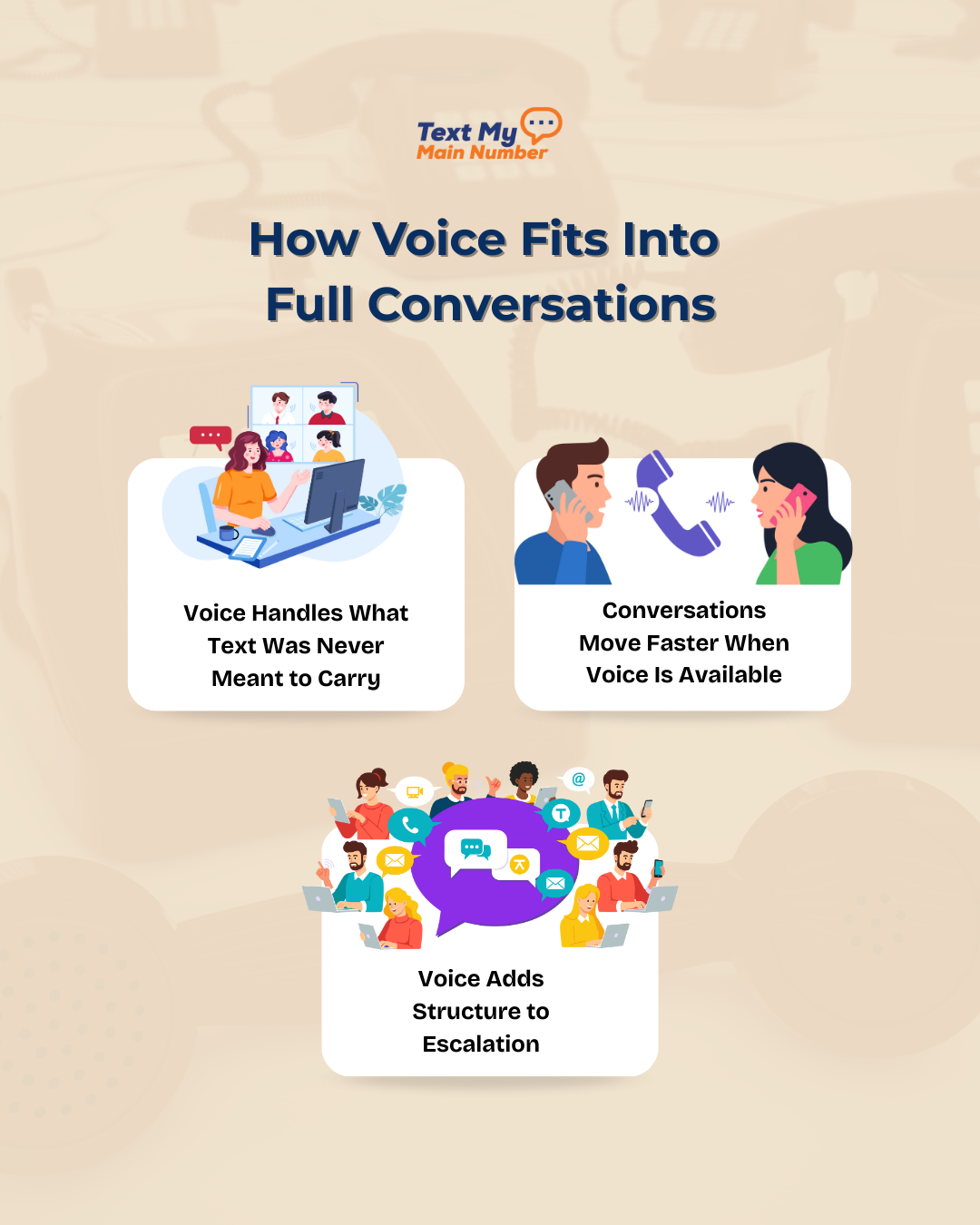
When businesses move from handling messages to managing conversations, voice stops being optional and starts becoming essential. Not as a replacement for texting, but as the support system that keeps conversations moving when messaging reaches its limits.
Texting is excellent for convenience. Voice is essential for clarity. That split matches how people actually think about contact methods — Pew Research found many adults say their preference depends on the situation, which is exactly why mature workflows treat voice as a strategic escalation rather than a competing channel.
Voice Handles What Text Was Never Meant to Carry
Certain moments in customer communication demand more than short written exchanges. Urgency, nuance, hesitation, and emotion don’t translate cleanly over text, especially when stakes are high or decisions are complex.
Voice allows teams to:
- Resolve misunderstandings immediately instead of clarifying over multiple messages
- Hear tone, uncertainty, or frustration that text can hide
- Address objections in real time without dragging momentum out over hours or days
A single call can often replace an entire chain of messages while leaving the customer feeling heard and reassured.
Conversations Move Faster When Voice Is Available
One of the biggest advantages of voice is compression of time.
What might take twenty messages spread across a day can often be resolved in five minutes on a call. That speed doesn’t just benefit the business. Customers feel relief when issues are handled decisively instead of lingering in a thread.
This is especially true when conversations reach a decision point. Pricing questions, service scope, scheduling changes, or concerns that block progress often move forward only once voice enters the picture.
Voice Adds Structure to Escalation
As businesses scale, not every interaction should stay at the same level.
Some conversations begin as simple texts and naturally escalate. Others start calmly and become urgent. Voice provides a clear next step when a situation outgrows messaging.
Instead of forcing everything to remain asynchronous, teams can shift the conversation to a call intentionally, knowing it will bring clarity rather than confusion. When that call is connected to the same conversation history, escalation feels seamless instead of disruptive.
Why VoIP Matters in Scaled Communication
Traditional calling systems treat voice as isolated events. Once the call ends, context disappears unless someone manually records it.
Modern VoIP changes that dynamic. When voice is part of a connected communication system, calls live alongside messages instead of apart from them. Teams can see that a call happened, understand why it happened, and continue the conversation afterward without starting over.
This is the difference between using voice reactively and using it strategically.
Voice doesn’t compete with texting. It completes it. And in businesses that scale communication successfully, the two work together to support full conversations from start to finish. This complementary relationship is explored further in How SMS and Voice Work Better Together for Growing Businesses, where convenience and clarity are treated as parts of the same conversation strategy.
What Full Conversations Look Like in Real Business Workflows
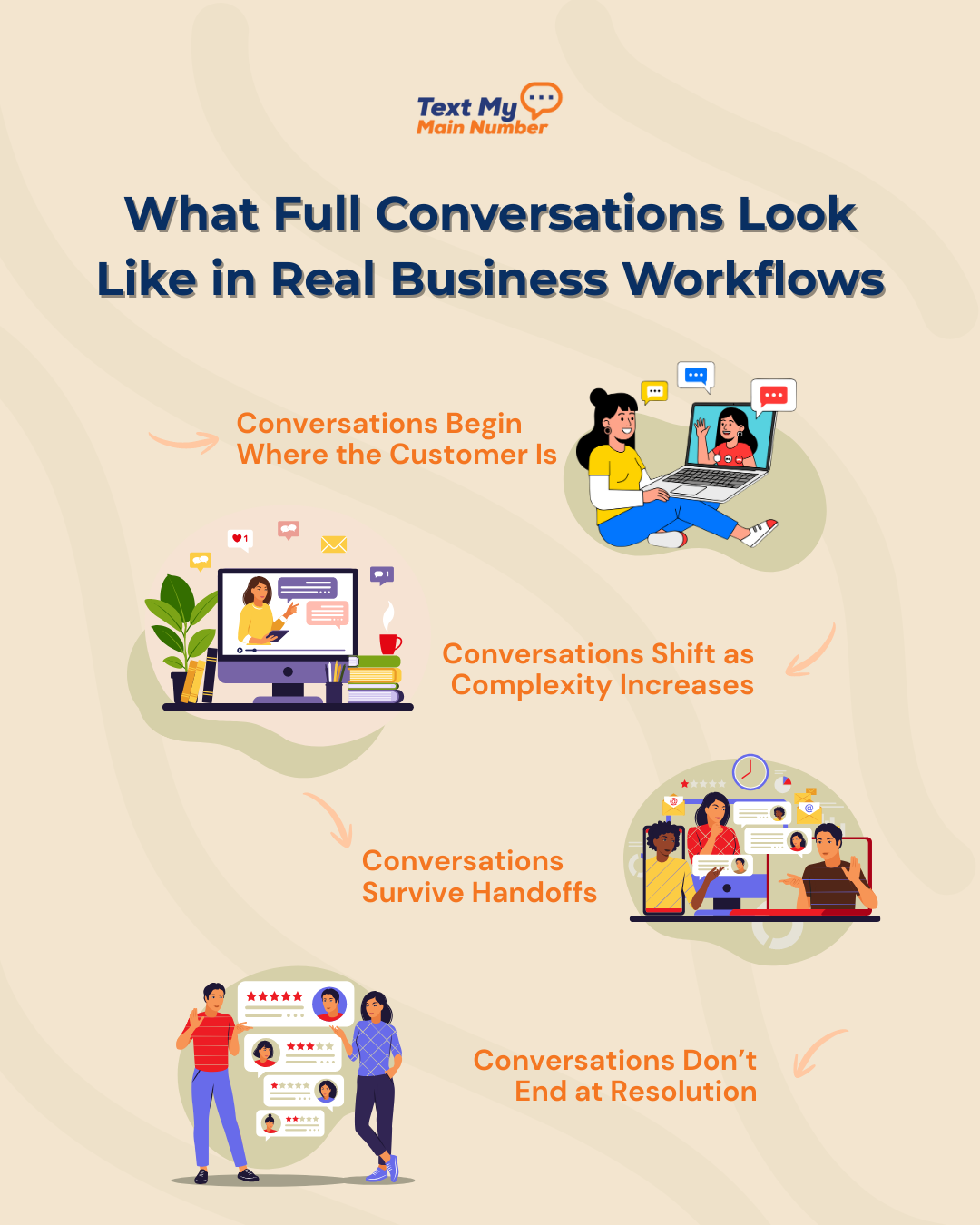
Managing customer conversations at scale isn’t about handling more messages. It’s about designing workflows that preserve context as interactions evolve. Full conversations don’t live in a single moment or channel. They move, pause, resume, and often involve more than one person.
In well-run teams, conversations follow a clear, flexible flow.
Conversations Begin Where the Customer Is
Most interactions start with convenience. A customer sends a text because it’s easy. They’re asking a quick question, checking availability, or looking for reassurance before taking the next step.
At this stage, speed matters more than depth. Teams respond quickly, confirm details, and remove friction without forcing the interaction into a heavier format.
Conversations Shift as Complexity Increases
As the interaction develops, the nature of the conversation changes.
Questions become more specific. Concerns surface. Decisions need to be made. This is where full conversations separate themselves from message exchanges. Instead of stretching a text thread indefinitely, teams recognize when a call will move things forward faster and more clearly.
The key difference in mature workflows is that this shift is intentional. The call doesn’t restart the interaction. It builds on it. The team member entering the conversation understands the context and picks up where things left off.
Conversations Survive Handoffs
In real operations, conversations rarely stay with one person.
Sales hands off to support. Support escalates to a specialist. Scheduling follows up after a call. In effective workflows, these handoffs don’t disrupt the customer experience because the conversation lives in the system, not in someone’s head.
Anyone stepping in can see what’s been discussed, what’s been promised, and what still needs to happen. Customers feel continuity even as roles change.
Conversations Don’t End at Resolution
A full conversation doesn’t disappear once an issue is resolved.
It becomes part of the relationship. Follow-ups reference past interactions. Future questions are answered with awareness of history. Over time, this continuity builds trust and reduces effort on both sides.
Teams managing full conversations aren’t just reacting. They’re building an ongoing communication record that supports long-term engagement.
Why Scaling Communication Is About Continuity, Not Speed
Fast responses are valuable, but speed alone doesn’t scale communication.
In fact, many businesses respond quickly and still feel disorganized. Messages go out. Calls happen. Yet customers repeat themselves, decisions slow down, and teams feel stretched. That’s because speed without continuity creates motion without progress.
Continuity is what allows communication to scale.
It ensures that context carries forward when conversations pause and resume. It allows interactions to move between channels without breaking. It supports handoffs without confusion. And it gives teams confidence to act without second-guessing what already happened.
When continuity is missing, teams compensate by working harder. They send more messages. They chase follow-ups. They rely on memory. Over time, that effort turns into fatigue.
When continuity is built into the system, speed becomes a byproduct instead of a goal. Conversations move forward naturally because nothing needs to be reconstructed or re-explained.
Businesses that scale communication successfully aren’t the ones that reply the fastest. They’re the ones that make every interaction feel connected, consistent, and intentional — no matter how large the operation becomes.
Where Text My Main Number Fits In
Text My Main Number is built for the exact transition this article describes: moving from handling messages to managing full conversations as a business grows.
Most teams don’t need more communication tools. They need fewer gaps. TMMN focuses on the layer where those gaps usually appear — the point where texting, calling, and follow-ups split into separate systems and people are left stitching context together manually.
By bringing business SMS and VoIP into one shared environment, Text My Main Number keeps conversations intact as they evolve. A customer can start with a text, move to a call when things get complex, and continue the conversation afterward without resetting or repeating themselves. The history remains visible. Ownership stays clear. Handoffs stop feeling risky.
For teams, this means fewer internal check-ins just to figure out what happened last. For customers, it means interactions feel continuous instead of fragmented. Communication becomes easier to manage precisely because it’s treated as one ongoing thread, not a series of disconnected moments.
The Future of Business Communication Is Conversation-Driven
Business communication isn’t moving toward a single channel. It’s moving toward continuity. That broader shift reflects what’s defined in What Unified Communications Means for Small Businesses in 2026 (And Why It Matters), where continuity replaces channel-first thinking as the foundation for scalable growth.
Customers will keep texting when it’s convenient and calling when it’s necessary. Teams will keep collaborating across roles. Conversations will continue to span days, channels, and people. The businesses that scale smoothly are the ones that design for that reality instead of fighting it.
The future isn’t about responding faster or adopting the latest tool. It’s about making every interaction feel connected, intentional, and easy to pick up where it left off.
When communication is built around conversations rather than messages, growth stops feeling chaotic. It starts feeling controlled. Texting and calling work best when they work together.
Start a 14-day free trial with Text My Main Number and see how connected SMS and VoIP help your team manage full customer conversations without losing context as you scale.

.svg)