

Most small business owners don’t spend their day thinking about phone systems. They think about customers, deadlines, scheduling issues, hiring, billing, and solving problems that pop up without warning. The phone only becomes top of mind when something goes wrong — a missed call that turns into a missed sale, a frustrated customer who couldn’t reach anyone, or a bill that suddenly looks higher than last month.
That’s usually when the big question surfaces:
Should we stay on a landline… or finally switch to VoIP?
It’s a fair question. Your phone number is more than a tool — it’s part of your identity. Customers trust it, your team relies on it, and operations depend on it. But the way businesses communicate has changed dramatically, especially over the last five years. Remote work is normal, customers expect text messaging, and flexibility is now a standard requirement, not a luxury.
That’s why so many small businesses in 2026 are re-evaluating VoIP vs landline — not in a technical sense, but in a real, everyday workflow sense. Which option actually supports your team, your customers, and the way your business runs right now?
Let’s break it down simply and clearly, human to human.
VoIP vs Landline: A Simple, Honest Comparison
Imagine two vehicles.
A landline is the old work truck your grandfather drove. Reliable. Predictable. Familiar. It has its quirks, but it gets the job done the same way it always has.
VoIP is the modern SUV. It does everything the truck can do, but with features designed for today’s world — Bluetooth, navigation, backup cameras, comfort, and efficiency.
Both vehicles will get you where you’re going. But only one reflects the reality of how people live and work in 2026.
Here’s the key distinction many business owners overlook:
Landlines are tied to a place.
VoIP is tied to people.
If your team works from the same desks every day, never remote, never mobile — the landline might still feel fine. But if your staff rotates locations, works from home, travels between job sites, or needs to stay reachable after hours… VoIP instantly fits that workflow better.
And because so much communication now happens via text, VoIP aligns naturally with how customers already prefer to interact. Businesses that want to strengthen their texting strategy can explore proven methods inside our guide on boosting SMS customer engagement.
How VoIP Works (Don’t Worry — It’s Simple)
VoIP sounds technical, but the idea is incredibly straightforward.
Instead of sending your voice through old copper wires buried underground — wires that haven’t fundamentally changed in decades — VoIP turns your voice into a digital signal and sends it over the internet. According to the FCC guidance on VoIP and traditional telephone networks, businesses are steadily shifting away from copper landline infrastructure as digital communication becomes the standard.
That’s it.
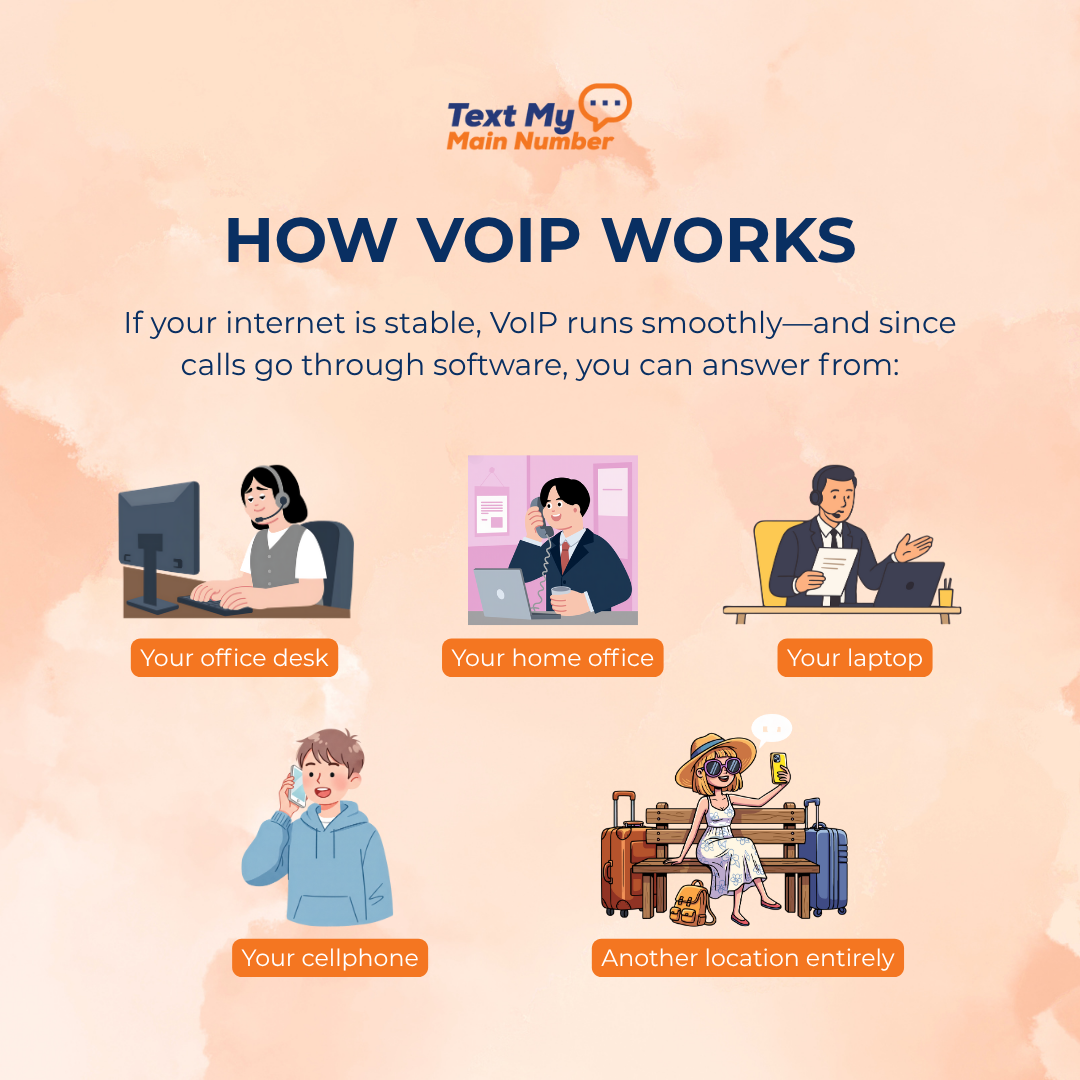
If your internet is stable, VoIP works smoothly. And because calls run through software instead of hardware, you can answer from:
- your office phone
- your home office
- your laptop
- your cellphone
- another location entirely
Customers don’t need to know where you are. They just get a clean, fast, professional answer.
This mobility is a big reason VoIP surged during the pandemic and stayed dominant afterward. Modern businesses aren’t static — they’re fluid. And communication systems need to match that.
What VoIP Actually Feels Like Day to Day
Most business owners don’t switch to VoIP for features or savings. They switch because of moments — those everyday pain points that landlines can’t solve.
Picture this:
You’re driving to a job site when a high-value customer calls. The office rings, but no one is there. With VoIP, the call rings your cellphone too. You answer, save the job, and keep the customer. If your business relies on texting alongside calls, make sure your number is fully compliant. Our guide on 10DLC registration for small businesses explains how to register properly so messages stay reliable.
Or this:
Your receptionist is out sick. Staff is stretched thin. Calls are backing up. With VoIP, you reroute everything in seconds — no technician needed.
Another:
Customers increasingly prefer texting for quick questions. VoIP integrates naturally with business texting — especially when paired with text enablement from TMMN — so communication stays unified.
Or a big one:
You hire someone new. With VoIP, you add extensions instantly. No hardware. No installation. No waiting.
This is why so many teams describe VoIP as relief. It removes friction. It adapts to chaos. It supports the unpredictable parts of running a small business.
The Only Real Downside
Yes — VoIP depends on your internet connection.
If your internet is unreliable, your call quality may suffer.
But most businesses today already have strong broadband, and VoIP providers offer built-in failover options that automatically route calls to mobile devices if an outage happens.
For the large majority of businesses, the upside far outweighs the downside.
Where Landlines Still Make Sense
Landlines still have a home in certain industries — medical offices, government facilities, long-established operations, and locations where pure simplicity is the priority.
And they do offer something appealing:
Predictability.
No updates. No settings. No onboarding. Pick up the phone, dial, and talk.
But customer expectations have changed.
People now expect:
- speed
- convenience
- texting
- remote communication
- flexibility outside 9–5
A landline wasn’t built for that world. Not because it’s bad — but because it was designed for a different era.
And when your business grows, landlines quickly become expensive:
- each new line costs more
- every office move requires installation
- every upgrade needs hardware
Eventually, the “old truck” becomes a limitation instead of an asset.
Let’s Talk Money: VoIP vs Landline Costs in 2026
At first glance, landlines seem cheaper. They’re older, so owners assume they’re more affordable.
But once you break the numbers down, that’s rarely the case.
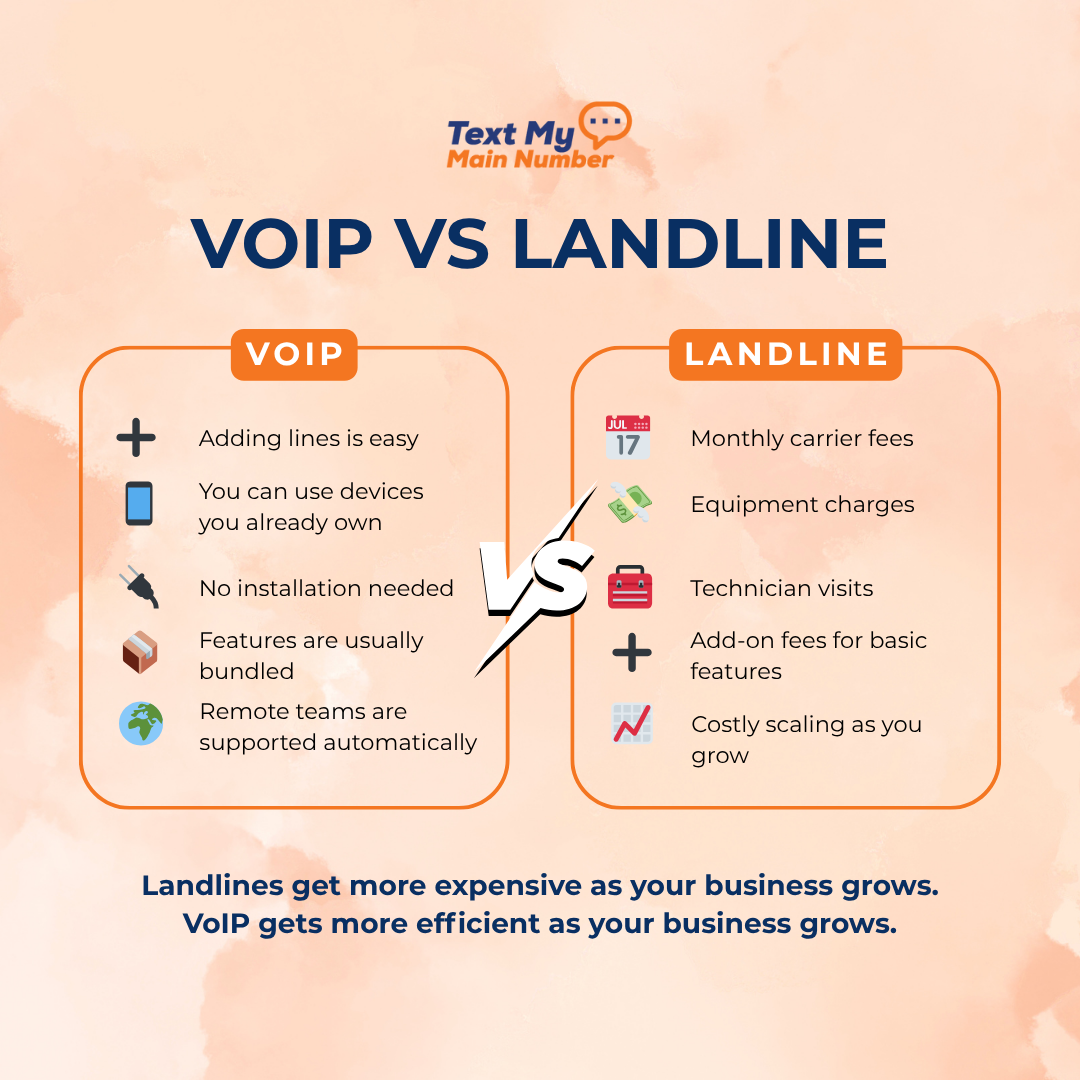
Landlines come with:
- monthly carrier fees
- equipment charges
- technician visits
- add-on fees for basic features
- high costs for scaling
VoIP flips that model. You’re paying for software, which means:
- adding lines is simple
- you can use hardware you already own
- installation isn’t needed
- features are bundled
- remote teams are supported automatically
Here’s the real cost difference:
Landlines get more expensive as your business grows.
VoIP gets more efficient as your business grows.
And if you’re paying separately for texting, routing, after-hours rules, or auto-responses, VoIP usually consolidates everything into one unified system.
So Which One Is Right for Your Business?
If your team works from the same desks, in the same building, every day… your landline may still be fine.
But that’s not how most businesses operate anymore.
Most small businesses in 2026 have:
- hybrid schedules
- remote staff
- field workers
- multiple locations
- seasonal hires
- customers who prefer texting
- the need to stay reachable everywhere
In those cases — which represents the majority — VoIP isn’t just a smart option… it’s the better long-term strategy.
And if you’re worried about losing your phone number, don’t be. Porting is standard now. You keep the same number.
Many businesses switch gradually by adding VoIP alongside their existing landline or by pairing VoIP with texting (via TMMN) to modernize communication without disruption.
The Bottom Line
Customers expect more in 2026 — faster replies, cleaner communication, and multiple ways to reach you. Landlines weren’t designed for that world.
VoIP was.
And in 2026, choosing VoIP is less about leaving the past behind and more about aligning your business with how people communicate today.
A Better Way to Communicate Starts Here
If you’re ready to modernize communication without switching carriers or changing your number, Text My Main Number can help.
Turn your existing landline or VoIP number into a full texting channel — fast setup, no downtime, and real human support.
Start your 14-Day Free Trial →

.svg)