
An AI can encounter a surprising amount of business information in an ordinary day: service descriptions, customer requests, operating policies, schedule changes, employee instructions, exceptions, complaints, and offhand comments made during conversations.
The difficult question is not whether all of that information can be collected. It is what the AI should be allowed to retain and use later.
That makes AI memory for business a governance decision, not a storage setting. This governance focus aligns with the principles discussed in How Businesses Handle 50+ Customer Conversations Per Day Without Chaos, underscoring the importance of clear ownership and controlled information flow in avoiding confusion.
An unrestricted record may preserve information that was temporary, mistaken, sensitive, or never approved as an operating rule. A memory that is too narrow may leave the AI without the context needed to support useful work. The operator has to decide where that boundary belongs.
A workable approach separates information into distinct categories:
This classification parallels frameworks in How to Assign, Track, and Close Customer Conversations Efficiently, which highlights structured segmentation to maintain clarity and accountability.
- Approved knowledge about the business
- Customer-specific information retained for a defined purpose
- Conversation-derived evidence that still needs review
- Temporary information that should not become durable memory
- Information that should not be retained at all
Those categories need different owners, retention boundaries, and review standards. Treating them as one undifferentiated pool creates confusion about what the AI knows, what it merely encountered, and what it has authority to rely on.
AI Memory Is a Business Governance Decision

The phrase “AI memory” can make the issue sound like a technical choice: turn memory on, increase its capacity, and give the system more context.
That skips the operator’s most important decisions.
Memory affects what the AI may carry from one interaction into another. Once information is retained, it can potentially influence future responses or proposed actions. The real questions are therefore operational:
- Which information is appropriate for reuse?
- Who approved it?
- For which tasks may it be used?
- How long should it remain in scope?
- What happens when it conflicts with more authoritative information?
- Who reviews whether it is still appropriate to retain?
These questions matter because a conversation, a memory, a policy, and current business truth are not interchangeable. A customer can report something that deserves attention without establishing a company-wide rule. An employee can describe a temporary exception without changing the standard service policy. A manager can discuss a possible change without authorizing it.
The AI may have encountered the words in every case. That does not mean the business has approved those words as reusable knowledge.
More memory is not automatically better memory. The useful target is governed context: information selected for a business purpose, placed within a defined scope, and reviewed by someone with the authority to make that decision.
Start With the Decisions the AI Needs to Support
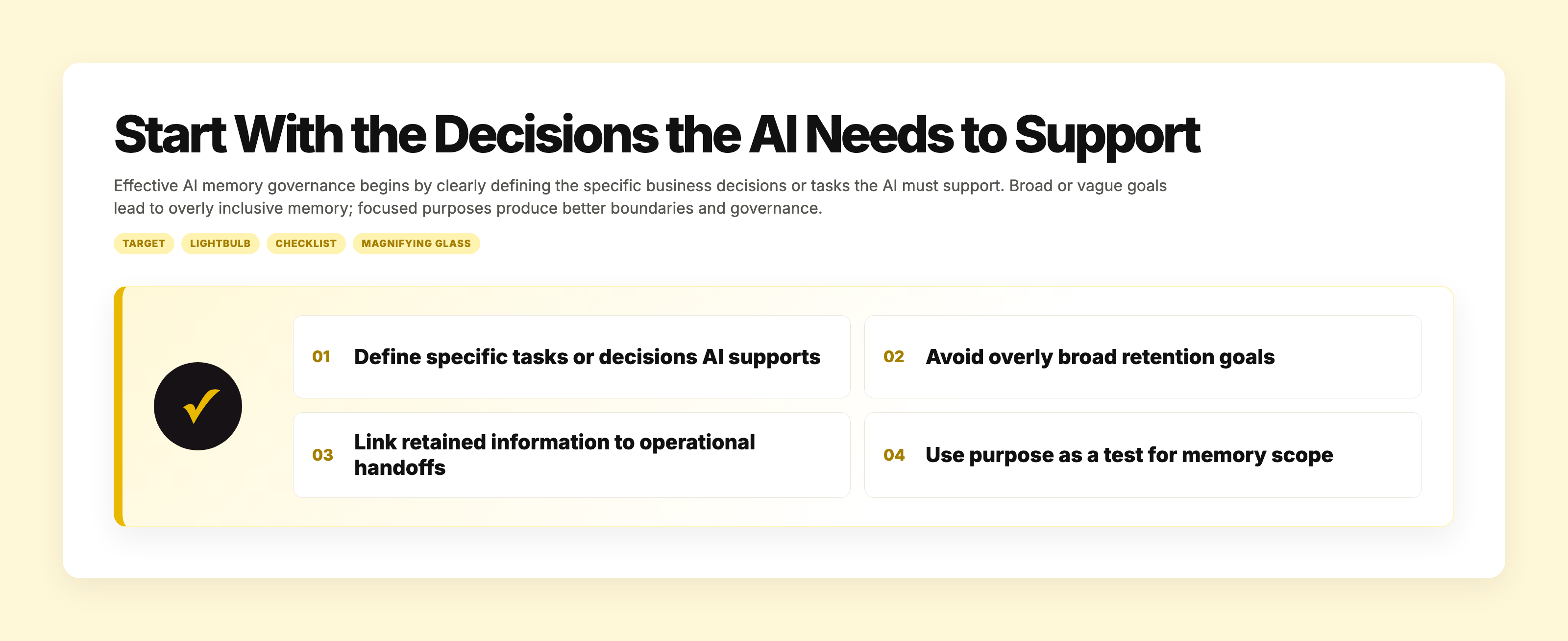
Before deciding what the AI should remember, define the work that retained information is supposed to support.
“Help with customers” is too broad. It leaves no meaningful boundary around what the system might retain. A narrower purpose produces better governance:
- Explain standard services and operating hours
- Prepare appointment requests for staff review
- Identify the customer and the location related to a request
- Preserve an approved communication preference
- Escalate requests involving exceptions
- Draft follow-up based on an authorized service status
Each purpose creates a different memory requirement.
An AI that explains standard services may need approved service descriptions, coverage boundaries, and escalation rules. It does not necessarily need a durable record of every person who asked a question.
An AI that supports an ongoing customer request may need selected customer-specific details. It still does not need every remark from every conversation. The retained information should be limited to what the defined task requires.
This purpose-first test prevents collection from becoming the default. Instead of asking, “Could this be useful someday?” ask:
> Which specific business decision or handoff becomes more reliable if this information is retained?
If no one can name that decision or handoff, the case for durable retention is weak. The information may be useful during the immediate interaction, but usefulness in the moment does not by itself justify future reuse.
Create an Approved Business-Knowledge Layer
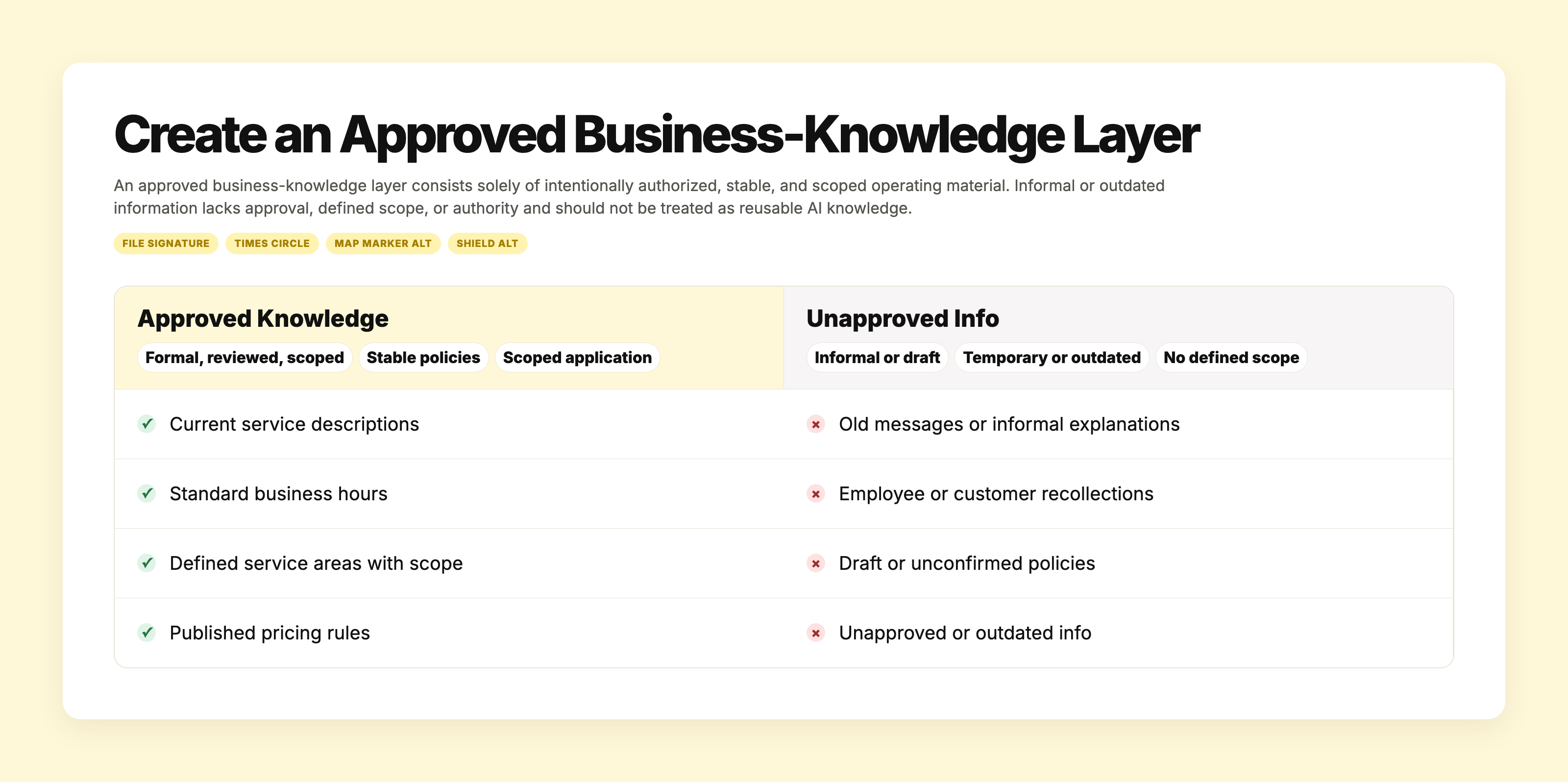
The first category to establish is approved business knowledge: information the organization has intentionally authorized for AI use.
This layer can include stable operating material such as:
- Current service descriptions
- Standard business hours
- Defined service areas
- Published pricing rules
- Scheduling requirements
- Approved answers to recurring questions
- Escalation conditions
- Policies governing cancellations, refunds, or exceptions
- Rules describing which decisions require a person
The key word is approved.
A service detail copied from an old message is not automatically approved knowledge. Neither is an employee’s informal explanation, a draft policy, or a customer’s recollection. The source may contain useful evidence, but authority comes from the business’s review and approval—not from the AI’s ability to retrieve the text.
This approved layer also needs visible boundaries. If a rule applies only to one location, service, customer category, or time period, that scope belongs with the rule. Otherwise, a statement that was correct in one setting can be misapplied elsewhere.
Conflicts should be resolved by authority, not by repetition. Ten old mentions of a policy should not outweigh one current, authorized policy. Frequency tells you that the AI encountered something often. It does not tell you that the information remains current or that the speaker had authority to establish it.
Building this layer is less about feeding the AI everything the business has written and more about selecting the material the business is prepared to stand behind.
Separate Customer-Specific Information From General Business Knowledge

Customer information should not be mixed casually into the same pool as organization-wide knowledge.
Separating customer-specific data echoes guidance from Business Texting for Small Companies: What Are the Benefits?, which emphasizes tailored treatment of individual customer details for effective communication.
A business policy may be appropriate across many interactions. A customer’s address, service history, accessibility need, contact preference, or active request applies within a narrower scope. That difference should be explicit.
For each type of customer-specific information, decide:
1. Purpose: Why is this detail needed?
2. Scope: Which customer, account, location, or active matter does it apply to?
3. Use: Which responses or proposed actions may rely on it?
4. Access: Which people or systems should be able to retrieve it?
5. Retention: When should it be reviewed or removed?
6. Authority: Who can approve its continued use?
Even an apparently convenient detail can create problems if retained without a boundary. “Call in the afternoon” could be a lasting communication preference, a one-day request, or an instruction connected only to a particular appointment. The words alone do not establish the intended duration.
Avoid treating durable customer memory as an automatic or universally available capability. Software implementations differ, and planned directions should not be mistaken for deployed, production-ready controls. If persistent customer information is important to the operation, verify that the actual system can enforce the required scope, access, retention, and review boundaries.
Until those controls are confirmed, a documented business requirement is not the same as a functioning memory capability.
Treat Conversations as Reviewable Evidence, Not Automatic Memory
Conversations are valuable because they reveal requests, changes, disagreements, and possible gaps in existing knowledge. They are also full of statements that should not automatically govern future work.
Consider what can appear in one exchange:
- A customer describes what they believe was promised.
- An employee improvises an exception.
- A manager mentions a policy change that has not been finalized.
- Someone provides a corrected address.
- A caller shares personal information unrelated to the request.
- A temporary scheduling constraint is discussed.
The AI should not flatten these statements into one category called “things the business knows.”

This approach aligns with insights from How Teams Actually Handle Customer Conversations Without Losing Context, reinforcing the importance of differentiating between knowledge states for accurate response.
A better rule is to treat conversation-derived information as evidence awaiting classification. Some items may support the immediate interaction and then expire. Some may become customer-specific information after confirmation. Some may signal that approved business knowledge needs review. Others should remain excluded from durable memory.
This distinction also improves handoffs. A reviewer should be able to see whether an item is:
- An approved rule
- A customer-specific fact used within a defined scope
- An unverified statement from a conversation
- A proposed change
- A temporary instruction
The AI’s confidence in a statement cannot grant that statement authority. Business authority must come from the person or process allowed to approve it.
Assign Ownership, Retention Boundaries, and Review
A classification system is only useful if someone operates it.
Start by assigning an owner to each information category. The person who approves service policies may be different from the person who reviews customer records or decides whether conversation-derived information should be retained. “The team” is rarely precise enough. Name a role with decision authority.
Then define a retention boundary. This does not require one universal timeline. Different information can have different conditions:
- Retain while a request is active.
- Review after a scheduled service is completed.
- Retain until the customer changes the preference.
- Review when the underlying policy changes.
- Exclude after the immediate conversation.
- Do not retain because the information is outside the approved purpose.
Review should also focus on consequence. Information capable of changing a price, commitment, customer treatment, or other consequential decision deserves stronger approval than low-impact context used to organize a draft. Human oversight should sit at meaningful boundaries rather than becoming a ceremonial approval attached to everything.
Finally, make status visible. Operators should not have to infer whether an item is approved, pending review, temporary, restricted, or expired. If the system cannot represent those distinctions, narrow the memory scope rather than pretending the governance exists.
A Hypothetical Memory Map for a Small Service Business
Consider a hypothetical home-maintenance company using AI to answer routine questions and prepare appointment requests for staff review.
Its memory map might look like this.
Approved business knowledge
The owner approves the current service list, standard operating hours, service area, appointment requirements, and the rule that unusual pricing requests must go to a manager.
These items are reusable because they have an identified owner and a defined business scope. A draft plan to extend weekend hours stays outside this layer until someone with authority approves it.
Customer-specific information
A returning customer has two service locations and asks that appointment messages identify which property is involved. The business decides that the location distinction supports an ongoing operational need.
A separate note says, “Use the side entrance on Tuesday.” That instruction may be relevant to one visit rather than an enduring customer preference. It receives a narrower retention boundary.
Conversation-derived evidence awaiting review
During a call, the customer says an employee promised a service that is not on the approved list. The statement matters, but it does not become a new company offering. It is retained, if appropriate, as evidence connected to the specific matter and routed to an authorized reviewer.
In another conversation, an employee mentions that a service area may soon expand. Because the change is not approved, the AI should not present it as current business knowledge.
Excluded or temporary information
Casual remarks unrelated to service, duplicate details, and information with no defined operating purpose do not become durable memory. A temporary scheduling observation can support the immediate exchange without being carried forward indefinitely.
This example is a governance design, not a claim that every AI product currently provides these controls. Durable customer memory, governed teaching, scoped retention, and review workflows may be incomplete or planned capabilities in a given system. Operators should verify actual behavior before relying on them.
A Practical Memory-Scope Checklist
Before allowing any category of information into AI memory for business, test it against these questions:
- What specific task, decision, or handoff requires this information?
- Is it approved business knowledge, customer-specific information, conversation evidence, temporary context, or excluded material?
- Who has authority to approve its use?
- Is the source authoritative, or does the item still need review?
- Where does the information apply—and where does it not apply?
- Could it change a consequential response, commitment, or action?
- Does it contain more detail than the defined purpose requires?
- How long should it remain available?
- What event should trigger review or removal?
- Can the actual system enforce the intended access and retention boundaries?
- Can a reviewer distinguish approved knowledge from pending or unverified material?
- If the governance cannot be enforced, should the item remain outside durable memory?
The decisive test is not whether the AI might find the information useful. It is whether the business is prepared to authorize its future use.
Choose one information category now—service rules, customer preferences, or conversation-derived updates—and map its purpose, owner, scope, retention boundary, and approval status. If any of those fields remains unclear, do not broaden the memory. Narrow it until the business can govern what the AI carries forward.
A 14-day free trial provides a bounded way to test these ideas in practice before making a broader commitment.

.svg)