
An AI system can produce a clear, confident answer and still be working from business information that is no longer true.
The immediate temptation is to treat that as an answer-quality problem: edit a document, adjust a prompt, or tell the AI the new rule. But the harder operational question remains unanswered. Which information is now authoritative? Who confirmed the change? When did it take effect? What did it replace? Where else is the old version still being used?
Those questions matter because business knowledge is not one undifferentiated collection of facts. A conversation may report that something changed. A stored memory may preserve an earlier decision. A policy may state what employees or customers are expected to do. Current business truth is the approved information that should govern work now. Those items can overlap, but they are not interchangeable.
To correct outdated AI business knowledge safely, a business needs more than a new sentence. It needs an operator-led lifecycle for identifying suspect information, reviewing its impact, approving a correction, superseding the prior version, and retiring it with a traceable record. The AI should not silently decide that a new statement has displaced an old one.
Why outdated AI knowledge is an operating risk, not just a content problem
Outdated information becomes an operating risk when it can influence a decision, response, recommendation, or action.
For an AI system, effective memory governance sets clear rules for what information is retained, reviewed, updated, or removed.
Consider the difference between a stale staff biography and an obsolete refund policy. Both are incorrect, but the consequences are different. One may create an awkward introduction. The other may cause a customer to receive guidance that conflicts with the business’s approved terms.
The same distinction applies across pricing, service areas, escalation paths, employee responsibilities, opening hours, scheduling rules, payment procedures, and permission boundaries. The correction process should therefore begin with the role the information plays, not merely the fact that a document contains old wording.
This is also why businesses should avoid treating every recorded statement as current truth. A customer conversation can be evidence that a problem exists. An employee message can propose a new process. Meeting notes can capture a decision under discussion. None of those records automatically grants authority to change the information used in ongoing work.
Turning scattered information into approved, correctable operating context requires a boundary between evidence and authority. A new statement may be credible enough to open a review without being authoritative enough to replace a policy.
That boundary protects the business from two opposite failures. The first is leaving known errors in place because nobody owns the correction. The second is allowing an unreviewed comment, exception, or misunderstanding to overwrite approved information.
Recognize the signals that knowledge needs correction
Most corrections begin with a discrepancy: something the AI says no longer matches what an operator believes the business has approved.
The signal may be direct. A manager changes a service policy. A price is formally updated. Responsibility for a process moves to a different person. A location stops offering a particular service. An internal procedure gains a required review step.
Other signals are less conclusive. An employee notices that the AI repeatedly gives an answer that conflicts with current instructions. A customer references terms that staff no longer recognize. Two approved-looking documents contain different versions of the same rule. A conversation suggests that an exception has become common practice.
These events should not all trigger an immediate update. They should trigger a correction review.
That distinction is essential. Detection asks, “Could this information be wrong?” Correction asks, “What is the approved replacement, and who has the authority to establish it?”
A practical correction intake should capture enough information to investigate the discrepancy:
- the exact statement believed to be outdated;
- where it appeared or was used;
- the proposed replacement;
- the source supporting that replacement;
- the date on which the change should take effect;
- the business areas, people, or customer interactions that may be affected.
A repeated bad answer is useful evidence because it reveals where old knowledge may be influencing work. It is not, by itself, proof of the correct replacement. The operator still has to locate or establish the approved business truth.
Use a governed correction lifecycle
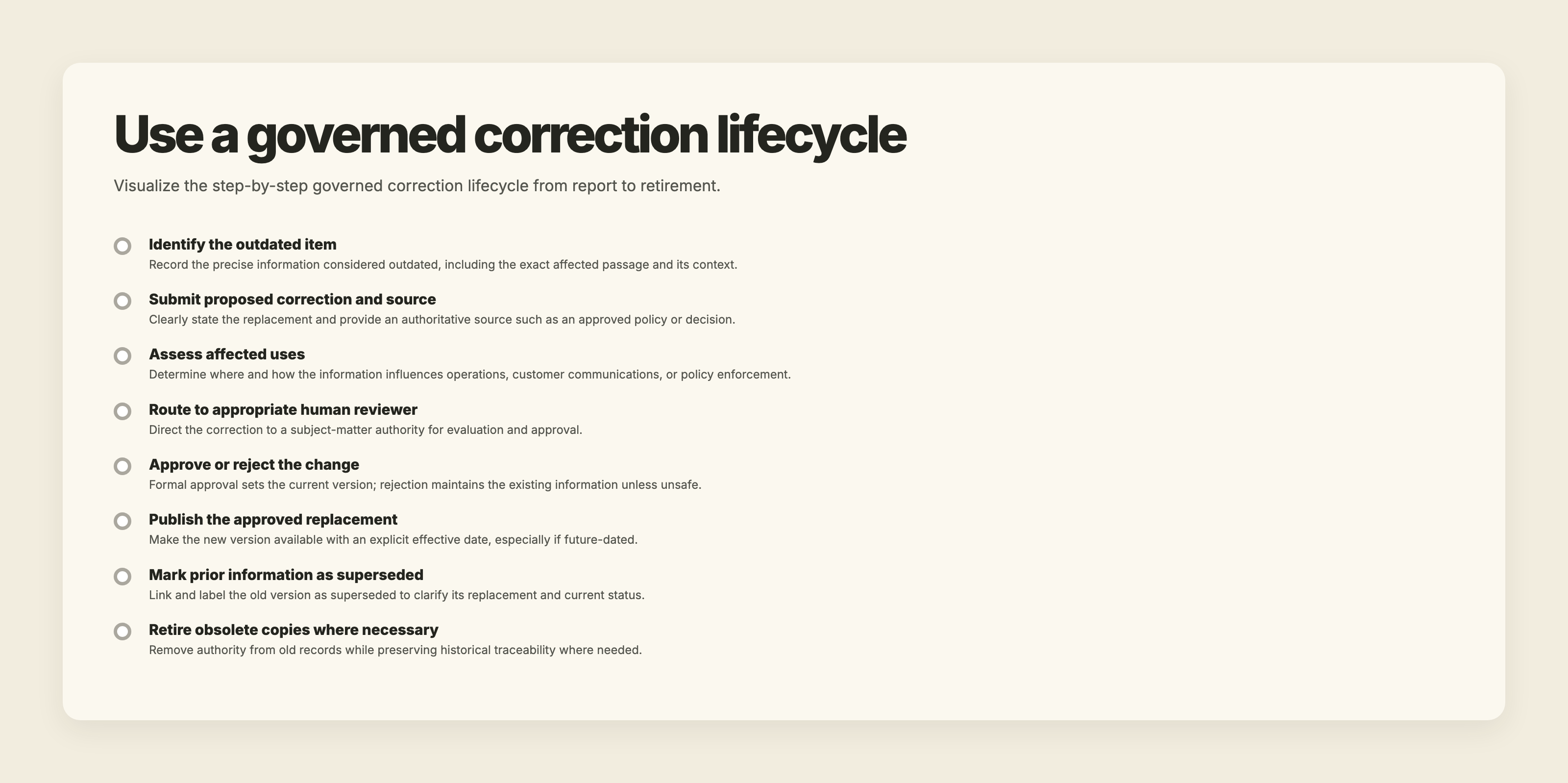
A correction lifecycle should make the change visible from first report through final retirement. The exact implementation can vary, but the operator decisions should remain explicit.
Identify the outdated item. Record the information precisely. “The policy is wrong” is too vague. Capture the affected passage, rule, record, or answer and the context in which it matters.
Submit the proposed correction and its source. The replacement should be stated clearly and supported by an appropriate source: an approved policy, an authorized decision, or another business record suitable for that subject. If no authoritative source exists, the business may need to make a decision before it can make a correction.
Assess the affected uses. Determine where the information matters. Is it used only for internal reference, or could it shape customer communication, pricing, financial handling, permissions, or policy enforcement? The same sentence can carry different risk depending on how it is used.
Route it to the appropriate human reviewer. Review ownership should follow subject-matter authority. A practical AI readiness checklist should assign decision rights as clearly as it assigns detection and escalation duties.
An operator can identify the problem without necessarily having the authority to approve the replacement.
Approve or reject the change. Approval establishes which version is current. Rejection should leave the existing information in place unless it has separately been suspended because it is unsafe or unresolved.
Publish the approved replacement. The new version should become available to the relevant uses only after approval. Its effective date should be explicit, especially when future-dated changes or transition periods are involved.
Mark the prior information as superseded. Do not leave the old and new versions looking equally current. Link the previous item to its replacement so an operator can see the relationship.
Retire obsolete copies where necessary. Superseded information may need to remain in a historical record, but it should no longer be presented as active guidance. Retirement is about removing authority, not necessarily destroying evidence.
The key control is the handoff between proposal and approval. An AI system may help surface a conflict or present information for review, but it should not independently decide that the business has changed its policy.
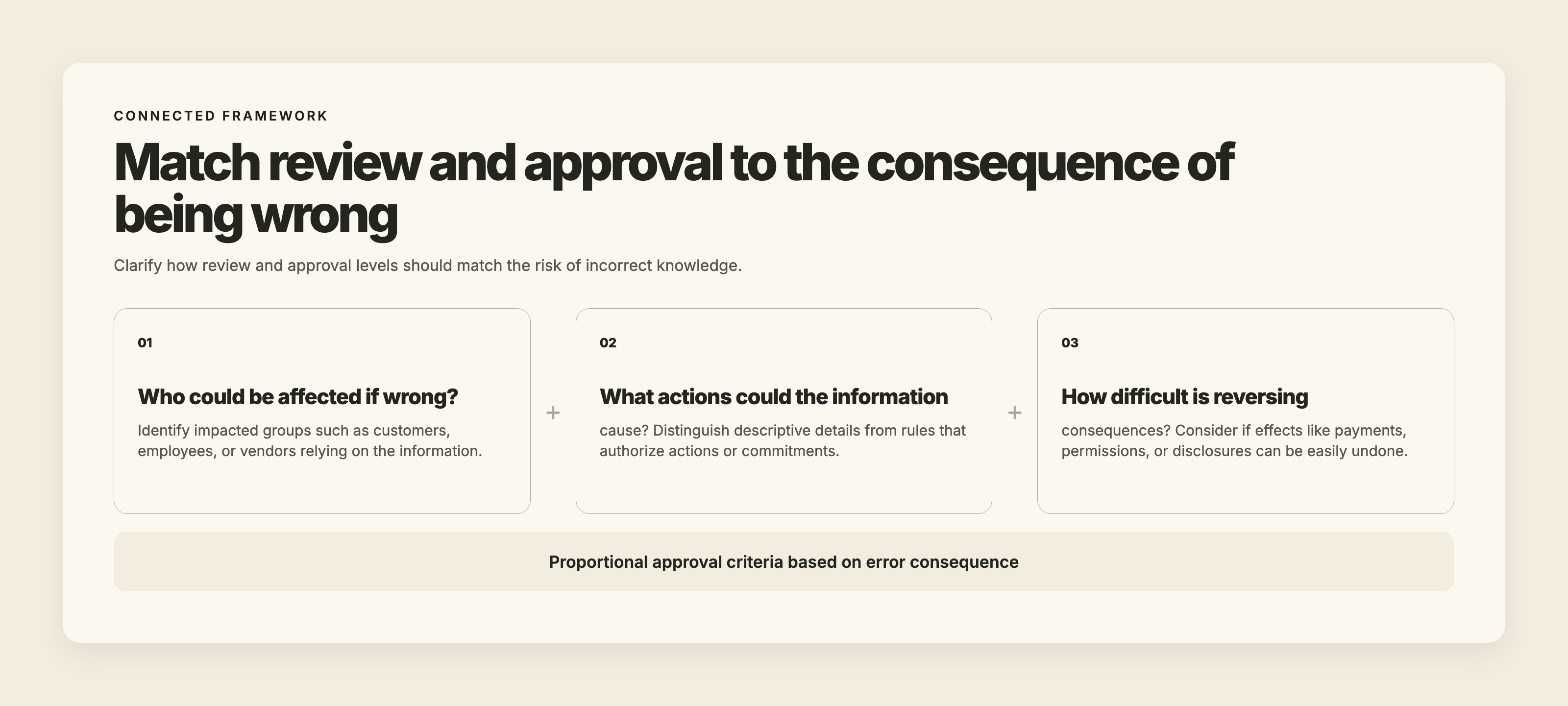
Match review and approval to the consequence of being wrong
Not every correction deserves the same process. Requiring senior approval for every spelling fix creates delay without adding meaningful control. Allowing any operator to revise consequential policies creates the opposite problem.
Approval should depend on consequence.
A low-risk operational detail might require review by the person who owns that workflow. Customer-facing service terms should receive more deliberate review from the person authorized to set them. Pricing, financial procedures, policy commitments, and permission-related information should have approval paths that reflect what could happen if the correction is wrong.
This is not an argument for attaching approval to every AI interaction. It is an argument for placing approval at consequential boundaries. The business must decide where a knowledge change crosses such a boundary.
Three questions help determine the level of review:
1. Who could be affected if this is wrong? Consider customers, employees, vendors, and other parties relying on the information.
2. What could the information cause someone to do? A descriptive detail and a rule that authorizes an action should not be treated alike.
3. How difficult would it be to reverse the effect? Information that can lead to a commitment, payment, denial, disclosure, or permission change warrants closer review.
The purpose is proportional control. Operators need enough friction to prevent unauthorized changes, but not so much that known errors remain active because correction is impractical.
Make supersession explicit
Publishing a corrected statement is only half the work. The correction remains ambiguous if the old version is still visible without a status or relationship to its replacement.
Imagine two records:
- “Customers may reschedule up to 12 hours before an appointment.”
- “Customers may reschedule up to 24 hours before an appointment.”
Without dates, status, approval, or lineage, an operator—and any system using those records—cannot determine which one governs. Recency alone may not settle the matter. The newer statement could be a proposal, a temporary exception, or an unapproved note.
A simple supersession record should answer:
- What changed?
- Why did it change?
- Who approved the replacement?
- When does it take effect?
- Which prior item does it replace?
- Where was the old information used?
- Has that old information been retired from active use?
The prior version can remain available for traceability while being clearly labeled as superseded. That distinction supports both current operation and later review. An operator can use the approved replacement without losing the history needed to understand an earlier answer or decision.
Supersession also prevents “correction by accumulation,” in which businesses keep adding new notes while never removing authority from old ones. A growing pile of conflicting statements is not corrected knowledge. It is unresolved history.
A hypothetical correction: an outdated service policy
The following hypothetical illustrates an operating model and product direction. It is not a description of a currently available customer-facing correction workflow.
Suppose a small service business changes its cancellation policy. The approved policy now allows cancellation without a fee until 24 hours before an appointment. Older business information still states that the cutoff is 48 hours.
An operator notices the conflict after reviewing an AI-generated customer response. The operator does not simply type, “Remember that the policy is now 24 hours.” Instead, the operator opens a correction and identifies the exact 48-hour statement as suspect.
The proposed replacement includes the 24-hour rule, the approved policy document supporting it, and the effective date. The operator also notes likely affected uses: customer questions, appointment reminders, cancellation explanations, and internal guidance for handling fees.
Because the change affects customer-facing policy and potential charges, it goes to the person authorized to approve those terms. That reviewer checks the supporting decision, confirms the effective date, and approves the replacement.
The 24-hour policy is then marked current. The 48-hour policy is labeled superseded and linked to the approved replacement. Active uses are checked so the older rule is no longer treated as authoritative. The old record may remain available to explain responses produced before the change, but it is retired from current guidance.
Finally, the business tests the affected questions. What happens if a customer asks about cancellation generally? What if the appointment was booked before the effective date? What if an employee finds the old policy in a historical conversation?
This final check is not permission for the AI to rewrite policy. It verifies whether the business’s approved correction is being represented where it matters and whether unresolved edge cases need their own decisions.
Build the correction practice before relying on the knowledge
A business does not need an elaborate system to establish correction discipline. It does need explicit answers to six operational questions:
- Who can report suspect information?
- What evidence is required for a proposed replacement?
- Who can approve changes in each business area?
- Which kinds of changes require heightened review?
- How are current, proposed, superseded, and retired information distinguished?
- How will active knowledge be reviewed for changes over time?
Start with one consequential category, such as customer-facing policies. Select a current rule and run a correction test: identify its owner, propose a documented change, route it to the proper approver, mark the old version superseded, and verify that active uses point to the replacement.
That same control discipline gives an AI the right business context to act on approved information rather than stale or conflicting rules.
If the business cannot complete that test without ambiguity, the immediate problem is not that the AI needs to learn more. A 14-day free trial can help you evaluate how these ideas fit your workflow.
The business first needs a reliable way to decide what is true now—and to show what stopped being true.

.svg)