Registering your 10DLC (10-Digit Long Code) campaign was supposed to be the hard part. And for many small businesses—whether you’re running a dental practice, managing a real estate firm, or operating a crisis hotline—it felt like crossing the finish line.
But here’s the thing: registration doesn’t guarantee success. It just gets you in the door.
What happens next—how you actually use your 10DLC number—determines whether your messages get delivered, flagged, or blocked. And too many small businesses are still making the same costly mistakes after registration that lead to rejections, throttling, or even full campaign shutdowns. To understand why carriers take these actions so seriously, it helps to look at Why 10DLC Campaigns Get Rejected (and How to Get Approved Faster), which breaks down the most common rejection triggers carriers flag after registration.
Let’s break it down.
6 Costly 10DLC Mistakes Small Businesses Keep Making
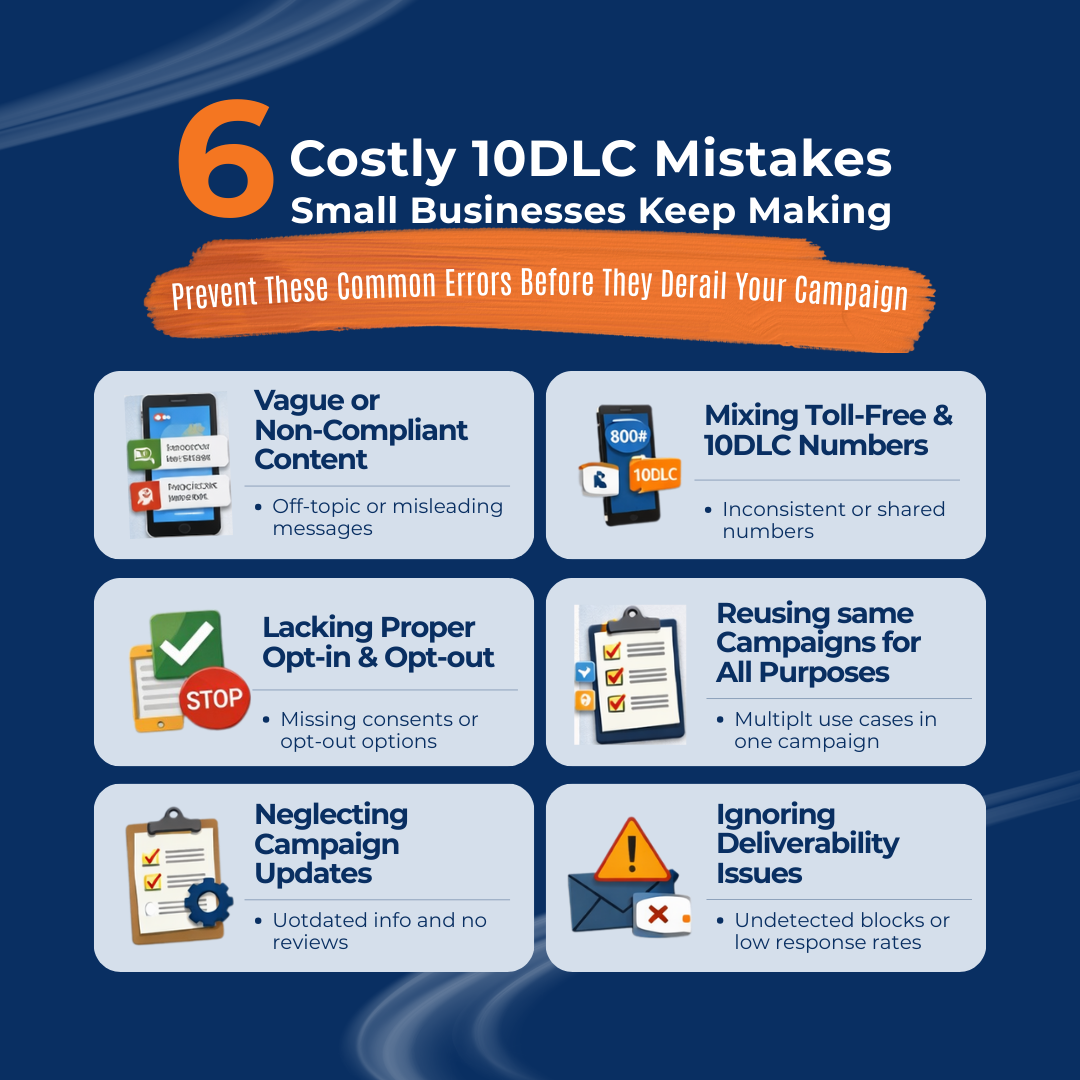
Even after completing 10DLC registration, many businesses unknowingly fall out of compliance. These mistakes aren’t always obvious—but they can quietly erode deliverability, trigger carrier blocks, and even get your campaign suspended. Let’s look at the most common post-registration errors small businesses make—and why they matter.
Sending Vague, Misaligned, or Non-Compliant Content
When you register a 10DLC campaign, you’re required to define its specific purpose—appointment reminders, customer service follow-ups, promotional alerts, etc. Carriers then approve your campaign based on that declared use case.
But once approved, if you start sending messages that don’t clearly align with your stated purpose, carriers take notice.
Here’s what that looks like in practice:
- Real Estate Use Case: You registered for "property showing confirmations," but later send weekly blast texts with new listings and price drops. That’s marketing content—not transactional updates—and violates your approved use case.
- Healthcare Use Case: You registered to send appointment reminders but start including links to payment portals or third-party sites. Carriers may interpret these as potential phishing attempts.
Even small changes in tone, content, or message frequency can raise red flags. If you're promoting something new, running a limited-time offer, or changing the type of communication altogether, update your campaign—or submit a new one.
Using Toll-Free and 10DLC Interchangeably (or Sharing Numbers Across Teams)
This confusion is especially common among teams that don’t fully understand the differences outlined in Long Codes vs. Short Codes for SMS: What’s the Difference and Which Is Right for Your Business?, where carrier expectations and use cases are clearly separated. Many small businesses assume they can use multiple messaging channels interchangeably: one week it’s a toll-free number, the next it’s a 10DLC. Some even use the same number for multiple departments or locations.
This leads to three big issues:
- Brand Confusion: Customers don’t know which number to trust or reply to.
- Compliance Gaps: Each number type has its own vetting and registration requirements. Mixing them undermines carrier trust.
- Identity Mismatch: Carriers are scanning for consistency between the brand, use case, and number identity. Inconsistency can get your messages blocked—even if the content is fine.
The fix: choose one dedicated number per campaign, register it correctly, and avoid switching or sharing unless you’ve updated the registration accordingly.
Skipping Proper Opt-In and Opt-Out Processes
If you’re unsure whether your consent practices meet carrier and TCPA standards, SMS Compliance in 2025: Your TCPA Text Message Compliance Checklist provides a clear breakdown of what’s required—and what can get campaigns suspended. This is one of the most common (and dangerous) mistakes. Carriers—and federal regulations like the TCPA—require documented, auditable consent for every contact on your list.
Here’s where businesses go wrong:
- Assuming a customer texting you first is the same as opt-in
- Collecting leads via web forms but not recording consent details
- Forgetting to include clear STOP instructions in messages
- Ignoring or delaying opt-out processing
These aren’t just best practices—they’re non-negotiable. Carriers regularly scan for violations. If opt-outs aren’t handled correctly, or if someone reports you for unsolicited messages, it can fast-track campaign suspension.
Platforms like Text My Main Number automatically manage opt-in tracking and opt-out compliance, so you don’t have to worry about manually updating lists.
Reusing the Same Campaign for Multiple Purposes
Each 10DLC campaign is registered with a specific purpose and message flow. It’s not a catch-all bucket.
For example:
- If you registered for “appointment confirmations,” and later want to add “customer satisfaction surveys” or “payment collection,” that’s a different campaign use case.
- If you expand your services and want to promote them via SMS, that’s a new purpose—and needs a new campaign ID.
Trying to squeeze new content into an old campaign often results in filtering, delivery failure, or a forced re-vetting by carriers. Don’t risk it. Register separately for new content types.
Neglecting Campaign Maintenance and Updates
Your business evolves. Your messaging evolves. But many small businesses forget to revisit and revise their campaign registration accordingly.
What can go stale?
- Your campaign description (what you say you’re sending)
- Your opt-in methods (how you collect customer consent)
- Your sender name or website domain
- Your message frequency or content format
When these shift—even slightly—your approved campaign may no longer reflect reality. Carriers notice mismatches, especially when complaints or delivery issues arise.
Regular audits (quarterly is ideal) can help you stay ahead of compliance drift.
Failing to Monitor Deliverability or Rejection Trends
If you’re seeing unexplained drops in engagement, Why Your Business Texts Aren’t Delivering (14 Causes & Proven Fixes) dives into the most common filtering, throttling, and blocking scenarios businesses encounter post-registration. Many business owners assume that as long as messages appear to “send,” everything’s fine. But SMS deliverability is rarely that straightforward.
Carriers may silently throttle or filter your messages without warning. No error message. No bounce notification. Just lower engagement and a drop in replies.
Warning signs of filtering or throttling include:
- A sudden dip in open or response rates
- Customers saying they never received your message
- Messages sent but no clicks or conversions
- Increased STOP requests in a short period
With Text My Main Number, you can monitor delivery success, rejection codes, and performance by campaign. That means you’ll catch issues early—before they spiral into account-level penalties.
What Happens When You Break the Rules (Even Accidentally)
.png)
Here’s the uncomfortable truth: even well-meaning businesses get penalized. You might think you’re playing by the rules. But if your messaging doesn’t line up with your approved 10DLC use case—or if your opt-in process isn’t airtight—carriers won’t give you the benefit of the doubt.
And the consequences go far beyond one failed message.
Silent Filtering and Message Delays
One of the most frustrating issues is that carriers don’t always tell you when something’s wrong. Your messages may appear to send successfully, but behind the scenes, they’re being throttled, delayed, or outright filtered.
You won’t see an error message.
You won’t get an alert.
But your customers? They never receive the message.
And that’s when the damage starts:
- Missed appointment reminders
- No-shows for consultations
- Ignored service updates
- Abandoned sales
This is especially dangerous in industries like healthcare, real estate, or field services, where timing and reliability are everything.
Escalated Vetting or Campaign Suspension
When carriers detect non-compliant behavior—even accidentally—they may flag your campaign for manual review. This can lead to escalated vetting, increased scrutiny of your use case, or in some cases, temporary suspension of your messaging capabilities.
Imagine this scenario:
- You’ve spent weeks building trust with clients
- You have campaigns running for upcoming promotions
- Suddenly, all SMS activity halts while your campaign is under review
It’s like losing your phone line at the worst possible moment.
Fines, Carrier Penalties, or Permanent Bans
The CTIA (Cellular Telecommunications Industry Association) and wireless carriers are enforcing 10DLC compliance with increasing severity. According to guidance published by the CTIA, 10DLC enforcement is designed to reduce spam and improve message trust across U.S. carrier networks. Businesses that repeatedly violate rules—or send high-risk or misleading messages—may be subject to financial penalties, or even blacklisting.
Penalties can include:
- Fines ranging from a few hundred to thousands of dollars per violation
- Full revocation of your 10DLC number and campaign access
- Mandatory re-registration (with no guarantee of approval)
If your brand gets flagged across multiple campaigns or numbers, recovering your sender reputation becomes exponentially harder.
Loss of Customer Trust and Brand Damage
Here’s where the long-term cost kicks in. Even if you dodge filters and avoid penalties, inconsistent or poorly timed messaging erodes trust.
To the customer, it looks like:
- Spammy, unexpected texts from numbers they don’t recognize
- Missing confirmations or appointment reminders
- Delayed responses to time-sensitive questions
- Unclear opt-out paths
And once trust is gone, it’s tough to win back—especially for businesses where relationships matter most, like dental practices, mental health clinics, real estate brokers, or insurance agents.
They may stop replying.
They may block your number.
They may even report you.
And just like email spam filters, once your number is flagged, carriers become less forgiving. 10DLC rules aren’t just red tape. They’re the infrastructure that protects both your business and your audience.
The Right Way to Use 10DLC: What Carriers Actually Want
Carriers aren’t trying to block your messages—they just want to see that:
- You’re sending expected, value-based content
- You’ve properly documented consent and opt-ins
- You follow opt-out procedures every single time
- Your brand and message style stay consistent and traceable
That’s where a platform like Text My Main Number comes in. It’s designed for real businesses that need clarity, control, and compliance—without the technical guesswork.
With features like:
- Easy-to-use SMS templates with built-in opt-out language
- Campaign tagging and reporting by use case
- Integrated VoIP and texting from one number
- Alerts for high rejection or bounce rates
TMMN helps small businesses stay ahead of 10DLC rules, even as they evolve.
Best Practices to Keep Your 10DLC Campaign Compliant in 2026

Maintaining compliance with 10DLC guidelines isn’t just about passing initial registration—it’s about consistently aligning your SMS activity with the standards carriers expect throughout the life of your campaign. In 2026, with tighter enforcement and more sophisticated monitoring tools in play, businesses must treat compliance as an ongoing discipline, not a one-time setup.
To protect your deliverability, maintain trust, and avoid costly disruptions, implement the following best practices as part of your routine campaign management process:
Ensure Message Content Matches the Approved Use Case
Every message you send should clearly reflect the purpose you outlined during campaign registration. If you were approved for appointment reminders, your content should focus strictly on scheduling or confirming appointments—not promotional offers, surveys, or payment links. Deviating from your use case, even slightly, puts your campaign at risk of rejection or filtering.
Maintain Accurate Opt-In Documentation
Carriers require proof that every recipient has given explicit, informed consent to receive SMS messages from your business. This requirement aligns with federal regulations outlined by the Federal Communications Commission (FCC), which governs TCPA enforcement and consumer consent rules. This means storing opt-in records that include the method (e.g., website form, text keyword, paper form), timestamp, and associated messaging language. If you can’t trace how a contact opted in, you’re vulnerable to disputes or compliance reviews.
Include Required Opt-Out Language in Every Campaign
Every message—especially the first in a sequence—should clearly instruct recipients on how to unsubscribe. A simple “Reply STOP to opt out” satisfies this requirement, but it must be visible, unambiguous, and functional. Platforms like Text My Main Number automate this process, making sure opt-out requests are processed immediately and logged properly.
Avoid Risky Links or Unapproved Domains
Carriers actively scan message content for links that redirect to unvetted, misleading, or blacklisted domains. If you’re sending URLs, make sure they point to recognizable, brand-owned domains with valid SSL certificates. Avoid short links that obscure destination URLs unless you’ve cleared them with your messaging provider.
Watch for High-Risk Language and Formatting
Certain keywords and formatting patterns—like “FREE!!!”, “LIMITED TIME ONLY!!!”, or all-caps phrases, are red flags for spam filters. While urgency and persuasion are important in marketing, your language must remain professional, compliant, and consistent with your use case. Always test your message tone through preview tools before deploying to your list.
Monitor Campaign Health and Delivery Metrics
Don’t wait for a problem to surface. Proactive monitoring of delivery rates, opt-out spikes, and rejection codes helps catch issues early—before they result in blocked numbers or campaign shutdowns. Text My Main Number provides real-time reporting and alerts that flag when something in your campaign is out of alignment.
When to Submit a New Campaign
If your messaging purpose evolves—whether you’re launching a new feature, running a limited-time promotion, or shifting from transactional updates to customer surveys—you must register a new campaign use case. Reusing an existing campaign for unrelated content is one of the fastest ways to get flagged by carriers.
Each campaign should serve one distinct purpose, with clearly defined content and opt-in paths. It’s better to maintain multiple compliant campaigns than to risk having your primary number blocked for misuse.
In a regulatory environment that’s growing more stringent by the month, playing it safe isn’t a constraint—it’s a competitive advantage. Businesses that invest in strong 10DLC practices gain higher deliverability, more reliable outreach, and a stronger foundation for customer engagement.
Real-World Example: Real Estate Firm Avoids Filtering and Boosts Lead Response
A real estate agency using 10DLC messaging to confirm showings and follow up with prospective buyers—content that matched their approved campaign use case. As their team ramped up marketing efforts, they decided to send weekly text alerts featuring new listings, price drops, and open house invites.
Rather than updating their existing campaign—which was registered strictly for transactional messages—they took the time to register a new campaign dedicated to promotional outreach. This included a clearly defined use case, updated message samples, and a documented opt-in process specific to marketing communications.
By keeping the two campaigns separate and aligned with carrier guidelines, the firm avoided deliverability issues that often occur when marketing content is sent under the wrong campaign classification. Messages were delivered consistently, engagement remained strong, and most importantly, they didn’t trigger any vetting delays or suspensions.
In the first month alone, their new campaign drove a 28% increase in click-throughs to featured property pages and helped convert time-sensitive buyer interest into scheduled showings—without compromising compliance. This example shows how proactive campaign segmentation isn’t just about avoiding penalties—it’s a strategic move that protects your message performance and builds long-term communication equity.
While individual brand case studies are less publicly documented due to privacy, industry sources consistently show that 10DLC registration boosts deliverability and engagement for businesses that depend on SMS. Registered 10DLC traffic gets higher throughput and routing priority from carriers and is less likely to be flagged or blocked compared with unregistered or generic long codes. This means companies using 10DLC can reach customers more reliably and with fewer operational interruptions.
Final Thoughts: 10DLC Compliance Isn’t Optional—It’s a Competitive Advantage
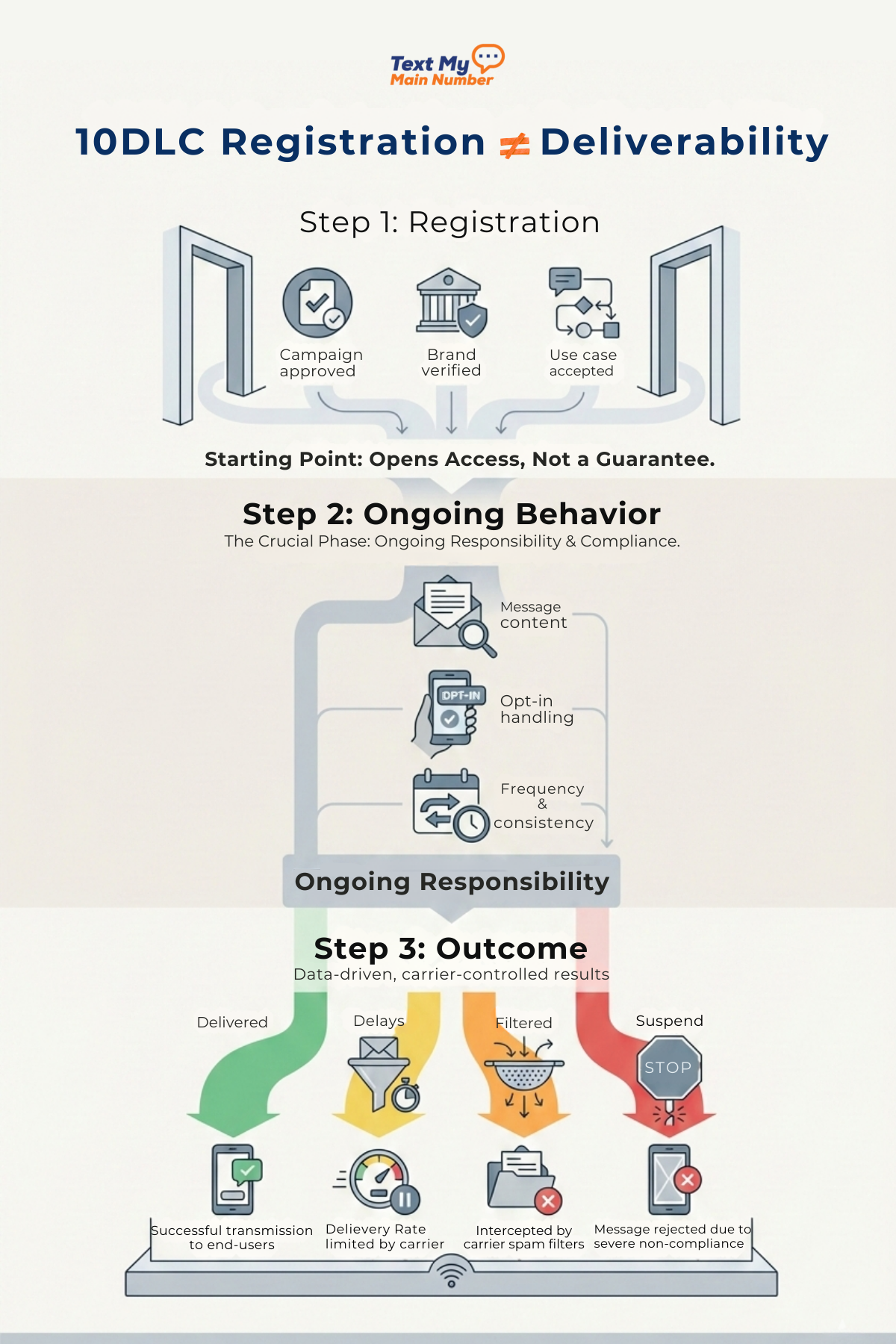
For small businesses that rely on SMS to stay connected with customers, 10DLC compliance is no longer just a box to check—it’s the backbone of message deliverability, trust, and long-term engagement. Carriers are raising the bar, and businesses that cut corners risk more than just undelivered texts. They risk missed opportunities, damaged credibility, and blocked communication channels.
But when done right, 10DLC isn’t a limitation—it’s a strategic asset. It ensures your messages reach the right people, at the right time, with the clarity and consistency your brand depends on.
Text My Main Number makes it easy to stay compliant from day one. From registration support to real-time delivery tracking and campaign-level insights, it’s built to help real businesses message confidently—without the guesswork.
Start your free 14-day trial today and experience the difference a fully compliant messaging platform can make.

.svg)