
If you run a small business, your phone system isn’t just a utility. It’s how customers decide whether you’re responsive, reliable, and worth trusting. Miss a call, delay a follow-up, or lose context, and the cost shows up fast in lost leads, missed appointments, or frustrated clients.
The debate between VoIP and landline phones usually gets framed as a technical decision. It isn’t. This same misconception is explored in greater depth in VoIP vs Landline in 2026: What’s Best for Small Business?, which looks at how communication expectations have shifted beyond traditional phone systems. It’s a workflow decision. The real question is simple: which option actually supports how small businesses communicate today?
Let’s break it down in plain language. No jargon. No hype. Just what matters.
What a Landline Really Is Today
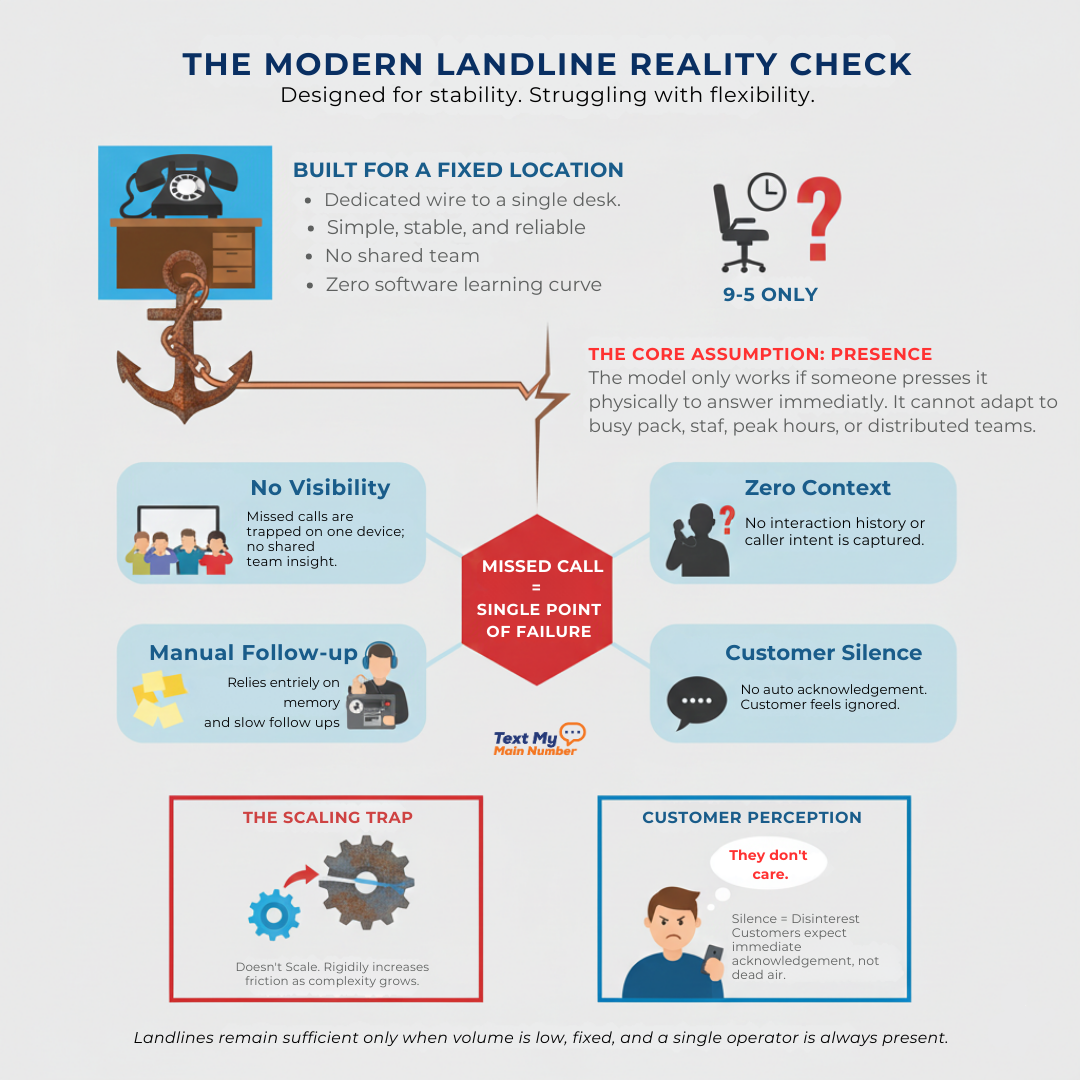
A traditional landline is built around a fixed and narrowly defined communication model. A physical phone connects through dedicated copper wiring, and calls are routed to a single location. When someone calls, the phone rings at that desk. If the call is answered, communication happens in real time. If it is not, the interaction ends or moves to voicemail.
From a reliability standpoint, landlines still perform exactly as designed. They are stable, familiar, and require very little ongoing management. There is no software layer, no learning curve, and minimal variation in how the system behaves day to day. For a long time, this simplicity aligned well with how small businesses operated.
The limitation appears when this model is applied to modern business workflows.
A landline assumes constant physical availability. It depends on someone being present at a specific location, during specific hours, and able to respond immediately. When that assumption holds, the system works. When it does not, the landline offers no built-in way to compensate.
When a landline call is missed, several issues surface at once:
- There is limited or no shared visibility into missed calls.
- Context about the caller’s intent or previous interactions is unavailable.
- Follow-up relies entirely on manual processes, such as checking voicemail and remembering to respond.
- There is no automatic acknowledgment that reassures the caller their attempt was received.
These gaps introduce friction not because teams are inattentive, but because real business environments are unpredictable. Front desks juggle multiple responsibilities. Staff step away to support customers in person. Calls arrive during peak hours, between appointments, or outside rigid office schedules. In those moments, the landline does not adapt or assist. It simply becomes a single point of failure.
There are still scenarios where this structure is workable. Landlines can be sufficient in situations where:
- Office hours are fixed and consistently staffed.
- Call volume is low and easy to manage.
- One person is responsible for all incoming communication.
- Internet reliability is a legitimate concern and alternatives are limited.
Even in these cases, the margin for error is narrow.
As soon as a business grows, extends its hours, increases call volume, or introduces shared responsibility across a team, the rigidity of a landline becomes more apparent. The system does not scale with operational complexity. It does not support mobility, distributed teams, or structured follow-up. It remains static while expectations continue to evolve.
From the customer’s perspective, none of this feels like a technical limitation. A missed call is experienced as silence. When silence replaces acknowledgment, trust erodes quickly, which is why many businesses experience the exact breakdown described in Why Small Businesses Lose Customers to Missed Messages (And How to Fix It). Silence is often interpreted as disinterest or unavailability, regardless of the actual cause.
That is the reality of landlines today. They are not unreliable, but they are inflexible. They were designed for a communication model that assumes presence and immediacy, not continuity, accountability, or follow-up. As customer expectations shift toward acknowledgment and responsiveness, that rigidity becomes increasingly difficult to justify.
What VoIP Actually Means (Without the Tech Talk)
VoIP, or Voice over Internet Protocol, is often described in technical terms that make it feel more complex than it really is. The name itself is not important. What matters is how VoIP changes the way calls move through a business and how people are able to respond to them.
At its core, VoIP replaces physical phone lines with an internet connection. Calls are transmitted digitally rather than through fixed copper wiring. That single change removes the physical constraints that define traditional phone systems and opens up far more flexible ways to handle communication.
Unlike a landline, a VoIP number is not tied to a specific desk or device. It exists independently of location. As long as there is an internet connection, calls can be answered wherever work is happening.
In practical terms, this changes how small businesses operate on a daily basis.
With a VoIP system in place:
- Calls can ring on multiple devices at the same time, including desk phones, laptops, or mobile phones.
- Team members can answer from different locations without forwarding calls manually.
- Voicemails are stored digitally and can be accessed, reviewed, and shared without relying on a single physical handset.
- Phone numbers are portable, making it easy to add users, support remote work, or change offices without disrupting customers.
The impact of these capabilities goes beyond convenience. VoIP removes the assumption that communication must happen in one place, at one desk, during narrowly defined hours. Instead, it allows businesses to design call handling around how their teams actually work.
For example, a real estate agency no longer needs every inquiry routed through one office phone. Agents can answer calls while in the field without exposing personal numbers. A service business can distribute calls across technicians or dispatch staff based on availability rather than proximity to a desk. A healthcare office can allow overflow calls to be handled remotely during peak times without overwhelming the front desk.
VoIP also makes it easier to adapt as the business changes. Adding new staff does not require installing new physical lines. Seasonal adjustments can be made without hardware upgrades. Teams can scale up or down without rebuilding the phone system.
The most important shift, however, is not technical. It is behavioral.
VoIP changes communication from something that happens in a fixed place to something that moves with the business. Calls are no longer trapped at a desk, and responsibility for answering them can be shared across a team. That flexibility is what makes VoIP fundamentally different from a landline, and why it aligns more closely with how modern small businesses operate today.
The Real Comparison: How Each Fits Into Daily Business Life

The difference between landlines and VoIP becomes clearest when you step away from feature lists and look at how each system behaves during a normal workday. This is not a question of which technology is newer, but which one aligns with the realities of modern business operations.
Availability and Responsiveness
A landline is built on a single assumption: someone is physically present when the phone rings. If that condition is met, communication happens. If it is not, the opportunity is lost or deferred to voicemail.
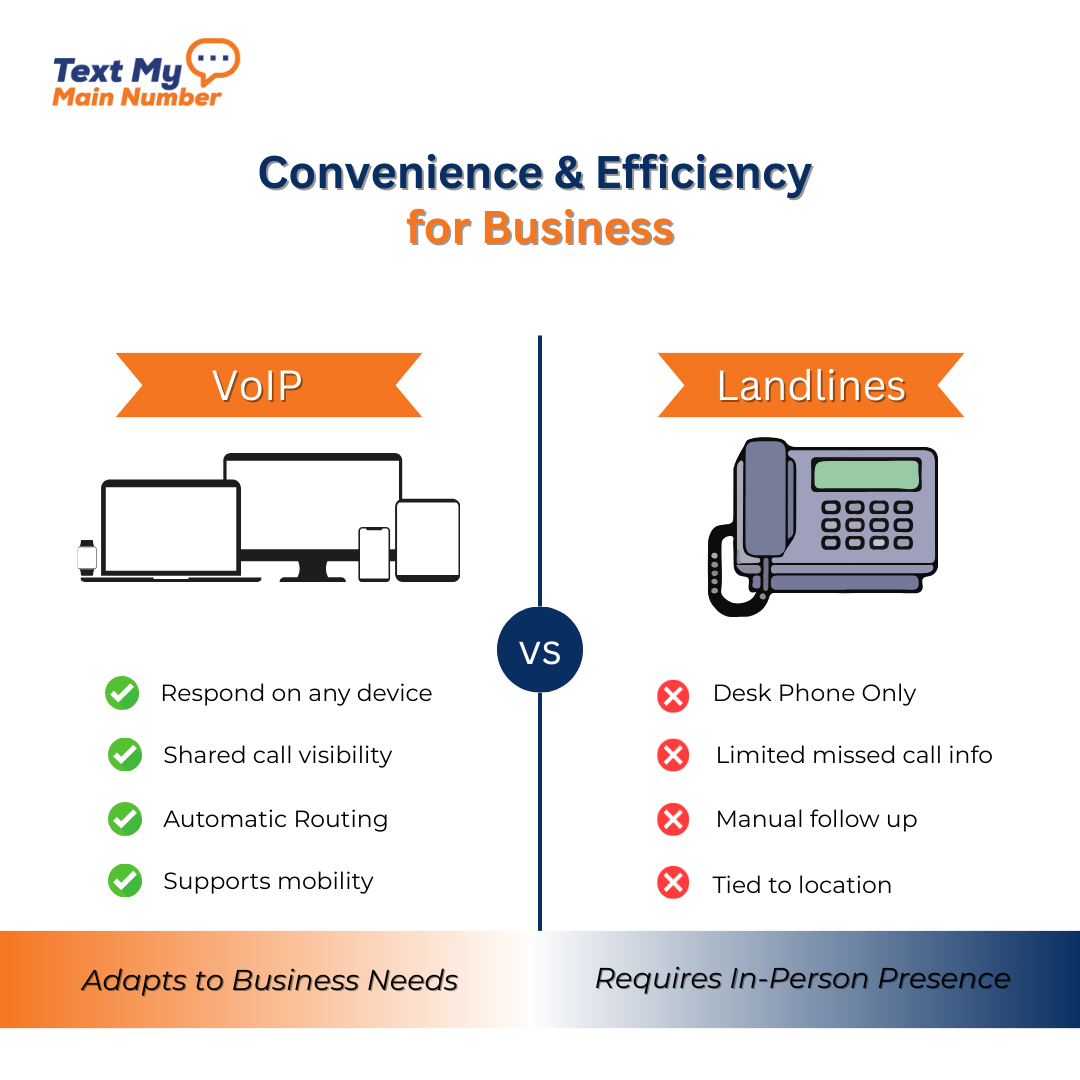
VoIP operates on a different assumption. It recognizes that people are mobile and that work does not happen exclusively at one desk. Calls can be answered from a desk phone, a laptop, or a mobile device, depending on where the team member happens to be at that moment. That flexibility fundamentally changes how businesses manage availability throughout the day.
This matters during peak hours, lunch breaks, and after-hours periods, when calls often arrive but staffing is stretched. Instead of forcing all responsibility onto one location, VoIP allows businesses to distribute availability across people rather than places.
In practical terms, this enables scenarios such as:
- A real estate agent answering a time-sensitive inquiry while on the way to a showing, without exposing a personal number.
- A service business routing incoming calls to the next available team member when technicians are in the field.
- A dental or healthcare office can reduce caller frustration by ensuring patients are not met with constant ringing during busy intake periods.
Responsiveness, in this context, is not about being available at all times. It is about ensuring that customer inquiries are acknowledged and handled by the right person, rather than being lost due to physical constraints.
Call Handling and Missed Opportunities
Landlines treat every call as a single, isolated event. The outcome is binary: the call is either answered or it is missed. Once missed, recovery depends entirely on manual follow-up.
VoIP systems introduce structure into this process. They provide mechanisms that help businesses understand what happened and respond accordingly.
Common capabilities include:
- Call forwarding to ensure calls are not tied to a single endpoint.
- Voicemail routing that allows messages to be accessed by multiple team members.
- Call logs that show which calls were missed, when they occurred, and how they were handled.
This structure matters because most missed calls are not the result of neglect. They occur during meetings, on job sites, or while staff are assisting other customers. VoIP does not eliminate missed calls, but it gives businesses visibility and control, making it possible to recover those interactions instead of losing them entirely.
Cost Structure: What You Actually Pay For
Landlines often appear cost-effective at first, particularly for very small setups. Over time, however, additional expenses tend to accumulate. These can include installation charges, per-line fees, hardware upgrades, and ongoing maintenance costs tied to physical infrastructure.
VoIP pricing is typically more transparent and easier to forecast. Businesses pay for access rather than wiring, and user-based pricing makes it simpler to scale up or down as needs change. Adding a new team member does not require installing new lines, and reducing capacity does not leave unused infrastructure behind.
For small businesses operating on tight margins, this predictability is often more valuable than the lowest initial cost. Knowing what communication will cost month to month allows for better planning and fewer surprises.
Flexibility as Your Business Changes
A landline is static by design. It remains in the same place and supports the same level of activity regardless of how the business evolves.
VoIP systems are built to adapt. As businesses grow or change, the phone system can adjust without major disruption.
This flexibility shows up in several ways:
- New hires can be added without purchasing or installing additional physical hardware.
- Remote or hybrid work can be supported without complicated call forwarding setups.
- Seasonal staff or temporary teams can be added and removed as demand fluctuates.
For service businesses, clinics, and agencies that experience changing workloads, this adaptability is not a convenience. It is a practical requirement. VoIP allows communication systems to evolve alongside the business rather than becoming a limiting factor.
When viewed through the lens of daily operations, the distinction is clear. Landlines are designed for stability in fixed environments. VoIP is designed for responsiveness in dynamic ones.
The Missing Piece in Most VoIP vs. Landline Comparisons
Most comparisons between VoIP and landlines focus almost entirely on voice calls. That framing misses a critical reality: business communication no longer happens through calls alone.
Customers call, but they also text. They follow up. When response speed matters as much as availability, the consequences are well documented in What Happens When Customers Don’t Hear Back Fast Enough. They expect some form of acknowledgment when they reach out, even if a live conversation cannot happen immediately. Silence, whether intentional or not, creates uncertainty.
Landlines offer no solution here. If a call is missed, the interaction effectively disappears unless someone checks voicemail and remembers to respond.
Many VoIP systems improve call accessibility, but they often stop at voice. They help teams answer more calls, but they do not address what happens when calls still go unanswered. And unanswered calls are inevitable in any real business environment.
That gap between availability and acknowledgment is where most communication breakdowns occur. This is the same gap many teams encounter when juggling calls and messages separately, a challenge explored in Business Texting vs Phone Calls: How to Use Both Effectively.
Where Text My Main Number Fits In
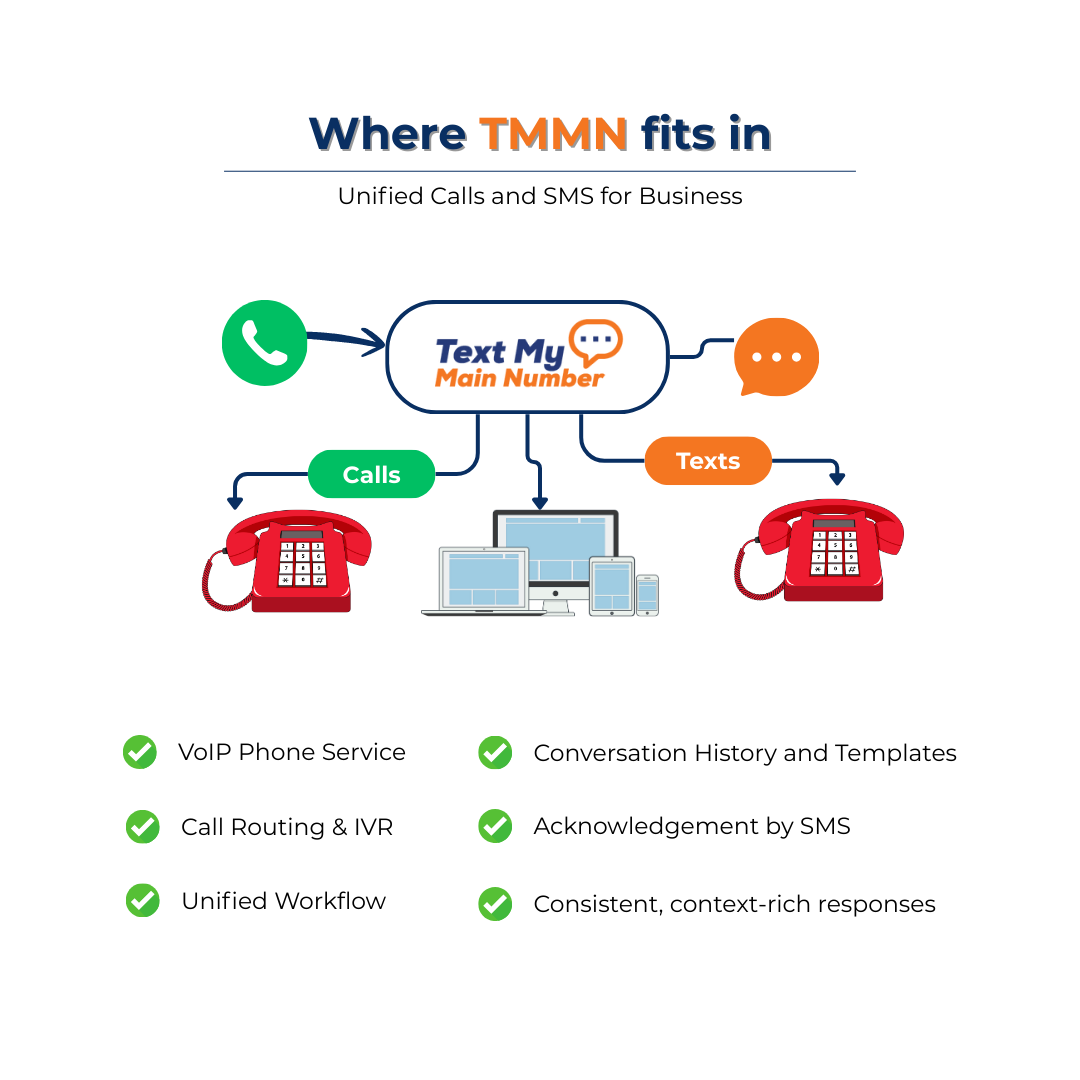
Text My Main Number is not an add-on layered on top of someone else’s phone system. It is a complete business communication platform that combines VoIP phone service and business texting in a way that reflects how customers actually reach businesses today.
Where traditional landlines focus only on live calls, and many VoIP systems stop at call routing, TMMN is designed around continuity. Calls and messages are treated as part of the same conversation, not separate channels that require separate tools or workflows.
At the foundation is TMMN’s hosted VoIP phone service. Businesses can use existing numbers or activate new ones, configure extensions, set business hours, and manage call flows through IVR without relying on physical hardware or fixed locations. Calls can be answered on desktop or mobile, making the system practical for both office-based and distributed teams.
What differentiates TMMN is how voice and messaging work together.
When a call is answered, the interaction is handled like any professional phone system. When a call is missed, the system does not default to silence. Instead, TMMN allows businesses to acknowledge that missed interaction through SMS, preserving the relationship even when live response is not possible.
In real-world terms, this means:
- Calls and texts operate as part of a single communication workflow, rather than isolated touchpoints.
- Missed calls can trigger text acknowledgments so customers know their outreach was received.
- Voicemails can be routed and followed up through messaging instead of being trapped in inboxes.
- Teams can rely on templates and conversation history to respond consistently and with context.
This approach is not about automating conversations. It is about removing uncertainty. Customers are not left wondering whether they reached the right number, called at the wrong time, or need to try again.
TMMN’s VoIP system also supports the operational needs businesses expect from a modern phone service, including IVR menus, ring groups, call routing, call recording, voicemail-to-SMS, and mobile access. These features exist to support real workflows, not to complicate them.
Most importantly, TMMN is built to scale with the business. New users, extensions, or locations can be added without reconfiguring physical infrastructure. Seasonal changes, growth, or shifts to remote work do not require a new phone strategy.
The result is a communication system that does not force businesses to choose between availability and professionalism. Voice calls are handled efficiently when possible, and acknowledged responsibly when they are not.
That combination is where Text My Main Number fits best: not as a replacement for good communication practices, but as the structure that makes them reliable.
Industry Scenarios Where This Matters Most
The value of a modern communication system becomes clearest in industries where timing, clarity, and follow-through directly affect outcomes.
- Real estate depends on speed. VoIP keeps agents reachable while they move between appointments, and Text My Main Number ensures that missed calls are acknowledged, keeping leads warm instead of losing them to silence.
- Healthcare and dental offices rely on reassurance. VoIP manages call flow, while TMMN confirms missed calls, standardizes appointment messaging, and reduces front-desk pressure without adding workload.
- Service businesses operate in the field. VoIP makes calls accessible across devices, and TMMN fills the gaps by acknowledging inquiries when teams are on job sites, preventing customers from moving on.
- Hotlines and support lines are built on trust. VoIP enables routing and availability, and Text My Main Number ensures callers are not left without acknowledgment when immediate answers are not possible.
Which Should a Small Business Choose?
If the choice were strictly between VoIP and landlines, VoIP would be the practical option for most modern small businesses. It is more flexible, more scalable, and better aligned with how teams actually work.
But the more important question is not which system answers more calls.
It is how your business handles the moments when answering is not possible.
That is where communication breaks down, opportunities are lost, and trust quietly erodes. And that is where tools like Text My Main Number do their most meaningful work, not by replacing existing systems, but by ensuring that silence never becomes the default response.
The Real Takeaway
The choice between a landline and VoIP is ultimately about how your business shows up for customers when it matters.
Landlines offer stability, but little flexibility. VoIP brings mobility and scale. What most businesses need, however, is not just a better way to answer calls, but a reliable way to handle the moments when answering is not possible. That is where communication either holds together or quietly breaks down.
Text My Main Number brings voice and messaging into a single, practical workflow, ensuring customers are acknowledged, conversations continue, and opportunities are not lost to silence. If you want to see how this works in real business settings, Text My Main Number offers a 14-day free trial, giving you a clear, hands-on way to experience more consistent communication without changing how your team already operates.
Sometimes the difference isn’t a better phone. It’s a better response.

.svg)