


For years, businesses were taught to pick a lane.
Either you answered the phone, or you pushed people to text. Either you optimized for calls, or you went all‑in on messaging. The assumption was that one channel would eventually replace the other.
That’s not how real customer communication works anymore.
Today’s customers move fluidly between text and voice depending on what they need in the moment. They text when it’s convenient. They call when something feels urgent, confusing, or important. They don’t see those as separate experiences — they expect them to connect.
The problem isn’t that SMS or voice is ineffective on its own. The problem is treating them like isolated tools instead of parts of the same conversation.
When businesses rely on only one channel, communication slows down, context gets lost, and customers feel friction even when teams are responding quickly. When SMS and voice work together, conversations feel natural, efficient, and complete.
This article breaks down why these channels complement each other — and what that looks like in real business scenarios.
Why Customers Don’t Choose Channels — They Choose Convenience
Customers don’t wake up thinking, Should I text this business or call them?
They think about effort. What’s the fastest way to get an answer? What feels easiest right now? What fits the situation they’re in?
If they’re in a meeting or on the go, they text. If something feels time‑sensitive or complicated, they call. If they start in one place and need more clarity, they expect to switch without starting over. From the customer’s point of view, this is reasonable. From the business side, it often exposes cracks.
A customer texts about pricing in the morning. Later that afternoon, they called to ask follow‑up questions. When the person answering the phone has no idea what was discussed earlier, the experience immediately feels disjointed. The customer repeats themselves. Momentum slows. Confidence drops.
This isn’t about impatience. It’s about expectations shaped by everyday digital life.
People are used to conversations carrying context. According to a global study by the Pew Research Center, texting and digital messaging have become some of the most widely used communication methods worldwide, shaping expectations for business conversations across channels. When that continuity disappears, it mirrors the patterns described in Why Small Businesses Lose Customers to Missed Messages (And How to Fix It). Messaging apps remember history. Support platforms show past interactions. Even personal phones make it easy to see what happened last. When business communication doesn’t do the same, customers notice — even if they can’t articulate exactly what feels off.
The takeaway is simple: customers don’t care which channel you use. They care that the conversation continues smoothly, regardless of how they reach you. That same breakdown between channels is why so many growing teams eventually run into the problems outlined in Why Texting Alone Isn’t Enough as Your Business Grows (And What Works Instead).
What SMS Does Better Than Voice
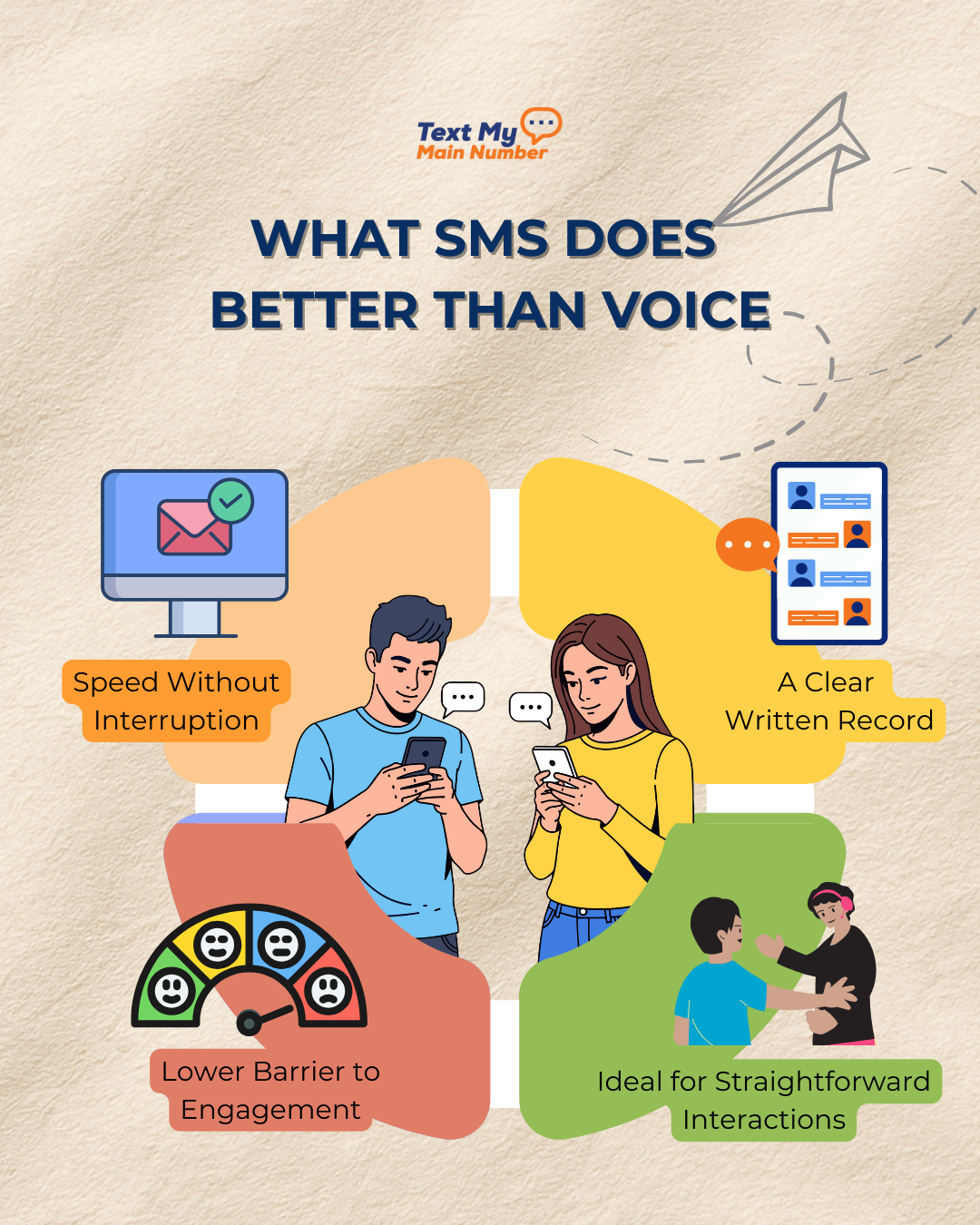
SMS shines when communication needs to be fast, simple, and unobtrusive. It’s not about depth or persuasion — it’s about removing friction and keeping conversations moving without demanding immediate attention.
For many everyday interactions, texting is the most efficient option for both customers and teams.
Speed Without Interruption
Texting allows conversations to happen without stopping someone’s day.
Customers can send a message while commuting, working, or multitasking. Your team can respond between tasks instead of carving out time for a call. This flexibility makes SMS ideal for interactions that don’t require real‑time discussion.
Common examples include:
- Appointment confirmations and reminders
- Simple pricing or availability questions
- Quick status updates or follow‑ups
In these situations, a call would feel heavier than necessary. Text keeps things light and efficient.
A Clear Written Record
One of SMS’s biggest advantages is permanence.
Details shared over text don’t disappear when the conversation ends. Addresses, dates, links, instructions, and confirmations live in the thread and can be referenced later by both the customer and the team. There’s no reliance on memory and no need to repeat information that’s already been shared.
For businesses, this reduces confusion and errors. For customers, it creates confidence that nothing will be forgotten.
Lower Barrier to Engagement
Many customers hesitate to call a business, even when they’re interested. Texting removes that hesitation.
Sending a message feels informal, low‑pressure, and familiar. As a result, customers are more likely to reach out with questions instead of abandoning the process altogether. This often leads to higher response rates, better show rates, and stronger overall conversion.
Texting doesn’t just support communication — it invites it.
Ideal for Straightforward Interactions
SMS performs best when the goal is clarity, not conversation.
If an interaction can be resolved in one or two exchanges, texting is usually the right choice. It respects the customer’s time, aligns with modern behavior, and delivers exactly what’s needed without unnecessary back‑and‑forth.
The mistake many businesses make is assuming that because SMS works so well in these moments, it should handle every situation. That’s where the balance starts to break.
What Voice and VoIP Still Do Better Than Text
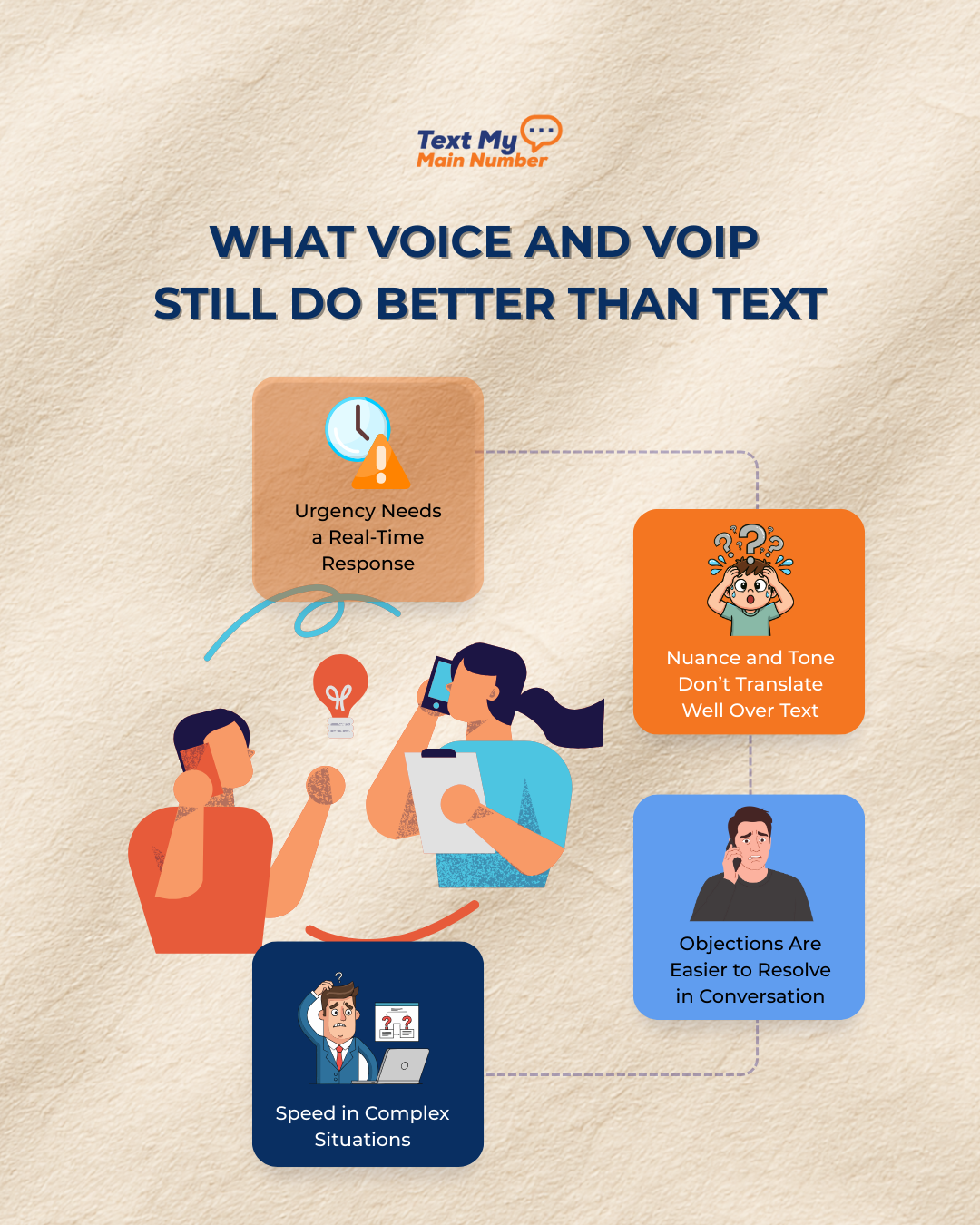
Texting is efficient, but it isn’t always effective.
There are moments in customer communication where speed, tone, and human nuance matter more than convenience. That’s where voice — especially modern VoIP — continues to outperform SMS.
Urgency Needs a Real-Time Response
When something feels urgent to a customer, waiting for a text reply can increase anxiety.
A call creates instant reassurance. Problems are addressed in real time. Questions don’t linger. For time-sensitive situations like last‑minute changes, service issues, or payment concerns, voice reduces friction instead of stretching it out across multiple messages.
Nuance and Tone Don’t Translate Well Over Text
Text strips away tone.
Even well‑written messages can be misinterpreted, especially when the topic is sensitive or complex. Voice allows teams to hear hesitation, frustration, or uncertainty and respond appropriately. That emotional feedback loop simply doesn’t exist in SMS. It’s the same reason tone, pacing, and intent play such a central role in Understanding Tone Indicators: A Guide to Clear and Effective Business Communication.
This is especially important in industries where trust matters — healthcare, real estate, professional services, or any situation involving money or long‑term decisions.
Objections Are Easier to Resolve in Conversation
When a customer hesitates, voice accelerates clarity.
Questions can be answered immediately. Concerns can be addressed in context. A single call can replace a long chain of clarifying texts that still fail to move the conversation forward.
This is why many deals that stall over text close quickly once a call happens.
Speed in Complex Situations
Complex issues don’t benefit from fragmentation.
A five‑minute call can resolve what might otherwise take twenty messages spread across hours or days. As noted in a piece from the Harvard Business Review, building trust through real-time, responsive communication helps audiences feel understood and engaged — a principle that applies when conversations shift between SMS and voice. Voice compresses time, reduces back‑and‑forth, and gets everyone aligned faster.
VoIP makes this even more effective by tying calls to the same system as messages, preserving context instead of creating another silo. This kind of integration is what separates modern systems from traditional setups, a difference explored in Small Business VoIP: A Comprehensive Guide to the Best VoIP Solutions.
The Problem With Using Only One Channel
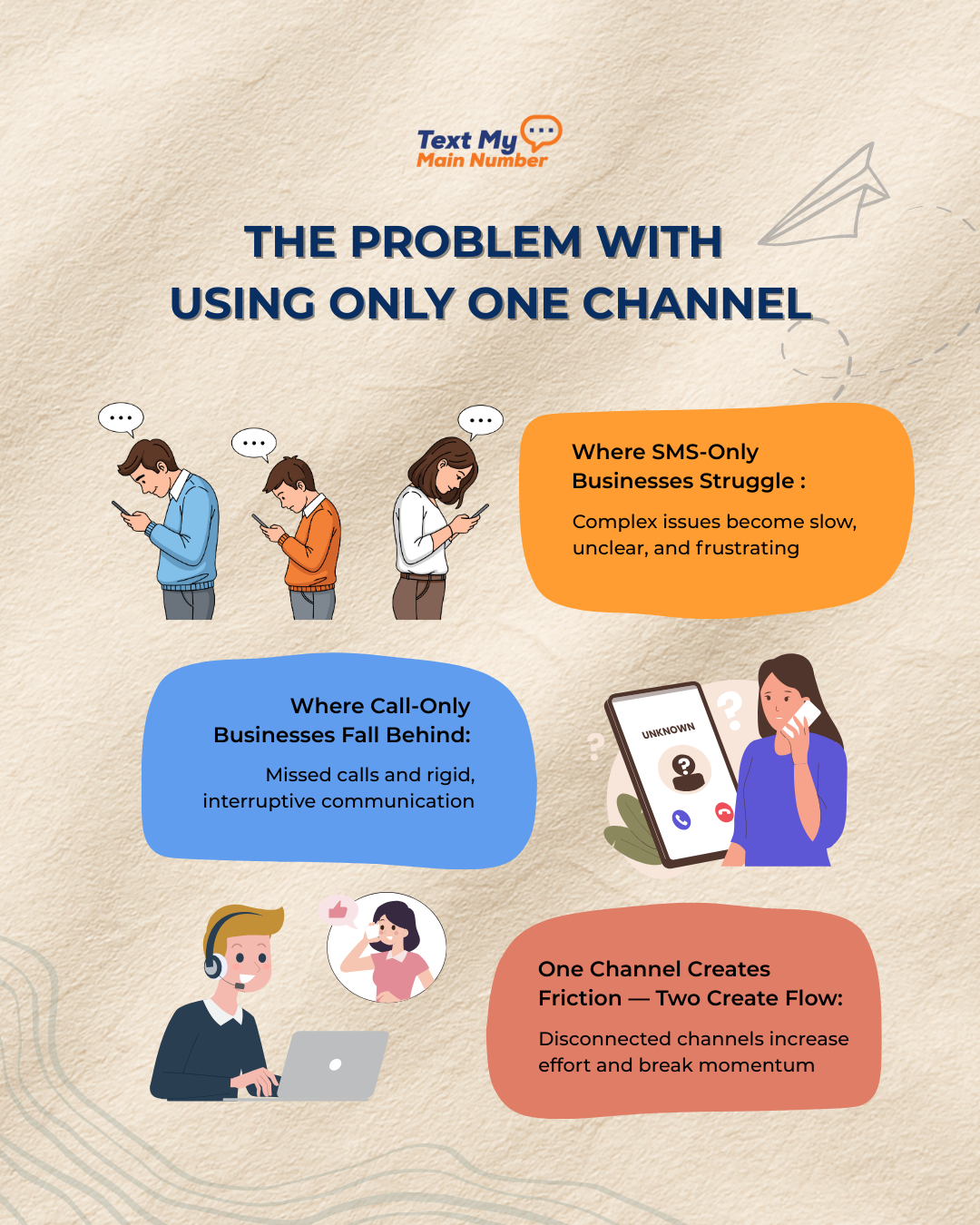
Businesses rarely fail because they choose the wrong channel. They struggle because they choose only one. Relying exclusively on SMS or voice creates predictable breakdowns — different problems, same outcome.
Where SMS‑Only Businesses Struggle
SMS‑only setups work well for simple interactions, but they begin to strain as complexity increases.
Conversations stretch longer than necessary. Urgent issues feel delayed. Nuanced discussions lose clarity. Customers grow frustrated when a problem that could be solved in minutes drags on through messages.
Teams also lose opportunities to build trust. Without voice, there’s no tone, no reassurance, and no real sense of connection during important moments.
Where Call‑Only Businesses Fall Behind
Call‑only businesses face the opposite problem.
Customers miss calls. Voicemails pile up. Follow‑ups rely on repeated dialing instead of lightweight confirmation. Simple questions that could be handled asynchronously interrupt both staff and customers.
Without texting, communication becomes rigid. Every interaction demands real‑time availability, which doesn’t match how people live or work anymore.
One Channel Creates Friction — Two Create Flow
The real issue isn’t SMS versus voice. It’s isolation.
When channels don’t work together, customers are forced to adapt to the business instead of the other way around. Conversations reset. Context disappears. Effort increases.
Businesses that connect SMS and voice remove that friction. They let conversations move naturally to the channel that fits the moment — without losing history, ownership, or momentum.
That’s when communication stops feeling like a limitation and starts working the way customers expect.
How SMS and Voice Actually Work Together in Practice
This is where theory turns into results.
When SMS and voice are treated as connected parts of the same system, communication stops feeling reactive and starts feeling intentional. The goal isn’t to force customers into a preferred channel. It’s to meet them where they are, then smoothly move the conversation to whatever works best next — without losing context, momentum, or trust.
Here’s what that looks like in real businesses.
Scenario 1: Missed Call → Immediate Text Follow-Up
A customer calls your business, but no one answers.
In a call-only setup, that call turns into a missed opportunity. Maybe there’s a voicemail. Maybe there isn’t. Either way, the customer is left waiting and wondering when or if someone will respond.
In a connected SMS + voice setup, the experience changes instantly.
The missed call automatically triggers a text acknowledging the attempt. The customer knows they weren’t ignored. They’re invited to reply, ask a question, or request a callback on their own terms. That single message preserves intent and keeps the conversation alive instead of letting it die in voicemail.
From the business side, this creates clarity. You see who called, what number they used, and how they responded. Follow-up becomes proactive instead of reactive. What could have been a lost lead turns into a continued conversation with context already intact.
Scenario 2: Text Conversation → Quick Call to Close
A potential customer starts with a text.
They ask about pricing. Then availability. Then a specific concern. The conversation is friendly, but it starts to stretch. Responses take longer. Details pile up. Momentum slows.
This is where SMS-only communication often stalls.
In a blended setup, the transition is natural. A team member recognizes that the conversation has reached a point where voice would be faster and clearer. They suggest a quick call. Because the customer already feels engaged and understood, they’re far more likely to say yes.
On the call, nothing needs to be repeated. The full text history is visible. Objections are addressed in real time. Questions are resolved immediately. What might have taken hours or days over text alone gets wrapped up in minutes.
The call doesn’t replace SMS. It completes it.
Afterward, the conversation can return to text for confirmation, next steps, or follow-ups — with everyone aligned.
Scenario 3: Ongoing Customer Relationship With Both Channels
Long-term customers rarely stick to a single channel.
They might text for routine requests, call when something feels urgent, and expect continuity every time they reach out. In disconnected systems, this creates confusion. In connected systems, it creates trust.
A customer texts about a minor update. Weeks later, they call with a related issue. The person answering sees the full interaction history and understands the relationship immediately. There’s no reset. No awkward catch-up. Just forward movement.
Over time, this consistency becomes part of the customer experience. Communication feels easy. The business feels organized. The relationship feels reliable.
That’s the real advantage of using SMS and voice together.
No more messages. No more calls. Just fewer breakdowns — and conversations that move naturally from start to finish, no matter how the customer chooses to connect.
Why This Matters More as Teams Grow
Growth changes the shape of communication inside a business.
What once worked through instinct and memory now depends on coordination. More people touch the same conversations. More handoffs happen between sales, support, scheduling, or billing. More moments exist where context decides whether an interaction feels smooth or sloppy.
Without shared visibility, teams operate in fragments. This kind of internal disconnect is exactly what’s examined in What Unified Communications Means for Small Businesses in 2026 (And Why It Matters).
Someone answers a text without knowing a call happened earlier. A follow-up is assumed but never sent. Two people respond to the same customer with slightly different answers. None of this comes from poor effort. It comes from a missing structure.
As teams grow, a few things become non-negotiable:
- Shared visibility so anyone can see what’s already happened
- Clean handoffs so responsibility doesn’t get lost between roles
- Conversation context so customers aren’t forced to start over
- Accountability so follow-ups happen intentionally, not accidentally
When SMS and voice live in separate silos, those fundamentals are hard to maintain. When they live together, teams move faster with less friction. Conversations stop depending on individual memory and start living inside the system.
That’s the difference between scaling activity and scaling competence.
Where Text My Main Number Fits In
Text My Main Number is designed for the stage where texting still matters — but texting alone is no longer enough.
Most businesses don’t want to replace SMS. They want it to work better, alongside voice, with visibility and continuity built in. TMMN bridges that gap by connecting business texting and VoIP calling inside one shared environment that teams can actually use.
Instead of juggling personal phones, separate inboxes, and disconnected call logs, teams see the full conversation in one place. Texts, calls, and follow-ups stay linked. Context carries forward. Ownership stays clear.
The result isn’t more tools or complexity. It’s fewer dropped threads, faster resolution, and communication that feels intentional instead of reactive.
The Future of Business Communication Is Blended, Not Channel-Based
Customers aren’t moving toward one channel. They’re moving between them.
Messaging, calling, and automation are already overlapping in how people communicate day to day. Businesses that try to force interactions into a single lane will keep fighting that reality. Businesses that adapt will feel easier to work with — without doing more work.
The future isn’t about choosing SMS or voice. It’s about letting conversations move naturally, while keeping history, context, and accountability intact.
When communication is blended, customers feel understood. Teams feel aligned. And growth feels controlled instead of chaotic.
That’s where business communication is headed — not louder, not more complex, just more connected.
Conclusion
Texting and calling aren’t competing tools. They’re two halves of the same conversation.
When SMS and VoIP work together, customers get faster answers, teams keep context, and conversations move forward without friction. You’re no longer forcing people into a channel — you’re meeting them where they are and responding in the way that makes the most sense.
Text My Main Number brings business texting and cloud-based VoIP together in one shared system, so calls, texts, and follow-ups stay connected as your team grows.
Explore how TMMN’s VoIP phone service supports real-world communication workflows.
Start your 14-day free trial and see what connected communication actually feels like.

.svg)

