Texting changed how businesses communicate. It made responses faster, conversations more personal, and follow-ups more reliable. For many small businesses, SMS was the first real upgrade from missed calls, voicemail black holes, and cluttered inboxes.
But here’s the thing: what works when you’re small starts to crack as you grow.
If your business is scaling — more leads, more customers, more staff, more conversations — texting alone stops being a solution and starts becoming a bottleneck. Messages get missed. Context disappears. Customers repeat themselves. Teams step on each other’s toes.
This article isn’t about abandoning SMS. It’s about understanding its limits — and what modern businesses actually need once growth kicks in.
The Early-Stage SMS Win (And Why It Feels So Good)
In the early days, SMS really did feel like a cheat code.
A customer texts instead of calling. You see it instantly. You reply right away. An appointment gets booked in two messages. A quick question turns into a sale. Follow-ups that used to fall through the cracks suddenly happen on time. Response times drop from hours to minutes, sometimes seconds.
The impact is immediate and visible. Customers notice. They comment on how “easy” you are to reach. Reviews start mentioning responsiveness. Conversations feel lighter, faster, more human.
For a solo operator or a two-person team, texting often is enough. Many small teams start here, which is why How Small Teams Manage Customer Conversations Without Burnout (2026 Guide) breaks down how early-stage workflows can stay organized before complexity sets in. Every message is familiar. You remember who said what. You know where each conversation left off because you were there for all of it. If someone texts back three days later, your brain fills in the context automatically. No notes needed. No handoffs. No confusion.
There’s also very little friction. No training. No complicated setup. No behavior change required. It fits naturally into how you already work. You’re not managing a system. You’re just talking to people.
That’s why so many businesses stop here.
SMS delivers fast wins with almost no effort. It solves the most painful communication problems early on, and it does it in a way that feels intuitive instead of technical. For a while, it feels like you’ve “fixed” customer communication.
But that feeling only lasts while volume stays low and ownership stays clear.
Once conversations multiply and more people get involved, the math changes — quietly at first, then all at once.
What Changes When Your Business Scales
Growth doesn’t just mean more revenue. It means more complexity.
More conversations are happening at the same time. More staff are touching the same customers. More channels where customers expect answers. More moments where context matters.
Here’s what that looks like in real businesses:
A home services company now has sales, scheduling, and support all texting customers — but no shared visibility.
A medical practice has patients texting for appointments, calling with urgent questions, and emailing documents — all disconnected.
A real estate team has leads texting agents directly, while admin staff tries to follow up blindly.
Nothing is broken. But nothing is fully working either.
This is the stage where texting alone quietly starts costing you money.
The Hidden Costs of SMS-Only Communication
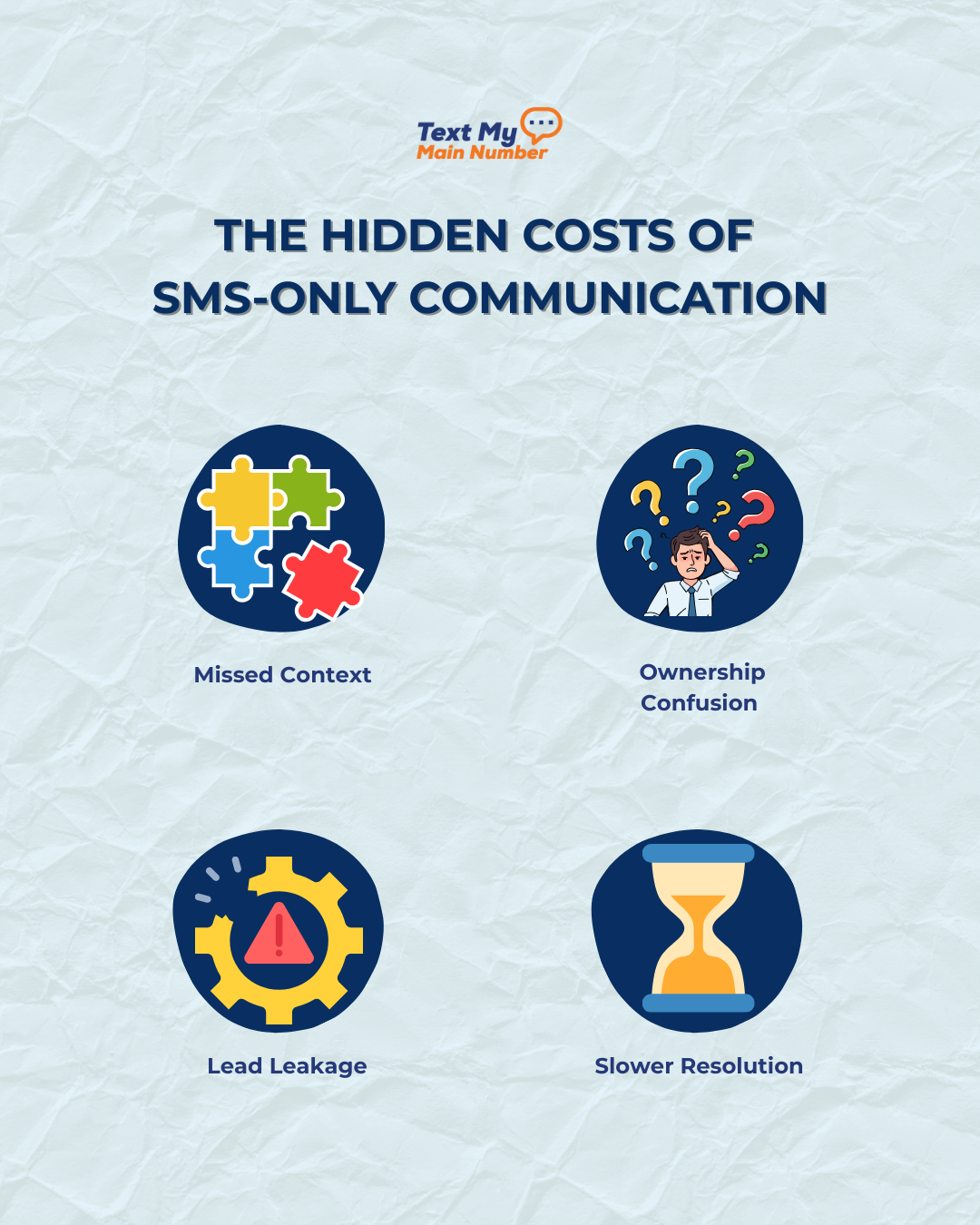
Texting feels inexpensive on the surface. A few dollars per month. Low learning curve. Fast replies. It looks efficient.
The real costs don’t show up on an invoice. They show up in friction, wasted time, and quiet revenue loss that’s easy to overlook until growth exposes it.
Missed Context
A text thread captures words, not the full customer story. It doesn’t show prior calls, earlier objections, past issues, or internal notes. When a conversation pauses and resumes days later, that missing context matters. Customers end up explaining themselves again. Staff fill in the gaps from memory or assumptions. Small misunderstandings turn into mistakes that feel avoidable in hindsight.
Then there’s ownership confusion, which creeps in as soon as more than one person touches the inbox.
Who’s responsible for replying? Did someone already respond? Was that follow-up sent or just talked about? Without shared visibility and clear handoffs, teams rely on mental notes and “I thought you handled it” logic. Messages slip through. Responses get duplicated. Accountability becomes fuzzy. This works when it’s just you. It falls apart the moment responsibility spreads.
Lead Leakage
Not every customer starts with a text. Some call. Some email. Some switch channels mid-conversation. This multi-channel reality is explored further in Why Modern Customer Communication Isn’t One Channel Anymore (2026 Guide), which explains why customers expect continuity across calls, texts, and email. When a business optimizes only for SMS, everything else becomes second-class. Calls go unanswered. Emails sit unread. Follow-ups happen inconsistently. Modern customers don’t commit to one channel — they choose whatever feels fastest or most comfortable in that moment. If you only meet them in one place, you lose the rest.
Slower Resolution
Texting is great for quick exchanges, but it’s inefficient for anything complex. A five-minute phone call can replace twenty back-and-forth messages. Urgent issues, emotional situations, or nuanced questions need a voice. SMS-only businesses stretch conversations that should’ve been resolved immediately, frustrating customers and burning staff time.
None of this feels catastrophic day to day. That’s what makes it dangerous.
Each issue is small on its own. Together, they quietly erode efficiency, clarity, and customer confidence — the exact things growing businesses can’t afford to lose.
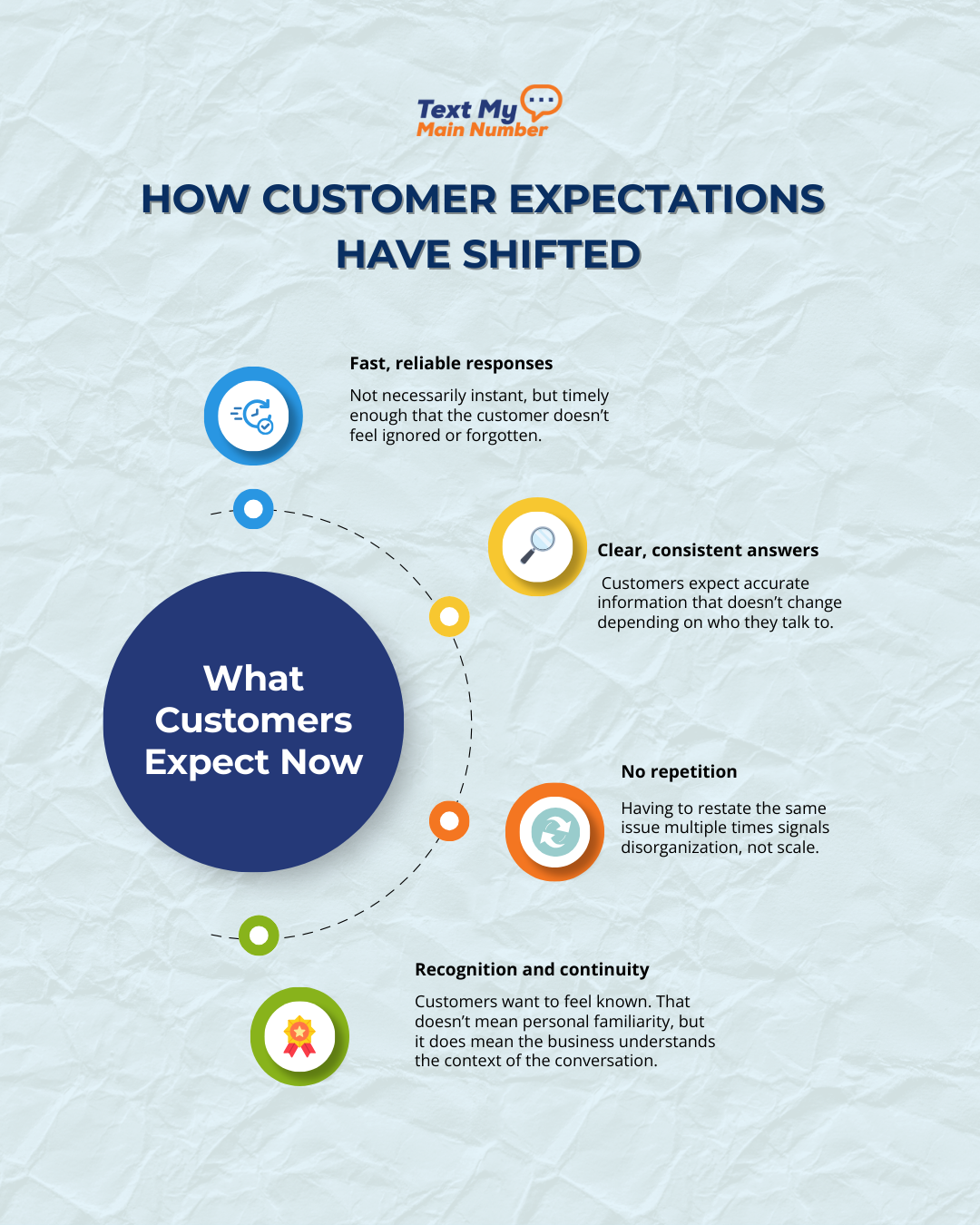
How Customer Expectations Have Shifted
.png)
But here’s the thing: what works when you’re small starts to crack as you grow.
Customer expectations around communication have changed quietly but permanently.
People no longer think in terms of channels like “text,” “call,” or “email.” They think in terms of outcomes. Did they get an answer? Was it handled quickly? Did the business seem organized and aware of its situation?
From the customer’s perspective, the channel is just a tool. The experience is what matters.
What Customers Expect Now
Across industries, expectations have converged around a few core behaviors:
- Fast, reliable responses
Not necessarily instant, but timely enough that the customer doesn’t feel ignored or forgotten. - Clear, consistent answers
Customers expect accurate information that doesn’t change depending on who they talk to. - No repetition
Having to restate the same issue multiple times signals disorganization, not scale. - Recognition and continuity
Customers want to feel known. That doesn’t mean personal familiarity, but it does mean the business understands the context of the conversation.
These expectations exist regardless of company size. A small business doesn’t get a pass for being “busy.” In fact, customers often hold smaller teams to higher standards because the interaction feels more personal.
The Reality of Modern Conversations
Real customer interactions rarely stay in one lane.
A customer might text first because it’s convenient, then call later because the issue feels urgent or complex. When they do, they assume the person on the phone already knows what they texted earlier. That assumption feels reasonable to them, because it reflects how they experience communication in their own lives.
When that continuity breaks, the impact is immediate.
The customer doesn’t see internal constraints or workload. They see a business that isn’t fully aligned. Even if your team is responsive and well-intentioned, the experience feels fragmented. And fragmentation erodes confidence.
Why This Matters More Than Ever
This shift isn’t about sophistication or shiny technology. It’s about competence.
Businesses that feel organized, aware, and consistent earn trust quickly. Those who don’t feel scattered, even when they’re trying hard. As customer expectations continue to rise, the gap between effort and perception matters more than the effort itself.
Meeting modern expectations isn’t about doing more. It’s about communicating in a way that feels seamless, connected, and reliable from the customer’s point of view.
Where SMS Alone Starts to Break Down
Texting is a powerful tool, but it has a natural ceiling.
It works exceptionally well when conversations are simple and self-contained. A quick question about pricing. A confirmation that an appointment is booked. A short update that doesn’t require much explanation. In these moments, SMS feels efficient and effortless, both for the customer and the business.
The problem isn’t what texting does well. It’s what happens when conversations stop being simple.
The Limits of Text-Based Conversations
As soon as communication becomes more nuanced, SMS starts to show its weaknesses. Complex questions require back-and-forth clarification. Urgent situations demand immediate attention and tone that text can’t always convey. Multi-step workflows, where information unfolds over time, are difficult to manage inside a single message thread without losing track of what’s been handled and what hasn’t.
Texting also struggles in team environments.
The moment more than one person interacts with the same customer, unstructured SMS becomes fragile. Without clear ownership, shared visibility, or conversation history beyond the thread itself, coordination breaks down quickly.
What Happens Without Structure
When SMS operates in isolation, predictable problems start to surface:
- Replies overlap because multiple people think it’s their responsibility to respond.
- Follow-ups are forgotten because no one is clearly accountable.
- Answers vary depending on who replies, creating inconsistency and confusion.
- Customers sense the disconnect and grow frustrated, even if individual responses are fast.
None of this means SMS is the wrong tool. It means it’s incomplete on its own.
Texting needs structure, visibility, and coordination around it to function well in growing businesses. Without that support, what once felt efficient slowly becomes a source of friction — for both teams and customers.
The Real Upgrade Isn’t More Texting — It’s Connected Communication
Most growing businesses don’t need more messages. They need better coordination.
That’s where unified communication comes in. As explained in What Unified Communications Means for Small Businesses in 2026 (And Why It Matters), it’s not about adding more tools, but about connecting conversations into one shared system.
Not as an enterprise buzzword — but as a practical way to:
• Keep SMS, voice, and conversations in one place
• Give teams shared visibility
• Preserve context across channels
• Respond the way the situation actually demands
This is the difference between reacting and operating.
Why Growing Teams Need Shared Visibility and Connected Communication
Growth changes how communication works inside a business.
What once lived comfortably in one person’s head now has to be shared. Responsibilities spread. Conversations multiply. Hand-offs become normal instead of occasional. This is the moment when personal inboxes and individual text threads quietly stop working.
Once more than one person is involved, communication becomes a team activity. Without shared visibility, even well-run teams start to feel scattered from the outside.
Why Visibility Becomes Non-Negotiable
As teams grow, a few fundamentals become essential:
- Shared access to conversations so no single person becomes a bottleneck
- Complete conversation history so anyone can pick up where things left off
- Clear ownership so messages don’t sit unanswered or get replied to twice
- Accountability so follow-ups actually happen and standards stay consistent
Without these, coordination depends on memory and informal check-ins. That might work for a short time, but it doesn’t scale. Customers experience delays, inconsistencies, and confusion even when the team itself is working hard.
The issue isn’t effort. It’s visibility.
Why Texting Alone Isn’t Enough for Teams
SMS is excellent for convenience. It’s fast, familiar, and low-friction. But when teams rely on texting alone, they’re forced to stretch it beyond what it’s designed to handle.
Certain situations demand more than text can offer.
Voice is still unmatched when conversations are urgent, emotionally sensitive, or complex. For a deeper comparison of when calls outperform messaging, see Business Texting vs Phone Calls: How to Use Both Effectively. Tone matters. Speed matters. Nuance matters. A five-minute call can prevent twenty messages of clarification and frustration.
Growing businesses don’t choose between texting and calling. They connect both.
What Connected Communication Actually Looks Like
In a well-structured system, communication flows naturally between channels:
- A missed call automatically triggers a text so the customer knows they weren’t ignored.
- A long or complicated text exchange moves seamlessly to a call when it makes sense.
- Call notes or summaries live alongside the message history, preserving context for the entire team.
This isn’t about adding layers or tools for the sake of it. It’s about choosing the right mode of communication for the moment and making sure everyone involved stays informed.
That’s not overengineering. That’s operational clarity.
When teams can see the full conversation, choose the right channel, and hand off confidently, communication stops being reactive. It becomes coordinated, efficient, and consistent — exactly what customers expect as businesses grow.
Where Text My Main Number Fits In — And Why It Matters at This Stage
Text My Main Number was built for the moment when texting still matters, but texting alone starts to fall short.
Most businesses don’t wake up one day needing a complex communication stack. They grow into it. TMMN starts where teams are already comfortable — business texting — and then removes the ceiling that usually comes with it. Instead of boxing you into SMS-only workflows, it gives you a shared communication foundation that can expand as your team and customer volume grow.
Rather than forcing businesses to juggle separate tools for texting, calling, and internal coordination, TMMN brings those conversations into one system your team can actually use day to day. No IT department. No months-long onboarding. No rewiring how people work. You simply gain visibility, continuity, and control over conversations that were already happening — just more scattered than you realized.
The result isn’t flashier communication. It’s fewer dropped threads, fewer misunderstandings, and fewer moments where someone says, “I thought someone else handled that.”
If you want a deeper breakdown of how this approach fits into modern small-business communication, our article on What unified communications means for small businesses explores that evolution in more detail.
Cost Isn’t the Real Question — Waste Is
When businesses hear “unified communication,” cost is often the first concern. It sounds like an enterprise upgrade when they’re just trying to stay efficient.
What’s harder to see is the ongoing waste caused by disconnected tools and fragmented workflows. Lost leads that never get followed up. Conversations that take twice as long as they should. Staff time spent searching for context or fixing avoidable mistakes. Customers who lose patience because they feel unheard or forgotten.
When one platform replaces multiple tools — and prevents those failures in the process — it usually pays for itself. Not because it’s cheaper on paper, but because it eliminates the chaos that quietly drains time, revenue, and trust.
The real expense isn’t the software. It’s the inefficiency you stop noticing once it becomes routine.
A Practical, Low-Friction Transition
Adopting a more connected system doesn’t mean ripping out what already works.
Most teams take a gradual, practical approach. They centralize SMS first. They add shared voice access where it makes sense. They give staff visibility into conversations instead of relying on memory or side messages. Workflows stay simple because simplicity is what makes systems stick.
The goal isn’t to add layers. It’s to add clarity — the kind that lets teams move faster without tripping over each other.
Why This Matters for the Future
Customer communication is only becoming more blended. Messaging, calling, and automation are already overlapping, and customers expect businesses to keep pace without friction.
They don’t care what tools you use. They care that you respond quickly, that you remember who they are, and that you don’t make them repeat themselves every time they reach out.
Texting alone can’t support that expectation forever.
Connected communication can — and that’s exactly the gap Text My Main Number is designed to fill as businesses grow.
Final Thought: Texting Is the Door — Not the House
Texting is a powerful starting point but growing businesses need more than messages alone.
With Text My Main Number, you get business texting and cloud-based VoIP calling in one connected system, so calls, texts, and customer context live in the same place. No juggling tools. No lost conversations. Just clearer, faster communication as you scale.
Explore how TMMN’s VoIP phone service helps teams handle calls, texts, and follow-ups together: Try 14 day free trial and see how connected communication actually feels.

.svg)