
Most communication problems inside growing businesses do not begin with silence.
They begin with mismatch.
A customer receives a phone call for something that could have been handled in a 15-second text message. An urgent issue gets buried inside an email thread nobody checks until later that afternoon. A sensitive issue gets reduced to fragmented SMS replies that slowly create misunderstanding instead of clarity.
Over time, these moments accumulate in ways most teams do not notice immediately.
That is why the conversation around SMS vs phone vs email is often framed too narrowly. The discussion usually becomes a feature comparison instead of an operational one. Faster versus slower. Modern versus traditional. Convenient versus professional.
But communication channels are not interchangeable.
Each one carries a different emotional tone, different urgency level, different customer expectation, and different operational cost. What matters is not simply whether communication happened. What matters is whether the communication matched the situation the customer believed they were in.
As businesses grow, channel selection starts affecting more than convenience. It affects labor efficiency, customer trust, internal coordination, response speed, escalation judgment, and eventually revenue consistency.
A company can stay busy all day and still leave customers feeling disconnected from what is happening.
Activity is easy to see. Consistency becomes harder to maintain once conversations start spreading across multiple people, devices, inboxes, and interruptions throughout the day.
Why Communication Problems Often Start With the Wrong Channel
Many communication problems begin long before a customer becomes visibly frustrated.
Inside the business, everything can appear active and responsive. Calls are being made. Emails are being sent. Text messages are moving throughout the day. Employees feel occupied. Conversations are happening constantly.
From the customer side, however, the experience can feel surprisingly uneven.
A customer leaves a voicemail while simultaneously replying to an earlier email. A receptionist assumes the technician already followed up by text. The owner believes the office confirmed the appointment because the customer “was already contacted.” Meanwhile the customer still feels uncertain about what is happening.
Most people do not analyze this uncertainty carefully. They simply start feeling less confident in the business.
This is where communication problems often begin taking shape.
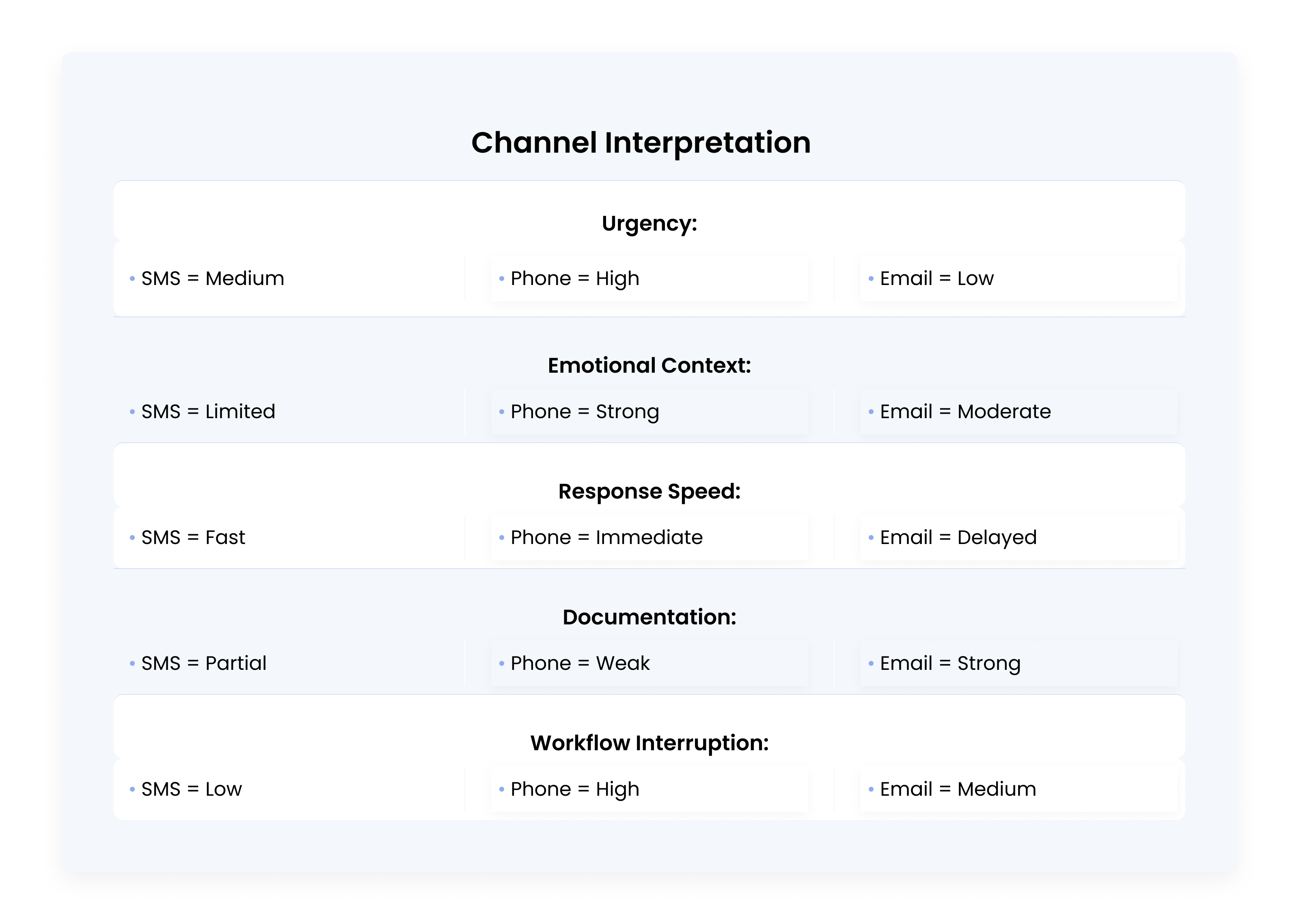
Phone calls demand immediate attention and force both people into the same moment at the same time. SMS creates expectations around speed and convenience. Email suggests lower urgency and more detailed communication. That distinction becomes more obvious as businesses start balancing real-time conversations with text-based coordination across multiple employees and customer touchpoints, which is why many teams eventually discover that How SMS and Voice Work Better Together for Growing Businesses becomes less about channel preference and more about workflow continuity.
Once those expectations stop aligning with the actual situation, the interaction itself begins feeling off even if the company believes communication is happening consistently.
Early-stage businesses can operate informally for a surprisingly long time. The owner answers calls directly. Staff members communicate however feels natural in the moment. One employee prefers texting while another prefers email.
That flexibility often works when communication volume remains manageable.
Growth changes the environment.
A business handling five conversations per day can operate casually without major consequences. A business handling fifty conversations per day starts encountering overlap, interruptions, delayed responses, repeated follow-ups, and internal assumptions about who handled what already.
The breakdown rarely arrives through one dramatic failure.
More often, the problems surface through small moments that gradually start stacking together.
A customer waits two extra hours for an update because one employee assumed another employee already responded. An estimate sits unread in email because the customer expected a text notification. A scheduling adjustment turns into four unanswered phone calls when a single text message would have resolved the situation immediately.
Individually, these situations feel manageable.
Repeated throughout the week, they begin slowing the business down in ways that are difficult to measure directly. In many growing businesses, this gradual communication slowdown starts appearing long before leadership recognizes it as a systems problem rather than an employee performance issue, which is exactly the pattern explored in How Small Businesses Manage Customer Conversations Without Dropping Leads.
One customer may sit in their kitchen at 4:45 PM waiting for a callback that never comes, refreshing their phone every few minutes while quietly debating whether to contact another company before the workday ends. Internally, several employees may have touched the conversation already, creating the impression that the issue is actively being handled.
That disconnect matters more than many companies realize.
Many customers now screen incoming calls automatically unless they recognize the number. A company may spend hours making outbound calls believing they are providing attentive service, while customers increasingly experience those calls as interruptions they will deal with later.
Email creates a different timing problem. Important messages may technically be delivered quickly while the actual conversation stretches across an entire day because the customer checks email only periodically between meetings, errands, or family obligations.
The result is not always immediate revenue loss.
Sometimes it appears as slower momentum inside the sales process.
Sometimes it shows up as hesitation during follow-up.
Sometimes people simply stop replying with the same urgency they showed earlier in the conversation.
Businesses rarely notice communication decline all at once. They usually sense it first through slower replies, harder follow-up, increased clarification, and conversations that suddenly require more energy to maintain.
The communication itself was not necessarily poor.
The fit was off.

How Customers Interpret SMS, Phone Calls, and Email Differently
People rarely analyze communication channels consciously, but they react to them emotionally almost immediately.
A phone call feels different from a text message before a single word is spoken, and that initial reaction shapes the interaction that follows.
Phone calls usually signal urgency, complexity, emotional nuance, or importance. People expect real-time interaction during calls. They expect clarification, reassurance, and focused attention.
That makes phone conversations valuable in situations involving conflict resolution, high-value decisions, emotionally sensitive discussions, complicated scheduling, or detailed explanation.
But the same qualities that make phone calls effective also make them expensive from a workflow perspective.
Calls interrupt workflow. They force both parties into the same time window. They create context switching inside busy offices. A quick appointment confirmation that could have taken ten seconds through SMS can easily become a seven-minute phone conversation once clarification, side questions, scheduling adjustments, and small talk begin naturally extending the exchange.
Across dozens of conversations each week, that accumulated time becomes meaningful labor.
SMS works differently because it lowers communication resistance. People can respond asynchronously without stopping meetings, interrupting dinner, leaving work, or committing to a live conversation. That convenience is one reason texting often becomes the fastest response channel for confirmations, ETA updates, scheduling coordination, and lightweight back-and-forth communication.
At the same time, SMS compresses emotional context in ways many teams underestimate.
Tone becomes easier to misread. Detailed explanations become fragmented. Sensitive conversations become awkward. A complicated billing issue handled entirely through text often becomes more tense because nuance disappears between short replies arriving minutes apart.
Employees may think they are keeping the exchange efficient while the person on the other side starts feeling brushed off.
Email occupies a separate category entirely.
People generally associate email with documentation, contracts, estimates, summaries, approvals, invoices, and lower-urgency communication. Email works well when information needs structure or future reference.
The challenge is timing.
Many companies overestimate how quickly people engage with email throughout the day.
A customer may respond to a text message within four minutes while leaving an email unopened until later that evening. That delay changes momentum even when the customer fully intends to respond.
This is where communication starts slowing without anyone recognizing it immediately.
People are not necessarily ignoring the business.
They are sorting communication by channel priority before they even process the content itself.
An unnecessary phone call can feel intrusive.
An emotionally sensitive text can feel dismissive.
An urgent email can create the impression that the company is disorganized internally.
The communication method itself influences how attentive, coordinated, or professional the business appears long before anyone consciously evaluates the company itself.
The Operational Cost of Using High-Effort Communication for Low-Effort Situations
A plumbing company handling roughly forty inbound inquiries per day provides a useful example.
Originally, the company managed nearly every customer interaction through phone calls.
Morning scheduling calls. Confirmation calls. Technician arrival calls. Follow-up calls. Payment reminder calls.
At first, the owner believed this created strong customer service because every interaction felt personal.
Behind the scenes, however, the workflow was consuming far more labor than the team realized.
The office manager spent nearly four hours each day making outbound calls, leaving voicemails, retrying unanswered numbers, and waiting for callbacks. Technicians regularly called the office from the road to confirm details customers had already communicated earlier.
The inefficiency became more visible during busy weeks.
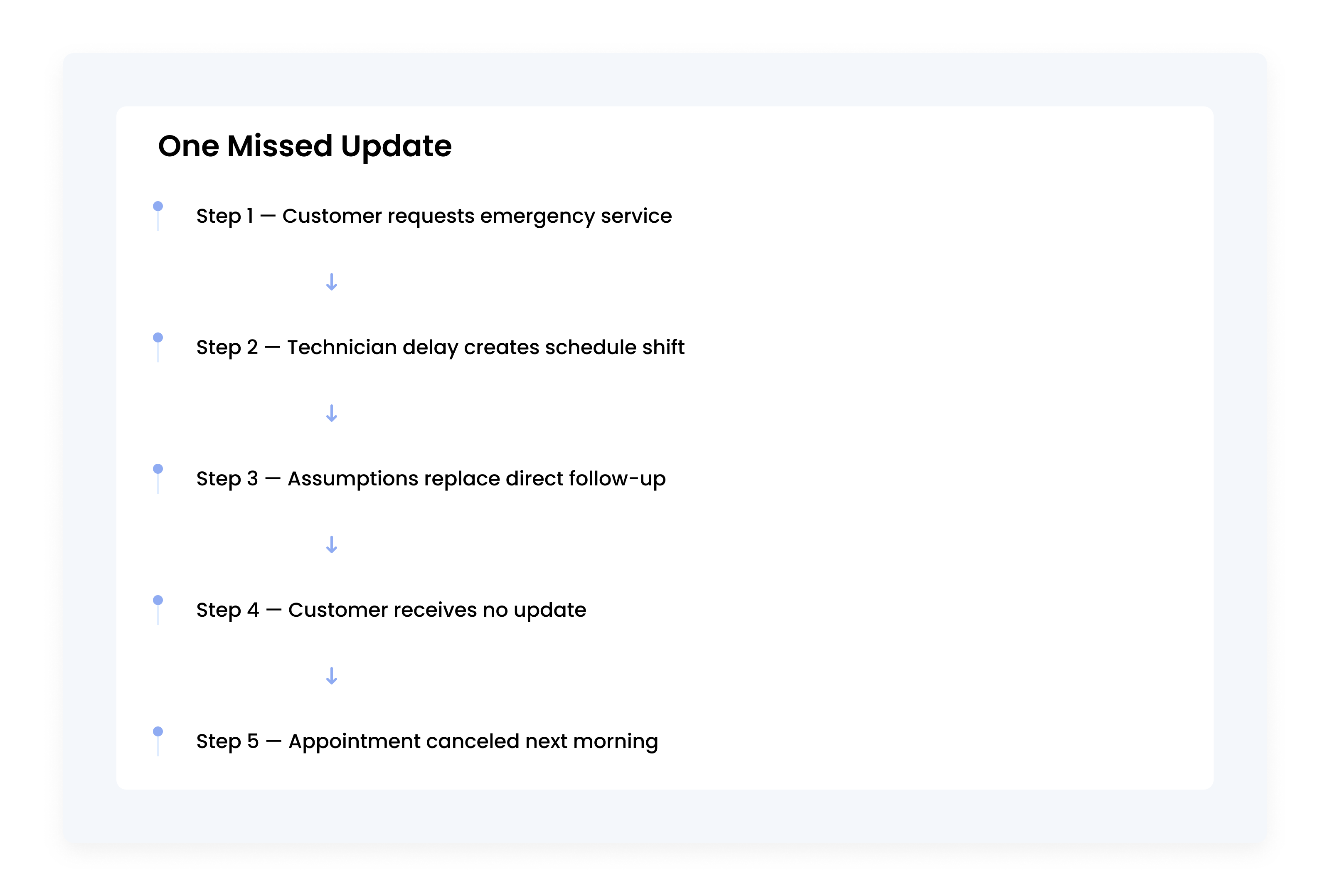
On a Tuesday morning, a customer called requesting emergency service for a leaking water heater. The receptionist answered the call and promised a technician would arrive later that afternoon.
Around noon, the technician realized he would be delayed because a previous job expanded unexpectedly.
He attempted to call the customer twice but received no answer.
Assuming the office would continue follow-up, he moved on to the next appointment because another customer was already waiting and dispatch was already juggling incoming service calls.
Meanwhile, the receptionist believed the technician had already spoken directly with the customer and updated the situation.
Nobody sent a text message.
By 3:30 PM, the customer still had no update.
The customer then emailed asking whether someone was still coming. The email remained unread until later that evening because the office staff was tied up handling inbound calls, dispatch coordination, and end-of-day scheduling adjustments.
The next morning, the customer canceled the appointment and hired another company.
Nothing about the situation looked catastrophic internally.
But several assumptions compounded together throughout the afternoon.
The technician believed the office would follow up.
The office believed the technician already handled it.
The customer interpreted the silence as lack of urgency.
This is how communication breakdowns usually appear in real businesses. Not dramatic collapse. Just several small gaps aligning at the wrong time.
After reviewing the workflow, the company shifted lower-complexity communication into SMS.
Appointment confirmations, technician ETA updates, scheduling reminders, and quick customer questions moved primarily into text messaging. That transition tends to work especially well in businesses where appointment timing, technician arrival windows, and customer coordination create constant low-level communication traffic throughout the day, which is one reason How to Use SMS for Effective Appointment Reminders and Confirmations has become increasingly relevant across service-based industries.
Phone calls became reserved for situations involving emotional nuance, emergency diagnosis, pricing disputes, large project consultations, or complicated scheduling problems.
The operational difference became measurable fairly quickly.
If the office manager previously spent four hours daily on outbound calls and reduced that workload by even ninety minutes per day through SMS handling, the business recovered approximately 7.5 labor hours weekly.
At a fully burdened labor cost of roughly $28 per hour, that equaled approximately $840 monthly in regained operational time.
The larger improvement, however, came from reduced communication drag throughout the day.
Customers received updates faster. Technicians experienced fewer interruptions while on-site. Office staff dealt with fewer voicemails and callback chains. Scheduling adjustments that previously consumed fifteen minutes sometimes became thirty-second text exchanges handled between other tasks while staff members were already multitasking across inbound activity.
The system did not suddenly become perfect.
Some customers still preferred calls. Certain situations still became messy during busy weeks. Delays still happened occasionally.
But the business removed a significant amount of unnecessary effort from routine communication, which allowed employees to focus attention where live interaction actually mattered.
The companies that scale communication effectively are usually not talking more.
They are spending less time recovering from avoidable communication drag.
Where Businesses Quietly Lose Time Between Channels
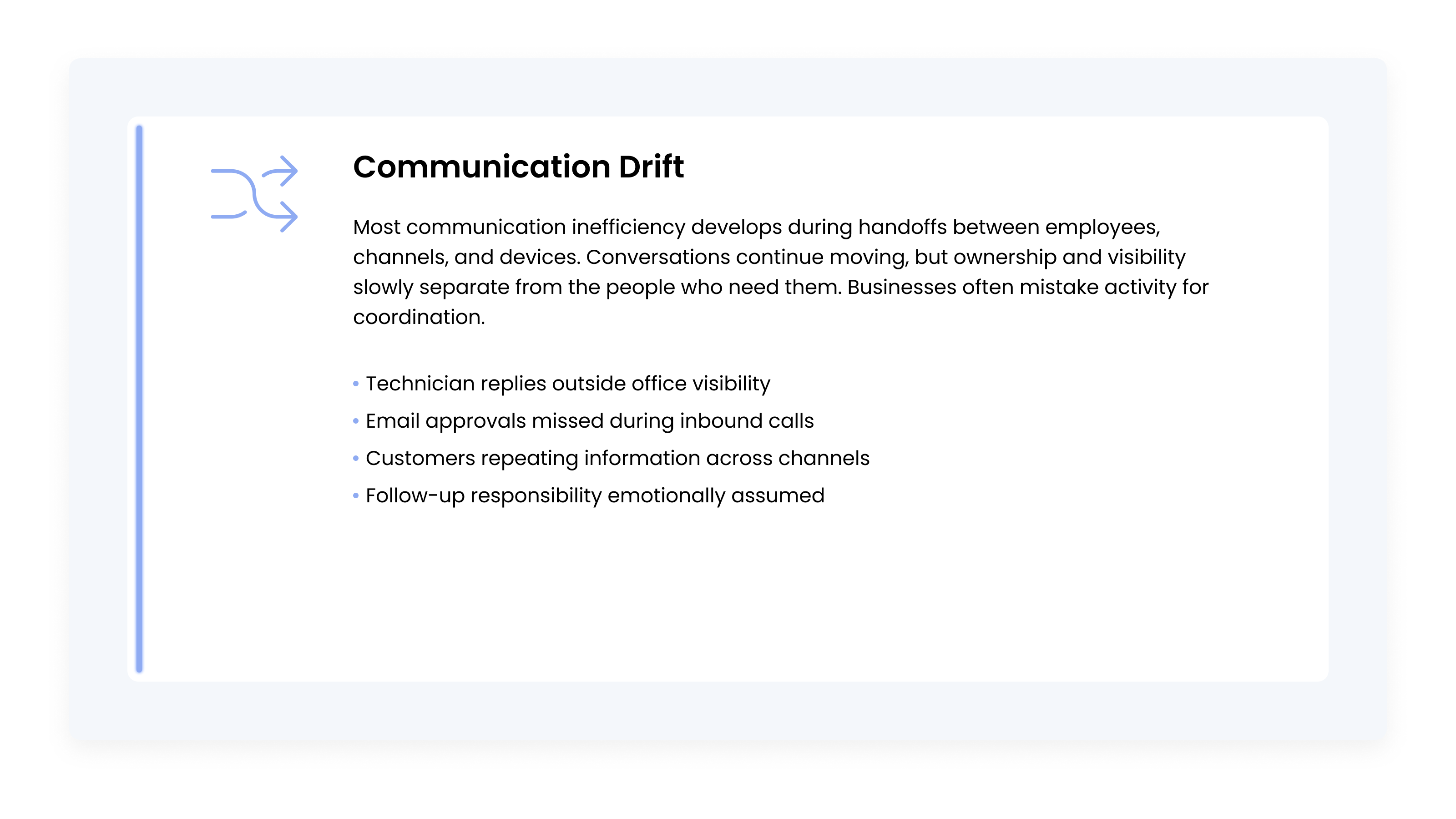
Most communication inefficiency develops between systems rather than inside them.
A text message itself is not usually the problem.
Neither is a phone call.
The trouble begins during transition points where information moves between people, devices, or channels without clear continuity.
A customer calls the office. The receptionist takes notes manually. The technician later sends a separate text update. The customer replies directly to the technician. The office never sees the response. An email estimate gets sent later that evening. Nobody confirms whether the customer opened it.
The conversation continues moving, but context starts separating from the people who need it.
This becomes especially difficult once multiple employees participate in customer communication.
A business owner may assume responsiveness is happening because activity is happening. Phones are ringing. Messages are moving. Emails are being sent throughout the day.
But activity and continuity are not the same thing.
One HVAC company experienced this repeatedly during summer emergency season.
The dispatcher texted customers estimated arrival windows. Technicians occasionally called customers directly if traffic delays occurred. Office staff later emailed invoices and maintenance recommendations.
Each individual interaction sounded reasonable on its own.
From the customer side, however, the experience often felt disjointed.
One customer replied by text asking whether the technician still planned to arrive that evening. The dispatcher had already gone home. The technician assumed the office handled scheduling communication after hours.
The following morning, the owner discovered the unanswered message while reviewing conversations before opening the office, while several newer inbound requests were already arriving at the same time.
No employee deliberately ignored the customer.
The larger problem was that nobody clearly owned the conversation once it moved across channels.
In another case, a technician arrived at a service call carrying outdated pricing information because revised details had only been updated inside an email thread between the office and customer the night before. The customer believed the technician already knew about the updated estimate. The technician walked into the appointment confused and defensive within the first two minutes of the conversation.
Those situations create tension quickly because customers interpret confusion as lack of coordination.
Inside growing businesses, communication responsibility often becomes emotionally assumed rather than operationally defined.
Employees think someone else probably handled it.
Managers assume the customer already received the update.
Technicians believe the office passed along the information.
The gaps are rarely intentional. They emerge because communication responsibilities become harder to track once multiple people participate in the same customer relationship.
Different channels also carry different urgency expectations.
A missed phone call feels immediately visible.
An unread email can disappear for hours without anyone noticing.
A text message sitting unanswered for three hours creates a completely different reaction than an unanswered email sitting overnight.
People rarely verbalize these distinctions directly.
Trust simply starts weakening conversation by conversation.
A Practical Framework for Choosing the Right Communication Method
Over time, many businesses eventually stop viewing communication channels as interchangeable.
Usually that realization comes after enough scheduling confusion, missed callbacks, duplicated follow-up, awkward escalation, or customer frustration accumulates internally.
At that point, communication selection stops feeling like personal preference and starts feeling tied to operational stability.
Different situations carry different communication weight.
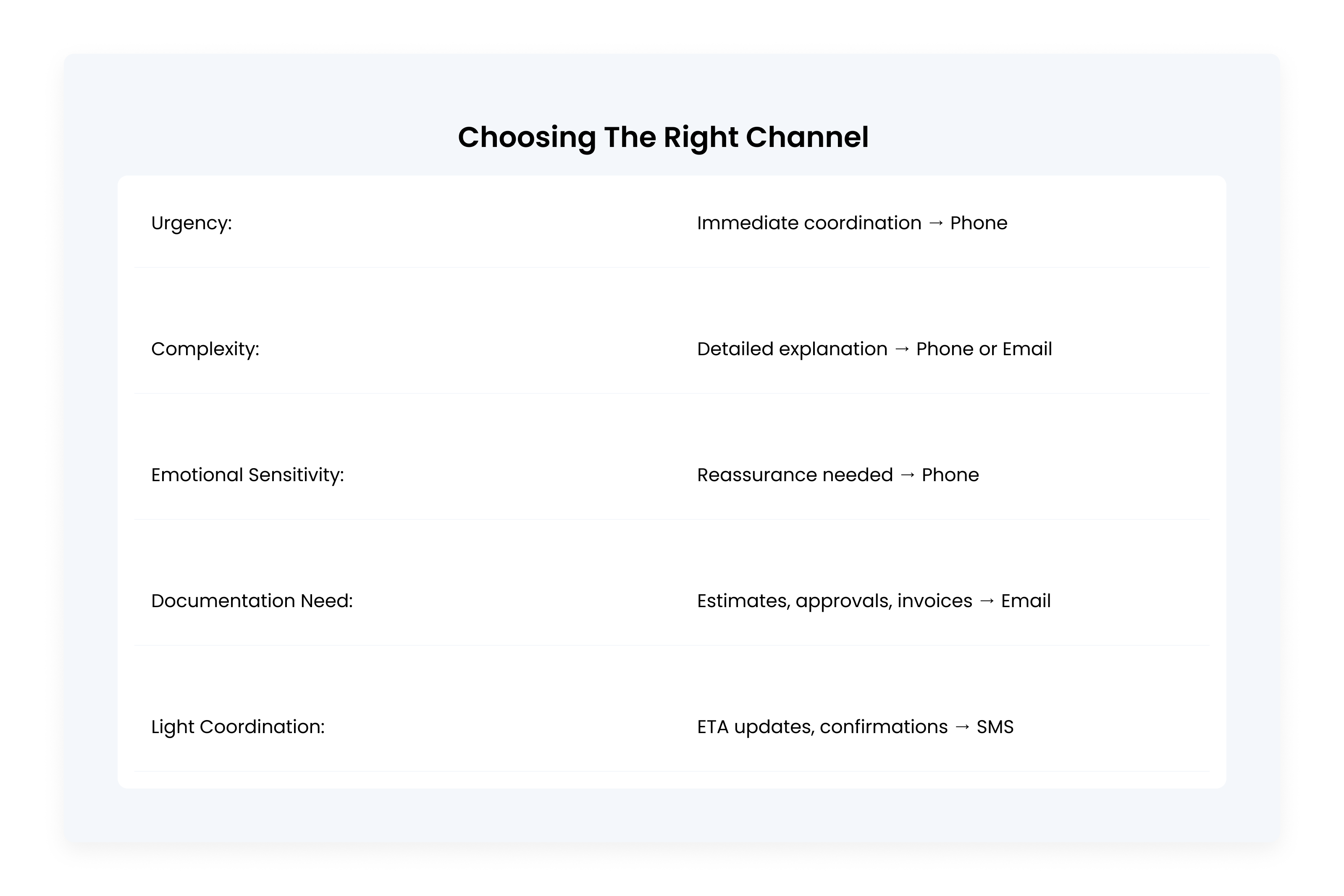
Growing teams usually begin sorting conversations through a few recurring filters, even if nobody formally labels them that way:
Urgency.
Complexity.
Emotional sensitivity.
Documentation need.
Urgency affects how quickly interaction needs to happen.
Some situations require immediate attention while others simply require acknowledgment. A technician delay may only require a short text update. A major project cancellation usually demands live conversation because the customer needs emotional context as much as information.
Many offices struggle here because once communication volume increases, nearly everything starts feeling urgent internally. Routine scheduling adjustments begin triggering unnecessary calls while genuinely time-sensitive issues drift through slower channels buried under normal activity.
Complexity changes the communication environment completely.
Detailed troubleshooting, emotionally nuanced discussions, or pricing negotiations often deteriorate when compressed into fragmented text exchanges.
This is where long message chains start appearing.
A customer asks a complicated question by text. Staff responds partially between other tasks. The customer becomes more confused. Additional messages continue for thirty minutes before somebody finally picks up the phone.
The problem was never lack of responsiveness.
The conversation simply outgrew the communication format being used.
Emotional sensitivity matters more than many operators initially realize.
People interpret tone differently depending on communication method. A refund denial delivered through SMS can feel abrupt even if the wording itself is polite.
Meanwhile, a quick scheduling adjustment sent through a formal email may feel colder than the situation actually requires.
Employees often believe they communicated clearly while the person on the other side walks away feeling dismissed, rushed, or emotionally unimportant.
Documentation creates another layer entirely.
Some communication needs future visibility. Estimates, invoices, approvals, policy clarification, and detailed summaries often belong in email because those conversations may need to be referenced later by employees, customers, or accounting staff.
Without continuity around documentation, teams start relying on memory, scattered message threads, sticky notes at the front desk, and verbal recollection between interruptions.
That becomes difficult once communication volume expands.
The strongest setups are not necessarily the most advanced technically.
They are the environments where employees consistently understand what belongs where, who owns follow-up, when conversations need escalation, and how information remains visible after the interaction ends.
When Speed Matters More Than Detail — and When It Doesn’t
One of the more subtle communication mistakes businesses make is assuming faster communication automatically means better communication.
People appreciate responsiveness.
But speed without context can still create confusion.
A dental office provides a useful example.
The office initially shifted appointment reminders and confirmations into SMS because phone call response rates had steadily declined.
The change improved attendance quickly.
Patients responded faster to texts than voicemail messages. Staff spent less time making outbound reminder calls. Rescheduling became easier operationally.
Over time, however, the office started extending SMS into conversations where texting worked less effectively.
Insurance disputes, billing explanations, and treatment plan discussions slowly migrated into fragmented message threads.
Patients began misunderstanding balances. Questions expanded across multiple messages. Emotional nuance disappeared between short replies sent hours apart.
At one point, a frustrated patient texted repeatedly asking why insurance coverage changed unexpectedly. The office responded intermittently between appointments. The patient interpreted the delayed replies as avoidance.
Meanwhile, the front desk staff believed they were actively managing the situation throughout the afternoon because they continued replying whenever they had a free moment between check-ins, phone interruptions, and insurance verification work.
Even though the staff was trying to help, the fragmented pace of the exchange started feeling emotionally evasive because every response arrived disconnected from the larger explanation the patient actually needed.
By the time someone finally called directly, frustration had already escalated.
This is where communication maturity starts becoming visible in day-to-day operations.
Speed works well when clarity already exists.
Once conversations require reassurance, explanation, emotional calibration, or trust repair, slower and more direct communication often becomes more effective.
People do not judge communication solely by response time.
They also judge whether the communication format matched the seriousness of the situation.
This is also why many customers still prefer phone conversations for large financial decisions, emergency situations, or emotionally sensitive concerns.
A live voice creates reassurance that short written communication often cannot replicate.
At the same time, many customers increasingly prefer SMS for logistical coordination because it reduces interruption and cognitive effort. For many businesses, texting becomes the fastest response channel for routine operational communication precisely because customers can answer quickly without rearranging their day.
The objective is not maximizing one communication channel over another.
It is reducing unnecessary strain while preserving clarity inside the relationship.

The Hidden Difference Between Convenience and Clarity
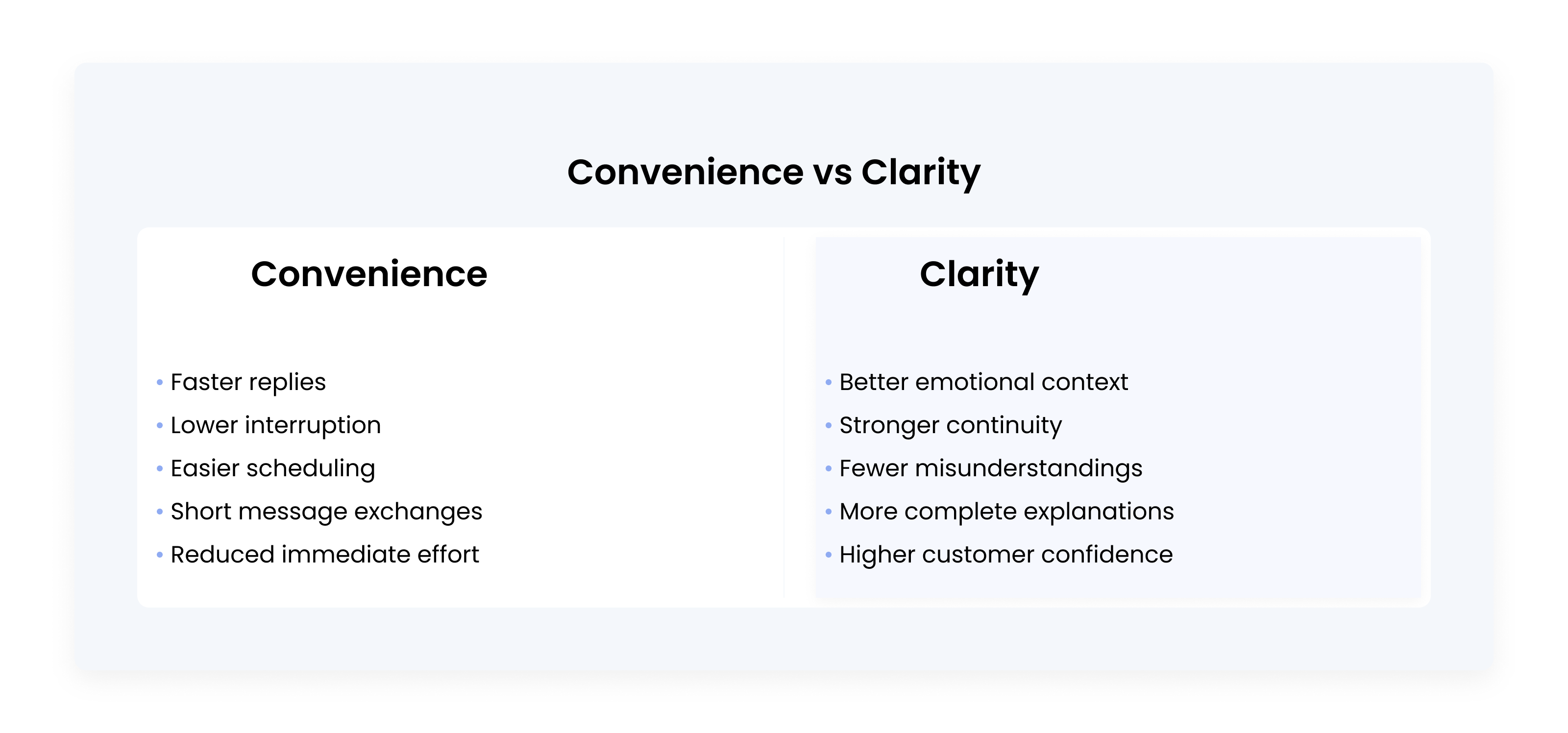
Convenience and clarity often get blended together inside customer communication environments even though they solve very different problems.
SMS is convenient.
That convenience alone does not make it sufficient for every situation.
Email creates documentation.
Documentation alone does not guarantee responsiveness.
Phone calls create personal interaction.
Personal interaction does not always create efficiency.
Most teams discover these tradeoffs gradually through experience rather than deliberate planning.
For example, many service businesses initially move heavily toward SMS because response rates improve quickly.
At first, the shift feels like obvious progress.
Customers answer faster. Staff handles communication quicker. Scheduling friction decreases.
Eventually, however, some teams realize they have unintentionally spread important conversations across dozens of short message threads.
Context becomes thinner.
Important details get buried.
Internal continuity starts weakening.
A technician may know the customer sounded frustrated during a call, but that emotional context never appears in the text thread visible to office staff later.
Email creates a different kind of slowdown.
Everything becomes documented while responsiveness stretches across the day.
A customer sends estimate approval by email. The office manager misses it while handling inbound calls. The project start date drifts several unnecessary days even though everyone technically communicated correctly.
From the customer side, the silence starts feeling intentional.
Most people are not evaluating a company’s internal communication workload rationally. They simply experience the outcome. Delayed responses begin feeling disorganized. Missed follow-up begins feeling personal. Slow movement creates doubt about whether the business is paying attention.
That doubt usually appears before customers fully disengage.
By the time revenue impact becomes obvious internally, the customer experience has often been weakening for weeks through small moments that never seemed serious individually.
How Growing Teams Create Consistency Across Customer Communication
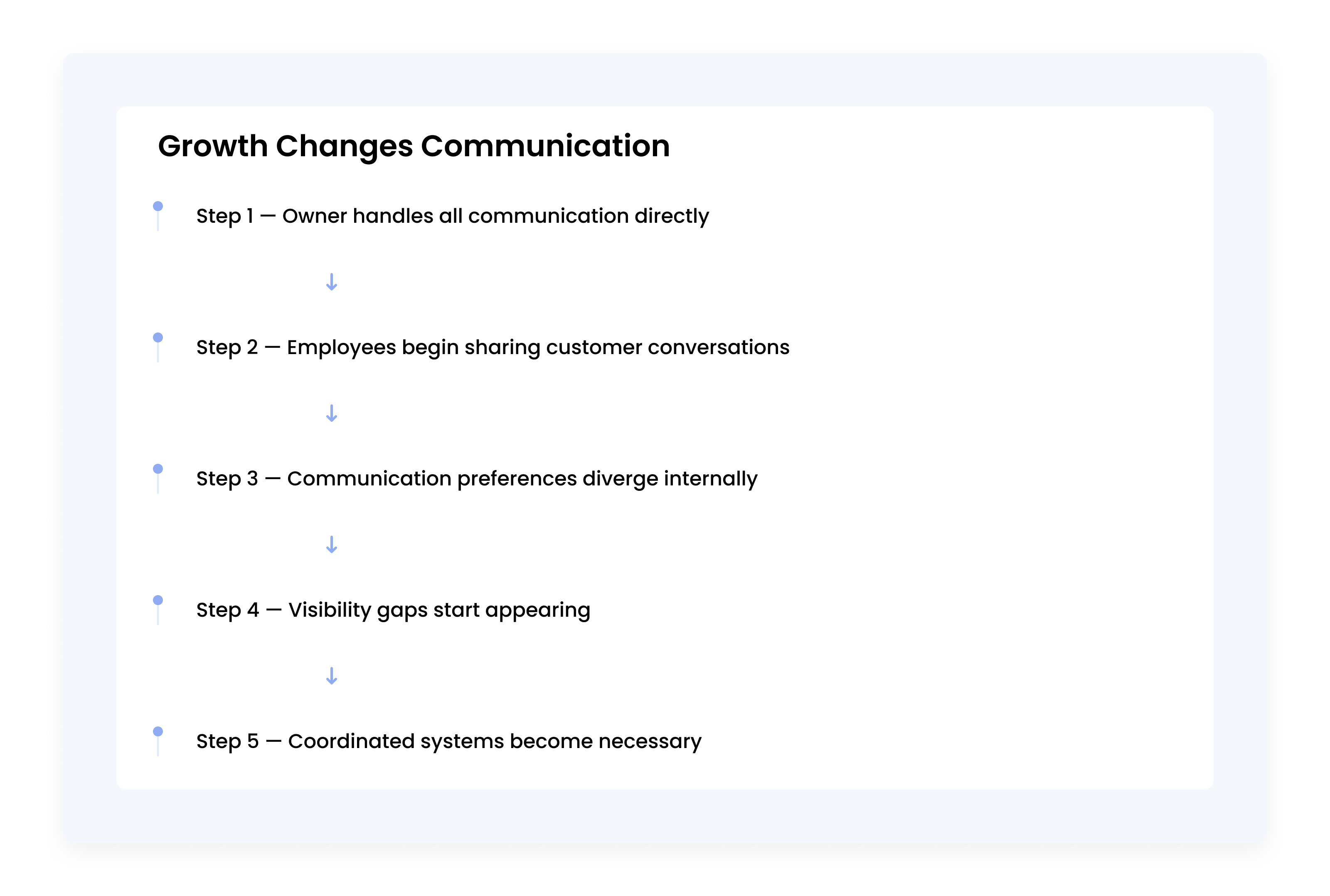
As businesses scale, communication quality becomes less dependent on individual personality and more dependent on operational consistency.
Early-stage companies often rely heavily on one highly responsive owner.
That owner remembers customer history instinctively. They understand context without needing documentation. They adapt communication style naturally because they personally oversee most interactions.
Growth changes that dynamic.
Multiple employees begin participating in customer interactions. Responsibilities spread across dispatchers, office staff, technicians, coordinators, sales representatives, and managers.
Without communication consistency, every employee gradually develops different instincts.
One person calls immediately.
Another prefers email.
Another sends multiple text messages throughout the day.
Customers experience those inconsistencies even when the internal team barely notices them.
Many businesses first recognize the issue after hiring their third or fourth employee. The owner can no longer personally bridge every conversation gap throughout the day, and communication inconsistency starts surfacing in ways that never existed when one person handled everything directly.
At that stage, conversations start shifting away from isolated exchanges and toward continuity across the customer relationship.
The priority becomes maintaining coordinated visibility across interactions rather than simply responding quickly in the moment. As communication volume increases, many teams eventually realize the real pressure comes less from message quantity and more from maintaining continuity across conversations that move between employees and channels throughout the day, which closely reflects the operational patterns discussed in How Teams Actually Handle Customer Conversations Without Losing Context.
That does not necessarily require massive infrastructure.
But it does require shared operational understanding.
Who owns follow-up?
When should communication escalate from text to phone?
What communication belongs in searchable documentation?
What happens if a customer replies after hours?
What visibility exists across channels?
These questions become increasingly important once communication volume grows.
Companies like TMMN have historically aligned more closely with this operational perspective rather than treating messaging purely as outbound communication volume. The real challenge is rarely whether a business can technically send texts or make calls.
The challenge is whether conversations remain coordinated once complexity increases across employees, channels, and ongoing customer relationships.
That broader operational direction is also where many platforms are slowly evolving over time. Businesses increasingly want continuity between conversations instead of isolated channel activity.
Not because every company suddenly needs enterprise infrastructure.
But because growth eventually exposes how expensive disconnected communication becomes once enough customers, employees, and conversations are moving simultaneously.
Key Takeaways
- Communication problems usually begin with channel mismatch long before businesses recognize visible breakdowns.
- The fastest communication channel is not always the clearest or most appropriate one for the situation.
- Communication strain often develops between channels rather than inside individual conversations.
- Businesses scale communication more effectively when channel expectations become operationally consistent across employees.
- People rarely analyze communication systems directly, but they notice very quickly when conversations start feeling harder than they should.
- The businesses that handle customer communication effectively are usually not the busiest or the loudest.
- They are the ones where conversations continue moving cleanly even when the day becomes chaotic.
Businesses evaluating whether their current communication workflow still supports that level of coordination can explore the platform directly through the 14-day free trial.
.svg)