


The Operational Breakdown Behind Missed Conversations
Most small businesses don’t think they have a customer communication management problem. Messages are getting answered. Calls are being returned. Someone is checking the inbox. From the outside, it looks like things are moving. But underneath that surface, something quieter is happening.
Conversations aren’t being managed — they’re being handled in fragments. This is exactly why Why Modern Customer Communication Isn’t One Channel Anymore (2026 Guide) matters: the breakdown rarely starts with one missed reply and usually starts with a business treating connected customer intent like separate tasks. A text comes in and gets answered. A call comes in later and gets routed somewhere else. A follow-up gets forgotten because it wasn’t tied to anything visible. Each interaction is handled in isolation, with no continuity between them.
In a typical front desk scenario, a receptionist might be juggling three active texts, two incoming calls, and a callback list from the day before. Each interaction gets handled in the moment, but nothing ties them together. By the end of the day, activity is high, but continuity is unclear.
At low volume, this holds together. When there are only a handful of conversations each day, people compensate. Memory fills the gaps. Someone remembers who called earlier. Someone remembers to follow up. The system doesn’t need to exist yet because the pressure hasn’t exposed it.
Then volume increases.
Now there are twenty, thirty, fifty conversations moving across the day. Some are texts. Some are calls. Some are callbacks that should have happened yesterday. Some are new leads that look urgent but aren’t handled with the right priority. Without a system, the difference between “active” and “progressing” disappears.
Messages are still being answered. Phones are still ringing. The business still feels active. But continuity is gone. And when continuity disappears, clarity follows. Decisions slow down. Follow-ups become inconsistent. Leads start to drift instead of convert.
Fragmentation rarely looks like failure. It looks like busyness.
Why Modern Customer Behavior Breaks Fragmented Systems
The issue becomes clearer when you look at how customers behave.
Customers don’t think in channels. They don’t separate a text from a call or a follow-up message the next day. This aligns with how modern customer experience is evaluated, where the entire journey—not individual touchpoints—defines how a business is perceived. When that continuity breaks, the experience doesn’t feel incomplete—it feels inconsistent.
In practice, that’s why Business Texting vs Phone Calls: How to Use Both Effectively is less about choosing one channel and more about keeping both inside the same operational thread.

To them, it’s one conversation. One intent. One decision they’re trying to make.
Inside most businesses, that single conversation gets split apart immediately.
A customer texts in the morning asking about availability. That message gets answered quickly. A few hours later, they call to ask a follow-up question. The person answering has no context, so the customer repeats everything. That evening, they send another message asking if they can book. It sits because it came through a different place that no one checked.
From the customer’s perspective, something feels off. Not because anyone was rude. Not because the business ignored them completely. But because the experience didn’t feel connected.
In many service businesses, 30–50% of serious leads will make more than one contact attempt before converting. When that second or third touchpoint isn’t aligned with the first, the experience weakens immediately.
Customers interpret gaps differently than businesses do. A delay doesn’t register as “they’re busy.” It creates uncertainty. That uncertainty is exactly what What Happens When Customers Don’t Hear Back Fast Enough exposes, because silence rarely feels neutral to a customer who is already deciding between options. A missed follow-up signals lack of interest. Being asked to repeat information signals disorganization.
These signals are subtle, but they compound.
Most customers won’t complain. They won’t point out what went wrong. They slow down, compare alternatives, and eventually move on without saying anything.
The Hidden Cost of Dropped Context and Delayed Follow-Ups
To see the real impact, you have to look at the numbers behind this behavior.
Consider a small service business generating 25 inbound leads per day. Across a month, that’s roughly 750 leads. If the business converts 30% of those leads and each customer is worth $300, the math is straightforward.
750 leads × 30% = 225 customers
225 × $300 = $67,500 per month
Now introduce fragmentation.

If just 20% of those daily leads experience some delay, lost context, or missed follow-up — often within a 2–6 hour response gap or a missed same-day callback — that’s 5 leads per day where the experience weakens.
Those leads don’t disappear immediately. But their likelihood to convert drops. Instead of converting at 30%, they convert closer to 15%.
Over a month, that becomes:
150 affected leads
At 30% → 45 customers
At 15% → 22 customers
That’s 23 lost customers.
23 × $300 = $6,900 in lost revenue
Nothing dramatic happened. No inbox failed. No system went down. But nearly $7,000 disappears quietly.
Because fragmentation doesn’t stay contained. It spreads. Response times stretch. Follow-ups become inconsistent. Internal coordination weakens. Over time, the system becomes less reliable.
The business doesn’t see a drop in demand. It sees uneven results. And uneven results are usually a signal of structural weakness, not market conditions.
What Actually Defines a Conversation Management System
At this point, the conversation usually turns to tools.
But tools aren’t the defining factor.
Customer communication management is about maintaining continuity across the entire lifecycle of a conversation.
A real system is built on three elements.
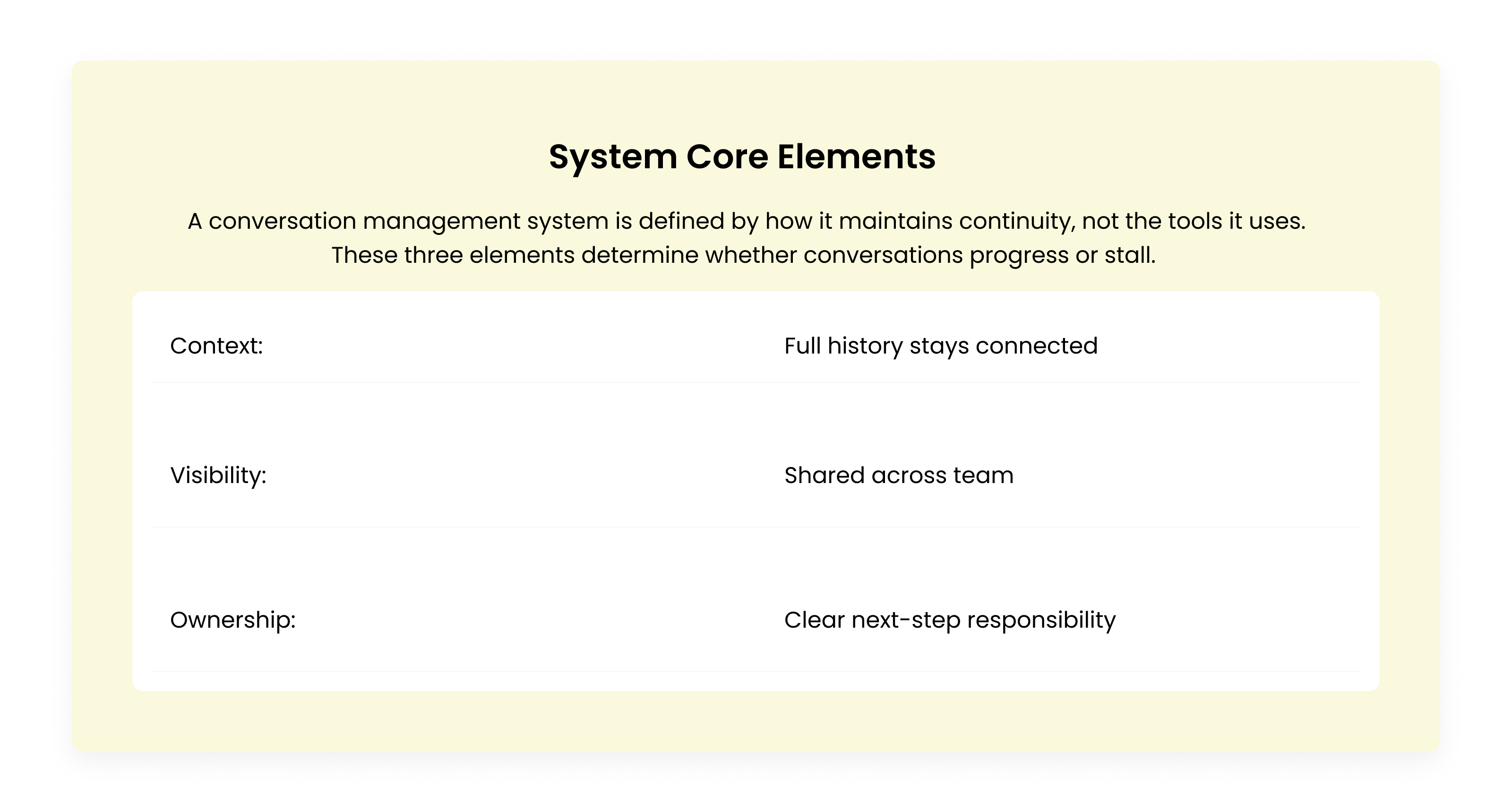
First, context stays intact. Every interaction — whether it begins as a text, moves to a call, or returns later — is connected. In practice, this means a team member can open a conversation and immediately see the full history without asking the customer to repeat anything.
Second, visibility is shared. Conversations are not buried inside individual inboxes or tied to specific people. A team can see what’s active, what’s waiting, and what requires attention in one place, without relying on handoffs or memory.
Third, ownership is clear. Someone is responsible for what happens next. Not just replying in the moment, but ensuring the conversation reaches a real outcome. There is always a next step, and someone owns it. Without that clarity, progress quietly stalls even when activity looks high.
When one of these breaks, the system weakens. When all three are missing, conversations become reactive instead of structured.
Most businesses don’t struggle from lack of effort. They struggle because effort is not organized into a system.
Continuity is what turns activity into outcomes.
A Simple Diagnostic: Where Your Conversations Are Breaking
You can usually find the gaps quickly.
Ask a simple question: if a lead contacts your business today, can you follow that conversation from start to finish without relying on memory?
Most businesses can’t.
Look for a few signals.

First, traceability. Can you see the full timeline of interactions without asking multiple people?
Second, continuity. If the customer reaches out again later, does the next person have full context immediately?
Third, ownership. At any moment, is it clear who is responsible for the next step?
Fourth, follow-up consistency. Are follow-ups happening on time, or only when someone remembers?
Fifth, outcome visibility. Can you clearly see whether a conversation converted, stalled, or was lost?
When these break, the conversation becomes fragile.
“I thought you handled that” is not a communication issue. It’s a structural one.
And fragile conversations don’t convert consistently.
Why Managing Channels Separately Fails at Scale
The common assumption is that managing each channel well is enough.
Respond quickly. Return calls. Stay active.
It sounds right, but it doesn’t scale.
Because the issue is not the channels. It’s the separation between them. The operational reason becomes clearer in SMS vs Voice vs Email vs Tickets: Choosing the Right Customer Communication Channel, where the real question is not which channel matters most, but how each one should support the same conversation.
Each channel creates a partial view of the customer. Each system holds a piece of the story. No one sees the whole.
That creates friction internally.
A receptionist answers a call without knowing there was a message earlier. A team member responds without knowing a quote was already discussed. A follow-up repeats information the customer already gave.
These aren’t major failures. But they accumulate.
A fragmented system looks active. A connected system feels coordinated.
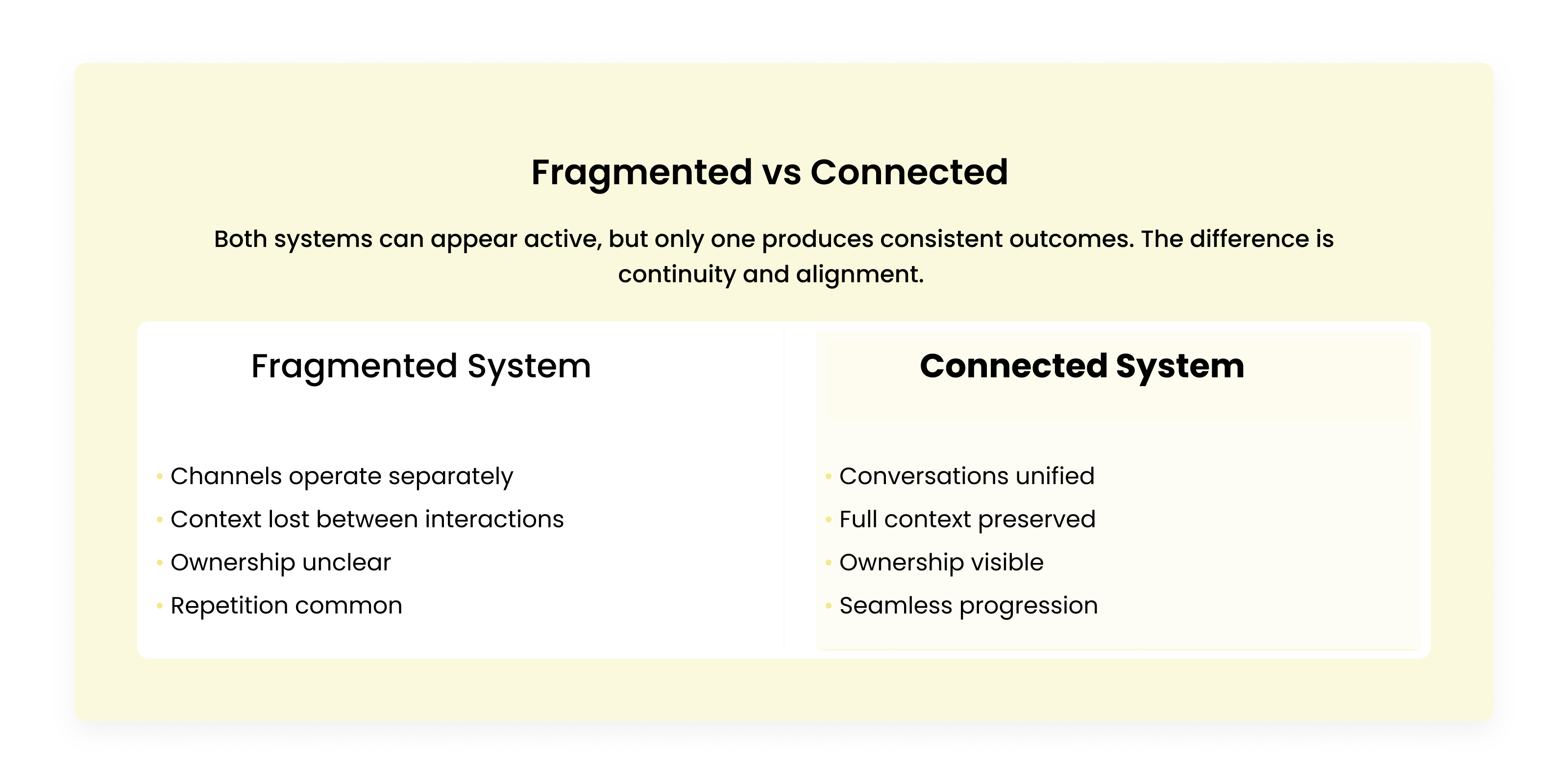
Here’s how it plays out in real terms.
A customer texts asking about availability. The receptionist responds and says someone will follow up. Later, the customer calls. Another person answers, unaware of the earlier message. They ask the same questions again. The call ends with “we’ll get back to you.”
Internally, both people assume the next step is handled. But no one follows up.
In a structured system, that same conversation would remain connected, visible, and owned — regardless of who interacted with it.
The next day, the customer chooses someone else.
Activity is visible. Ownership disappears quietly.
Where Structured Conversation Systems Begin to Matter
Eventually, effort stops being enough.
You can’t respond faster to fix fragmentation. You can’t hire your way out of a broken structure. You can’t rely on memory once volume increases.
This is where structured systems begin to matter.
Not as tools, but as a shift in how the business thinks.
Instead of thinking in channels, the business thinks in conversations.

Instead of asking “did we respond,” it asks “did this move forward?”
Instead of relying on individuals, it creates shared visibility and clear ownership.
Strong systems don’t just capture messages. They preserve continuity, surface what matters next, and make responsibility visible without friction.That kind of visibility is what Why Visibility in Customer Communication Matters for Small Businesses points to, because teams make better decisions when the full conversation stays visible instead of scattered.
This is where systems like TMMN fit — not as messaging tools, but as part of a structure that keeps conversations connected across time, channels, and people.
Because once conversations are treated as a single thread, alignment becomes non-negotiable.
That’s the shift.
Managing customer communication isn’t about being everywhere. It’s about making sure nothing breaks in between. For businesses ready to operationalize that shift, a 14-day free trial is a practical way to see what connected conversations actually look like in day-to-day workflow.
Key Takeaways
- Fragmentation hides inside activity and quietly reduces conversion without obvious failure.
- Customers experience one continuous conversation, even when businesses treat it as separate interactions.
- Small delays and missed context compound into measurable revenue loss over time.
- Visibility, context, and ownership are what determine whether conversations progress or stall.
- Consistency in follow-up is what separates active businesses from effective ones.

.svg)

