
When business owners compare working memory vs long-term memory in AI, the useful question is not which one is more advanced. It is which information the AI needs now, which information may need to remain available later, and what could go wrong if those categories are confused.
An AI helping with a single assignment may need the latest instructions, relevant documents, and immediate constraints. That is working context: information assembled for the task in front of it.
Other information may be useful across repeated assignments. A recurring preference, a stable business term, or an enduring relationship detail might need to remain available beyond one interaction. That is the role long-term AI memory is meant to address.
The distinction sounds simple until the business has to decide what belongs where. Information that is useful today may be wrong next month. A detail worth carrying into future work may still be too narrow to apply everywhere. A remembered instruction may be mistaken for permission. An old statement may look like current business truth.
The operating challenge, then, is not merely giving an AI more information. It is assigning information to the right memory class—and refusing to treat either class as automatically correct, current, or authoritative.
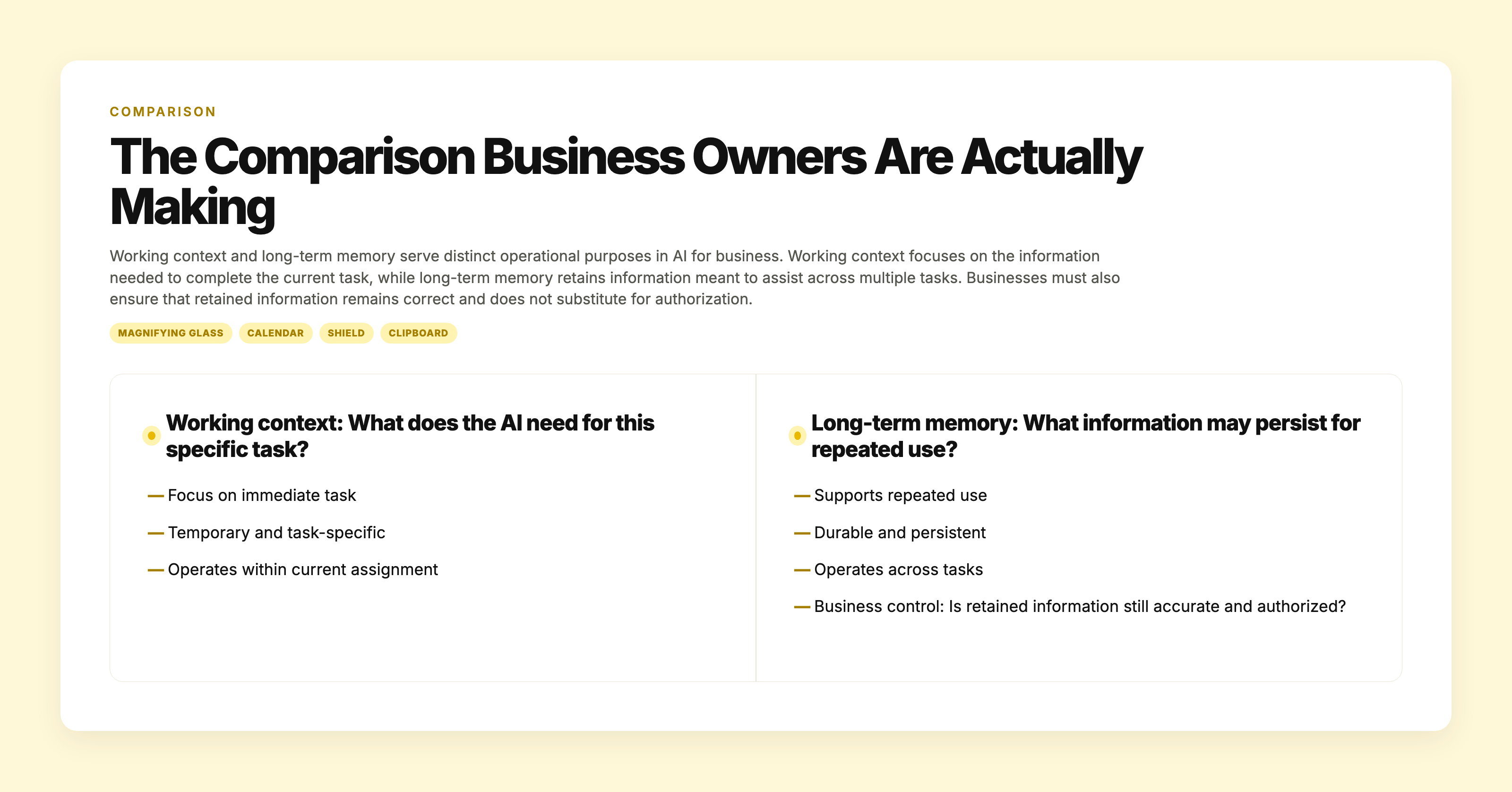
The Comparison Business Owners Are Actually Making
“Memory” can make AI sound as though it either remembers the business or does not. That framing hides the more practical comparison.
Working context supports the current assignment. Long-term memory is intended to make selected information available beyond that assignment.
Consider the difference between telling an AI, “For this follow-up, focus on the revised delivery date,” and expecting it to retain, “This client generally prefers concise written updates.” The first instruction belongs to a specific piece of work. The second might be relevant again, assuming the business has a valid reason to retain it and a way to distinguish it from changing instructions.
These are different operating needs:
- Working context asks: What does the AI need to handle this task?
- Long-term memory asks: What information may need to persist for repeated use?
- Business control asks: Is that information still correct, and does it actually authorize anything?
The third question cannot be answered merely by remembering more.
Operating memory distinctions in AI must consider how How Teams Actually Handle Customer Conversations Without Losing Context influences decision-making boundaries between tasks and persistent knowledge.
This matters because modern AI work depends on more than a prompt. Useful operation can involve business context, institutional memory, permissions, human approval at consequential boundaries, traceable actions, and evaluation against real outcomes. Memory contributes to that operating environment, but it does not replace the other parts.
A remembered fact is not necessarily a current fact. A remembered request is not necessarily an approved policy. A remembered preference is not permission to take an action.
That boundary should shape every memory decision.
Working Context: What the AI Needs for the Task in Front of It
Working context is the temporary, task-relevant information an AI uses during a current assignment. It narrows the AI’s attention to what matters now.
For a business owner, this could include the objective of the task, the materials to consider, the deadline, the intended audience, and constraints that apply to this particular piece of work. If the assignment is to draft a client follow-up, the working context might contain the purpose of the message, the latest discussion points, the new date to communicate, and the desired next step.
The value of working context is focus. It gives the AI enough situational information to work on a bounded assignment without assuming that every detail should become a durable part of future work.
That temporary quality is often useful. A one-time exception does not need to follow the business into unrelated assignments. A draft position does not need to harden into a lasting rule. Immediate input depends on reliability, as How to Route Customer Messages So Nothing Gets Missed frames the practical need to supply precise information for task success.
A project-specific deadline should not continue influencing work after the project is complete.
Working context also gives an operator a clearer review surface. Instead of asking whether the AI somehow “knows the business,” the owner can inspect a more concrete question: Did it receive the right information for this assignment?
That does not guarantee a correct result. The supplied information may be incomplete, inconsistent, or already outdated. But the boundary makes diagnosis easier. If the AI missed a key constraint, the operator can ask whether the constraint was included, whether its meaning was clear, and whether it applied to the current task.
Working context should therefore be treated as a prepared input, not as universal business truth. It is a bounded set of information selected for a purpose.
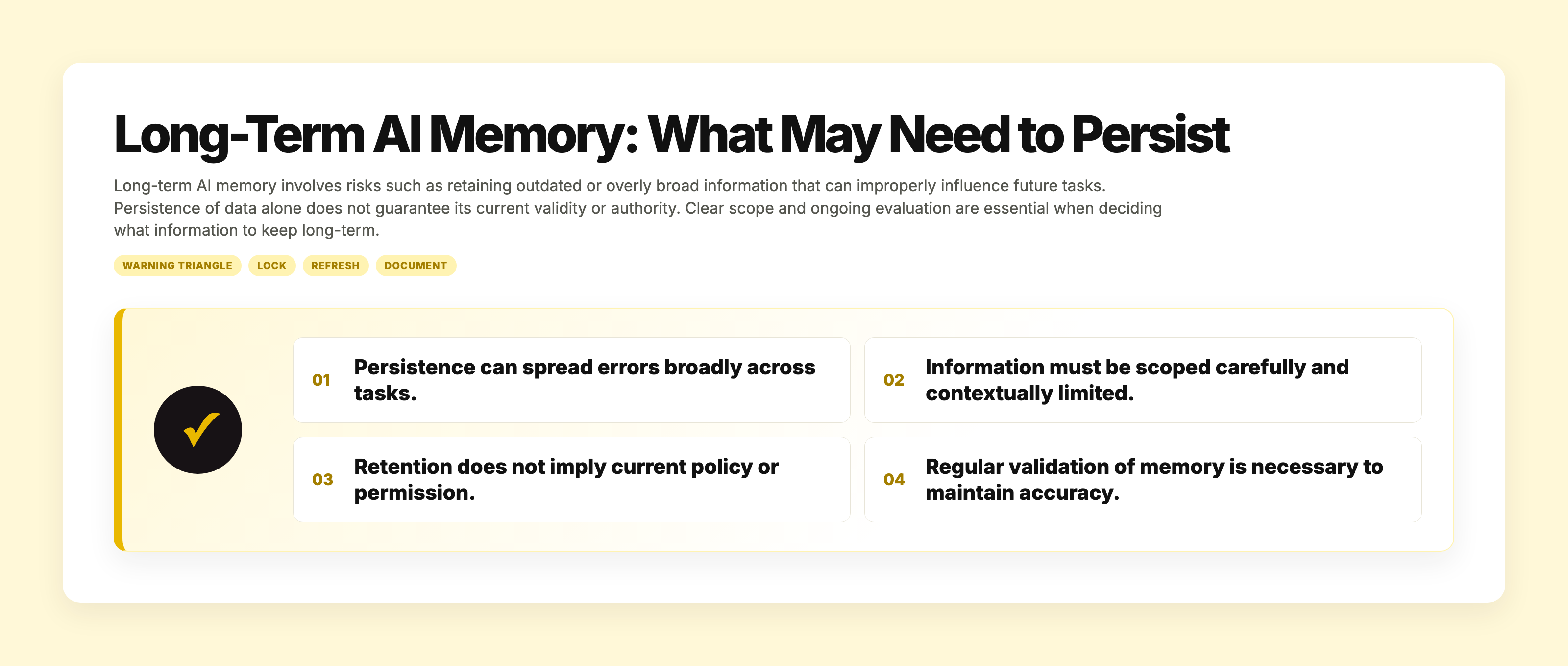
Long-Term AI Memory: What May Need to Persist
Long-term AI memory addresses a different need: selected information that may remain useful after the current interaction ends.
The key word is selected. Durable memory should not mean retaining every available detail or turning every conversation into a permanent instruction. It means identifying information that has a legitimate recurring role.
A business might consider durable memory for a stable term it uses repeatedly, a recurring communication preference, or a standing piece of background information that is relevant across similar tasks. The purpose is continuity. The AI should not need to be reintroduced to the same useful detail every time it handles comparable work.
But persistence changes the risk.
A temporary mistake can disrupt one assignment. A durable mistake can influence many future assignments. An overly broad memory may escape the situation in which it was valid. A preference recorded without enough scope may be applied to the wrong person, channel, or type of work.
Long-term memory therefore needs to be understood as retained information—not as an independent source of authority.
Suppose an AI retains the statement, “Use short messages for routine updates.” That statement still leaves operational questions. Does it apply to every recipient? Only to one kind of update? Was it a preference, a temporary experiment, or a standing instruction? Has it since changed?
The fact that information persisted does not settle those questions.
The same boundary applies to business policy and current truth. A memory can record what was said or previously established. It does not, by persistence alone, prove that the information remains current. Nor can an AI reason its way from a remembered detail to permission it was never granted.
Long-term memory may reduce unnecessary repetition, but only when the retained information remains meaningfully separated from current instructions, policy, and authority.
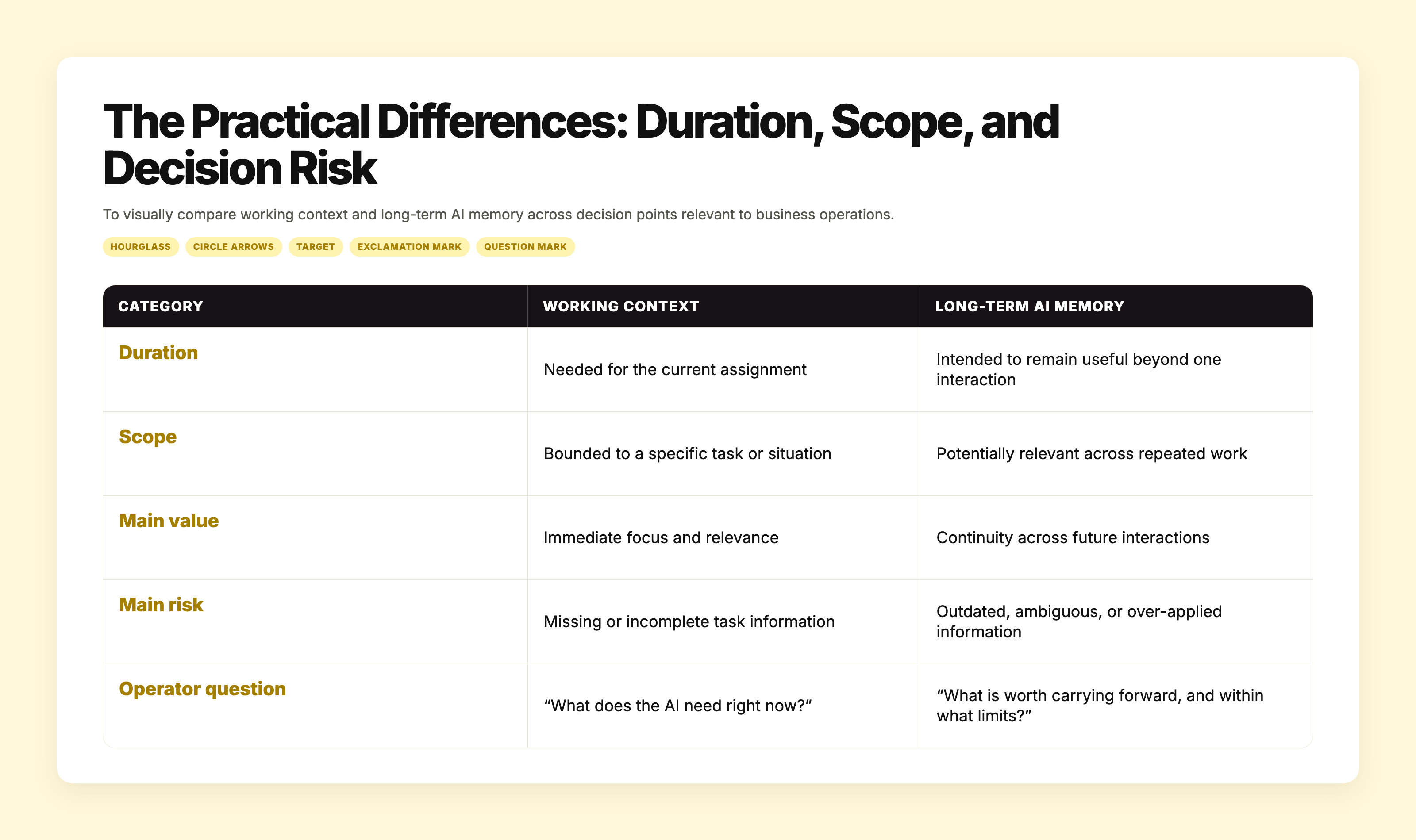
The Practical Differences: Duration, Scope, and Decision Risk
The most useful comparison is not technical. It is operational.
Duration
Working context is needed for the current assignment. Long-term AI memory is intended to remain useful beyond one interaction.
Scope
Working context is bounded to a specific task or situation. Long-term AI memory may be relevant across repeated work.
Main Value
Working context provides immediate focus and relevance. Long-term AI memory provides continuity across future interactions.
Main Risk
The main risk with working context is missing or incomplete task information. With long-term AI memory, the risk shifts to information becoming outdated, ambiguous, or applied more broadly than intended.
Operator Question
For working context, ask: “What does the AI need right now?”
For long-term AI memory, ask: “What is worth carrying forward, and within what limits?”
Duration is the first test. If information matters only until a draft is completed, an issue is reviewed, or a particular decision is prepared, it is probably working context. Persistence would add little and might create confusion later.
Scope is the second test. Some information is valid only inside one assignment. The balance between scope and risk is crucial because Why Businesses Lose Track of Customer Conversations (And How to Fix It) highlights the operational cost when memory boundaries are blurred or neglected.
Other information has a recurring role. The operator must distinguish “use this for today’s message” from “consider this whenever handling this defined type of work.”
Decision risk is the third test. Ask what happens if the information is incomplete, stale, or used outside its proper boundary.
If the consequence is a weak first draft that a person will review, the risk may be limited. If the remembered information could affect a consequential action, a commitment, or a business rule, memory alone is not enough. The action may require current information, appropriate permission, or human approval.
These tests prevent a common conceptual error: assuming long-term memory is simply working context with a longer expiration date. Persistence changes how often information can influence work and how far an error can travel. That makes durable information a distinct operating choice.
It also explains why more memory is not automatically better. More retained information can mean more continuity, but it can also mean more old, irrelevant, or insufficiently scoped material competing for influence. The objective is not maximum retention. It is fit between the information and the work.
A Hypothetical Scenario: Preparing for a Client Follow-Up
Consider a hypothetical small business preparing a client follow-up. This scenario illustrates memory classes only. It does not describe a particular product capability, deployment, or rule about what any business should retain.
The immediate assignment is to draft a message after a project discussion. The owner supplies the AI with current details:
- The purpose is to confirm the next step.
- The expected delivery date changed during the discussion.
- The message should mention one unresolved question.
- The owner wants to review the draft before it is sent.
Those details are working context. They are relevant to this follow-up, and several may become irrelevant as soon as the task is complete. The changed date should shape the current draft, but it does not need to become a general instruction for future work. The unresolved question belongs to this situation. The review requirement describes the boundary around the immediate task.
Now suppose the client has repeatedly expressed a preference for brief written updates rather than long explanations. A business might decide that this limited preference is useful across future assistance and should remain available over time.
That would be a candidate for long-term memory, but its wording and scope matter. “Prefers brief written updates” is narrower than “always communicate briefly.” The first records a recurring preference in a defined setting. The second turns that preference into a sweeping instruction that may not fit a proposal, a complex issue, or a situation requiring detailed explanation.
Even a well-scoped memory does not determine the whole follow-up. The latest delivery date must still come from current task information. The unresolved question must still be presented accurately. The retained preference does not authorize sending the message, changing a commitment, or omitting important details.
The two memory classes work on different parts of the assignment. Working context provides the facts and constraints of this follow-up. Durable memory may contribute limited continuity. Neither should be mistaken for complete, verified business truth.
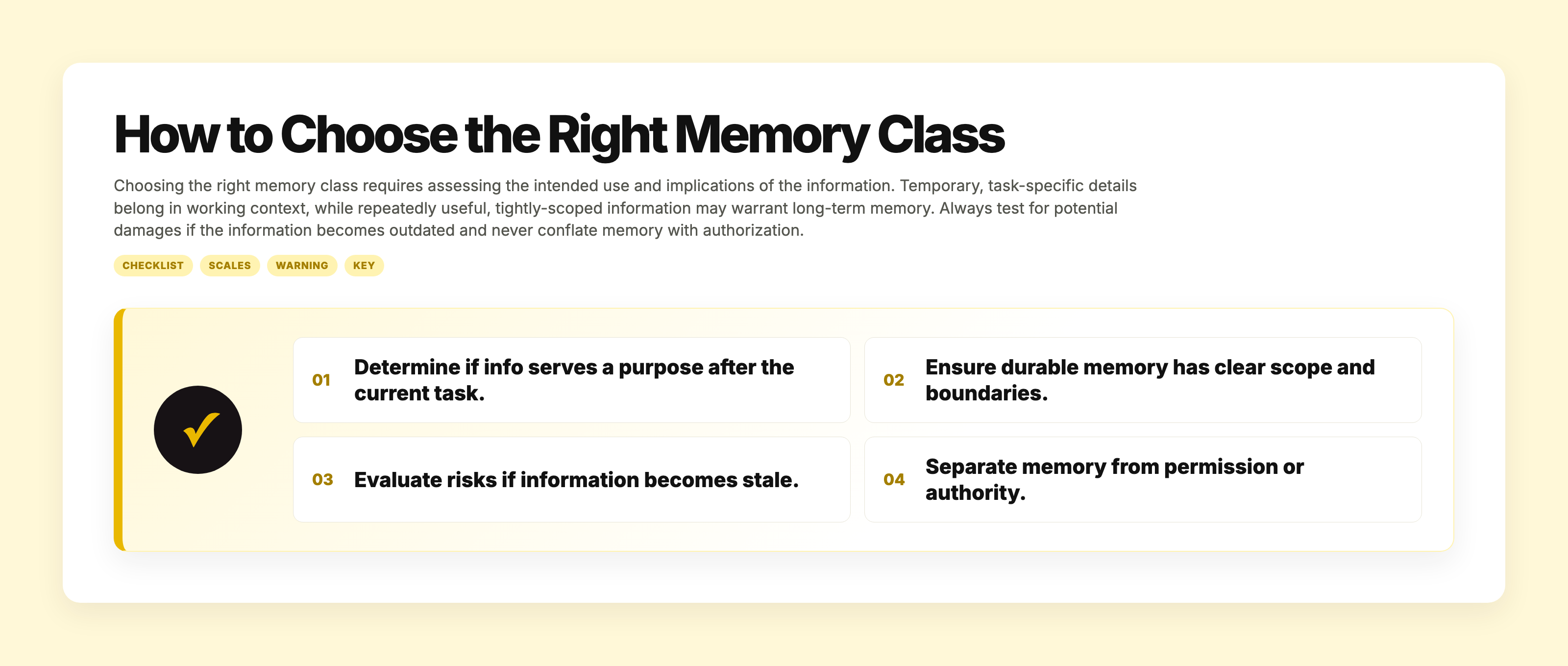
How to Choose the Right Memory Class
Start with the operating need, not with a general desire for the AI to “remember everything.”
Ask first: Will this information still serve a defined purpose after the current task ends?
If not, keep it in working context. This is the better fit for temporary objectives, current materials, one-time exceptions, active deadlines, and situation-specific constraints.
If the information may be useful repeatedly, ask a harder question: Can it be stated clearly enough to carry forward without becoming broader than intended?
A durable memory needs a meaningful boundary. Identify what the information applies to, when it should matter, and what it does not establish. “Use this wording in today’s response” is temporary. “This audience generally uses this defined term” may have recurring value, but it still should not silently become a universal business rule.
Then test currentness: How damaging would it be if this detail remained available after it changed?
How to Handle Multiple Customer Conversations Without Losing Track provides operational insight into when to choose temporary versus durable memory based on clarity and control.
Information with a high cost of becoming stale should not be trusted merely because it was once retained. It may need current confirmation before use. Persistence and freshness are different properties.
Finally, separate memory from authority: Does recalling this information imply permission to do something?
If the answer might be yes, the memory decision is not the whole decision. Knowing a preference does not grant approval. Remembering a prior action does not authorize repeating it. Retaining a statement does not turn it into policy.
A practical default follows:
Use working context when information is specific to the assignment. Consider long-term memory when the information has recurring value, can be tightly scoped, and can be kept distinct from current truth, policy, and permission.
Memory Is Useful, but It Is Not the Whole Operating Model
The working memory vs long-term memory AI decision is ultimately a question of fit.
Working context helps an AI address the assignment in front of it. Long-term memory may preserve selected information for future use. The first creates task focus; the second can create continuity. Neither deserves automatic trust simply because the information is available.
Before deciding that a detail should persist, apply one concrete test: write down the future task it should support, the boundary within which it remains valid, and what it does not authorize. A 14-day free trial can help you evaluate how these ideas fit your workflow.
If those three points cannot be stated clearly, keep the information in working context until they can.
.svg)