
An AI coworker becomes difficult to manage when its assignment sounds broad but its authority remains unclear.
“Help with customer follow-up” may seem like a reasonable instruction. Operationally, it leaves nearly every important question unanswered. Which customers? Based on what information? What counts as needing follow-up? May the AI contact anyone, or only prepare work for review? What happens when records disagree? Who confirms that the work was completed correctly?
A small business does not need an elaborate AI department to answer those questions. It does need an operating model.
The practical starting point is one bounded job: a defined result, approved information, explicit limits, human checkpoints, a review rhythm, and evidence that the work produced the intended outcome. That turns supervision from occasional prompt editing into ordinary operational management.
Consider a recurring hypothetical throughout this article: an AI coworker prepares a weekly customer-follow-up queue. It uses an approved set of records, identifies items matching documented criteria, and presents the proposed queue to a human owner. The example is illustrative, but the management questions are broadly applicable.
Start With One Bounded Job, Not a General-Purpose Assistant
A general instruction creates a hidden management burden. When an AI coworker is told to “handle anything related to follow-up,” the operator must repeatedly judge whether each new action belongs inside the job. The scope gets negotiated through individual interactions rather than established in advance.
Define the job as an operating responsibility instead.
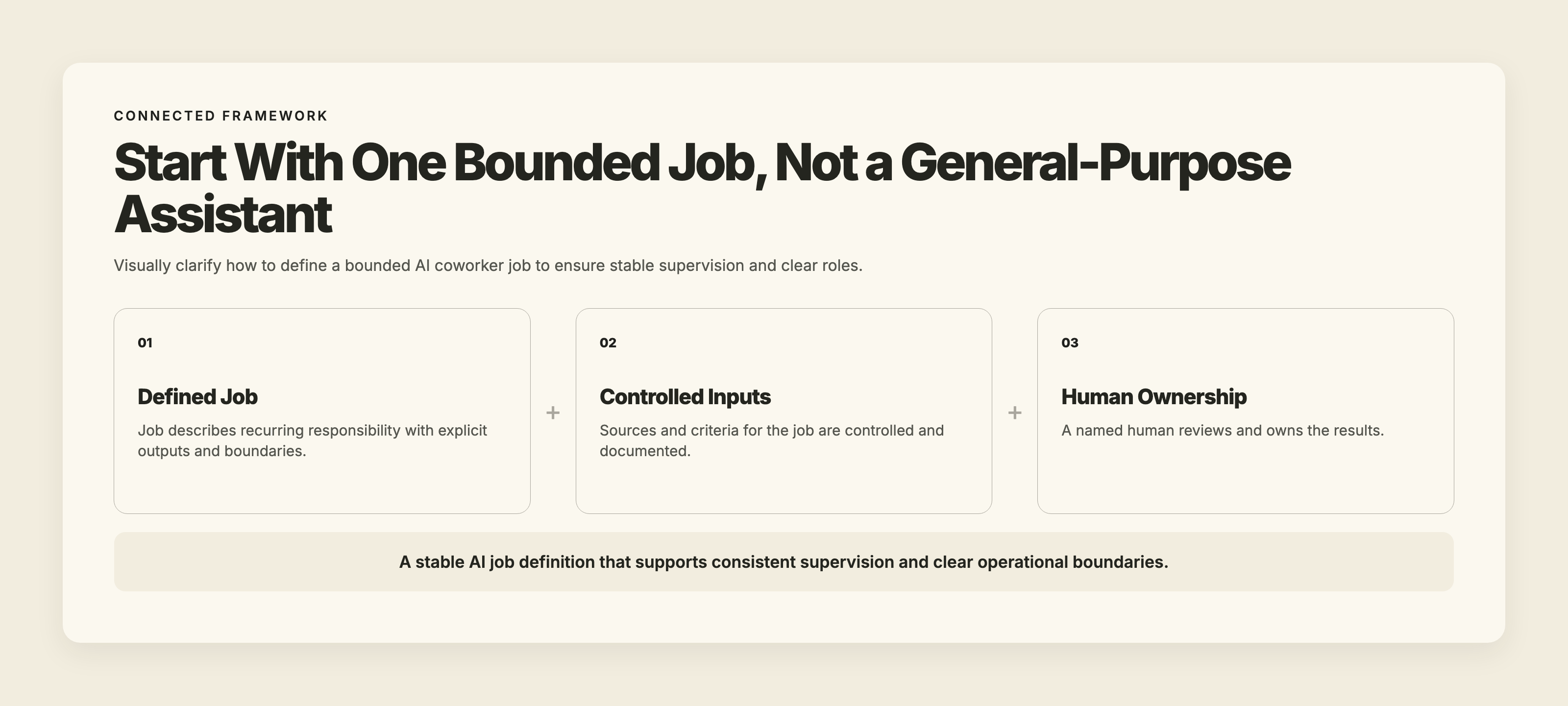
For the hypothetical follow-up coworker, the job might be:
> Once each week, prepare a proposed customer-follow-up queue from the approved source list, explain why each item qualifies, and submit the queue to the designated owner for review.
That description establishes several useful boundaries. The work is recurring. The output is a proposed queue, not an independently launched campaign. The source list is controlled. Each recommendation requires a reason. A named human owns the next step.
The job definition should also identify what “done” means. “Reviewed the records” describes activity. “Submitted a proposed queue containing the required fields, source references, and qualification reasons” describes a result that someone can inspect.
Keep the first assignment narrow enough that its inputs, decisions, and outputs remain visible. Do not quietly add adjacent responsibilities because they appear convenient. Drafting messages, changing customer records, setting priorities, and sending communications are separate actions. They may require different information, permissions, and review points.
A useful test is whether the operator can answer four questions without improvising:
1. What exact result is the AI coworker responsible for producing?
2. What work is outside that responsibility?
3. Where does its work hand off to a person?
4. Who owns the final result?
If those answers change from week to week, the job is not yet stable enough to supervise consistently.
Define the Context It May Use—and What It Must Ignore
An AI coworker cannot be managed only through a task description. That delegation depends on operational AI readiness across ownership, permissions, and oversight.
It also needs controlled business context: the information it is allowed to treat as relevant when doing the job.
Small-business information is rarely one clean body of truth. A conversation may contain a customer request. A note may reflect an employee’s interpretation. A policy may state the approved rule. A current system record may show that the situation has changed. Those materials are not interchangeable merely because they all mention the same customer.
For the weekly follow-up queue, the operator should identify the approved sources by name. These might include a designated customer-status record, the current follow-up criteria, and a maintained exclusions list. The point is not to provide every document the business possesses. It is to establish which information is admissible for this job.
The operating instructions should also say what the AI coworker must ignore. That boundary is part of giving an AI the right business context, not just telling it which sources to use.
Examples could include old exports, personal notes, superseded procedures, incomplete drafts, or conversation excerpts that have not been confirmed as current business truth.
That exclusion work matters because access is not the same as approval. An AI coworker may be able to retrieve a document without being authorized to rely on it. Likewise, a plausible interpretation does not turn uncertain information into established fact.
Conflicts need a correction path. Suppose a customer appears eligible for follow-up in one record but appears on the current exclusions list. The AI coworker should not silently choose whichever source seems more convincing. It should identify the conflict, preserve the relevant references, and route the item to the designated owner.
The owner can then decide which information is correct and update the maintained source. That last step is important. Correcting a single output without correcting the underlying context leaves the same error ready to recur.
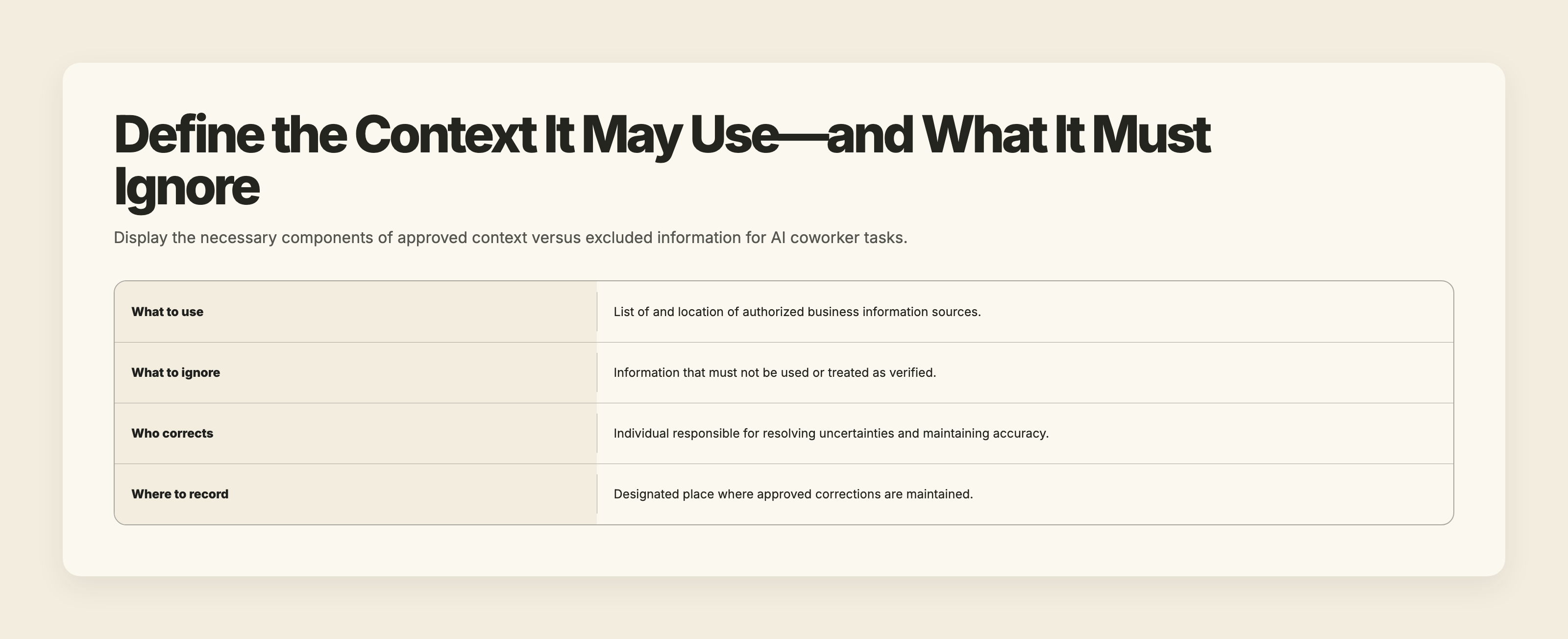
When defining context, write down:
- the approved sources for the job;
- the version or location that should be treated as current;
- the information that must not be used;
- the person responsible for resolving uncertainty;
- the place where approved corrections are recorded.
The goal is not unlimited knowledge. It is dependable use of bounded, correctable business information.
Set Operating Limits Before Work Begins
A clear job and approved context still do not establish authority. The AI coworker also needs limits on what it may do with that information.
For the follow-up example, preparing a queue could be allowed while sending messages remains prohibited. The coworker might be permitted to classify records according to written criteria but not invent a new category. It might highlight missing information but not fill gaps through unsupported assumptions.
Write the limits as operating rules rather than vague cautions. “Be careful with customer information” does not tell the coworker what to do when a record is incomplete. “Do not add the item to the proposed queue; mark it as blocked and identify the missing field” creates an observable response.
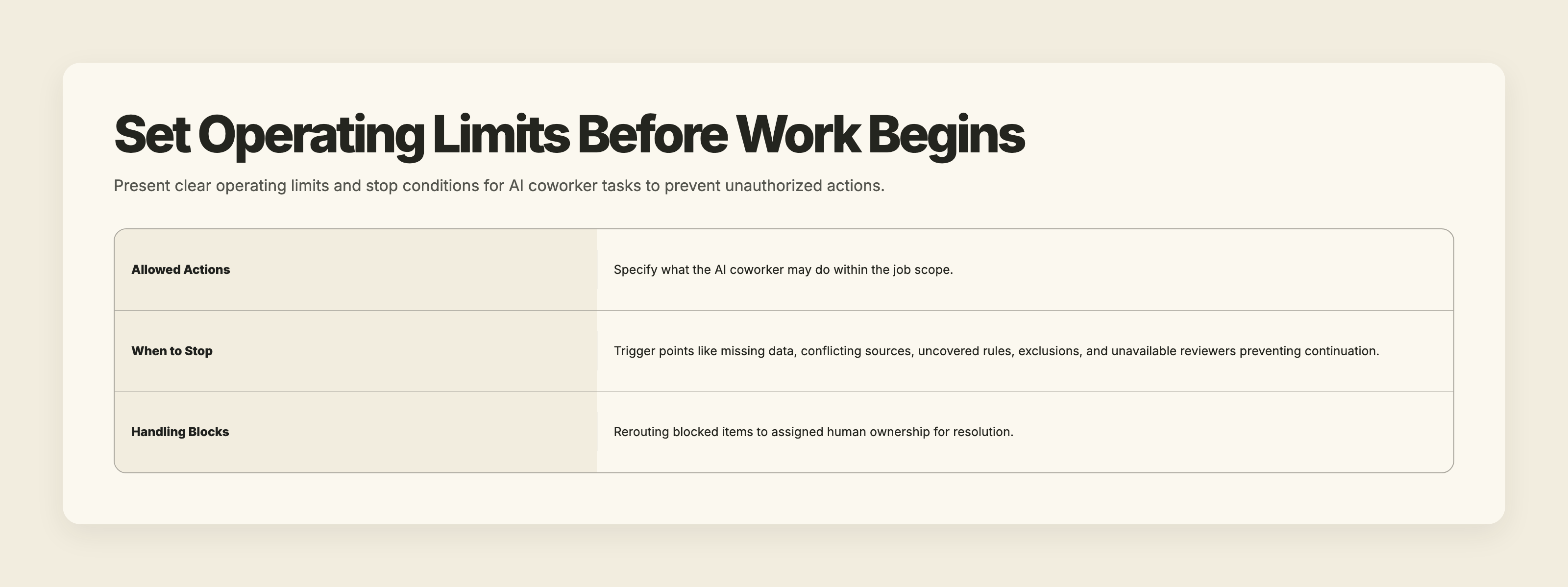
Stop conditions deserve particular attention. An AI coworker should know when not to continue. Possible stop conditions for this bounded assignment include:
- required information is missing;
- approved sources conflict;
- no documented rule covers the situation;
- an item falls within an explicit exclusion;
- the requested action exceeds the job definition;
- the designated reviewer is unavailable.
A stop is not a failure if it prevents uncertain work from being presented as settled work. It is a handoff. For that handoff to work, the coworker needs to surface the issue in a form a person can resolve: what it was attempting, where it became blocked, what sources were involved, and what decision is needed.
The escalation path should name a role or person. “Ask a manager” is fragile in a small business where different people may interpret the issue differently. “Route blocked queue items to the customer-operations owner before Thursday’s review” establishes ownership and timing.
Build Human Checkpoints Into the Workflow
Human review should be part of the job design, not an emergency response added after something looks wrong.
The central rule is straightforward: the AI coworker’s ability to analyze information or produce a recommendation does not grant it business permission. Reasoning can support a proposed action. It cannot establish the authority to take that action.
In the follow-up workflow, the operator might review the proposed queue before any customer communication occurs. The review should not be a ceremonial glance at a polished result. It should expose enough of the work for the reviewer to judge whether the queue follows the approved rules.
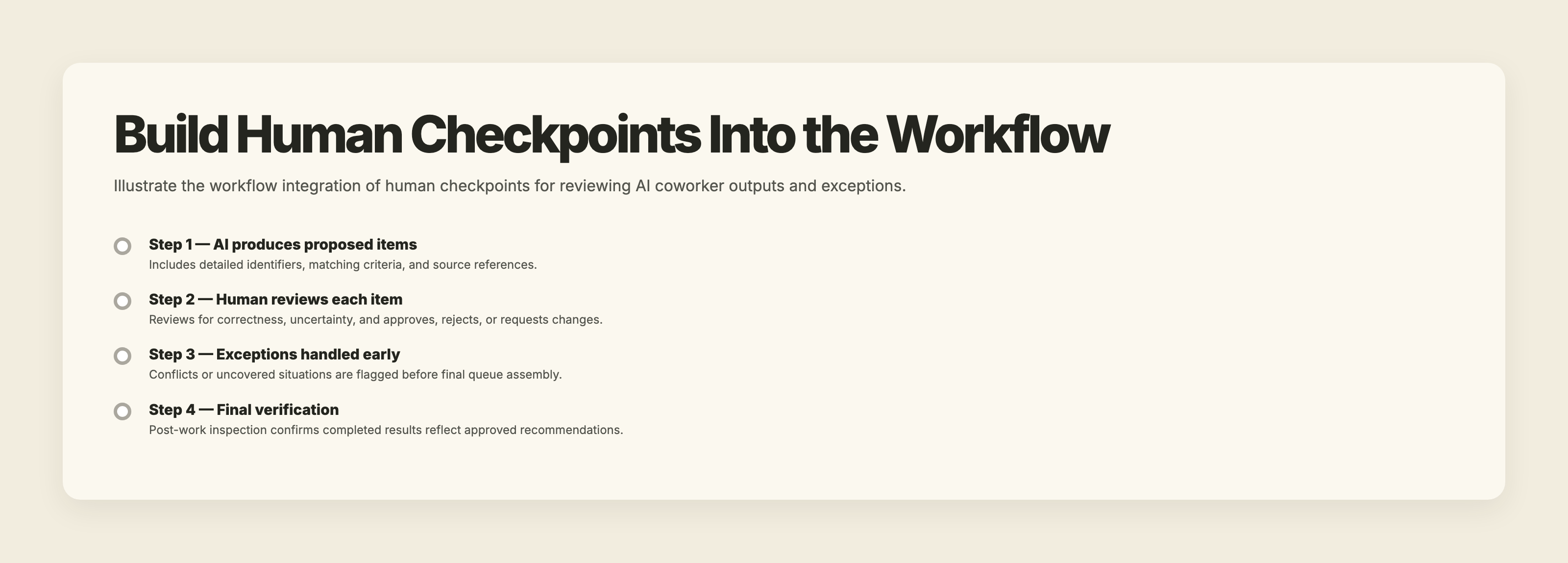
Each proposed item could therefore include the customer identifier, the criterion it matched, the approved source used, any uncertainty found, and the recommended next step. The reviewer can approve the item, reject it, request correction, or resolve an exception.
Other checkpoints may occur earlier. The same checkpoint discipline should govern customer conversation handoffs, so each lead retains a clear owner as it moves between people or systems.
If the AI coworker encounters a source conflict, it should not wait until the final queue is assembled to mention it. If it proposes an interpretation not covered by existing instructions, that proposal should remain visibly unapproved.
Completed work may need inspection as well. A reviewed queue proves that a recommendation was accepted. It does not by itself prove that the resulting follow-up happened or that the business record reflects the outcome.
This distinction prevents several states from collapsing into one. Proposed work is not authorized work. Authorized work is not attempted work. Attempted work is not completed work. Completed work is not necessarily verified work.
Manage those states explicitly, especially when responsibility passes between the AI coworker and a human.
Create a Simple Daily and Weekly Supervision Rhythm
Supervision becomes expensive when every interaction is treated as a new design session. A regular rhythm makes exceptions, corrections, and drift easier to see.
For a weekly assignment, the daily check can be brief. Inspect whether the coworker is progressing, blocked, or waiting for a decision. Resolve urgent source conflicts and missing information before they accumulate. Do not use the daily check to redesign the entire job in response to one unusual item.
The weekly review should look beyond the latest output. Examine which items were accepted, rejected, corrected, or escalated. Look for repeated misunderstandings. Determine whether the problem came from the job definition, an outdated source, an unclear rule, or work outside the coworker’s permitted scope.
That diagnosis affects the correction.
If the approved criteria changed but the maintained instructions did not, correct the source. If the rule was accurate but too ambiguous to apply consistently, clarify the rule. If the coworker repeatedly receives requests beyond its assignment, reinforce the handoff and exclusions rather than stretching the job informally.
Changes should be deliberate. An operator may be tempted to expand the role after a few acceptable outputs: add message drafting, then record updates, then sending. Each addition changes the operating conditions. It introduces new actions, handoffs, and verification requirements.
Expand one boundary at a time, and only after rewriting the job to reflect the added responsibility. Otherwise, the documented role and the actual role will diverge.
Require Proof of Work, Not Just a Status Update
“Done” is a weak report because it conceals the path between assignment and result.
For each work cycle, keep a practical record of what was proposed, what received human authorization, what was attempted, what was completed, and what was verified. Not every small-business workflow needs a complex technical log. It does need enough traceability for the owner to reconstruct what happened.
For the follow-up queue, proof of work might include:
- the dated proposed queue;
- the reason and source reference for each item;
- the reviewer’s decision;
- unresolved exceptions;
- the recorded completion state;
- the evidence used to verify completion.
The evidence should match the claimed result. A generated draft proves that a draft exists. It does not prove that anyone reviewed it. An approval proves permission was given. It does not prove that the action occurred. A status label saying “complete” is weaker than a maintained record showing the completed action and its outcome.
This record gives the weekly review something firmer than impressions. It also makes correction more precise. If inappropriate items repeatedly enter the proposed queue, the operator can inspect the criteria and source references. If approved items remain unfinished, the problem may sit after the AI coworker’s handoff rather than inside its work.
Activity can look productive while leaving the operating result uncertain. When teams standardize how they manage customer conversations, activity becomes easier to trace, but a closed task still does not prove the intended result.
Verification closes that gap.
Use a One-Page AI Coworker Operating Brief
Before putting an AI coworker for small business operations into a recurring workflow, capture the assignment on one page. The brief should be short enough to maintain but specific enough to govern the work.
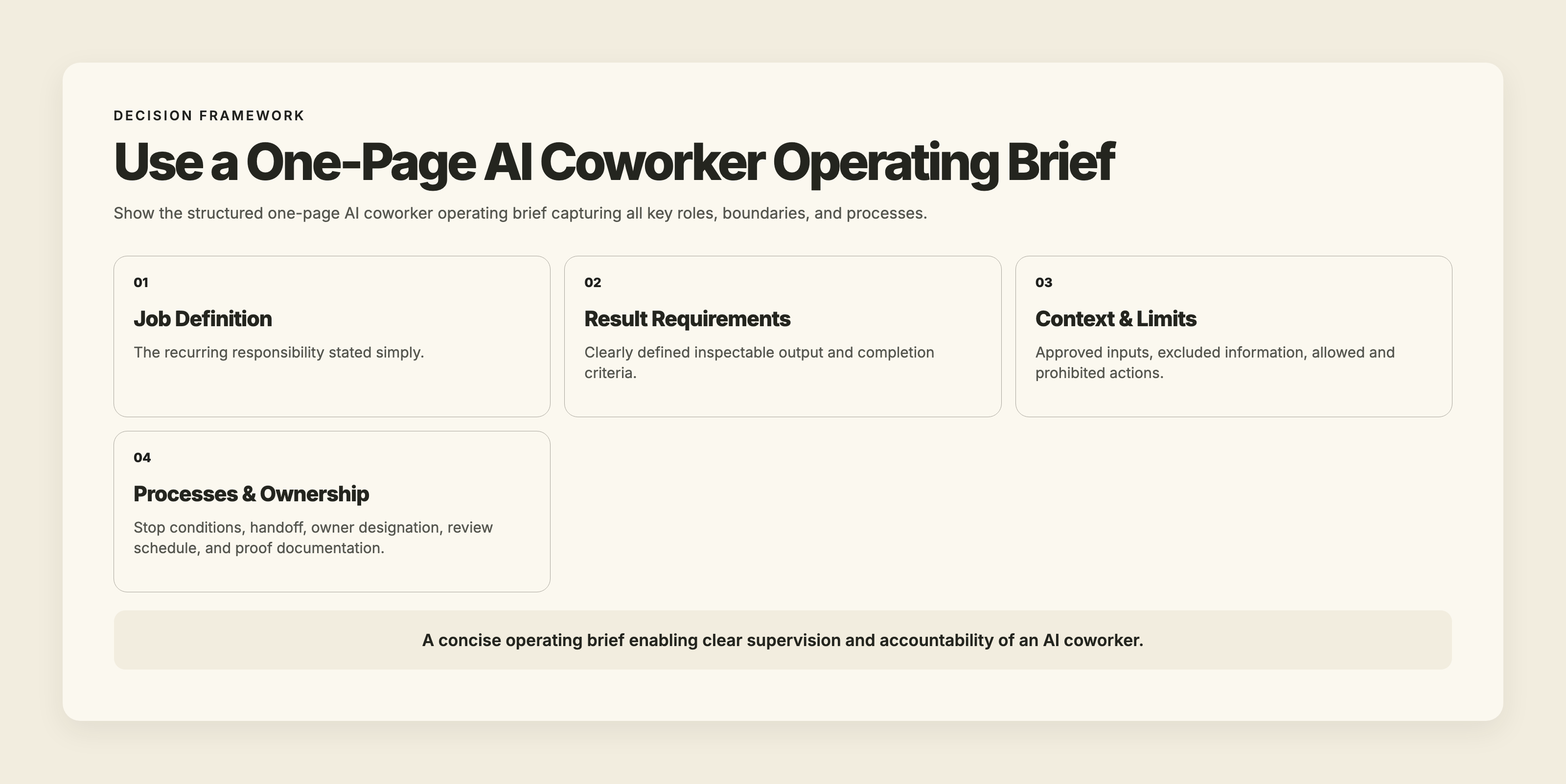
Use these fields:
Job
State the single recurring responsibility in one sentence.
Required result
Define the inspectable output and what qualifies it as complete.
Approved inputs
Name the sources the coworker may use and where the current versions are maintained.
Excluded information
List material it must ignore or treat as unverified.
Allowed actions
Specify what it may prepare, classify, recommend, or record.
Prohibited actions
State what it may not decide, change, send, or represent as completed.
Stop conditions
Identify missing information, conflicts, uncovered cases, and other conditions that require a pause.
Handoff and owner
Name the person responsible for review, exceptions, and the final business result.
Review rhythm
Set the daily or weekly moments for blocked work, output review, and operating corrections.
Proof required
Define the records needed to distinguish proposed, authorized, attempted, completed, and verified work.
Do not approve the brief merely because the job description sounds useful. Test it against one real work cycle on paper. Take a recent follow-up case and ask which approved source the AI coworker would use, where it would stop, what a human would review, and what evidence would prove completion.
If any answer depends on “it should probably know,” the operating brief is not finished. Tighten that boundary before assigning the job. A 14-day free trial can help you evaluate how these ideas fit your workflow.
That is the practical decision: not whether an AI coworker can appear busy, but whether you can supervise one bounded responsibility without guessing what it knew, what it was allowed to do, or whether the work actually happened.